Multifamily operators have no shortage of financial benchmarks.
Rent growth. Occupancy. NOI. Operating expenses. Turn costs. Delinquency. Revenue per unit.
But when the conversation shifts to ancillary revenue, the benchmarking becomes less straightforward.
An operator may know that one property generated more ancillary revenue than another. That does not necessarily mean the first property is performing better.
A larger property will naturally generate more revenue. A property with higher turnover may have more opportunities to generate move-related revenue. A community with stronger resident engagement may outperform another even if both properties have similar unit counts.
The real question is not:
“How much ancillary revenue did the property generate?”
It is:
“How efficiently is the property converting its available resident and move-event opportunities into ancillary revenue?”
That distinction is the foundation of effective multifamily ancillary revenue benchmarking.
For asset managers, revenue leaders, and multifamily ownership groups, the objective should be to build an internal benchmarking framework that compares properties using consistent definitions, relevant peer groups, and normalized metrics.
External benchmarks can provide context, but they should not replace portfolio-specific benchmarks.
The National Apartment Association has long emphasized the importance of internal benchmarking, noting that external comparisons can be difficult when data definitions, charts of accounts, and comparison groups differ.
For ancillary revenue specifically, this makes internal benchmarking especially important.
Why ancillary revenue is difficult to benchmark
Traditional multifamily revenue is relatively easy to understand.
If Property A generates more rental revenue than Property B, the comparison can be normalized using metrics such as revenue per unit, occupancy, market characteristics, and other operating factors.
Ancillary revenue is more fragmented.
It can come from multiple services and resident interactions, including:
- Moving services
- Packing
- Storage
- Insurance
- Utilities
- Internet and connectivity
- Resident services
- Other embedded service partnerships
The opportunity also depends heavily on resident lifecycle events.
A property with 500 units and 50% annual turnover does not have the same move-event opportunity as a 500-unit property with 30% turnover.
Likewise, two properties with the same number of move-ins can produce different ancillary revenue depending on:
- Resident engagement
- Service availability
- Service placement
- Conversion
- Vendor coverage
- Property adoption
- Timing
- Resident demand
This means total ancillary revenue is an incomplete benchmark.
It tells you what happened.
It does not necessarily tell you how efficiently the property performed.
The benchmarking mistake: comparing total dollars
Imagine two properties:
| Metric |
Property A |
Property B |
| Units |
1,000 |
500 |
| Annual move events |
500 |
250 |
| Ancillary revenue |
$150,000 |
$100,000 |
At first glance, Property A appears to be the stronger performer because it generated $150,000 versus $100,000.
But the comparison changes when the revenue is normalized.
Revenue per unit
Property A:
$150,000 ÷ 1,000 = $150 per unit
Property B:
$100,000 ÷ 500 = $200 per unit
Property B is generating more ancillary revenue per unit despite producing less total revenue.
That is why operators should avoid using portfolio totals as the primary benchmarking metric.
Total revenue is useful for financial reporting.
Normalized revenue is more useful for performance comparison.
Benchmarking should start with the right denominator
The denominator determines what the benchmark actually tells you.
For ancillary revenue, there are several useful denominators.
Units
Useful for understanding portfolio-scale economics.
Ancillary revenue per unit = Total ancillary revenue ÷ Total units
Occupied units
Useful when comparing properties with different occupancy levels.
Ancillary revenue per occupied unit = Total ancillary revenue ÷ Occupied units
Move events
Useful when the revenue opportunity is directly connected to resident moves.
Revenue per move event = Attributed ancillary revenue ÷ Eligible move events
Qualified engagements
Useful for evaluating service conversion.
Revenue per engagement = Attributed revenue ÷ Qualified engagements
No single metric answers every question.
The strongest benchmarking framework uses multiple metrics together.
1. Revenue per occupied unit
Revenue per occupied unit: is one of the simplest ways to normalize ancillary revenue.
The formula is:
Revenue per occupied unit = Ancillary revenue ÷ Occupied units
Why use occupied units instead of total units?
Because the number of residents occupying the property represents the active resident base from which many ancillary opportunities originate.
For example:
| Property |
Ancillary revenue |
Occupied units |
Revenue per occupied unit |
| A |
$150,000 |
950 |
$158 |
| B |
$110,000 |
475 |
$232 |
| C |
$180,000 |
1,450 |
$124 |
Property C generates the most total ancillary revenue.
But Property B has the highest revenue per occupied unit.
That tells the asset manager something important.
Scale and efficiency are not the same thing.
Revenue per occupied unit is therefore useful for portfolio comparisons, but it should not be used alone.
It does not explain why one property performs better.
2. Revenue per move event
For Moved’s revenue infrastructure model, the move event deserves special attention.
A move-in, move-out, or transfer creates a concentrated period of resident activity.
Residents may need:
- Professional movers
- Packing supplies
- Storage
- Insurance
- Utilities
- Connectivity
- Other move-related services
That makes the move event a more specific denominator for measuring move-related ancillary revenue.
Formula
Revenue per move event = Attributed ancillary revenue ÷ Eligible move events
Consider:
| Property |
Move events |
Revenue |
Revenue per move |
| A |
400 |
$120,000 |
$300 |
| B |
300 |
$120,000 |
$400 |
| C |
600 |
$120,000 |
$200 |
All three properties generate the same revenue.
But their performance is clearly different when measured against move volume.
Property B is generating twice the revenue per move of Property C.
That makes the benchmark much more actionable.
Moved’s platform is specifically designed around resident move-ins, move-outs, and transfers, with embedded ancillary services and resident workflows.
For operators using a move-event model, this is a critical distinction:
The question is not only how much revenue the portfolio generates. It is how much revenue each qualified resident event produces.
3. Service penetration
Revenue tells you the financial result.
Service penetration helps explain the level of adoption.
A property could have low ancillary revenue because residents are not engaging with available services.
Alternatively, residents may be engaging heavily but purchasing at a low rate.
Those are different problems.
A simple penetration metric is:
Service penetration = Residents using a service ÷ Eligible residents
For example:
- 1,000 eligible residents
- 250 residents use a moving or storage service
Service penetration = 25%
Operators can calculate this separately for:
- Moving
- Packing
- Storage
- Insurance
- Utilities
- Connectivity
- Other services
This creates a service-level view of the portfolio.
4. Conversion rate
Service penetration tells you how many residents use a service.
Conversion rate tells you how effectively engagement turns into a transaction.
For example:
1,000 residents receive an offer
↓
400 engage with the service
↓
100 complete a transaction
The operator can calculate:
Engagement rate = 400 ÷ 1,000 = 40%
Conversion rate = 100 ÷ 400 = 25%
That distinction matters.
Suppose Property A has:
- 50% engagement
- 10% conversion
And Property B has:
- 25% engagement
- 30% conversion
Which one performs better?
There is no immediate answer.
Property A has stronger engagement.
Property B converts engaged residents more efficiently.
The right response is not to rank one property and ignore the other.
Instead, investigate the two different bottlenecks.
Property A: Why isn’t engagement converting?
Property B: Why is resident engagement lower?
This is the value of a multi-stage benchmark.
5. Revenue by service category
A portfolio-wide ancillary revenue number can conceal important differences in service performance.
Break revenue down by category.
Example
| Service |
Revenue |
% of ancillary revenue |
| Moving |
$400,000 |
40% |
| Storage |
$250,000 |
25% |
| Insurance |
$150,000 |
15% |
| Utilities |
$100,000 |
10% |
| Connectivity |
$75,000 |
7.5% |
| Other |
$25,000 |
2.5% |
This tells the operator where the revenue is coming from.
The next step is to combine revenue with volume.
A high-revenue service with very low penetration could represent an expansion opportunity.
A high-penetration service with low revenue per transaction could require a different economic analysis.
This is why service mix should be part of the benchmark, not just total ancillary income.
6. Revenue by move event
Another useful comparison is to separate revenue according to the resident lifecycle event that created the opportunity.
For example:
Move-in revenue
Revenue generated during resident onboarding.
Move-out revenue
Revenue generated during resident offboarding.
Transfer revenue
Revenue generated when residents move between properties within the same portfolio.
This creates an important portfolio-level view.
If move-ins produce strong ancillary revenue but move-outs produce almost none, the operator has identified a potential gap.
The same applies to portfolio transfers.
Moved’s sales materials specifically position portfolio transfers as an opportunity to capture residents within the network and monetize move-outs rather than allowing the resident relationship to end without another revenue opportunity.
Why move-event benchmarking matters
Consider a 10,000-unit portfolio.
If the operator benchmarks only:
Total ancillary revenue
it can see whether revenue increased or decreased.
But if the operator benchmarks:
- Revenue per occupied unit
- Revenue per move
- Service penetration
- Engagement
- Conversion
- Revenue by service
- Revenue by move type
the operator can begin explaining the change.
For example:
Ancillary revenue increased 15%.
That sounds positive.
But perhaps move volume increased 25%.
In that case, revenue grew more slowly than the opportunity base.
Conversely:
Ancillary revenue increased 10% while move volume remained flat.
That may indicate improved monetization efficiency.
The second scenario could be strategically more interesting.
7. Property cohort benchmarking
Not every property should be compared against every other property.
A Class A urban high-rise should not necessarily be benchmarked directly against a suburban garden community.
Likewise, a newly launched property may not be comparable to a stabilized asset.
This is where property cohort benchmarking becomes important.
Create peer groups based on relevant characteristics.
Potential cohort variables include:
- Property class
- Unit count
- Geographic market
- Property age
- Occupancy
- Resident profile
- Turnover
- Move volume
- Service availability
- Operating model
- Portfolio maturity
The objective is simple:
Compare properties against the properties they can reasonably be expected to resemble.
NAA’s benchmarking methodology provides a useful example of why comparison groups matter. Its historical benchmarking work emphasized relevant comparison groups, transparent methodology, consistent data, and apples-to-apples comparisons.
Don’t benchmark a stabilized property against a launch property
This is an easy mistake.
A newly launched property may have:
- Lower resident volume
- Different move patterns
- Lower service adoption
- Different staffing
- Limited vendor coverage
- Incomplete historical data
A stabilized property may have years of operating history.
Their performance should not necessarily be judged against the same benchmark.
Instead, create cohorts such as:
New properties: 0–12 months
Emerging properties: 12–24 months
Stabilized properties: 24+ months
The exact definitions should reflect the operator’s portfolio.
The important principle is comparability.
Internal benchmarks are often more useful than generic industry averages
This is particularly important for ancillary revenue.
There is no single universal number that tells every multifamily operator what ancillary revenue “should” be.
The right benchmark depends on:
- Portfolio composition
- Property class
- Geography
- Resident demographics
- Move volume
- Available services
- Vendor economics
- Operating model
- Resident engagement
Industry benchmarking can provide context.
But internal data can reveal what is realistically achievable within your own operating environment.
NAA has previously highlighted the value of internal benchmarking when external data is difficult to compare because operators may use different definitions, accounting structures, and comparison groups.
That principle is especially relevant to ancillary revenue.
Build a three-level benchmarking model
A strong multifamily ancillary revenue benchmark can operate at three levels.
Level 1: Portfolio benchmark
Measure:
- Total ancillary revenue
- Revenue per occupied unit
- Revenue per move
- Overall conversion
- Service penetration
This answers:
“How is the portfolio performing?”
Level 2: Cohort benchmark
Compare similar properties.
Measure:
- Revenue per occupied unit
- Revenue per move
- Engagement
- Conversion
- Service mix
- Move-event performance
This answers:
“Which property groups are outperforming their peers?”
Level 3: Property benchmark
Analyze individual properties.
Measure:
- Move volume
- Resident engagement
- Service penetration
- Conversion
- Revenue per transaction
- Revenue per move
- Vendor performance
This answers:
“Where should the team take action?”
This three-level structure prevents executives from getting trapped between two extremes:
Too much detail → property-level noise.
Too little detail → portfolio averages that hide the problem.
Create an internal ancillary revenue benchmark
A practical benchmark can be built in six steps.
Step 1: Standardize the data
Define:
- What counts as ancillary revenue
- What counts as a resident engagement
- What counts as a conversion
- What counts as a move event
- What counts as an eligible resident
Do this before comparing properties.
Step 2: Normalize revenue
Track at least:
Revenue per occupied unit
and
Revenue per move event
This gives you both a portfolio and lifecycle view.
Step 3: Add the conversion funnel
Track:
Eligible residents → Engagement → Conversion → Revenue
This identifies where performance changes.
Step 4: Create property cohorts
Group comparable properties.
Avoid one portfolio-wide benchmark that treats every asset as identical.
Step 5: Establish a baseline
Use historical internal performance.
For example:
Baseline: trailing 12-month performance
Target: improvement against baseline
Stretch: top-quartile internal performance
This is generally more actionable than selecting an arbitrary external number.
Step 6: Monitor variance
Once the benchmark exists, identify outliers.
For example:
Top quartile
Properties consistently exceeding the internal benchmark.
Middle 50%
Properties performing within the expected range.
Bottom quartile
Properties requiring investigation.
This creates a simple operating cadence for regional and asset-management teams.
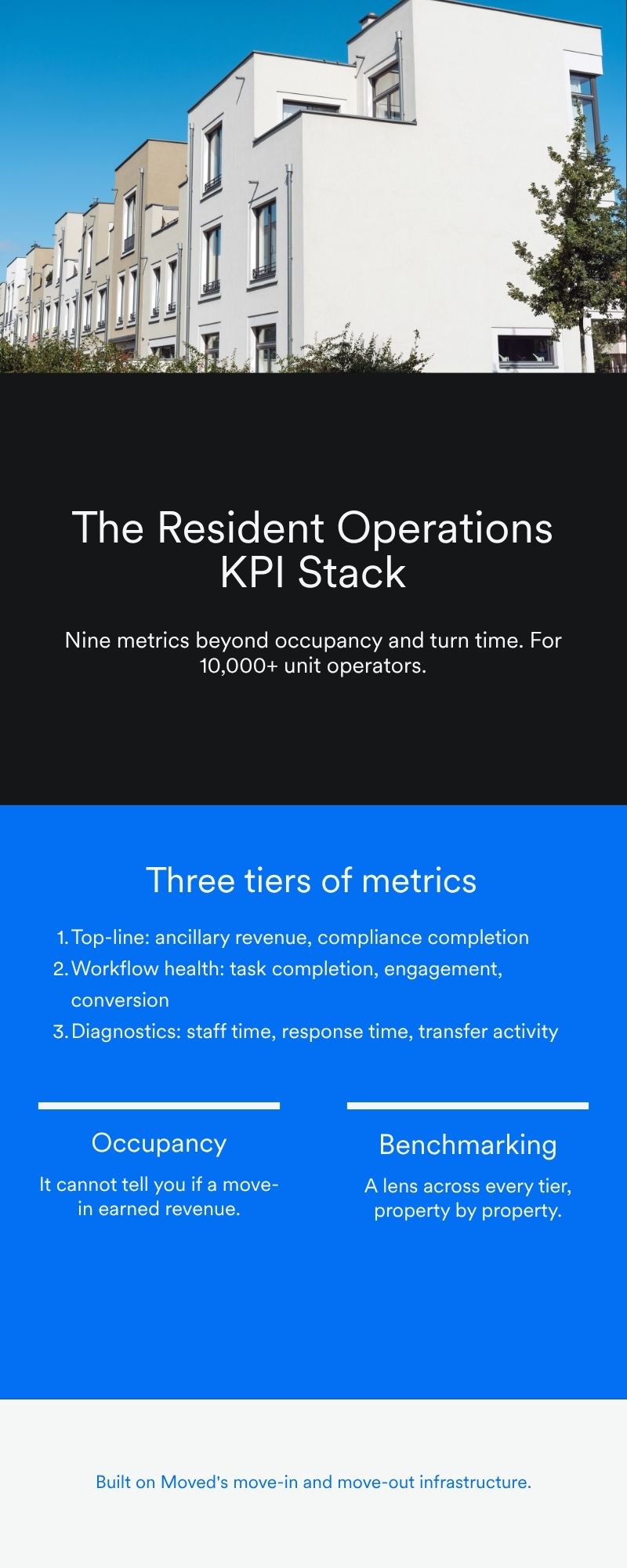
What should a multifamily ancillary revenue dashboard include?
A useful dashboard doesn’t need dozens of metrics.
Start with a focused scorecard.
| KPI |
Purpose |
| Total ancillary revenue |
Measures overall financial contribution |
| Revenue per occupied unit |
Normalizes portfolio performance |
| Revenue per move |
Measures move-event economics |
| Service penetration |
Measures adoption |
| Engagement rate |
Measures resident interaction |
| Conversion rate |
Measures commercial effectiveness |
| Revenue by service |
Shows service mix |
| Revenue by move type |
Shows lifecycle contribution |
| Revenue by property |
Identifies property variance |
| Revenue by cohort |
Enables apples-to-apples comparison |
The dashboard should then highlight:
Top performers
Bottom performers
Largest month-over-month changes
Largest cohort variance
Highest opportunity gaps
The role of benchmarking in RevGen optimization
Benchmarking is not the end of the RevGen strategy.
It is the diagnostic layer.
Suppose a property ranks in the bottom quartile for revenue per move.
That does not automatically tell you what to fix.
The operator needs to look deeper.
Scenario 1: Low engagement
Residents are not interacting with available services.
Potential areas to investigate:
- Workflow placement
- Communication
- Timing
- Resident experience
- Service relevance
Scenario 2: High engagement, low conversion
Residents are interested but not completing transactions.
Potential areas to investigate:
- Vendor selection
- Pricing
- Friction
- Availability
- Service experience
Scenario 3: High conversion, low revenue
The property is converting residents but generating relatively little revenue.
Potential areas to investigate:
- Service mix
- Transaction economics
- Vendor revenue share
- Product mix
- Average transaction value
Scenario 4: High revenue but low penetration
A smaller group of residents generates strong revenue.
Potential opportunity:
Expand penetration without damaging resident experience.
Benchmarking tells you where to investigate.
It does not replace the investigation.
Don’t use benchmarking to create arbitrary targets
There is a temptation to create a single number:
“Every property should generate X dollars of ancillary revenue.”
That approach is risky.
A benchmark should represent a meaningful comparison—not an arbitrary quota.
For example, if Property A has twice the move volume of Property B, the same absolute revenue target doesn’t make sense.
Likewise, if Property A has a materially different resident profile or service mix, its expected performance may differ.
Instead, use ranges.
Example internal framework
Below benchmark: Bottom 25%
Expected range: Middle 50%
Leading performance: Top 25%
Then investigate the characteristics of properties in the top quartile.
What are they doing differently?
That question is usually more valuable than simply setting a higher target.
Benchmarking should also account for risk
Ancillary revenue cannot be evaluated only through financial output.
Insurance and compliance are part of the resident move lifecycle.
An operator may generate revenue while still leaving compliance gaps.
That creates an incomplete picture.
For this reason, a mature benchmark should include a risk layer alongside the revenue layer.
Track:
- Insurance completion
- Verification status
- Outstanding compliance tasks
- Documentation completion
- Exceptions
- Escalations
Moved’s platform supports centralized resident tasks and insurance documentation/verification as part of the move workflow.
This matters because the best-performing property isn’t necessarily the one that generates the most ancillary revenue.
It should also be operating within the required risk and compliance framework.
The operational layer matters, but it comes after revenue
The same principle applies to operational efficiency.
Operators can measure:
- Staff time
- Manual tasks
- Outstanding tasks
- Response times
- Workflow completion
These metrics are valuable.
But they should support the broader financial objective.
Moved’s stated positioning places revenue generation first, risk mitigation second, and operational efficiency as a supporting layer.
That means the benchmarking framework should follow the same hierarchy:
Revenue
↓
Risk
↓
Operations
This keeps the analysis connected to asset-level financial outcomes.
How Moved can support portfolio-level benchmarking
Moved is designed as a move infrastructure platform that embeds revenue-generating services including movers, packing, storage, insurance, utilities, and connectivity into the resident onboarding workflow.
The platform also supports resident onboarding, offboarding, transfers, ancillary-service activation, resident data reporting, and PMS integrations.
That creates the foundation for measuring the resident move lifecycle as more than an administrative process.
For multifamily operators, Moved’s multifamily platform provides the operator-facing context for connecting resident move workflows with ancillary revenue opportunities.
For the resident-facing experience, Moved’s resident platform shows how the move process can bring required tasks and services into one experience.
This is particularly relevant when benchmarking move-related revenue because the operator can think about the complete lifecycle:

Move event
↓
Resident engagement
↓
Service activation
↓
Conversion
↓
Revenue
↓
Portfolio comparison
That is the difference between simply reporting ancillary revenue and building a RevGen benchmarking system.
Common ancillary revenue benchmarking mistakes
Mistake 1: Benchmarking total dollars
Large properties will naturally generate more revenue.
Better: Normalize revenue.
Mistake 2: Using one benchmark for every property
Different properties have different operating conditions.
Better: Build relevant cohorts.
Mistake 3: Measuring revenue without conversion
Revenue tells you the result, not the funnel.
Better: Track engagement and conversion alongside revenue.
Mistake 4: Ignoring move volume
Move-related services depend on resident lifecycle events.
Better: Track revenue per move.
Mistake 5: Benchmarking only against external data
External data can be useful, but definitions and comparison groups may differ.
Better: Build an internal benchmark first and use external data for context.
Mistake 6: Setting arbitrary revenue targets
A single number doesn’t account for property differences.
Better: Use performance ranges and peer cohorts.
Mistake 7: Ignoring service mix
Two properties can generate the same revenue through very different services.
Better: Benchmark revenue by category.
Mistake 8: Treating compliance as separate
Revenue growth should not come at the expense of risk controls.
Better: Include insurance and compliance metrics in the operating framework.
Frequently asked questions
What is ancillary revenue benchmarking in multifamily?
Ancillary revenue benchmarking is the process of comparing non-rent revenue performance across multifamily properties, cohorts, and portfolios using normalized metrics such as revenue per occupied unit, revenue per move event, service penetration, and conversion rate.
What is a good ancillary revenue benchmark for apartments?
There is no universal ancillary revenue number that applies to every apartment property. The appropriate benchmark depends on property characteristics, resident volume, move activity, available services, geography, and operating model. For that reason, operators should establish internal benchmarks using comparable properties and historical performance.
What is the best metric for benchmarking multifamily ancillary revenue?
There is no single best metric. Revenue per occupied unit is useful for portfolio normalization, while revenue per move event is particularly useful when revenue is generated around resident move-ins, move-outs, and transfers. Conversion and service penetration help explain the underlying performance.
How should multifamily operators compare ancillary revenue across properties?
Operators should compare properties using consistent definitions and relevant cohorts. Useful comparison factors include unit count, occupancy, property class, geography, turnover, move volume, service availability, and portfolio maturity.
Should ancillary revenue be measured per unit?
Yes, revenue per unit can be useful, but it should not be the only benchmark.
Revenue per occupied unit can provide a more relevant normalization when comparing active resident populations.
Why should operators benchmark revenue per move?
Move-related services are tied to resident lifecycle events.
Revenue per move helps determine how effectively a property converts each eligible move event into ancillary revenue, independent of overall property size.
How can operators identify their best-performing properties?
Rank properties using normalized metrics such as revenue per occupied unit, revenue per move, engagement, and conversion.
Then compare properties within relevant cohorts rather than ranking every property against the entire portfolio.
Should insurance be included in ancillary revenue benchmarking?
Insurance-related revenue can be included where applicable, but insurance should also be tracked separately as a compliance and risk-mitigation metric.
Revenue alone does not capture the full value of insurance verification.
How often should multifamily operators benchmark ancillary revenue?
Monthly monitoring is useful for identifying changes and outliers, while quarterly reviews can provide a stronger basis for strategic portfolio decisions.
Operators should also use trailing periods where appropriate to reduce noise from short-term fluctuations.
Final takeaway: Benchmark the opportunity, not just the revenue
Multifamily operators don’t need another dashboard showing a single ancillary revenue number.
They need a framework that explains why properties perform differently.
The strongest ancillary revenue benchmarking model connects:
- Revenue per occupied unit
- Revenue per move
- Service penetration
- Conversion
- Service mix
- Move-event performance
- Property cohorts
- Portfolio variance
That creates a much clearer picture of RevGen performance.
It also helps asset managers move from a passive question:
“How much ancillary revenue are we generating?”
to a more valuable one:
“How efficiently is each property converting its available resident and move-event opportunities into revenue?”
That is the benchmark that can drive action.
And for operators managing large portfolios, the objective should not be to find a single industry-wide number and force every property toward it.
The objective is to build a consistent, internally defensible, continuously improving benchmark that accounts for the realities of each property while still giving leadership a clear portfolio-wide view.
Moved approaches the resident move as revenue-generating infrastructure, embedding services such as moving, packing, storage, insurance, utilities, and connectivity into the resident onboarding workflow while supporting risk mitigation and operational consistency.
Operators looking to evaluate their resident move infrastructure can connect with the Moved team.
For additional context, see Moved’s existing resources on the move-in and move-out revenue opportunity and resident onboarding automation. These should be treated as supporting resources rather than substitutes for the benchmarking framework outlined above.