
Early lease termination is the process that lets a resident end a lease before its end date, usually by giving written notice and paying a termination fee or rent until the unit is re-let. A clear policy sets the notice period, the cost, the legal exceptions, and the move-out steps, so every property handles each request the same way.
Across a 10,000+ unit portfolio, early termination requests arrive every week. Some come from residents relocating for work, some from servicemembers with orders, and some from residents whose household has changed. This guide covers why the policy matters, the termination options operators use, the legal rules that override the lease, and how to run each request as a structured move-out in residential real estate.
Why Early Termination Needs A Portfolio Standard
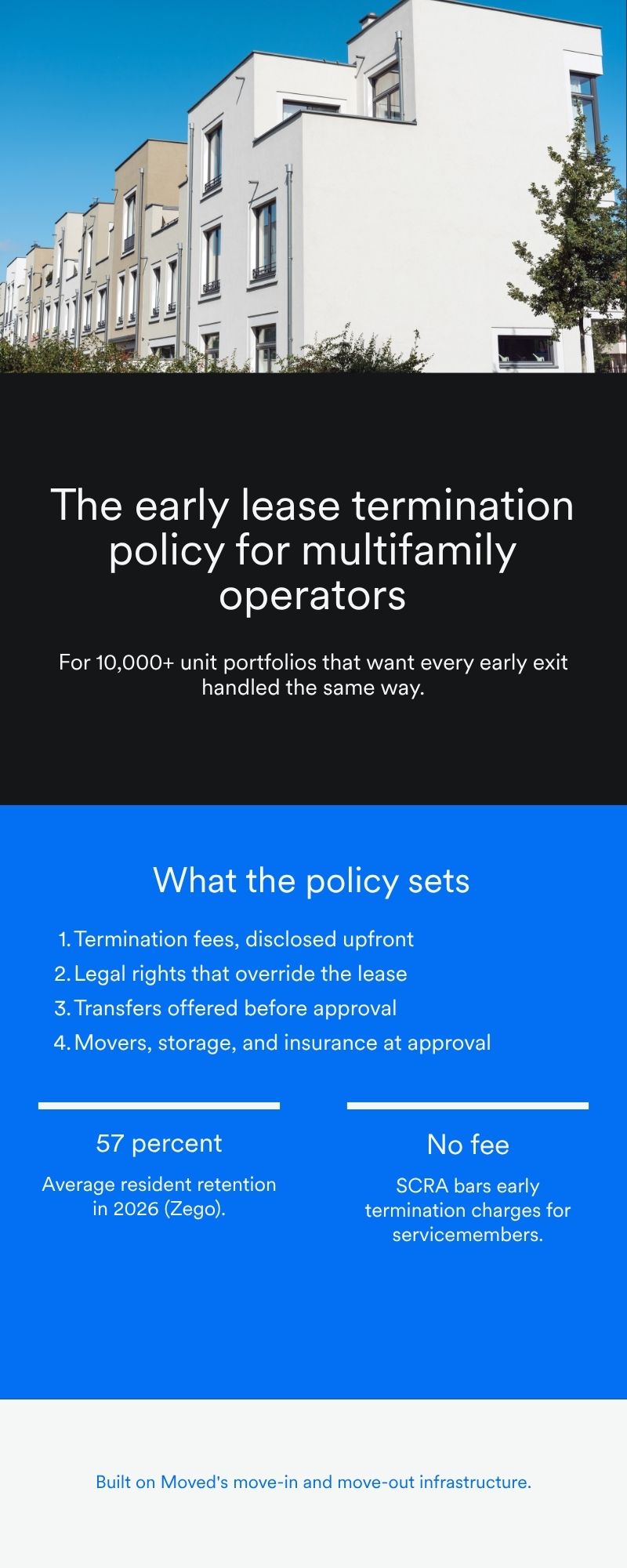
Every early termination becomes a turn sooner than planned. Zego’s 2026 Resident Experience Management Report found that average retention fell to 57 percent, down from 60 percent in 2024, so each unplanned move-out adds to a number that is already under pressure.
Turnover has cost about $3,872 per resident, according to an earlier edition of Zego’s report reported by Multifamily Dive, a figure that includes marketing, repairs, concessions, and lost rent.
The replacement lease may also need an incentive. RealPage found concessions on 15.4 percent of stabilized U.S. apartments in August 2026, with the average discount equal to about 5.7 weeks free on a 12-month lease, according to its August 2026 concessions update.
When each site handles early termination differently, the portfolio cannot see what each request costs or recovers. A written standard makes the outcome predictable for residents and measurable for the operator.
The Revenue Case: An Early Termination Is Still A Full Move
A resident who ends a lease early still has to move. They need movers or a truck, packing help, and often storage, usually on a shorter timeline than a planned move-out. The unit that opens up then needs a new resident, who will book their own move, utilities, internet, and renters insurance.
That puts early termination inside the move-in and move-out revenue workflow. Moved’s newsletter The RevGen Leak Map describes move-out as a moment where easy transition offers and moving services preserve goodwill. A resident leaving early is under time pressure, which makes a ready set of moving options more useful to them.
Operators who present movers, packing, and storage as soon as a termination request is approved keep that spending inside their own resident flow. The same workflow then starts the move-in for the next resident.
Retention Before Termination: Paylode, A Moved Company
Some early termination requests can become a renewal or a transfer instead. Zego’s 2026 research found that 31 percent of renters would be much more likely to renew if their community offered a renter rewards program.
Paylode is a Moved company. Moved acquired Paylode in November 2025, adding a perks and rewards platform that helps brands increase loyalty and retention through personalized perks and action-based rewards. Paylode’s clients have included Equity Residential and FirstKey Homes.
When a request arrives, the first step is to check whether the resident’s need can be met inside the portfolio. A resident who needs a smaller unit or a different city may qualify under an apartment transfer policy, and the rewards they have earned can continue with the new lease.
Early Lease Termination Options Operators Use
Most portfolios offer one or more of the options below. The right mix depends on the market, the lease form, and state law.
| Option | How it works | What the operator should weigh |
|---|---|---|
| Termination fee (buyout) | The resident gives written notice and pays a fixed fee set in the lease | Predictable for both sides; the fee must be disclosed upfront |
| Rent until re-let | The resident owes rent until a new resident moves in, plus a reletting fee where the lease allows it | Ties cost to actual vacancy; requires active marketing of the unit |
| Lease takeover or assignment | An approved applicant assumes the remaining lease | Keeps the unit occupied; requires full screening of the new resident |
| Transfer within the portfolio | The resident moves to another unit or community under a new lease | Keeps the resident; needs available inventory |
| Statutory termination | A resident uses a right granted by law, such as military orders or family violence protections | The law sets the terms, and lease fees may be barred |
Write the chosen options into an early termination clause in the lease, and use the same clause at every property. Residents should see the cost and the steps when they sign, well before the day they need them.
Legal Rules That Override The Lease
Federal law gives servicemembers a right to end a residential lease. Under the Servicemembers Civil Relief Act, 50 U.S.C. section 3955, a servicemember may terminate a lease after entering military service or receiving orders for a permanent change of station or a deployment of at least 90 days.
For a lease with monthly rent, the termination takes effect 30 days after the next rent due date following delivery of written notice and a copy of the orders. The landlord may not impose an early termination charge, and rent paid in advance for the period after termination must be refunded within 30 days.
States add their own rights. Texas, for example, lets a tenant terminate and avoid liability for future rent following family violence under Texas Property Code section 92.016, and many other states have similar protections.
Many states also require a landlord to try to re-let a unit a resident has left. Texas Property Code section 91.006 gives a landlord a duty to mitigate damages when a tenant abandons the premises, and a lease provision that waives that duty is void. A rent-until-re-let policy therefore needs a documented marketing effort behind it.
Fee Transparency And Disclosure
Termination and reletting fees fall within the fee transparency questions regulators are asking. The Federal Trade Commission’s advance notice of proposed rulemaking on rental housing fees, published in March 2026, asks about one-time fees charged at the beginning or end of a lease term.
Moved’s guide to the FTC rental fee rulemaking covers how to disclose charges cleanly. For early termination, the practical standard is to state every fee in the lease and repeat it in the written approval, with the date it is due.
How To Process An Early Termination Request, Step By Step
- Receive the request in writing through one channel and record the reason and the requested move-out date.
- Check for a statutory right, such as military orders or a protected family violence request, and route it to the required process.
- Offer a transfer or a lease takeover where the resident’s need allows it.
- Confirm the termination option, the fee or rent obligation, and the final move-out date in a written approval.
- Offer movers, packing, and storage, and send the move-out steps and inspection details.
- Remind the resident to keep renters insurance active until the keys are returned.
- Schedule the pre-move-out inspection and list the unit for the next resident.
- Complete the final inspection and settle the security deposit under state law.
The inspection and deposit steps follow the same standard as any move-out. Moved’s move-in and move-out inspection checklist sets out the room-by-room process and the timing rules that decide disputes.
Insurance And Financial Risk During An Early Exit
A resident leaving early may cancel renters insurance as soon as they sign a new lease elsewhere. An uninsured resident-caused loss in the final weeks, such as a water leak during packing, then falls on the property’s own policy or balance sheet.
Make active coverage until key return a condition of the approval, and confirm it in the same step as the move-out date. Moved’s guide to capturing renters insurance requirements explains how listing the property as an interested party gives notice if a policy is cancelled.
Running Early Terminations Across A 10,000+ Unit Portfolio
- One early termination clause, used in every lease, with state-specific addenda where the law requires them.
- One intake channel, with statutory requests flagged and routed automatically.
- Transfers and lease takeovers offered before a termination is approved.
- Every fee disclosed in the lease and confirmed in the written approval.
- Moving services, insurance confirmation, and inspection scheduling triggered on approval.
- Termination volume, reasons, recovery, and days vacant reported by property.
Traditional tools focus on task tracking and administrative coordination. Moved embeds revenue-generating services and insurance verification directly into the workflow, transforming move coordination into structured revenue infrastructure.
Moved is a move infrastructure platform that embeds revenue-generating services, including movers, packing, storage, insurance, utilities, and connectivity, directly into the resident onboarding workflow. It helps property operators increase ancillary income while mitigating compliance risk, and the guide to resident onboarding automation shows how that workflow is built.
For the departing resident, a clear exit process is part of the resident experience. For operators, Moved for multifamily operators shows how the same process runs across a portfolio.
Frequently Asked Questions
What is early lease termination?
Early lease termination is ending a lease before its end date under terms set by the lease or by law. It usually requires written notice and a termination fee or rent until the unit is re-let.
What is an early lease termination clause?
An early termination clause is the lease section that sets the notice period, the fee or rent obligation, and the steps a resident follows to end the lease early.
What is a reletting fee?
A reletting fee is a charge some leases apply when a resident leaves early, to cover the cost of finding a new resident. It should be stated in the lease and disclosed before the resident signs.
Can a servicemember break a lease without a fee?
Yes, when the lease qualifies under the Servicemembers Civil Relief Act. The landlord may not impose an early termination charge, though rent owed up to the effective termination date is still due on a prorated basis.
Does a landlord have to re-rent the unit after a resident leaves early?
Many states require landlords to make reasonable efforts to re-let the unit. Texas, for example, sets a duty to mitigate damages that a lease cannot waive.
Turn early exits into managed moves
An early termination is a move-out on a short timeline, and the next resident’s move-in follows soon after. To see how termination requests, insurance confirmation, and move services run as one move-in and move-out workflow across a 10,000+ unit portfolio, book a walkthrough with the Moved team.