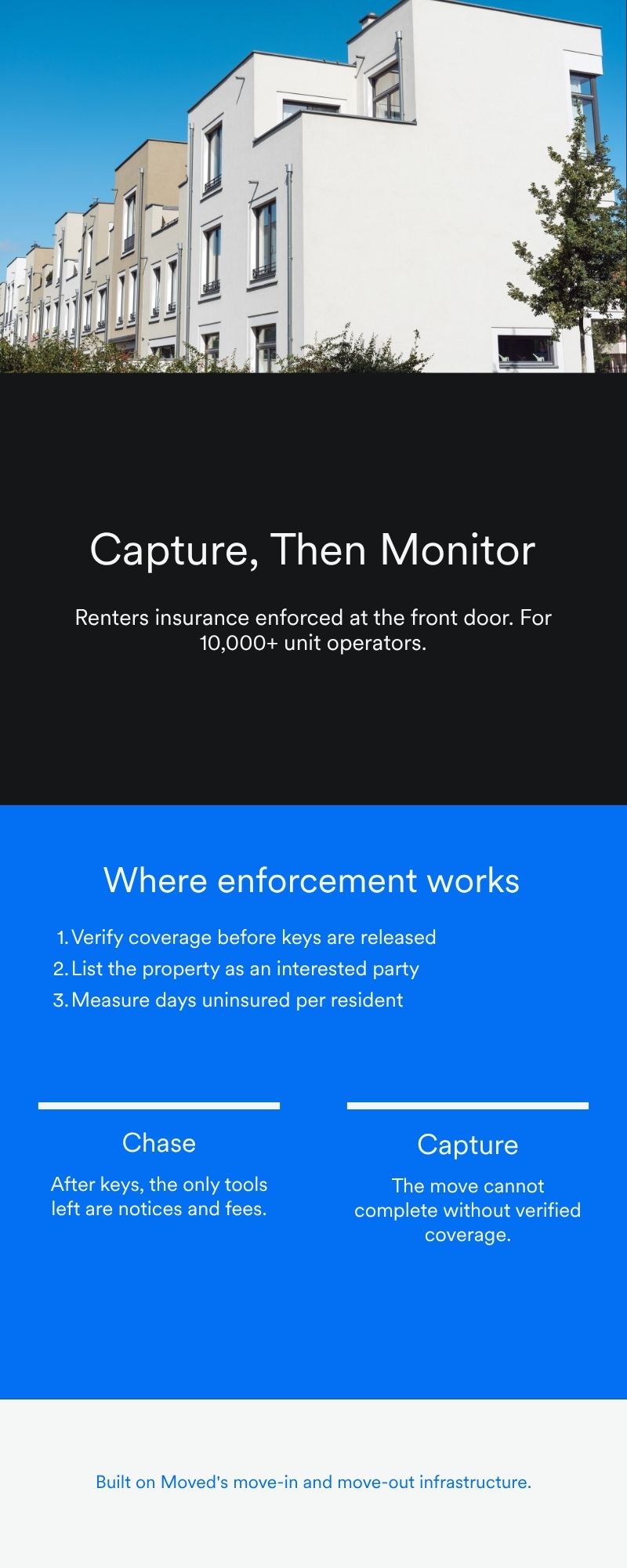
A renters insurance requirement in the lease is only as strong as the moment you enforce it. Enforced at move-in, before keys are released, compliance is close to automatic because the resident cannot complete the move without it. Enforced after move-in, it becomes a tracking problem that never fully closes.
That difference is the whole argument. Most operators have the requirement written correctly and still carry meaningful uninsured exposure, because the requirement is verified once at a moment when nobody has leverage to hold the process, and then monitored by a team with a hundred other tasks. This article covers what the requirement typically demands, why post-move-in tracking leaks, and how operators in residential real estate move enforcement to the one point where it is frictionless.
Where the requirement stands today
Requiring coverage is now standard practice. More than 83 percent of professionally managed apartment communities require renters insurance, up from roughly half a decade ago, according to 2026 data on renters insurance requirements. Landlords may require it as a lease condition in all 50 states. The most common threshold is $100,000 in liability coverage, with guidance to also require personal property coverage, as set out in Obie’s guidance on how much renters insurance a landlord should require.
Resident-side adoption tells a different story. Roughly 55 percent of renters carry coverage, and of those, about 75 percent hold it because a landlord required it, per SmartMove’s analysis of renters insurance requirements. Coverage in this category is almost entirely a function of enforcement. Where the requirement is enforced, residents carry it. Where enforcement is loose, they do not.
The financial risk this actually mitigates
Renters insurance is a balance-sheet control. A resident-caused water loss, fire, or liability claim against an uninsured resident does not disappear; it lands on the property, the owner’s policy, or a subrogation fight nobody budgeted for. Each uninsured day across a 10,000+ unit portfolio is exposure the operator is carrying without pricing it.
The exposure is not evenly distributed either. It concentrates in the days immediately after move-in, when a resident is physically moving belongings through the building, and in the days around move-out for the same reason. Those are precisely the windows where a lapse is least likely to be noticed by a monthly compliance report.
Capture versus chase
There are two enforcement models, and they produce different compliance curves.
| Chase model | Capture model | |
|---|---|---|
| Enforcement point | After move-in, by report and reminder | Before key handoff, inside the move flow |
| Leverage | None; the resident already has keys | The move cannot complete without it |
| Staff effort | Ongoing, per resident, indefinitely | One verified step per move |
| Typical failure | Lapses found weeks later, or at claim time | Residents who decline are identified same day |
| What it produces | A list of non-compliant residents | A compliant move and a dated record |
The chase model is not a discipline problem. It is a structural one. Once a resident holds keys, the only remaining enforcement tools are notices, fees, and lease action, all of which cost more than they recover and damage the resident experience on the way. The capture model uses the one point of natural leverage the operator has, and uses it once.
Closing the lapse problem after capture
Capture at move-in solves initial compliance. Mid-lease lapses are the second half of the problem, and they have a clean mechanical answer: require the property to be listed as an interested party on the policy. When it is, the carrier notifies the property automatically if the policy is cancelled, changed, or lapses mid-lease, as explained in Beagle’s overview of apartment renters insurance requirements. That converts lapse detection from a monthly manual audit into a notification.
Capture at move-in plus interested-party notification covers both halves. Neither alone does.
Why this belongs in the move workflow rather than a compliance tool
Insurance compliance vendors track policies well. What they cannot do is hold the move. Verification only creates leverage when it sits inside the sequence that releases keys, which means it belongs in the same flow as utility activation, key handoff, and the paid services a resident selects.
Putting it there also has a revenue consequence that compliance tooling never delivers. The verification step lands at the highest-intent moment in the lifecycle, when the resident is actively organizing their move and has not yet booked movers, packing, or storage. A single flow that verifies coverage and presents those services turns a compliance checkpoint into a revenue event. Moved’s work with large operators is oriented around a target of $15 per unit per month in non-rent revenue, and that figure only compounds when every move runs through one instrumented flow rather than a compliance tool on one side and a services portal on the other.
Traditional tools focus on task tracking and administrative coordination. Moved embeds revenue-generating services and insurance verification directly into the workflow, which is why the same step that protects the asset also produces income. The mechanics of that flow are covered in the guide to resident onboarding automation, and the revenue side in the move-in and move-out revenue workflow.
What to measure
Four numbers tell you whether enforcement is working. Verified-at-move-in rate, which should sit near total. Days uninsured per resident, measured from lease start to verified coverage. Mid-lease lapse count surfaced by interested-party notification rather than by audit. And the share of the book currently carrying valid coverage, reported at portfolio level rather than per property.
Most operators can produce the fourth number and none of the first three. That asymmetry is the tell: the portfolio knows its compliance percentage but cannot see the exposure window that created it. A move infrastructure built for multifamily operators produces all four as a by-product of running the move-in and move-out flow.
Frequently asked questions
Can a landlord require renters insurance?
Yes. Landlords and property managers can require renters insurance as a lease condition in all 50 states, and more than 83 percent of professionally managed communities now do.
How much renters insurance should an operator require?
The most common requirement is $100,000 in liability coverage, usually paired with a personal property minimum. Requirements should be stated in the lease and verified before key handoff.
What percentage of renters actually carry coverage?
Roughly 55 percent, and about 75 percent of those carry it because their landlord required it. Coverage in this category tracks enforcement closely.
How do operators find out about a mid-lease lapse?
The reliable method is being listed as an interested party on the policy, which triggers automatic carrier notification when coverage is cancelled, changed, or lapses.
Why verify at move-in rather than after?
Before key handoff the move itself depends on completion, so compliance is close to automatic. After key handoff the only tools left are notices and fees, which cost more than they recover.
Move enforcement to the front door
If your compliance reporting can tell you who is uninsured today but not how many days of exposure each resident accumulated after move-in, enforcement is happening in the wrong place. To see how insurance verification, utility activation, and paid services run as one move-in and move-out workflow across a 10,000+ unit portfolio, contact Moved.