Security deposit interest is the interest a landlord owes a resident on a security deposit held during the tenancy, where state or local law requires it. Some jurisdictions set a fixed rate, some tie the rate to what the bank pays, and some publish a new rate every year. For multifamily operators, the requirement is easy to meet only when each property’s rule is recorded, interest is tracked from the day the deposit is paid, and the final amount is settled at move-out.
Across a 10,000+ unit portfolio, deposit interest touches thousands of move-in and move-out records each year. This guide compares four sets of rules, shows how to calculate interest, lists the steps to follow at move-out, and explains how to run deposit interest inside a structured move-in and move-out process in residential real estate.
Why Deposit Interest Deserves A Standard Process
The amounts per resident are often small, but the obligation applies to every deposit the property holds where the rule is in force. A missed payment or a wrong rate repeats across every unit in that jurisdiction, and the error often surfaces at move-out, when the resident compares the deposit statement with what the law requires.
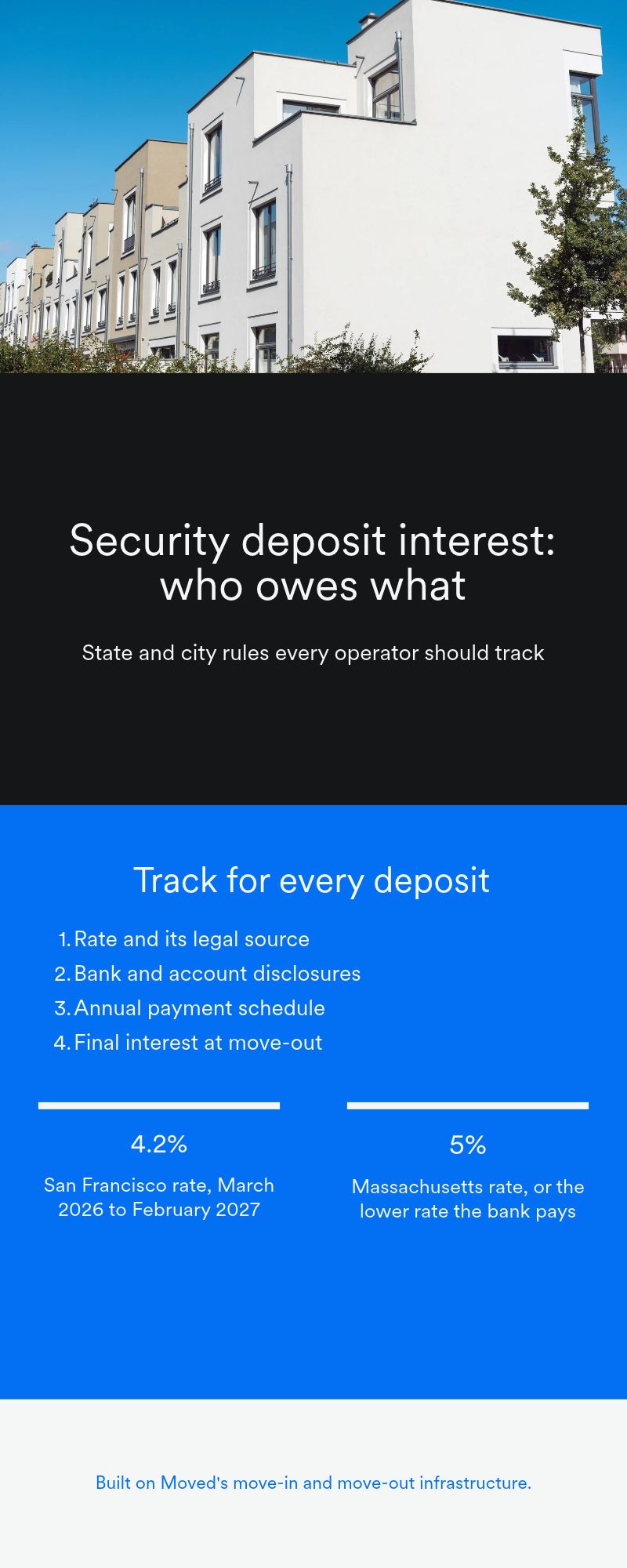
Rates also change. San Francisco’s Rent Board set the rate at 4.2 percent for March 1, 2026, through February 28, 2027, down from 5.0 percent the year before, so a rate built into a system once will be wrong the following year.
Move-outs keep the calculation busy. Zego’s 2026 Resident Experience Management Report found that average retention fell to 57 percent, down from 60 percent in 2024, which means more deposits closing out and more final interest amounts to calculate each year.
Security Deposit Interest Rules In Four Jurisdictions
The table below compares four well-known examples. Other states and cities have their own rules, so confirm the requirement for every property in your portfolio.
| Jurisdiction | Who it covers | Interest owed | When it is paid |
|---|---|---|---|
| New York | Deposits for buildings with six or more family dwelling units | Interest earned in an interest-bearing account at a New York bank, less 1 percent per year the landlord may keep as administration expenses | Held in trust until repaid or applied, or paid to the resident each year |
| Massachusetts | Residential security deposits and last month’s rent paid in advance | 5 percent per year, or the lesser amount the bank paid | Each year of the tenancy, and within 30 days if the tenancy ends before the anniversary date |
| Minnesota | Residential security deposits | 1 percent per year, simple and noncompounded, with amounts under $1 excluded | With the deposit, or with a written statement explaining any amount withheld, within three weeks after the tenancy ends and the landlord receives a mailing address |
| San Francisco | Residential security deposits covered by the city’s Administrative Code | 4.2 percent for March 1, 2026, through February 28, 2027 | Under the city’s rules, with the rate published each January |
New York
Under New York General Obligations Law section 7-103, a deposit for a building with six or more family dwelling units must be placed in an interest-bearing account at a bank with a place of business in the state. The landlord must tell each resident in writing the name and address of the bank and the amount of the deposit.
The landlord may keep a sum equal to 1 percent per year of the deposit as administration expenses. The rest of the interest belongs to the resident and is either held in trust until it is repaid or applied to rent, or paid to the resident each year.
Massachusetts
Massachusetts General Laws chapter 186, section 15B requires the deposit to be held in a separate interest-bearing account in a Massachusetts bank, with a receipt naming the bank and account given to the resident within 30 days. When a deposit is held for a year or longer, the resident is owed interest at 5 percent per year or the lesser amount the bank paid.
Interest is paid each year with a statement, and if the tenancy ends before the anniversary date, accrued interest is due within 30 days. The same rate applies to last month’s rent collected in advance, and for that payment the statute lets the landlord either pay the interest or tell the resident to deduct it from the next rent payment.
Minnesota
Minnesota Statutes section 504B.178 sets interest at 1 percent per year, simple and noncompounded. It runs from the first day of the month after the deposit is paid in full to the last day of the month in which the landlord returns the deposit or sends the required statement, and any amount under $1 is excluded.
The landlord must return the deposit with interest, or send a written statement showing why it is being withheld, within three weeks after the tenancy ends and after receiving the resident’s mailing address or delivery instructions.
San Francisco
San Francisco’s Rent Board calculates the rate each year under Administrative Code Chapter 49.2, using the annual average of the 90-day AA financial commercial paper rate for the prior calendar year as published by the Federal Reserve. The board publishes the new rate in early January for the one-year period beginning March 1.
Because the rate changes every March, the calculation for a long tenancy has to apply each year’s rate to the matching period.
How To Calculate Security Deposit Interest
For simple interest, multiply the deposit by the annual rate and by the number of years, or fractions of a year, that the rule covers. The examples below use assumed deposits and, where needed, assumed bank rates to show the method.
| Example | Calculation | Interest owed |
|---|---|---|
| Minnesota, $1,500 deposit held two and a half years | $1,500 × 1% × 2.5 | $37.50 |
| Massachusetts, $2,000 deposit, bank paid 2% for one year | Lesser of 5% and the bank rate: $2,000 × 2% | $40.00 |
| New York, $2,000 deposit, account earned 3% for one year | $60 earned, less $20 for the 1% administration allowance | $40.00 to the resident |
| San Francisco, $3,000 deposit for March 2026 to February 2027 | $3,000 × 4.2% | $126.00 |
Record the deposit date, the rate source, and the accrual start date for every lease, and confirm the method with your accounting team. Where a rule ties interest to what the bank paid, keep the bank statements that support each amount.
Deposit Interest Steps At Move-Out
- Confirm the move-out date and request the resident’s forwarding address as soon as notice is received.
- Identify the rule that applies to the property and the rate for each period of the tenancy.
- Calculate interest from the accrual start date to the end date the rule sets.
- Complete the move-out inspection and itemize any lawful deductions.
- Add the interest to the deposit balance on the final statement.
- Send the statement and payment within the deadline that applies, and keep proof of delivery.
Moved’s security deposit return letter guide covers state return deadlines and how to word the final statement. The move-in and move-out inspection checklist shows how to document the unit so deductions hold up.
Common Deposit Interest Mistakes
- Applying one rate across every state and city in the portfolio.
- Keeping last year’s rate in a jurisdiction that publishes a new one each year.
- Starting the interest clock on the wrong date, or stopping it too early.
- Leaving out the bank and account disclosures that some states require at move-in.
- Forgetting interest on last month’s rent where the law covers it.
- Sending the final statement without an interest line, so the resident cannot see how the amount was reached.
The Revenue Case: Settle The Deposit Inside The Move-Out Flow
Deposit interest is calculated at the same moment the resident is planning a move. The notice to vacate starts the clock on both the final statement and the resident’s need for movers, packing, and storage.
The move-in and move-out revenue workflow uses that moment. When the forwarding address request, the inspection booking, and move services arrive in one flow, the property collects the information it needs for the deposit and offers services the resident is about to buy anyway.
At move-in, the same flow records the deposit date, amount, and bank disclosure for every new resident. That record is what makes the final interest calculation accurate years later.
Retention At Move-In And Renewal: Paylode, a Moved Company
The best deposit outcome for an operator is a resident who renews and keeps the deposit in place. Every renewal postpones a move-out, a final statement, and a turn.
Paylode is a Moved company. Moved acquired Paylode in November 2025, adding a perks and rewards platform that helps brands increase loyalty and retention through personalized perks and action-based rewards. Zego’s 2026 report found that 31 percent of renters would be much more likely to renew if their community offered a renter rewards program.
Starting perks at move-in, alongside the deposit receipt and bank disclosure, connects the resident to the community from the first week of the lease.
Disclosure And Insurance
Deposit terms belong in the same disclosure set as every other move-in charge. The Federal Trade Commission’s advance notice of proposed rulemaking on rental housing fees asks about fees charged at the beginning or end of a lease term, and Moved’s guide to the FTC rental fee rulemaking covers how to present those charges together.
A deposit covers damage the resident causes to the unit, and renters insurance covers the resident’s own belongings and liability. Moved’s guide to capturing renters insurance requirements at move-in explains how to confirm coverage before keys are released.
Running Deposit Interest Across A 10,000+ Unit Portfolio
- A jurisdiction table that lists the interest rule, rate source, and payment timing for every property.
- A calendar reminder each January for jurisdictions that publish a new annual rate.
- Deposit date, amount, bank, and accrual start date recorded at move-in.
- Annual interest payments or statements generated on each lease anniversary where required.
- Final interest calculated automatically when a move-out date is confirmed.
- Interest disputes and late statements reported by property.
Traditional tools focus on task tracking and administrative coordination. Moved embeds revenue-generating services and insurance verification directly into the workflow, transforming move coordination into structured revenue infrastructure.
Moved is a move infrastructure platform that embeds revenue-generating services, including movers, packing, storage, insurance, utilities, and connectivity, directly into the resident onboarding workflow. It helps property operators increase ancillary income while mitigating compliance risk, and the guide to resident onboarding automation shows how that workflow is built.
For residents, an accurate deposit statement is part of the resident experience. For operators, Moved for multifamily operators shows how the same process runs across a portfolio.
Frequently Asked Questions
What is security deposit interest?
Security deposit interest is the amount a landlord owes a resident for holding the resident’s security deposit, where state or local law requires it. The rate, the accrual period, and the payment timing depend on the jurisdiction.
Do landlords have to pay interest on security deposits?
Only where the law or the lease requires it. New York, Massachusetts, and Minnesota have statewide rules, San Francisco has a city rule, and other states and cities set their own requirements.
How do you calculate security deposit interest?
Multiply the deposit by the annual rate and by the time the rule covers, using simple interest unless the law says otherwise. For example, a $1,500 deposit held two and a half years in Minnesota earns $37.50 at 1 percent per year.
When is security deposit interest paid?
It depends on the rule. Massachusetts requires interest each year of the tenancy, New York allows it to be held in trust or paid each year, and Minnesota requires it with the deposit return within three weeks after the tenancy ends.
What is the San Francisco security deposit interest rate for 2026?
The Rent Board set the rate at 4.2 percent for March 1, 2026, through February 28, 2027. The rate for the prior year, March 1, 2025, through February 28, 2026, was 5.0 percent.
Close Every Deposit With The Right Number
Accurate deposit interest is a small line on the final statement and a large share of the resident’s trust at move-out. To see how deposit records, move-out services, and move-in onboarding run as one move-in and move-out workflow across a 10,000+ unit portfolio, book a walkthrough with the Moved team.