Security deposit alternatives are options that replace all or part of a traditional cash security deposit at move-in. Common types include deposit insurance and surety bonds, recoupment programs, installment plans, and deposit loans. They can lower the cash a resident needs on move-in day, but they also change who pays for damage, what the resident pays over time, and which state rules apply.
Across a 10,000+ unit portfolio, an alternative offered at one property and explained differently at another creates disputes at move-out. This guide covers the main options, what state law says about them, the questions to ask before adding one, and how to present any alternative inside a structured move-in and move-out process in residential real estate.
Why Move-In Costs Drive Interest In Alternatives
A security deposit arrives at the same time as first month’s rent, fees, movers, and utility setup. Freddie Mac’s renter guide on alternative security deposits notes that this combined upfront cost can be a challenge for some renters and that many companies offer alternatives.
The same guide warns that the cumulative out-of-pocket costs of an alternative may be more than the traditional deposit over time. It also notes that, depending on the option, the renter may still be liable for damage to the unit.
Those two points deserve the most attention in any disclosure. An alternative explained in plain terms at move-in, with the long-term cost and the damage liability stated in writing, avoids a surprise at move-out.
Common Types Of Security Deposit Alternatives
The table below summarizes the options Freddie Mac describes, plus surety bonds, which some states address by statute.
| Option | How it works | What to confirm |
|---|---|---|
| Recoupment | The resident agrees to pay for damage up to a pre-approved amount, and a deposit company bills the resident if the damage is not paid at move-out | The billing process, the dispute process, and whether the company reports to credit agencies |
| Deposit insurance | The resident pays monthly premiums for a policy, up to a limit, that covers damage the resident causes | The coverage limit, whether the resident must repay the insurer, and the total premium over the lease |
| Surety bond | The resident buys a bond that secures the obligations a deposit would cover | Whether state law allows the bond, whether the property must consent, and how disputes with the surety work |
| Installments | The resident pays the deposit in smaller amounts, typically monthly | The schedule, what happens if the resident moves out before it is complete, and how the deposit is held |
| Deposit loan | The resident borrows the deposit amount from a lender | That the loan is a separate agreement between the resident and the lender, with its own terms |
Installments keep the traditional deposit and only change its timing. The other options replace the deposit, at least in part, with a product the resident pays for.
What State Law Says About Deposit Alternatives
Deposit laws were written for cash deposits, and only some states address alternatives directly. Check the rules for every property before adding an option, and pay special attention to how the state defines a security deposit.
California
California Civil Code section 1950.5 defines security broadly as any payment, fee, deposit, or charge imposed at the beginning of a tenancy for purposes such as covering unpaid rent, damage, or cleaning. For security collected on or after July 1, 2024, most landlords may not demand more than one month’s rent, and some small landlords may collect up to two months.
The section also says a lease may not describe any security as nonrefundable. Any alternative that collects a charge from the resident at the start of a California tenancy should be reviewed with counsel against that definition and cap.
Massachusetts
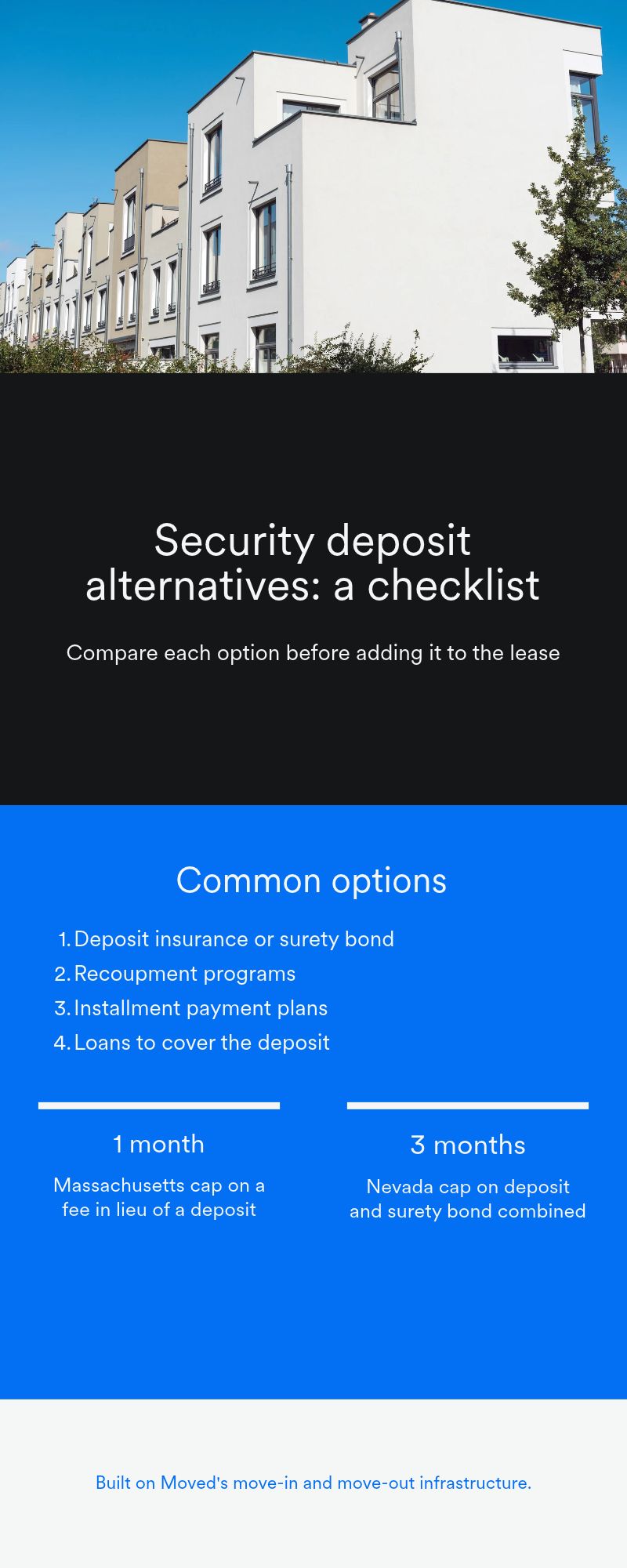
Massachusetts General Laws chapter 186, section 15B authorizes the state’s Executive Office of Housing and Livable Communities to allow, by regulation, a fee in lieu of a security deposit. The statute sets conditions that any such fee must meet.
- The fee must be optional for both the tenant and the landlord, and the tenant may choose a full security deposit instead.
- Whether the fee is wholly or partly non-refundable must be disclosed in writing.
- The total fee, over the lease and any extensions, may not exceed one month’s rent.
- A landlord who offers the fee must offer it to every approved applicant regardless of income, race, gender, gender identity, disability, sexual orientation, immigration status, household size, or credit score, and may not use those factors to set the amount.
- A tenant may opt out of the fee by paying the deposit, and the fees paid plus the deposit may not exceed one month’s rent in total.
Confirm whether the implementing regulations are in effect before offering a fee in lieu of a deposit at a Massachusetts property.
Nevada
Under Nevada Revised Statutes section 118A.242, a tenant may buy a surety bond in lieu of all or part of the security deposit if the landlord consents. The landlord is not required to accept a bond and may not require a tenant to buy one.
The security, the bond, or the two combined, including last month’s rent, may not exceed three months’ rent. If the tenant sends the surety a written dispute within 30 days after receiving the landlord’s itemized accounting, the surety may not report the claim to a credit reporting agency unless it obtains a judgment against the tenant.
Questions To Ask Before Adding An Alternative
- Is the option optional for the resident, and is a traditional deposit always available?
- What will the resident pay over the full lease, compared with the deposit it replaces?
- Who pays for damage at move-out, and can the resident still be billed for it?
- How does the provider handle claims, disputes, collections, and credit reporting?
- Does state or local law treat the charge as security, and does it fit within the deposit cap?
- Is the option offered to every approved applicant on the same terms?
- How will the property file a claim, and does the process fit the move-out inspection timeline?
Document the answers for each provider and each state. Moved’s guide to pet rent, pet fees, and pet deposits shows the same approach for another charge that varies by state.
How Alternatives Change Move-Out
With a cash deposit, the property deducts lawful charges and returns the balance with an itemized statement. With an alternative, the property may instead file a claim with a provider, and the provider may then bill the resident.
That second step happens after the resident has moved, so the documentation has to be complete before the claim is filed. Moved’s move-in and move-out inspection checklist shows how to record the unit’s condition at both ends of the lease.
Where a resident pays a traditional deposit, the usual rules still apply, and Moved’s security deposit return letter guide covers state deadlines and the final statement.
The Revenue Case: Present Every Move-In Cost In One Flow
Residents compare the deposit, its alternatives, and the cost of moving at the same moment. Presenting the deposit choice next to movers, packing, and storage gives the resident one place to plan the cost of the move.
The move-in and move-out revenue workflow places those services in the onboarding flow when the resident needs them. The same flow can record which deposit option the resident chose, so the move-out team knows whether to issue a refund or file a claim.
At move-out, the outgoing resident again needs movers, packing, and storage. A record of the deposit option, captured at move-in, keeps the final settlement on schedule while those services are offered.
Retention After Move-In: Paylode, a Moved Company
A lower upfront cost can make move-in easier, and the experience after move-in decides whether the resident renews.
Paylode is a Moved company. Moved acquired Paylode in November 2025, adding a perks and rewards platform that helps brands increase loyalty and retention through personalized perks and action-based rewards. Zego’s 2026 Resident Experience Management Report found that 31 percent of renters would be much more likely to renew if their community offered a renter rewards program.
Introducing perks during onboarding gives the resident something of value in the same weeks they are paying the largest move-in costs.
Disclosure And Insurance
A deposit alternative is a move-in charge, and it should be disclosed with every other charge. The Federal Trade Commission’s advance notice of proposed rulemaking on rental housing fees asks about fees charged at the beginning or end of a lease term, and Moved’s guide to the FTC rental fee rulemaking covers how to present those charges in one place.
Deposit insurance and renters insurance are different products. Deposit insurance covers damage the resident causes to the unit, up to a limit, while renters insurance covers the resident’s own belongings and liability, and Moved’s guide to capturing renters insurance requirements at move-in explains how to confirm that coverage before keys are released.
Running Deposit Alternatives Across a 10,000+ Unit Portfolio
- One approved list of deposit options per state, reviewed by counsel against each state’s definition of security and its deposit cap.
- A written disclosure for each option that shows the cost over the lease and who pays for damage.
- The same options offered to every approved applicant at a property, on the same terms.
- The resident’s deposit choice recorded at move-in and visible to the move-out team.
- Claims filed only after the move-out inspection is documented.
- Disputes, claims, and resident complaints reported by property and by provider.
Traditional tools focus on task tracking and administrative coordination. Moved embeds revenue-generating services and insurance verification directly into the workflow, transforming move coordination into structured revenue infrastructure.
Moved is a move infrastructure platform that embeds revenue-generating services, including movers, packing, storage, insurance, utilities, and connectivity, directly into the resident onboarding workflow. It helps property operators increase ancillary income while mitigating compliance risk, and the guide to resident onboarding automation shows how that workflow is built.
For residents, a clear choice of deposit options is part of the resident experience. For operators, Moved for multifamily operators shows how the same process runs across a portfolio.
Frequently Asked Questions
What are security deposit alternatives?
Security deposit alternatives are options that replace all or part of a cash security deposit, such as deposit insurance, surety bonds, recoupment programs, installment plans, and deposit loans. They lower the cash due at move-in but can cost more over the lease.
Are security deposit alternatives refundable?
Often they are not, and Freddie Mac notes that choosing an alternative will likely affect how much of the related cost a renter gets back, if anything. Massachusetts requires any fee in lieu of a deposit to state in writing whether it is non-refundable, and California does not allow a lease to describe security as nonrefundable.
Can a landlord require a security deposit alternative?
Some states prevent it. Nevada does not allow a landlord to require a surety bond, and Massachusetts requires any fee in lieu of a deposit to be optional, with a full deposit always available.
Does a resident still pay for damage with a deposit alternative?
It depends on the option. With some alternatives, the resident may still be billed for damage at move-out, so the disclosure should state who pays and how claims are handled.
Is deposit insurance the same as renters insurance?
No. Deposit insurance covers damage the resident causes to the unit, up to a limit, while renters insurance covers the resident’s own belongings and personal liability.