Pet rent is a monthly charge a resident pays to keep a pet in an apartment, added to base rent for as long as the pet lives in the unit. It usually sits alongside two other pet charges: a one-time pet fee and a refundable pet deposit. For multifamily operators, the mix of charges, the state rules that limit them, and the way they are presented during move-in decide whether a pet policy is accepted, disputed, or ignored.
Across a 10,000+ unit portfolio, pet charges touch thousands of leases every year. This guide covers the three charge types, the state rules that cap them, how assistance animals are handled after recent federal changes, and how to run pet registration inside a structured move-in and move-out process in residential real estate.
Why Pet Policy Matters At Portfolio Scale
Pets are now part of everyday leasing. In PetScreening’s 2026 State of Pets in Rental Housing Report, a survey of 673 property managers and leasing professionals, 81 percent of operators reported growth in pet ownership and 68 percent described themselves as pet-friendly.
The same report found that 43 percent of renters report owning a pet, compared with 71 percent of U.S. households in American Pet Products Association data. PetScreening says part of that gap may come from unauthorized and underreported pets, whose charges, damage terms, and rules were never agreed in writing.
Pet policy also affects how long residents stay. Residents in pet-friendly housing stayed 21 percent longer on average than residents of housing that did not allow pets, according to a 2021 report from Michelson Found Animals Foundation and the Human Animal Bond Research Institute, and 83 percent of owners and operators surveyed said pet-friendly vacancies fill faster.
Pet Rent, Pet Fees, And Pet Deposits Compared
Each charge does a different job, so the lease should name each one separately and explain what it covers.
| Charge | How it works | Refundable | What it usually covers |
|---|---|---|---|
| Pet rent | A recurring monthly amount added to rent, per pet or per household | No, because it is part of rent | Ongoing wear on the unit and shared pet amenities |
| Pet fee | A one-time charge collected when the lease starts or when a pet is added | Depends on state law, since some states treat charges at the start of a tenancy as security | Administration and preparing the unit for a pet |
| Pet deposit | A one-time amount held against damage caused by the pet | Yes, minus deductions for pet damage beyond ordinary wear and tear | Damage found at the move-out inspection |
Some operators charge all three, and some charge only one or two. Whatever the mix, the amount of each charge, whether it applies per pet or per household, and when it starts should appear in the pet addendum and on the move-in summary.
State Rules That Limit Pet Charges
State and local law sets the outer limits of a pet policy. Two states show how different those limits can be.
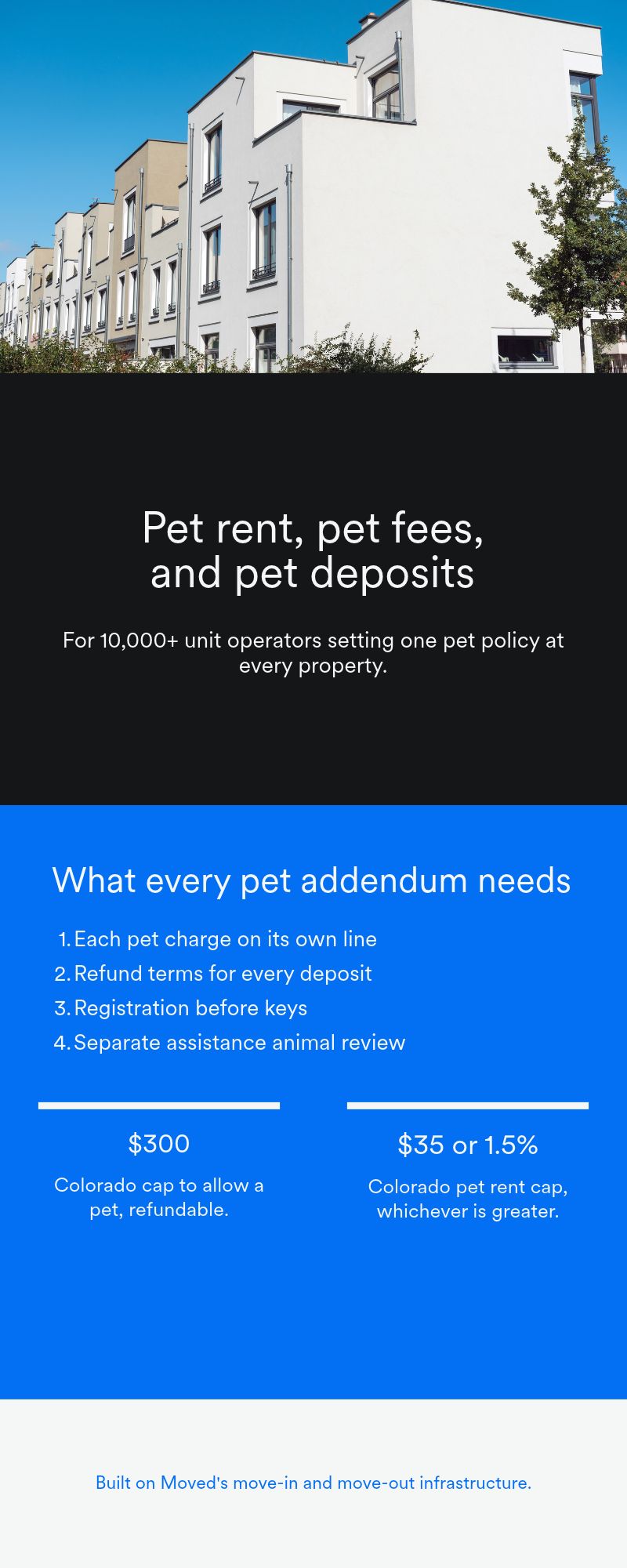
In Colorado, House Bill 23-1068 limits the amount a landlord may charge to allow a pet to $300 and requires that pet security deposit to be refundable. It also caps pet rent at $35 per month or 1.5 percent of monthly rent, whichever is greater, according to the Colorado Division of Real Estate summary, and the law took effect on January 1, 2024.
As an illustrative example, a resident paying $2,000 in monthly rent in Colorado could be charged up to $35 in pet rent, because 1.5 percent of $2,000 is $30 and the $35 figure is greater. At $3,000 in monthly rent, 1.5 percent is $45, so $45 becomes the limit.
In California, Civil Code section 1950.5 defines security as any payment, fee, deposit, or charge imposed at the start of a tenancy, including amounts used to repair damage. Under that definition, pet deposits and other one-time pet charges collected at the start of a tenancy are generally treated as security, so they count toward the state’s cap of one month’s rent for most landlords.
The same California section bars any lease from describing security as nonrefundable. Other states and cities set their own rules, so the pet addendum should be reviewed for each market before it is used.
Assistance Animals After The 2025 And 2026 Federal Changes
Assistance animal requests follow a different path from pet registration. Under the Fair Housing Act, a resident with a disability can ask for a reasonable accommodation to keep an animal, and that request should go through a separate accommodation process.
Federal guidance on those requests has changed. HUD withdrew its 2020 notice on assistance animal requests, FHEO-2020-01, in a memo dated September 17, 2025, as LeadingAge reported. On May 22, 2026, HUD’s Office of Fair Housing and Equal Opportunity rescinded that guidance and said it would find reasonable cause for a failure to accommodate only where the animal is individually trained to perform disability-related work or tasks, according to an analysis by Duane Morris.
The same analysis notes that private lawsuits under the Fair Housing Act remain available and that state and local laws are unaffected, and some of those laws may protect assistance animals more broadly. Decide with fair housing counsel how pet rent, pet fees, and pet deposits apply to each approved accommodation, and document every decision the same way at every property.
How To Build The Pet Addendum
A pet addendum works best when every property uses the same structure, with state and local versions only where the rules require them.
- Define which animals are allowed and any limits on number, breed, or weight.
- List each pet charge, its amount, and whether it applies per pet or per household.
- State which charges are refundable and how pet damage is assessed at move-out.
- Require registration of every pet before keys are released, with the records your policy requires.
- Set a process for pets added during the lease, including the date new charges start.
- Route assistance animal requests to the accommodation process.
- Explain how unauthorized pets are handled and what happens if a pet causes damage or a nuisance.
Restrictions are still common. In the PetScreening survey, 78.4 percent of respondents cited limits on the number of pets per household, 66.7 percent cited breed restrictions, and 59.8 percent cited weight limits, so any restriction in the addendum should be applied the same way at every property.
Unauthorized Pets And The Registration Gap
An unregistered pet is a resident whose pet charges and damage terms were never agreed in writing. When damage appears at move-out, the property has no addendum to point to and no deposit set aside for it.
Make registering a pet part of the move-in steps every resident completes. Adding a pet later should be just as easy, so residents who adopt during the lease have a simple way to report it.
Inspections close the loop. Moved’s move-in and move-out inspection checklist covers how to record unit condition with photos, which gives the property a baseline for any pet damage claim.
The Revenue Case: Pet Registration Belongs In The Move-In Flow
Pet registration happens in the same window when a resident books movers, packing, and storage, sets up utilities and internet, and buys renters insurance. Placing the pet addendum inside that flow keeps every move-in task in one place and gives the resident one checklist to finish.
That is the logic of the move-in and move-out revenue workflow: services and requirements are presented when the resident needs them. Residents moving with a pet can also review coverage options in Moved’s guide to pet insurance.
At move-out, the process runs in reverse. The pet deposit and any pet damage flow into the itemized deposit statement covered in Moved’s security deposit return letter template, while the outgoing resident books movers, packing, and storage for the next home.
Pet-friendly Communities And Resident Retention: Paylode, A Moved Company
A pet policy that is clear from the first day supports the longer stays described in the HABRI research. Retention also depends on what residents receive after they move in.
Paylode is a Moved company. Moved acquired Paylode in November 2025, adding a perks and rewards platform that helps brands increase loyalty and retention through personalized perks and action-based rewards. Zego’s 2026 Resident Experience Management Report found that 31 percent of renters would be much more likely to renew if their community offered a renter rewards program.
For pet owners, perks introduced during move-in give a new resident something of value alongside the new pet charges.
Disclosure And Insurance At Move-In
Pet rent and pet fees are part of what a resident pays, so they should appear in advertising and in the lease alongside other charges. The Federal Trade Commission’s advance notice of proposed rulemaking on rental housing fees asks about fees charged at the beginning or end of a lease term. Moved’s guide to the FTC rental fee rulemaking covers how to present every move-in charge in one place.
Pets also raise liability questions. Confirm that each resident’s renters insurance meets the community’s liability requirement before keys are released, and Moved’s guide to capturing renters insurance requirements at move-in explains how to verify coverage inside the move-in flow.
Running Pet Policy Across A 10,000+ Unit Portfolio
- One pet addendum template, with state and local versions where the rules differ.
- Each pet charge shown as its own line in the lease and on the move-in summary.
- Pet registration required before keys are released and available any time a pet is added.
- A separate reasonable accommodation process for assistance animals, reviewed with fair housing counsel.
- Pet damage documented with photos at the move-in and move-out inspections.
- Unauthorized pet findings, pet charge disputes, and accommodation requests reported by property.
Traditional tools focus on task tracking and administrative coordination. Moved embeds revenue-generating services and insurance verification directly into the workflow, transforming move coordination into structured revenue infrastructure.
Moved is a move infrastructure platform that embeds revenue-generating services, including movers, packing, storage, insurance, utilities, and connectivity, directly into the resident onboarding workflow. It helps property operators increase ancillary income while mitigating compliance risk, and the guide to resident onboarding automation shows how that workflow is built.
For residents, a clear pet policy is part of the resident experience. For operators, Moved for multifamily operators shows how the same process runs across a portfolio.
Frequently Asked Questions
What is pet rent?
Pet rent is a recurring monthly charge added to a resident’s rent for keeping a pet in the unit. It is separate from any one-time pet fee or refundable pet deposit.
What is the difference between pet rent, a pet fee, and a pet deposit?
Pet rent is charged every month, a pet fee is a one-time charge, and a pet deposit is a one-time amount held against pet damage and returned minus allowed deductions. Some states limit or reclassify these charges, so check local rules.
Is it legal to charge pet rent and a pet deposit?
It depends on state and local law. Colorado caps pet deposits at $300 and pet rent at $35 a month or 1.5 percent of monthly rent, whichever is greater, and California counts pet deposits toward its security deposit cap.
Do residents pay pet rent for an emotional support animal?
Federal guidance changed in 2025 and 2026, and HUD rescinded its 2020 assistance animal guidance in May 2026. Private Fair Housing Act claims and state and local laws still apply, so decide with fair housing counsel how pet charges apply to each approved accommodation.
Is a pet deposit refundable?
A pet deposit is refundable, minus deductions for pet damage beyond ordinary wear and tear. Colorado requires pet deposits to be refundable, and California bars any lease from calling security nonrefundable.
Make Every Pet Charge Clear
A consistent pet policy keeps pet charges routine and pet damage claims defensible across every property. To see how pet registration, insurance verification, and move services run as one move-in and move-out workflow across a 10,000+ unit portfolio, book a walkthrough with the Moved team.