Large industry conferences like NAA Apartmentalize are often positioned as networking opportunities. For residential operators, that framing is incomplete.
These events are dense with high-intent conversations, vendor discovery, and strategic insight. They represent a rare environment where operational decisions, revenue strategies, and technology adoption intersect.
Operators who approach conferences without a clear prioritization framework often leave with information but no direction.
Operators who approach them with intent leave with decisions that impact revenue, risk, and portfolio performance.
To understand the scale and relevance of the event, you can explore the official overview.
The core problem: lack of focus leads to low impact
The biggest challenge at large conferences is not access. It is a focus.
With hundreds of sessions, vendors, and conversations, operators are forced to constantly shift attention. Without clear priorities, this creates decision fatigue sets in.
Most teams fall into reactive behavior.
They attend sessions based on availability, engage with vendors based on visibility, and collect insights without a structured way to apply them.
This leads to three outcomes.
- No clear connection between conference activity and portfolio performance
- Vendor conversations that do not translate into implementation
- Missed opportunities to capture revenue
The problem is not the conference. It is the lack of a defined strategy.
Reframing conference priorities for residential operators
To extract value from large conferences, operators need to shift their mindset.
The objective is not exposure. It is aligned with business outcomes.
Every activity at the conference should connect to one of three priorities.
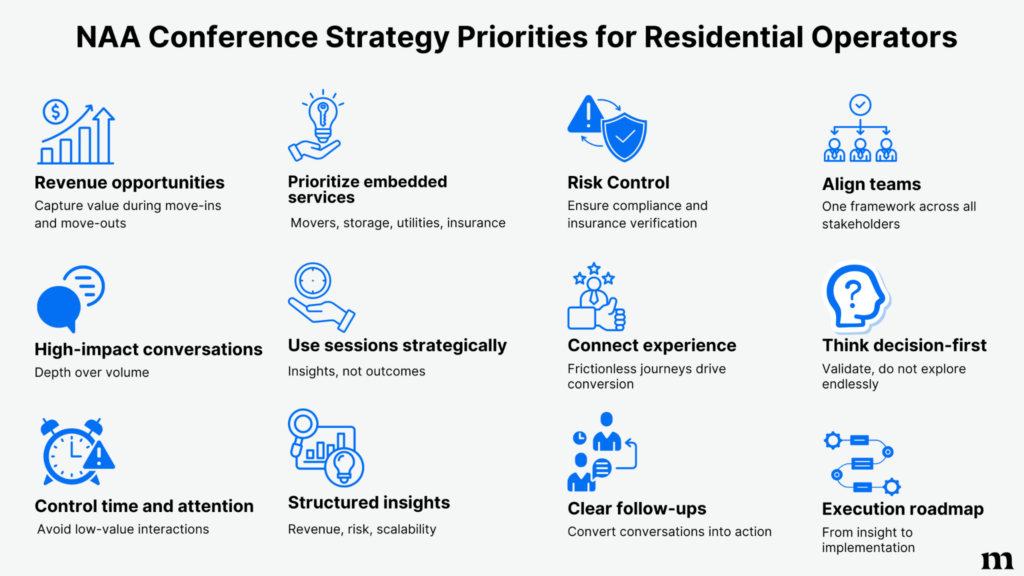
Revenue generation must come first. This includes identifying ways to capture ancillary income during high-intent moments such as move-ins and move-outs.
Risk mitigation should follow. This involves improving compliance, reducing liability, and gaining visibility into operational exposure.
Operational efficiency should support both. It should enable consistency and scalability across the portfolio.
This hierarchy aligns with how modern move infrastructure platforms are designed.
Priority 1: Focus on revenue opportunities within the resident lifecycle
The most overlooked opportunity at conferences is revenue.
Residential operators spend significant time optimizing leasing and marketing. However, the resident lifecycle itself contains multiple monetization points that remain underutilized.
Move-ins and move-outs are among the most valuable of these moments.
During a move, residents actively purchase services such as movers, packing, storage, utilities, insurance, and connectivity.
The issue is not demand. It is captured.
Most operators allow these transactions to happen outside their ecosystem, resulting in zero participation in that revenue.
This is where conference prioritization should begin.
You should be actively looking for solutions that embed these services directly into workflows.
To understand how this impacts portfolio performance, review the move-in and move-out revenue strategy.
Priority 2: Identify solutions that embed services, not just manage tasks
One of the most important distinctions operators need to make is between tools and infrastructure.
Many vendors at conferences position themselves as workflow solutions. They improve coordination but do not create financial value.
Modern platforms take a different approach.
They embed revenue-generating services directly into operational workflows, transforming processes into structured revenue systems.
This includes integrating:
- Moving services such as movers, packing, and storage
- Utility setup and connectivity
- Renters insurance and compliance verification
When these services are embedded, they drive both revenue and improved resident experience.
This is the type of solution operators should prioritize.
Priority 3: Evaluate how solutions reduce risk and enforce compliance
Risk is often underrepresented in conference conversations.
However, it plays a critical role in portfolio performance.
Insurance verification, compliance tracking, and liability management are essential for maintaining operational control.
Operators should prioritize vendors that provide structured systems for managing these areas.
This includes automated verification processes and centralized documentation.
Without these systems, risk remains fragmented and difficult to manage at scale.
Modern platforms integrate risk management directly into workflows, ensuring consistency across properties.
Priority 4: Align internal teams before attending
Conference success is not driven by individual effort. It is driven by team alignment.
Different stakeholders approach conferences with different priorities.
Leasing teams focus on experience. Operations teams focus on process. Leadership focuses on financial outcomes.
Without alignment, vendor evaluation becomes inconsistent.
Before attending, teams should agree on:
- What defines a high-impact solution
- How vendors will be evaluated
- What outcomes are expected post-event
This ensures that every conversation contributes to a shared objective.
Priority 5: Prioritize high-impact conversations over volume
At large conferences, there is a tendency to maximize the number of interactions.
This approach reduces depth and limits value.
Instead, operators should focus on fewer, higher-quality conversations.
Each interaction should be tied to a specific objective.
This includes understanding how a solution generates revenue, how it integrates into workflows, and how it performs at scale.
High-impact conversations lead to actionable insights.
Low-impact conversations create noise.
Priority 6: Use sessions as strategic inputs, not primary outputs
Sessions provide valuable context, but they should not be the primary focus.
The real value of conferences comes from applying insights, not collecting them.
Operators should attend sessions that align with their strategic priorities.
These include topics related to revenue generation, ancillary income, and resident lifecycle optimization.
Sessions should inform your thinking, but decisions should be driven by direct evaluation of solutions.
Priority 7: Connect resident experience with revenue strategy
Resident experience is often treated as a standalone priority.
In reality, it is directly linked to revenue.
When services are embedded into a seamless workflow, residents experience less friction. At the same time, operators capture value from transactions.
This creates alignment between experience and financial performance.
To see how this works in practice, explore the resident experience platform.
Priority 8: Navigate the conference with a decision-first mindset
Once you are on-site, the biggest shift you need to make is from exploration to decision-making.
Most operators continue exploring throughout the event. They move from booth to booth, session to session, collecting information without narrowing their focus.
This creates cognitive overload.
Instead, your mindset should be centered on validation.
You have already defined your priorities. Now your goal is to confirm which solutions align with those priorities and which do not.
Every conversation should move you closer to a decision.
If a vendor cannot clearly demonstrate how they impact revenue, reduce risk, or scale across your portfolio, they should not move forward in your evaluation process.
Priority 9: Control your time and attention deliberately
Time is the most constrained resource at large conferences.
Without control, it gets consumed by low-impact activities.
You need to be intentional with how you allocate it.
Focus on depth over breadth. High-value conversations require time and clarity.
Avoid getting pulled into long product demos that do not align with your predefined priorities.
Instead, structure your day around targeted meetings and strategic sessions.
This ensures that your attention is directed toward outcomes rather than activity.
Priority 10: Capture insights in a format that supports execution
One of the most common failure points after conferences is poor documentation.
Operators often rely on scattered notes, making it difficult to compare vendors or make decisions later.
Your documentation should be structured and consistent.
After each conversation, capture insights across three dimensions.
Revenue impact should be clearly defined. This includes how the solution generates income and what services are embedded.
Risk mitigation should be documented. This includes compliance processes, insurance verification, and liability management.
Operational scalability should be evaluated. This includes integration capabilities and portfolio-wide implementation.
This structure ensures that insights translate into actionable decisions.
Priority 11: Convert conversations into structured follow-ups
The value of a conference is realized after the event, not during it.
Every meaningful conversation should lead to a defined next step.
This includes scheduling deeper discussions, aligning stakeholders, and exploring pilot opportunities.
Without this transition, conversations lose momentum.
Operators often delay follow-ups, which reduces clarity and weakens decision-making.
Act quickly while the context is still fresh.
Priority 12: Build a post-conference execution roadmap
After the conference, your focus should shift from input to execution.
Start by reviewing all vendor insights using your evaluation framework.
Identify which solutions have the strongest potential to impact revenue and reduce risk.
From there, build a roadmap that outlines how these solutions will be evaluated, piloted, and scaled.
This roadmap should include clear ownership, timelines, and expected outcomes.
It should also define how success will be measured across the portfolio.
To better understand how move workflows translate into revenue systems, revisit the move-in and move-out revenue strategy.
Priority 13: Prioritize integration over isolated adoption
One of the most critical strategic decisions operators face is whether to adopt individual tools or build a connected system.
Isolated tools may solve specific problems, but they often create fragmentation.
This leads to inconsistent workflows and limited scalability.
The alternative is to prioritize integration.
This means selecting solutions that embed directly into the resident lifecycle and connect with existing systems.
When services such as movers, storage, utilities, insurance, and connectivity are integrated into a unified workflow, they create a structured revenue infrastructure.
To understand how this connects with onboarding workflows, explore the resident onboarding automation framework.
Priority 14: Align conference outcomes with long-term portfolio strategy
Large conferences should not be treated as standalone events.
They should be integrated into your broader portfolio strategy.
Every decision made at Apartmentalize should support long-term objectives.
This includes increasing ancillary revenue, improving compliance, and standardizing operations across properties.
When conference outcomes are aligned with strategic goals, they create a lasting impact.
Otherwise, they remain isolated insights.
The bigger shift: from conference participation to strategic advantage
The most effective operators do not measure conference success by activity.
They measure it by outcomes.
They use Apartmentalize as a platform to identify, evaluate, and implement solutions that drive financial performance.
They move from fragmented workflows to integrated systems.
They capture revenue during high-intent moments.
They reduce risk through structured compliance.
They scale operations with consistency.
Moved represents this shift in the industry.
It is a move infrastructure platform that embeds revenue-generating services, including movers, packing, storage, utilities, insurance, and connectivity, directly into the resident workflow, enabling operators to turn everyday processes into structured revenue opportunities while maintaining operational control.
Conclusion: Clarity drives conference ROI
Large industry conferences can either create clarity or confusion.
The outcome depends on your priorities, your framework, and your execution.
When you focus on revenue, evaluate risk, and prioritize scalable solutions, the path forward becomes clear.
You move beyond exploration.
You make decisions with confidence.
You build systems that generate value across your portfolio.
And most importantly, you turn conference participation into a strategic advantage.
FAQs
What should residential operators prioritize at large conferences like NAA?
Operators should prioritize revenue generation, risk mitigation, and scalable solutions that integrate into the resident lifecycle rather than focusing only on features or networking.
Why do many operators struggle with conference ROI?
Most operators lack a clear framework and focus on exploration rather than decision-making, leading to low-impact outcomes and missed opportunities.
How can operators ensure better decisions at conferences?
By defining priorities before attending, using a structured evaluation framework, and focusing on high-impact conversations tied to financial outcomes.
What role does vendor selection play in conference success?
Vendor selection directly impacts revenue, risk, and scalability. Choosing the right partners ensures that conference insights translate into measurable results.
How should operators follow up after a conference?
Operators should review insights, prioritize vendors, schedule follow-ups, and build a clear implementation roadmap to drive ROI.