
Tenant abandoned property is personal property a resident leaves in a unit, storage space, or common area after the tenancy ends and they have moved out. Most states require the property to give written notice, store the items for a set period, and release or dispose of them only as the law allows. For operators, every item left behind also delays the turn and the next resident’s move-in.
Across a 10,000+ unit portfolio, belongings left after move-out are a regular occurrence, and each one creates notice, storage, and liability steps for a site team. This guide covers the state rules that apply, why residents leave property behind, how to prevent it, and how to handle it step by step in residential real estate.
What State Law Requires
State rules set the notice, the waiting period, and what the property may do with unclaimed items. California and Florida follow a similar structure, shown below as worked examples.
| Requirement | California | Florida |
|---|---|---|
| Written notice | To the former tenant and anyone the landlord reasonably believes owns the property | To the former tenant and anyone the landlord reasonably believes owns the property |
| What the notice must say | A description of the property, that reasonable storage costs may be charged, where to claim it, and the claim deadline | A description of the property, that reasonable storage costs may be charged, where to claim it, and the claim deadline |
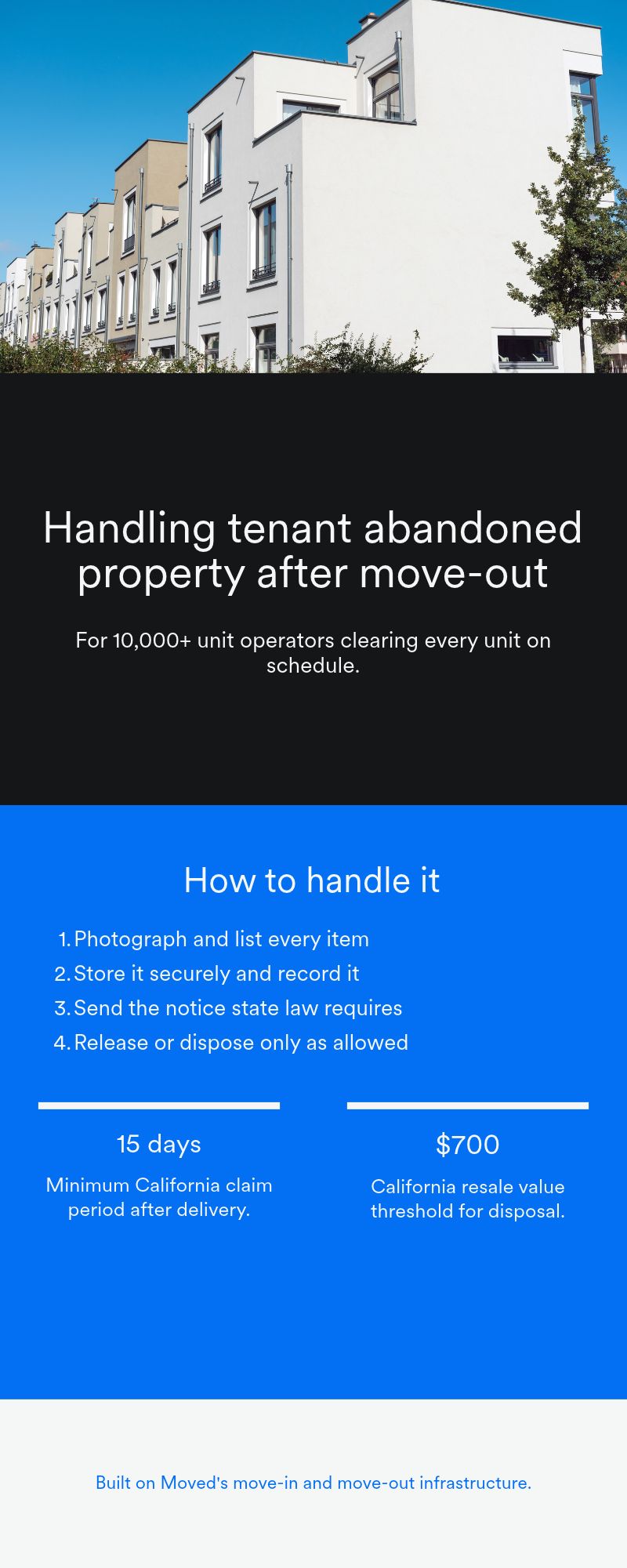
| Claim deadline | At least 15 days after personal delivery, or 18 days after mailing | At least 10 days after personal delivery, or 15 days after mailing |
| Unclaimed property | Sold at public sale, unless the landlord reasonably believes its total resale value is less than $700, in which case it may be kept or disposed of | Handled under the disposal rules that follow in the same chapter |
The California rules come from Civil Code section 1983 and Civil Code section 1988. The Florida notice rules come from Florida Statutes section 715.104.
California also builds a reminder into the move-out process. When a property notifies a resident of the right to a pre-move-out inspection under Civil Code section 1950.5, the notice must include a statement that former tenants may reclaim abandoned personal property, subject to conditions and possible storage costs.
Why Residents Leave Property Behind
- The movers ran out of time or space on moving day.
- The resident had nowhere to put items between homes.
- Large items, such as furniture or appliances, were too costly to move.
- Items were left in a storage locker, garage, or common area the resident forgot about.
- The resident left in a hurry after an early termination or a holdover.
Most of these are moving problems. Booked movers with the right capacity, a storage option for the gap between homes, and a reminder about storage spaces and common areas remove most of the reasons property is left behind.
The Revenue Case: Prevention Runs Through The Move
The best time to prevent abandoned property is the day notice to vacate arrives. Offering movers, packing, and storage in the same message lets the resident plan for every item, including the large ones.
That puts prevention inside the move-in and move-out revenue workflow. Storage matters most, because it gives a resident whose new home is smaller, or not yet ready, a place for belongings that would otherwise stay in the unit.
Moved’s move-out cleaning checklist includes removing all personal items from the unit and storage spaces, so the expectation is set in writing well before move-out day.
The Cost Of Property Left Behind
Abandoned property holds up the turn. Turnover has cost about $3,872 per resident, according to an earlier edition of Zego’s Resident Experience Management Report reported by Multifamily Dive, a figure that includes repairs and lost rent. Items that must be stored through a notice period can delay cleaning and maintenance in the unit.
Site teams also spend time on inventories, notices, and calls with former residents, which takes them away from leasing and resident service.
Handling the property also carries risk. A notice that leaves out an item, or a disposal before the deadline, can expose the property to a claim from the former resident.
Goodwill At Exit: Paylode, A Moved Company
How a property handles a resident’s belongings affects what that resident says about the community. Paylode is a Moved company. Moved acquired Paylode in November 2025, adding a perks and rewards platform that helps brands increase loyalty and retention through personalized perks and action-based rewards.
A respectful, documented process for returning belongings keeps the relationship intact, even when a resident has left quickly.
How To Handle Abandoned Property, Step by Step
- Confirm the tenancy has ended and the unit has been vacated, including the return of keys.
- Photograph and list every item, describing each one well enough for the owner to identify it.
- Move the items to secure storage, and record the date and location.
- Send the written notice required by state law to the former resident and any other likely owner, using every address the property has.
- Release items to anyone who claims them by the deadline, charging only the reasonable storage costs the law allows.
- After the deadline, sell, keep, or dispose of unclaimed items only as state law permits.
- Keep the notice, photos, and disposal record with the resident file.
The photo record links to the final inspection. Moved’s move-in and move-out inspection checklist covers the room-by-room photo standard that should capture any items left in the unit.
Deposits, Fees, And Insurance
Some states allow storage or removal costs to be charged against a deposit, and others limit it. New York, for example, lists the moving and storage of the tenant’s belongings among the costs a landlord may retain from a deposit, under General Obligations Law section 7-108. Any such charge belongs on the itemized statement, and Moved’s security deposit return letter template shows how to list it.
Any removal or storage fee should also be stated in the lease. The Federal Trade Commission’s advance notice of proposed rulemaking on rental housing fees asks about one-time fees charged at the beginning or end of a lease term, and Moved’s guide to the FTC rental fee rulemaking explains how to disclose them.
Renters insurance should stay active until keys are returned, since a loss during packing falls on the property if coverage has lapsed. Moved’s guide to capturing renters insurance requirements explains how to get notice of a cancelled policy.
Running Abandoned Property Handling Across A 10,000+ Unit Portfolio
- One abandoned property procedure, with state-specific notice periods and disposal rules.
- Notice templates prepared for each state, with the required statements already included.
- Movers, packing, and storage offered at notice to vacate.
- A reminder about storage lockers, garages, and common areas sent before move-out.
- Photo inventories and notices stored with the resident record.
- Abandoned property cases, days to clear, and claims reported by property.
Traditional tools focus on task tracking and administrative coordination. Moved embeds revenue-generating services and insurance verification directly into the workflow, transforming move coordination into structured revenue infrastructure.
Moved is a move infrastructure platform that embeds revenue-generating services, including movers, packing, storage, insurance, utilities, and connectivity, directly into the resident onboarding workflow. It helps property operators increase ancillary income while mitigating compliance risk, and the guide to resident onboarding automation shows how that workflow is built.
For departing residents, a clear plan for their belongings is part of the resident experience. For operators, Moved for multifamily operators shows how the same process runs across a portfolio.
Frequently Asked Questions
What counts as tenant abandoned property?
Personal property a resident leaves in the unit, a storage space, or a common area after the tenancy ends and they have moved out.
How long must a landlord keep a tenant’s belongings?
It depends on the state. California requires a claim deadline at least 15 days after personal delivery of notice, or 18 days after mailing, and Florida requires at least 10 days, or 15 days after mailing.
Can a landlord throw away a tenant’s belongings right away?
Generally, no. Most states require written notice and a waiting period before unclaimed property can be sold, kept, or disposed of.
Can a landlord charge for storing abandoned property?
Many states allow reasonable storage costs to be charged before the property is returned, and the notice must say so in California and Florida.
How can operators prevent residents from leaving property behind?
Offer movers, packing, and storage when notice arrives, remind residents about storage spaces and common areas, and confirm the move-out plan two weeks before the move.
Clear Every Unit On Schedule
A booked move with storage in place is the simplest way to keep belongings from being left behind. To see how notices, moving services, inspections, and insurance verification run as one move-in and move-out workflow across a 10,000+ unit portfolio, book a walkthrough with the Moved team.