A move-out cleaning checklist tells a departing resident exactly how clean the unit must be when they return the keys, room by room. Sent at notice to vacate, it sets a clear standard, cuts disputes over cleaning charges, and shortens the turn. For operators, it also opens the move-out conversation at the moment residents are booking movers, packing help, and storage.
Across a 10,000+ unit portfolio, cleaning expectations often differ by property and by site team. This guide covers why a standard checklist matters, the rules that limit cleaning deductions, a room-by-room checklist, and how to run move-out cleaning as part of a structured move-out in residential real estate.
Why A Standard Cleaning Checklist Matters
Cleaning charges are a common source of deposit disputes, and the law limits what a property can claim. In California, a deposit may cover cleaning needed to return the unit to the same level of cleanliness it was in at the start of the tenancy, under Civil Code section 1950.5. The same statute bars charging a resident for professional carpet cleaning or other professional cleaning unless it is reasonably necessary to restore that condition, excluding ordinary wear and tear.
New York bars deposit deductions for ordinary wear and tear and for damage caused by a prior tenant, under General Obligations Law section 7-108. A resident who never received a written cleaning standard has a strong argument that a charge was unexpected.
Cleaning also drives turn time. Turnover has cost about $3,872 per resident, according to an earlier edition of Zego’s Resident Experience Management Report reported by Multifamily Dive, a figure that includes repairs and lost rent. A unit returned clean is ready for maintenance sooner.
The Revenue Case: The Checklist Arrives When The Move Is Being Planned
Notice to vacate is the point at which a resident starts planning the move. They are comparing movers, deciding what goes into storage, and buying packing supplies. A cleaning checklist sent the same day is one of the first move-out messages a resident reads.
That makes it a natural place to present moving options as part of the move-in and move-out revenue workflow. Moved’s newsletter The RevGen Leak Map describes move-out as a moment where easy transition offers and moving services preserve goodwill. A resident whose movers, packing, and storage are booked has more time to clean.
Goodwill At Exit: Paylode, A Moved Company
How a move-out is handled shapes what a resident says about the community afterward. Paylode is a Moved company. Moved acquired Paylode in November 2025, adding a perks and rewards platform that helps brands increase loyalty and retention through personalized perks and action-based rewards.
Some residents who give notice can still be kept. Zego’s 2026 Resident Experience Management Report found that 31 percent of renters would be much more likely to renew if their community offered a renter rewards program. Before sending move-out steps, check whether a renewal or an apartment transfer meets the resident’s need.
The Room-By-Room Move-Out Cleaning Checklist
The checklist below sets the standard most operators expect. Adjust it to match each property’s move-in condition, and keep the wording plain, so residents can follow it without calling the office.
| Area | What the resident should clean | What the property should note |
|---|---|---|
| Kitchen | Inside and outside the oven, range, refrigerator, freezer, dishwasher, and microwave; cabinets and drawers; counters; sink and faucet; range hood | Appliances emptied and switched to normal settings |
| Bathrooms | Toilet, tub or shower, tile and grout, sink, mirror, vanity, cabinets, and exhaust fan cover | Fixtures free of buildup that was absent at move-in |
| Living areas and bedrooms | Floors swept, vacuumed, or mopped; baseboards; light switches and outlet covers; closet shelves | Marks beyond normal use, such as heavy scuffs or stains |
| Windows and doors | Window sills, tracks, blinds, and interior glass; doors and door handles | Missing or damaged blinds recorded separately |
| Walls | Spot cleaning only, using methods the property approves | Nail holes and paint touch-ups follow the property’s wear and tear policy |
| Balcony, patio, and storage | Swept and emptied, with no items left behind | Any items left are handled under state abandoned property rules |
| Trash and belongings | All personal items and trash removed from the unit and storage spaces | Removal costs, where allowed, listed in the lease |
| Keys and access | Keys, fobs, garage remotes, and mailbox keys returned | Count matched to the move-in record |
The checklist covers cleanliness. Damage, repairs, and the photo record follow the inspection process set out in Moved’s move-in and move-out inspection checklist.
Cleaning, Damage, And Wear And Tear
Residents often confuse cleaning with damage. A clear checklist separates the two, so the final statement holds up if a charge is questioned.
| Category | Examples | Who covers it |
|---|---|---|
| Ordinary wear and tear | Light carpet wear in walkways, minor scuffs, faded paint | The property, as part of the turn |
| Cleaning | Grease in the oven, soap buildup in the shower, dust on blinds | The resident, or a charge where the law allows it |
| Damage | Holes in walls, broken blinds, burns or stains in flooring | The resident, documented through the inspection |
When To Send The Checklist And What Follows
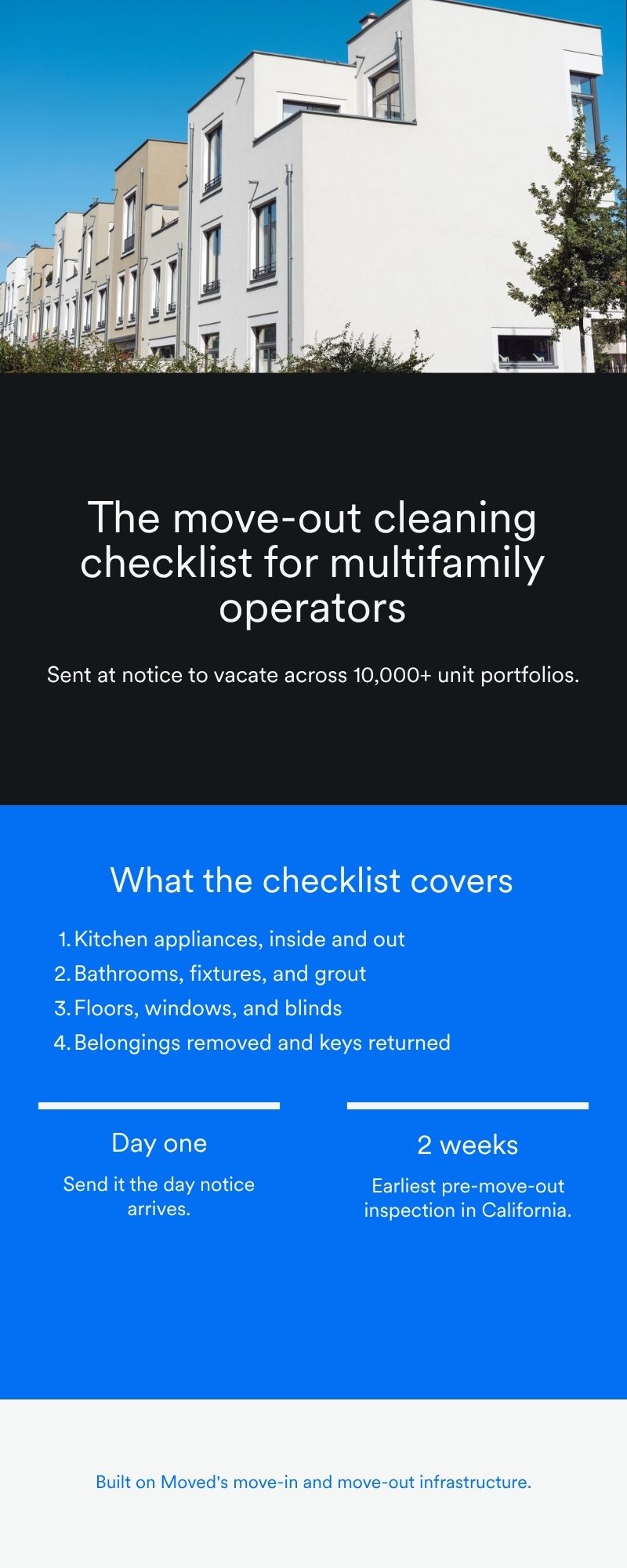
- Send the checklist the day notice to vacate is received, along with the move-out steps and the final move-out date.
- Offer movers, packing, and storage in the same message, so the resident can book early.
- Offer a pre-move-out inspection. In California, it may take place no earlier than two weeks before the tenancy ends, with 48 hours’ written notice.
- Give the resident the list of cleaning or repairs found at that inspection, so they can fix them before leaving.
- Complete the final inspection with photos after keys are returned and before any cleaning begins.
- Send the itemized deposit statement within the state deadline, using Moved’s security deposit return letter template as a guide.
Fee Disclosure And Insurance At Move-Out
Any flat cleaning fee or charge for removing items should appear in the lease before it appears on any final statement. The Federal Trade Commission’s advance notice of proposed rulemaking on rental housing fees asks about one-time fees charged at the beginning or end of a lease term. Moved’s guide to the FTC rental fee rulemaking covers how to disclose those charges at lease signing.
Renters insurance should stay active until keys are returned. A water leak or fire during the final weeks of packing and cleaning is a resident-caused loss the deposit cannot cover. Moved’s guide to capturing renters insurance requirements explains how to get notice if a policy is cancelled early.
Running Move-Out Cleaning Across A 10,000+ Unit Portfolio
- One cleaning checklist, with property-specific notes for appliances, flooring, and outdoor spaces.
- The checklist sent automatically at notice to vacate, with moving services offered in the same message.
- Pre-move-out inspection offers sent on the same trigger.
- Cleaning, damage, and wear and tear kept as separate lines in every inspection and statement.
- Cleaning charges, disputes, and days to turn reported by property.
Traditional tools focus on task tracking and administrative coordination. Moved embeds revenue-generating services and insurance verification directly into the workflow, transforming move coordination into structured revenue infrastructure.
Moved is a move infrastructure platform that embeds revenue-generating services, including movers, packing, storage, insurance, utilities, and connectivity, directly into the resident onboarding workflow. It helps property operators increase ancillary income while mitigating compliance risk, and the guide to resident onboarding automation shows how that workflow is built.
For departing residents, clear instructions are part of the resident experience. For operators, Moved for multifamily operators shows how the same process runs across a portfolio.
Frequently asked questions
What should a move-out cleaning checklist include?
Every room and appliance: the kitchen, bathrooms, living areas, bedrooms, floors, windows, blinds, outdoor spaces, and storage, plus removal of all belongings and the return of keys.
When should a property send a move-out cleaning checklist?
On the day notice to vacate is received, so the resident can plan cleaning alongside movers, packing, and storage.
Can a landlord charge for professional cleaning at move-out?
It depends on state law and the lease. In California, a property may not charge for professional cleaning unless it is reasonably necessary to return the unit to its move-in condition, excluding ordinary wear and tear.
What is the difference between cleaning and wear and tear?
Cleaning covers dirt and buildup a resident can remove, such as grease or soap scum. Wear and tear is the natural decline from normal use, such as light carpet wear, and is generally the property’s cost.
Is a move-in and move-out cleaning checklist the same document?
The same checklist can be used at both ends of the tenancy. Recording the unit’s condition at move-in sets the standard the resident returns it to at move-out.
Make Every Move-Out Cleaner And Faster
A cleaning checklist sent at notice sets expectations early and keeps the turn on schedule. To see how notices, inspections, moving services, and insurance verification run as one move-in and move-out workflow across a 10,000+ unit portfolio, book a walkthrough with the Moved team.