For multifamily property managers, the resident experience begins long before move-in day. It starts the moment a lease is signed. What happens between lease signing and key handoff determines whether a new resident feels confident and welcomed — or stressed and uncertain.
Yet in many communities, onboarding still relies on emails, spreadsheets, printed checklists, and back-and-forth phone calls. Staff manually coordinate elevator reservations. Residents ask the same questions repeatedly. Insurance documents are submitted late. Moving trucks show up without notice. The result? Frustration on both sides.
This is where resident onboarding automation software changes the game.
Instead of juggling disconnected tasks, property managers can create a structured, guided move-in process. Residents receive clear instructions, scheduled reminders, and coordinated moving support — all without staff chasing paperwork or answering repetitive questions.
Modern renters expect digital convenience. They order groceries, schedule rides, and sign contracts online. They also expect a simple move-in process. Communities that rely on manual workflows risk:
- Higher staff workload
- Increased move-in day confusion
- Negative first impressions
- Lower renewal rates
By contrast, the best resident onboarding software multifamily operators use creates consistency across every property. It removes uncertainty, reduces errors, and improves operational efficiency.
Why This Matters in 2026
Staffing challenges continue across the U.S. multifamily industry. Leasing teams are stretched thin. Operations teams manage more units per employee than ever before. Every manual task adds cost.
At the same time, online reviews heavily influence leasing decisions. A chaotic move-in experience often leads to poor ratings — even if the apartment itself is perfect.
Automation protects both your team and your reputation.
Communities that want to simplify the entire move-in journey can see how Resident moves, automated. works in practice by exploring the streamlined resident experience offered.
What Is Resident Onboarding Automation?
Clear Definition for Property Managers
Resident onboarding automation software is a system that manages the entire move-in process from lease signing to post-move follow-up through structured, automated workflows.
Instead of relying on manual coordination, the system:
- Sends scheduled welcome messages
- Provides digital move-in checklists
- Collects required documents
- Coordinates moving logistics
- Tracks progress in one place
In simple terms, it replaces scattered communication with a guided experience.
How It Differs from Traditional Onboarding
Traditional process:
- Lease signed
- Staff sends a manual email
- The resident forgets the required documents
- Elevator scheduling is handled by phone
- Moving details unclear
- Staff reacts to problems
Automated process:
- Lease signed
- System triggers welcome sequence
- The resident receives the checklist instantly
- Move-in time selected online
- Documents are uploaded to one place
- Staff monitors progress from the dashboard
The difference is predictability. Automation removes guesswork and reduces last-minute surprises.
Why Manual Onboarding Is Costing You More Than You Think
Many property managers underestimate the true cost of manual onboarding.
1. Staff Time Adds Up Quickly
Each new lease may require:
- 5–10 emails
- Multiple reminder calls
- Elevator scheduling coordination
- Insurance verification follow-ups
- Move-day confirmations
Multiply that by dozens of move-ins per month across a portfolio. The hours compound quickly.
Resident onboarding automation software reduces repetitive communication by sending structured reminders automatically.
2. Move-In Day Chaos Hurts Your Brand
When moving trucks arrive without a scheduled dock time or elevators are double-booked, stress spreads quickly. Residents often associate these issues with property management — even if the problem stems from poor coordination.
The best resident onboarding software multifamily communities use prevents these conflicts by allowing residents to reserve move-in times within pre-approved windows.
3. Poor First Impressions Reduce Renewals
The first few days in a new home shape long-term perception. If onboarding feels disorganized, trust declines early. Residents may already begin considering alternatives when renewal time arrives.
Automation creates consistency — and consistency builds trust.
Core Features of Resident Onboarding Automation Software
To understand its impact, property managers should evaluate the essential components of an effective system.
Automated Welcome & Communication
- Immediate welcome message after lease signing
- Step-by-step instructions
- Timed reminders
- Clear move-in preparation guidance
Residents know exactly what to do and when.
Digital Document Collection
- Insurance uploads
- Lease confirmations
- Community acknowledgments
No more chasing missing paperwork.
Smart Move Scheduling
Instead of staff manually coordinating elevators, residents choose available time slots. The system prevents overlapping reservations and notifies building teams automatically.
Integrated Moving Support
One of the most overlooked onboarding problems is moving logistics. Residents often scramble to find reliable movers.
Communities that integrate moving coordination allow residents to Hire Movers as part of their onboarding flow. This reduces last-minute disruptions and improves overall experience.
Real-Time Tracking for Property Teams
Managers can view:
- Who has completed the required steps
- Who still needs reminders
- Scheduled move-in times
- Document status
This visibility reduces uncertainty and allows proactive management.
Why the Best Resident Onboarding Software Multifamily Operators Use Improves NOI
Automation is not just about convenience. It directly affects financial performance.
Reduced Labor Costs
By minimizing repetitive tasks, teams can handle more leases without increasing headcount.
Higher Resident Satisfaction
Clear communication reduces stress. Less stress leads to better reviews and a stronger community reputation.
Increased Renewal Rates
When onboarding is smooth, residents begin their lease on a positive note. That positive perception often influences renewal decisions months later.
Lower Risk Exposure
Clear documentation records and structured communication logs protect against disputes.
In competitive markets, operational efficiency and resident experience are key differentiators. Communities adopting resident onboarding automation software are seeing measurable improvements in both.
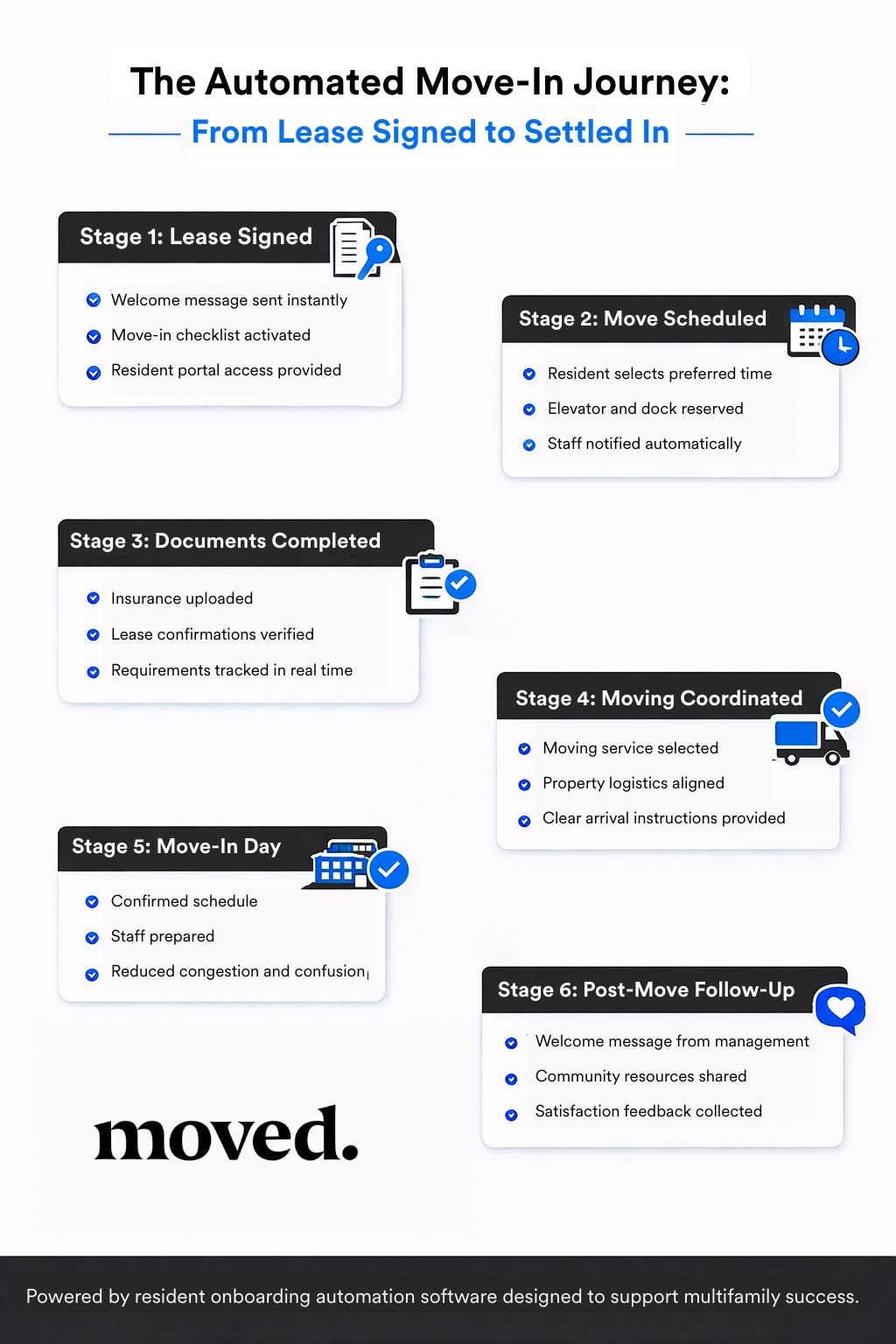
Step-by-Step: How Resident Onboarding Automation Works
Property managers often ask: What actually happens after we implement resident onboarding automation software?
Below is a clear breakdown of how the process works in real communities.
Step 1: Lease Signed → Workflow Begins
The moment a lease is finalized, the system automatically triggers:
- A welcome message
- A move-in checklist
- Important dates and next steps
- A link to select a move-in time
There is no delay and no need for manual follow-up. The resident immediately knows what to expect.
This early clarity sets the tone for the entire relationship.
Step 2: Resident Selects a Move-In Time
Instead of calling the office to coordinate schedules, the resident:
- Views available move-in windows
- Selects a preferred time
- Receives confirmation instantly
The system prevents double bookings and notifies staff automatically. Elevator and dock scheduling become predictable instead of reactive.
This is one of the biggest time-saving benefits of resident onboarding automation software.
Step 3: Moving Coordination Built Into the Process
Moving day often creates the most stress. When residents scramble to find movers at the last minute, delays and property damage become more likely.
Communities that streamline this step allow residents to Hire Multifamily Movers as part of their onboarding flow. This keeps everything coordinated within one system.
Instead of multiple vendors and separate phone calls, moving logistics become part of the guided move-in experience.
Step 4: Required Documents Submitted Digitally
Residents upload:
- Proof of insurance
- Signed acknowledgments
- Required community forms
The system tracks completion automatically. Staff can see who has completed requirements and who needs reminders — without sending multiple emails.
This reduces compliance risk and eliminates paperwork delays.
Step 5: Automated Reminders Before Move-In Day
As move-in day approaches, the system sends:
- Time reminders
- Parking or dock instructions
- Access details
- Contact information for support
Residents feel prepared. Staff are informed. Surprises are minimized.
Step 6: Move-In Day Execution
On move-in day:
- Staff know which units are scheduled
- Elevators are reserved
- Moving vendors are coordinated
- The timeline is clear
This structure reduces hallway congestion, resident complaints, and operational confusion.
Step 7: Post-Move Follow-Up
The best resident onboarding software multifamily operators rely on does not stop at key handoff.
After move-in, the system can:
- Send a welcome message from management
- Share community guidelines
- Introduce maintenance procedures
- Collect satisfaction feedback
This final step reinforces professionalism and builds long-term trust.
Key Metrics Property Managers Should Track
To evaluate the impact of resident onboarding automation software, track measurable performance indicators.
1. Average Onboarding Completion Time
How long does it take residents to complete the required steps?
Automation should shorten this timeline.
2. Staff Hours Per Move-In
Measure email volume and coordination time before and after implementation.
3. Move-In Day Complaints
Track elevator conflicts, parking confusion, and documentation issues.
4. Resident Satisfaction Scores
Early experience influences long-term perception.
5. Renewal Rate Trends
A smoother onboarding experience often correlates with stronger retention.
By reviewing these metrics quarterly, property managers can quantify operational improvements instead of relying on assumptions.
How to Choose the Best Resident Onboarding Software Multifamily Communities Can Trust
Not all solutions are designed specifically for multifamily operations. When evaluating options, focus on practical needs.
Ease of Use for Residents
- Clear interface
- Mobile-friendly design
- Simple instructions
If residents struggle to navigate the system, adoption will suffer.
Ease of Use for Staff
- Central dashboard
- Minimal training required
- Clear status tracking
Automation should reduce workload — not create new complications.
Built-In Moving Integration
Many systems focus only on documents and communication. However, moving coordination is one of the most complex parts of onboarding.
Look for resident onboarding automation software that integrates moving logistics directly into the workflow rather than treating it as a separate process.
Scalability Across Portfolio
Whether you manage 100 units or 10,000 units, the system should provide:
- Portfolio-wide visibility
- Property-level customization
- Consistent experience across locations
Reliable Support and Demonstrated Experience
Choose a provider that understands multifamily operations and has real-world experience improving move-in workflows.
If you want to evaluate how a fully integrated onboarding system works in practice, you can book a demo to see how automation can fit your portfolio.
Common Mistakes to Avoid When Implementing Resident Onboarding Automation
Adopting resident onboarding automation software can significantly improve efficiency — but only if implemented correctly. Property managers should avoid these common mistakes.
1. Overcomplicating the Workflow
Automation should simplify the process, not overwhelm residents with too many steps. Keep the onboarding journey clear:
- Welcome message
- Checklist
- Move-in scheduling
- Document upload
- Moving coordination
- Confirmation
Simple structure leads to higher completion rates.
2. Failing to Communicate the Change to Residents
Even the best resident onboarding software multifamily communities use requires a clear explanation.
Residents should know:
- Why the system is being used
- How it benefits them
- Where to get support if needed
A short introductory message reduces confusion and increases adoption.
3. Not Training Staff Properly
Automation reduces manual work, but teams must understand:
- How to monitor the dashboard
- How to review document status
- When to intervene if needed
Training ensures automation enhances operations rather than creating uncertainty.
4. Treating Moving Logistics as Separate
Move-in day is often the most stressful part of the onboarding journey. If moving coordination is not integrated, problems still occur.
Communities that allow residents to Hire Movers directly within the onboarding process reduce:
- Dock congestion
- Elevator conflicts
- Last-minute vendor issues
Integrated logistics create smoother move-in days and protect the building.
5. Ignoring Post-Move Engagement
Onboarding should not end when keys are handed over. A follow-up message builds trust and reinforces professionalism.
Resident onboarding automation software should include:
- Welcome confirmation
- Community resource links
- Feedback requests
A strong finish improves satisfaction and sets the tone for lease renewal.
Competitive Advantage in 2026: Why Automation Is No Longer Optional
The multifamily industry has shifted. Residents now compare communities based on experience — not just rent price or amenities.
Property managers who still rely on manual onboarding face several disadvantages:
- Higher labor costs
- Inconsistent communication
- Increased risk of negative reviews
- Lower retention rates
The best resident onboarding software that multifamily operators depend on delivers a consistent, guided experience across every property.
Experience Is the New Differentiator
In competitive markets, prospects often choose between similar units. When one property offers a structured, stress-free move-in experience and another offers a manual process, the difference is clear.
Automation demonstrates professionalism from day one.
Staffing Efficiency Protects Margins
With labor costs rising, property managers must find ways to handle more leases without expanding staff. Resident onboarding automation software reduces repetitive tasks and frees teams to focus on leasing, resident relationships, and property operations.
Efficiency directly supports net operating income.
Online Reviews Influence Leasing
Move-in chaos frequently appears in online reviews. Complaints about elevator scheduling, unclear instructions, or moving day confusion can impact occupancy rates.
Automation reduces these friction points and protects brand reputation.
Final Thoughts: Why Now Is the Right Time to Upgrade
Resident expectations are higher than ever. Staffing resources remain tight. Operational efficiency directly impacts profitability.
Manual onboarding processes create unnecessary stress for residents and additional workload for teams. In contrast, structured automation delivers:
- Clear communication
- Organized move scheduling
- Coordinated moving logistics
- Verified documentation
- Improved first impressions
Property managers who invest in resident onboarding automation software position their communities for stronger retention, better reviews, and long-term operational stability.
The shift toward automation is not about replacing people — it is about supporting teams with structured systems that reduce friction and create consistency.
Communities that adopt the best resident onboarding software for multifamily portfolios are seeing measurable improvements in efficiency, satisfaction, and renewal performance.
The move-in experience sets the tone for the entire lease. When onboarding is smooth, everything that follows becomes easier.
Frequently Asked Questions (FAQ)
1. What is resident onboarding automation software?
Resident onboarding automation software is a system that manages the entire move-in process from lease signing through move-in day and post-move follow-up. It automatically sends welcome messages, collects required documents, schedules move-in times, coordinates logistics, and tracks completion — all in one structured workflow.
Instead of relying on manual emails and phone calls, property managers can guide residents through a clear, step-by-step digital process.
2. How does resident onboarding automation software improve move-in day operations?
It improves move-in day operations by:
- Allowing residents to select approved move-in time slots
- Preventing elevator or dock scheduling conflicts
- Sending automated reminders
- Tracking document completion before arrival
This reduces last-minute confusion and helps staff prepare in advance, leading to a smoother experience for everyone.
3. Why do multifamily communities need the best resident onboarding software?
The best resident onboarding software multifamily communities use provides:
- Consistent communication across properties
- Reduced staff workload
- Better documentation tracking
- Coordinated moving logistics
- Improved resident satisfaction
With staffing constraints and increasing resident expectations, automation helps communities stay efficient while delivering a professional experience.
4. Does resident onboarding automation replace leasing teams?
No. It supports leasing teams by removing repetitive tasks. Instead of chasing paperwork or answering the same questions repeatedly, staff can focus on resident relationships, leasing performance, and property operations.
Automation enhances team productivity — it does not replace it.
5. How does automation impact resident satisfaction?
First impressions matter. A structured, clear move-in process reduces stress and confusion. Residents feel prepared and supported rather than overwhelmed.
Communities that implement resident onboarding automation software often see:
- Fewer move-in complaints
- Better online reviews
- Higher early-lease satisfaction
A positive start increases the likelihood of renewal.
6. Can automation help reduce operational costs?
Yes. By reducing manual coordination, repetitive communication, and scheduling conflicts, property managers save staff hours. Over time, this leads to lower operational strain and better resource allocation.
Efficiency directly supports stronger portfolio performance.
7. Is resident onboarding automation software scalable for large portfolios?
Yes. Modern systems are designed to support both single-property operators and large multifamily portfolios. They provide portfolio-level visibility while allowing customization at the property level.
This ensures a consistent experience across locations without increasing administrative burden.
8. How quickly can a property implement resident onboarding automation software?
Implementation timelines vary depending on portfolio size and system integration needs. However, many communities can begin using automation within weeks once workflows and property settings are configured.
The key is starting with a clear onboarding structure and aligning staff on the process.
9. What should property managers look for when selecting a solution?
Property managers should evaluate:
- Ease of use for residents
- Clear dashboard visibility for staff
- Built-in move scheduling
- Integrated moving coordination
- Reliable support
The best resident onboarding software multifamily operators choose is designed specifically for real estate operations, not generic workflow tools.
10. How does onboarding automation support long-term retention?
A smooth onboarding experience builds trust from day one. Residents who feel organized, supported, and informed are more likely to view management positively throughout their lease.
Since renewal decisions are influenced by overall experience, improving the move-in journey can contribute to stronger retention outcomes.