For years, multifamily operators relied on rent increases as the primary lever for Net Operating Income (NOI) growth. That playbook is now under pressure. Regulatory constraints, market competition, and resident sensitivity to pricing have made rent growth both unpredictable and unsustainable as a sole strategy.
Today, the most sophisticated operators are shifting focus. Instead of asking how much more rent can be charged, they are asking how much more value can be captured across the full resident lifecycle.
This is where a critical shift happens. The move-in and move-out process, along with resident onboarding and offboarding, is no longer just an operational necessity. It is one of the highest-intent, highest-conversion windows in the entire resident journey.
Yet for most portfolios, this lifecycle remains fragmented, manual, and financially underutilized.
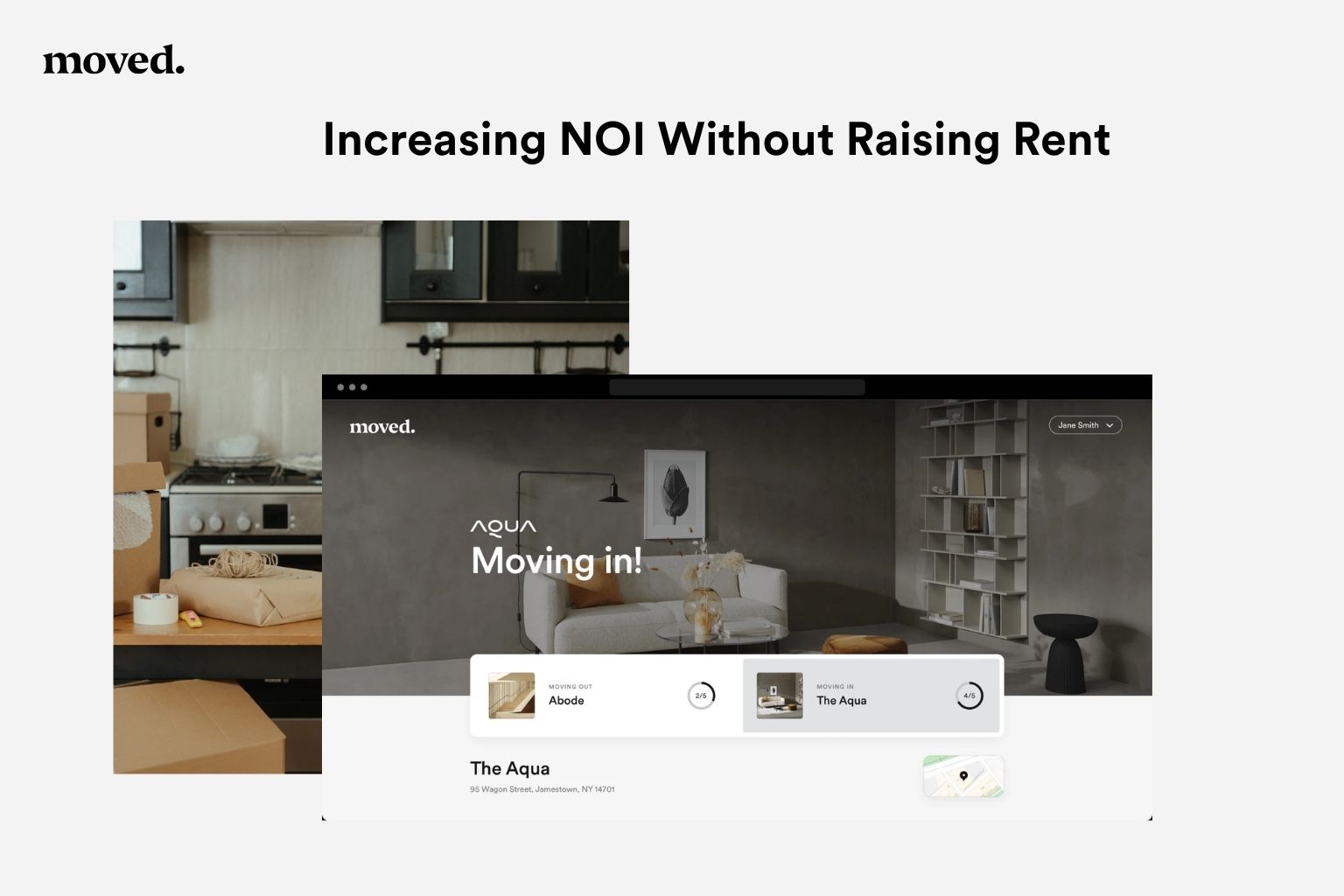
This blog explores how to increase NOI in multifamily without raising rent by transforming the move lifecycle into a structured revenue and risk-managed system.
The hidden problem: NOI leakage across the move lifecycle
Every move event introduces complexity. New residents must complete onboarding tasks. Departing residents go through offboarding. Teams coordinate vendors, verify compliance, and manage timelines.
But beneath this operational layer lies a deeper issue.
Revenue is being lost.
Where NOI leakage actually occurs
Across most portfolios, the move-in and move-out lifecycle suffers from three systemic gaps:
1. Uncaptured ancillary revenue opportunities
Residents are already purchasing services during moves:
- Movers and packing services
- Storage solutions
- Renters insurance
- Utilities and internet setup
However, these transactions typically happen outside the property’s ecosystem. That means zero participation in revenue, zero visibility, and zero control.
2. Fragmented onboarding and offboarding workflows
Onboarding and offboarding are often managed through emails, PDFs, or disconnected systems. This leads to missed tasks, delayed compliance, poor resident experience, and increased operational workload.
3. Compliance and insurance risk exposure
Insurance verification is inconsistent. Vendor coordination lacks standardization. Documentation is scattered.
This creates financial risk, not just operational friction.
As outlined in the Moved Content Writing SOP, these issues directly impact revenue, compliance, and portfolio performance.
Why rent increases are no longer the primary lever
Increasing rent is the most visible path to NOI growth, but it is also the most constrained.
Key limitations of rent-driven NOI growth
- Rent caps in multiple markets
- Increased resident churn due to affordability pressure
- Competitive pricing dynamics across comparable assets
- Negative impact on resident satisfaction and retention
In contrast, ancillary revenue and operational efficiency offer scalable, repeatable, and less disruptive growth opportunities.
The shift is clear. NOI growth must now come from monetizing moments of intent, not just adjusting base rent.
The opportunity: Monetizing the move-in and move-out lifecycle
The move lifecycle represents a unique convergence of urgency, intent, and decision-making.
During move-in onboarding, residents are actively setting up their new home. During move-out offboarding, they are coordinating logistics and services again.
These are high-conversion windows.
What makes the move lifecycle valuable
- Residents are already spending money
- Decisions are time-sensitive
- Services are non-optional
- Engagement is naturally high
According to the Moved platform data, properties leveraging structured move workflows see up to a 200 percent increase in ancillary conversion and over 96 percent resident engagement.
This is not an incremental improvement. It is a fundamental shift in how revenue is captured.
Reframing operations: From workflows to revenue infrastructure
Traditional systems treat onboarding and offboarding as task management processes.
Moved introduces a different approach.
Instead of managing tasks, it embeds revenue-generating services directly into the move lifecycle.
What this looks like in practice
During resident onboarding:
- Movers, packing, and storage options are integrated
- Renters insurance is verified and offered
- Utilities and internet setup are embedded
- Concierge services guide completion
During resident offboarding:
- Move-out services are reintroduced
- Storage and logistics solutions are surfaced
- Transfer opportunities within the portfolio are captured
This transforms the move-in and move-out journey into a structured revenue engine rather than a checklist.
Moved operates as a move infrastructure platform that embeds revenue-generating services directly into the resident onboarding workflow while mitigating compliance risk.
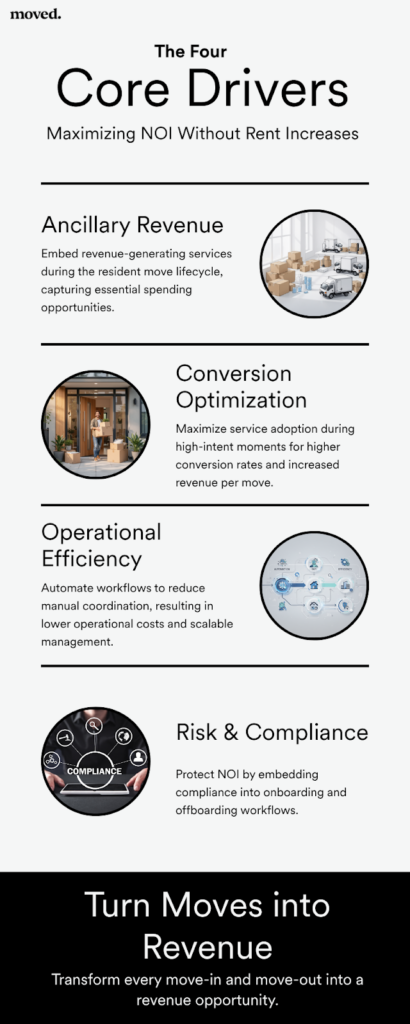
The four core drivers of NOI without rent increases
To systematically increase NOI without raising rent, operators must focus on four integrated drivers.
1. Ancillary revenue expansion
Ancillary revenue is the most immediate and scalable lever.
By embedding services into the onboarding and offboarding process, properties can participate in transactions that residents are already making.
Key categories include:
- Moving services and logistics
- Storage and packing
- Renters insurance
- Utilities and connectivity
- Marketplace partnerships
The difference is not in offering these services, but in embedding them directly into the resident journey.
2. Conversion optimization during high-intent moments
Timing matters more than availability.
A generic vendor list produces low engagement. A guided onboarding experience produces high conversion.
When services are presented at the right moment within the move lifecycle:
- Decision friction is reduced
- Completion rates increase
- Revenue capture improves
3. Operational cost reduction through automation
Manual coordination across move-ins and move-outs is expensive.
Site teams spend significant time on email follow-ups, document collection, scheduling logistics, and compliance checks.
Automation reduces this burden.
Teams save over three hours per move when workflows are centralized and automated.
4. Risk mitigation as a financial lever
Risk is often overlooked as a contributor to NOI.
Incomplete insurance verification, missing documentation, and inconsistent processes can lead to liability exposure, financial penalties, and operational disruptions.
By embedding compliance into onboarding and offboarding workflows, properties reduce risk while improving process consistency.
Connecting the full lifecycle: Why partial solutions fail
Many operators attempt to optimize only one part of the move journey.
Fragmented approaches limit impact.
A lifecycle-driven model
To fully unlock NOI growth, the entire lifecycle must be connected:
- Pre-move engagement
- Move-in onboarding
- Resident lifecycle
- Move-out offboarding
- Portfolio transfers
Each stage builds on the previous one and creates a continuous revenue and data loop.
How Moved operationalizes this strategy
Moved automates the entire move lifecycle, from onboarding to offboarding, while embedding revenue-generating services and compliance workflows.
Key capabilities include:
- Centralized onboarding and offboarding dashboards
- Embedded ancillary service marketplace
- Automated reminders and task completion tracking
- Insurance verification and compliance management
- Portfolio-wide visibility across move events
To understand how residents experience this journey, explore the Moved Resident Experience Platform.
From strategy to execution: Building a repeatable NOI growth engine
In Part 1, we established that increasing NOI without raising rent requires a structural shift. The move-in and move-out lifecycle, combined with onboarding and offboarding, is not just an operational workflow. It is a monetization layer.
Now the focus shifts to execution.
How do you operationalize this across a portfolio in a way that is scalable, measurable, and aligned with financial outcomes?
This section breaks down the implementation model, revenue mechanics, and a realistic case projection.
Step 1: Audit your current move lifecycle
Before introducing new systems, operators need clarity on where revenue leakage and inefficiencies exist today.
What to evaluate
Start by mapping your current move-in and move-out workflows:
- How are onboarding tasks completed today
- How are offboarding processes managed
- Where are residents sourcing services like movers, storage, and insurance
- How is compliance verified
- How much time site teams spend per move
Most portfolios discover the same pattern. High manual effort, low visibility, and zero participation in resident spend.
This audit becomes the baseline for measuring NOI improvement.
For a deeper understanding of how lifecycle gaps impact revenue, refer to the Move-In and Move-Out Process Optimization for Property Management Revenue.
Step 2: Centralize onboarding and offboarding into a single system
Fragmentation is the root cause of both inefficiency and missed revenue.
The next step is to unify onboarding and offboarding into a centralized system that:
- Guides residents through move-in and move-out tasks
- Automates reminders and completion tracking
- Embeds service offerings directly into the workflow
- Standardizes compliance and documentation
This is where the difference between workflow tools and infrastructure platforms becomes clear.
Traditional tools digitize checklists. Infrastructure platforms create controlled, monetized workflows.
To understand how structured onboarding drives engagement and completion, explore the Ultimate Guide to Resident Onboarding Automation.
Step 3: Embed revenue-generating services into the lifecycle
This is the most critical step.
Revenue is not generated by offering services. It is generated by embedding them at the right moment in the move journey.
Core service categories to integrate
During move-in onboarding:
- Moving services and packing
- Storage solutions
- Renters insurance with verification
- Utilities and internet setup
- Furniture rental and home setup services
During move-out offboarding:
- Move-out logistics and movers
- Storage and transition services
- Cleaning and junk removal
- Transfer options within the portfolio
The key is not the volume of vendors. It is relevance, timing, and integration.
Residents should not need to leave the onboarding or offboarding flow to complete these actions.
Step 4: Align commercial structure with NOI outcomes
One of the most important strategic decisions is how revenue is captured.
Modern platforms operate on flexible, revenue-aligned models rather than fixed-cost structures.
This means:
- Revenue is generated when residents transact
- Property participation is tied to actual usage
- Economics scale with portfolio activity
This aligns incentives across operators and platform providers.
As outlined in the SOP, commercial models should be positioned as partnership-based and aligned with property financial goals rather than framed as cost savings alone .
Step 5: Automate compliance and risk management
Revenue growth without risk control is incomplete.
Insurance verification, vendor compliance, and documentation must be embedded into the onboarding and offboarding workflow.
What this includes
- Renters insurance verification at move-in
- Vendor COI submission and approval
- Utility activation proof
- Centralized document storage
This reduces liability exposure and ensures operational consistency across the portfolio.
It also removes the burden from site teams, allowing them to focus on resident experience rather than administrative follow-ups.
Step 6: Leverage portfolio-wide data for optimization
Once the system is live, the next phase is optimization.
Data collected across move-ins and move-outs provides insights into:
- Service conversion rates
- Resident preferences
- Revenue per move
- Task completion timelines
- Operational bottlenecks
After an initial period, typically around 60 to 90 days, operators can refine:
- Service mix and partnerships
- Pricing strategies
- Workflow sequencing
- Engagement triggers
This creates a compounding effect on NOI.
Case projection: What NOI impact actually looks like
For most multifamily operators, the challenge is not whether NOI can be increased without raising rent. The challenge is visibility.
Revenue tied to the move-in and move-out lifecycle is often invisible because it happens outside the property’s control. Residents independently source movers, insurance, storage, and utilities, while operators have no participation in those transactions.
When onboarding and offboarding workflows are centralized and structured, this visibility changes.
What changes after implementation
Instead of estimating impact through assumptions, operators begin to see:
- Actual ancillary revenue generated per move
- Service-level conversion rates across onboarding and offboarding
- Resident engagement across the move lifecycle
- Time saved across site teams
- Compliance completion rates
This shift from assumption to measurable performance is what enables sustainable NOI growth.
Why this matters at the portfolio level
Without lifecycle infrastructure:
- Revenue opportunities remain external
- Performance cannot be tracked
- Optimization is not possible
With a structured move lifecycle:
- Revenue becomes trackable and repeatable
- Operational efficiency is measurable
- Portfolio-wide optimization becomes achievable
Over time, this creates a compounding effect where both revenue capture and operational performance improve continuously.
The key takeaway is simple.
NOI growth without raising rent is not driven by projections. It is driven by control, visibility, and consistent execution across every move-in, move-out, onboarding, and offboarding event.
Beyond revenue: Strategic advantages at the portfolio level
While revenue is the primary driver, the long-term advantages extend further.
1. Improved resident experience
A structured onboarding and offboarding process reduces friction and stress during moves.
Residents receive:
- Clear guidance
- Integrated services
- Faster completion of tasks
This leads to higher satisfaction and better retention outcomes.
To explore how this experience is delivered, visit the Moved Resident Experience Platform.
2. Increased team efficiency and retention
Burnout in onsite teams is often driven by repetitive, manual coordination tasks.
Automation reduces this burden and improves:
- Productivity
- Job satisfaction
- Operational consistency
3. Portfolio-wide standardization
Instead of property-level variations, operators gain:
- Consistent workflows
- Centralized visibility
- Scalable processes
This is critical for large portfolios managing thousands of units.
Learn how this is implemented across portfolios in the Moved Multifamily Solutions Platform.
4. Capture of internal transfer demand
Move-outs are often treated as churn events.
However, with the right system, they become opportunities to retain residents within the portfolio.
By capturing transfer intent during offboarding:
- Leasing costs are reduced
- Occupancy stability improves
- Revenue continuity is maintained
Common mistakes to avoid
Even with the right strategy, execution gaps can limit results.
1. Treating this as a vendor marketplace only
Without workflow integration, services remain underutilized.
2. Focusing only on move-in
Ignoring move-out means losing half the revenue opportunity.
3. Not standardizing across the portfolio
Inconsistent adoption reduces scalability and data quality.
4. Overlooking compliance integration
Revenue without risk control creates exposure.
Implementation roadmap summary
To operationalize NOI growth without raising rent:
- Audit current move-in and move-out workflows
- Centralize onboarding and offboarding
- Embed revenue-generating services into the lifecycle
- Align commercial structure with revenue outcomes
- Automate compliance and documentation
- Optimize using portfolio-wide data
This transforms the move lifecycle into a repeatable, scalable revenue engine.
Conclusion: NOI growth is now an operational strategy
The future of multifamily NOI growth will not be driven by rent increases alone.
It will be driven by how effectively operators:
- Capture resident spend during high-intent moments
- Automate and standardize operations
- Reduce risk and inefficiencies
- Connect the full move lifecycle from onboarding to offboarding
Moved enables this transformation by turning move-ins, move-outs, and transfers into a structured, revenue-generating system rather than a fragmented operational process.
If you are evaluating how to unlock NOI without pricing pressure, the next step is to assess your current lifecycle gaps and identify where revenue is being lost.
To get started, connect with the team here:
Contact Moved
FAQs
How can multifamily properties increase NOI without raising rent
By capturing ancillary revenue during move-in and move-out, automating onboarding and offboarding, and reducing operational costs through centralized workflows.
What is ancillary revenue in multifamily
Ancillary revenue includes income from services such as movers, storage, renters’ insurance, utilities, and other resident services integrated into the lifecycle.
Why is the move lifecycle important for NOI
It is a high-intent phase where residents are actively making purchasing decisions, making it the most effective point to capture additional revenue.
How does onboarding and offboarding impact operations
Structured onboarding and offboarding reduce manual workload, improve compliance, and increase task completion rates, leading to better efficiency and lower costs.