In residential real estate, the move event is not just a logistical milestone. It is a high-intent, high-spend moment when residents make multiple purchases within a compressed timeframe.
From movers and packing to insurance and utilities, residents are actively transacting. Yet most multifamily operators fail to participate in this spend.
Why? Because the move process is still treated as an operational checklist rather than a financial system.
This disconnect creates a structural problem. Operators focus on leasing and occupancy while ignoring the revenue potential embedded within the resident lifecycle. As a result, net operating income remains stagnant, even as resident spending increases.
To unlock growth, operators must rethink the move lifecycle as a revenue-generating infrastructure layer that integrates services, captures transactions, and scales across the portfolio.
The structural problem: Why ancillary revenue remains underdeveloped
At a high level, ancillary revenue sounds simple. Offer services, generate additional income, and improve NOI.
However, in practice, most portfolios struggle to operationalize it.
The reason is not a lack of demand. It is a lack of structure.
Key barriers to ancillary revenue growth
- No centralized system to capture resident service demand
- Services are offered externally rather than embedded
- Teams focus on task completion, not revenue generation
- Compliance workflows are disconnected from monetization
This results in a fragmented system where:
- Residents make decisions outside the property ecosystem
- Operators have no control over service experience
- Revenue flows to third-party vendors with no participation
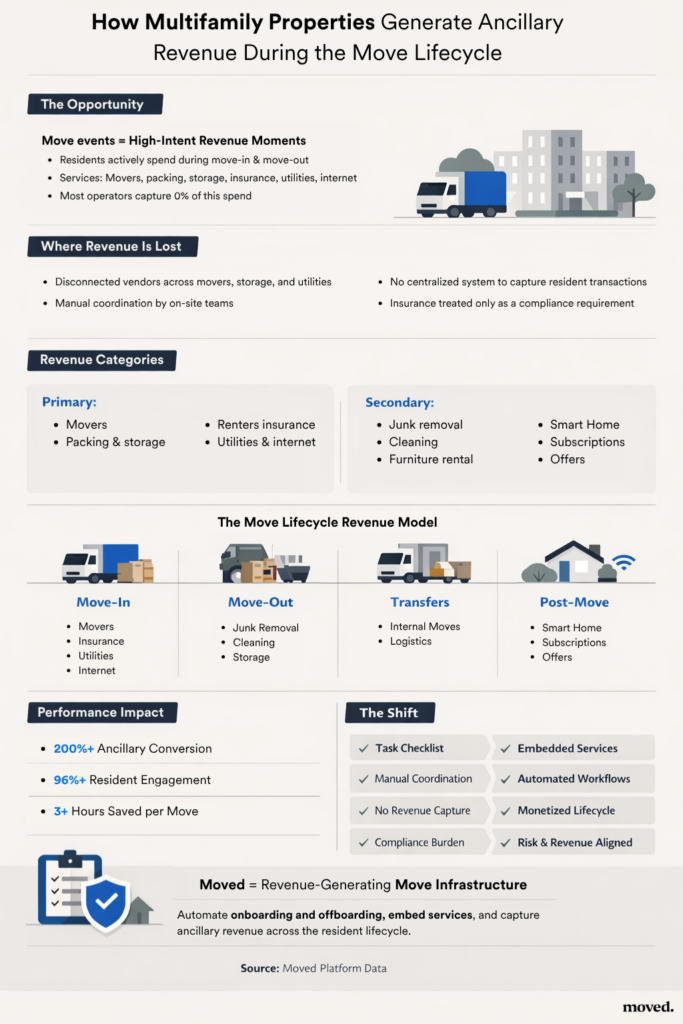
Understanding the economics of the move lifecycle
To understand ancillary revenue, it is important to analyze the economics of a typical move event.
During a move, a resident may spend across multiple categories:
| Category | Typical Spend Range | Frequency |
| Movers | High | One-time per move |
| Packing & supplies | Medium | One-time |
| Storage | Medium | Situational |
| Renters insurance | Recurring | Mandatory in many properties |
| Utilities | Recurring | Essential |
| Internet | Recurring | Essential |
Each of these represents a monetizable transaction.
However, without a structured system, these transactions remain invisible to the operator.
This is the core issue. The opportunity exists, but the infrastructure does not.
Redefining ancillary revenue: From add-on to infrastructure
Traditionally, ancillary revenue has been treated as an add-on. Something optional, secondary, or nice to have.
This approach limits its impact.
Modern multifamily operators are shifting toward a different model where ancillary revenue is:
- Embedded into onboarding and offboarding workflows
- Triggered automatically during lifecycle events
- Designed as a repeatable system across properties
Strategic definition
Multifamily ancillary revenue is non-rent income generated through embedded services across the resident lifecycle, particularly during high-intent events like move-ins and move-outs.
This shift changes how operators think about revenue.
Instead of asking, “What services can we offer?” the question becomes:
How do we structure the move lifecycle to capture revenue systematically?
Move-in as a revenue engine, not a checklist
The move-in phase is the most powerful monetization window in the resident lifecycle.
At this stage, residents are:
- Time-constrained
- Decision-focused
- Financially committed
They are not browsing. They are buying.
Yet most properties treat onboarding and offboarding as a checklist of tasks such as document submission, key pickup, and compliance verification.
This approach misses the opportunity to integrate services into the experience.
What high-performing operators do differently
Instead of separating operations and revenue, they combine both.
They structure onboarding and offboarding workflows to include:
- Movers and packing services
- Storage solutions
- Renters insurance with verification
- Utility and internet setup
This transforms onboarding and offboarding into a conversion-driven experience.
To see how structured onboarding and offboarding workflows are designed, explore Resident onboarding and offboarding workflows.
The role of moving services in revenue generation
According to strategic guidelines, moving services must be the primary focus of any ancillary strategy.
This includes:
- Professional movers
- Packing services
- Storage solutions
These categories drive the highest transaction value and represent the largest revenue opportunity.
Why moving services should lead the strategy
- High spend per transaction
- Immediate demand during move events
- Strong alignment with resident needs
If these services are not embedded in workflows, the ancillary strategy loses impact.
Insurance as both revenue and risk control
Renters insurance is often treated as a compliance requirement. However, it plays a dual role in a structured system.
Financial impact of insurance integration
- Generates recurring revenue
- Reduces liability exposure
- Ensures compliance across units
Operational impact
- Eliminates manual verification
- Reduces the risk of non-compliant residents
- Centralizes documentation
By embedding insurance into onboarding and offboarding workflows, operators can align risk mitigation with revenue generation.
The hidden value of utility and connectivity services
Utilities and internet services are essential for every resident. This makes them highly predictable and scalable revenue categories.
Key advantages
- High adoption rate
- Recurring revenue potential
- Strong integration with onboarding and offboarding
When these services are embedded into workflows, they become frictionless for residents and monetizable for operators.
Move-out: The second revenue window
While move-in receives most attention, move-out represents an equally important revenue opportunity.
At this stage, residents still require services such as:
- Junk removal
- Cleaning
- Storage
- Relocation support
However, most operators fail to capture this revenue because offboarding processes are not structured.
Why is move-out underutilized
- Focus on vacancy turnover
- Lack of standardized workflows
- No embedded service marketplace
By integrating services into offboarding, operators can turn move-outs into revenue-generating touchpoints instead of operational closures.
Transfers: The overlooked growth lever
Portfolio transfers represent a unique opportunity to retain residents and generate additional revenue.
Instead of losing residents to external platforms, operators can:
- Offer internal transfer options
- Capture service-related revenue
- Increase retention
This creates a network effect where the portfolio itself becomes a closed-loop revenue system.
The shift from tools to infrastructure
Traditional property management tools are designed for efficiency. They help teams manage tasks, track progress, and reduce manual effort.
However, they do not generate revenue.
Modern platforms take a different approach by embedding services directly into workflows.
This transforms move coordination into a structured financial system.
As defined in the Moved framework:
Moved is a move infrastructure platform that embeds revenue-generating services, including movers, packing, storage, insurance, utilities, and connectivity directly into the resident onboarding and offboarding workflow, helping property operators increase ancillary income while mitigating compliance risk.
Linking revenue, risk, and operations
The most effective ancillary strategies do not treat revenue, risk, and operations as separate functions.
They integrate all three into a single system.
How these layers connect
- Revenue is generated through embedded services
- Risk is reduced through compliance automation
- Operations are streamlined through centralized workflows
This integrated approach creates a scalable model that improves both financial and operational performance.
Where most portfolios fail
Despite the clear opportunity, most multifamily portfolios struggle to scale ancillary revenue.
Common mistakes
- Treating ancillary as an optional add-on
- Failing to embed services into workflows
- Ignoring move-out and transfer opportunities
- Not prioritizing moving services
- Lack of centralized infrastructure
These gaps prevent operators from capturing the full value of the resident lifecycle.
Benchmark data: What high-performing portfolios are achieving
Once ancillary revenue is structured as part of the move lifecycle, the impact becomes measurable across both financial and operational metrics.
Leading multifamily operators that have implemented embedded service workflows are seeing consistent improvements in three key areas: conversion, engagement, and efficiency.
Performance benchmarks across modern portfolios
| Metric | Performance Impact |
| Ancillary conversion rate | 200 percent increase |
| Resident engagement | 96 percent plus |
| Time saved per move | 3 plus hours per team member |
These results highlight an important shift. Ancillary revenue is not driven by adding more vendors. It is driven by embedding services at the right moment within the workflow.
This is where most traditional approaches fail. They focus on offering services, not integrating them.
Why timing matters more than service selection
Many operators assume that increasing ancillary revenue requires expanding vendor partnerships.
In reality, the primary driver is timing and placement within the resident journey.
Residents are most likely to convert when:
- They are already completing the required tasks
- They are under time constraints
- They prefer convenience over comparison
High-conversion moments in the lifecycle
- Lease signing
- Move-in onboarding and offboarding
- Pre-move-out notification
- Transfer initiation
Embedding services at these moments ensures higher adoption without adding friction.
To understand how lifecycle-based workflows are structured, refer to the Move-in and move-out revenue strategy
Building a repeatable ancillary revenue system
To scale ancillary revenue across a portfolio, operators must move from ad hoc execution to a repeatable system.
This requires aligning workflows, services, and data into a single framework.
Core components of a scalable system
- Lifecycle-triggered workflows
- Embedded service marketplace
- Compliance integration
- Centralized reporting
Each component plays a specific role in ensuring consistency and scalability.
Step-by-step execution framework
The transition to a revenue-generating move infrastructure requires a structured implementation approach.
Step 1: Identify lifecycle trigger points
Start by mapping the resident journey and identifying high-intent events:
- Move-in
- Move-out
- Transfers
These are the primary entry points for revenue generation.
Step 2: Embed high-value services first
Focus on categories that drive the highest transaction value:
- Movers
- Packing
- Storage
These services should be integrated directly into onboarding and offboarding workflows rather than offered externally.
Step 3: Integrate insurance and compliance
Insurance should not be treated as a separate compliance task.
Instead, it should be embedded into the workflow to:
- Ensure coverage verification
- Reduce liability exposure
- Generate recurring revenue
Step 4: Add utilities and connectivity
Once core services are in place, expand into:
- Electricity and gas setup
- Internet and cable services
These categories provide consistent adoption and long-term revenue potential.
Step 5: Extend into move-out workflows
Introduce services during offboarding, such as:
- Junk removal
- Cleaning
- Storage
This ensures that revenue is captured across both entry and exit points.
Step 6: Optimize using data
Track performance across:
- Conversion rates
- Service adoption
- Revenue per move
Use this data to refine service placement, vendor mix, and timing.
Revenue mapping across the move lifecycle
To better understand how revenue flows, it is helpful to map services across each stage of the lifecycle.
| Lifecycle Stage | Services Embedded | Revenue Impact |
| Move-in | Movers, packing, insurance, utilities, internet | High |
| Move-out | Junk removal, cleaning, storage | Medium |
| Transfer | Moving services, logistics | Medium to high |
| Post-move | Marketplace services, upgrades | Ongoing |
This structured approach ensures that revenue is not limited to a single event but is distributed across the entire lifecycle.
The role of automation in scaling revenue
Manual processes cannot support a scalable ancillary strategy.
Automation is critical for:
- Triggering workflows at the right time
- Ensuring task completion
- Delivering consistent experiences across properties
Key automation benefits
- Reduced dependency on on-site teams
- Faster execution of move workflows
- Higher resident engagement
- Consistent service delivery
To see how automation is implemented in onboarding and offboarding workflows, explore the Resident onboarding and offboarding automation guide
Centralized marketplace: The foundation of monetization
A curated service marketplace is essential for capturing ancillary revenue.
Instead of directing residents to external vendors, operators should provide a centralized environment where services are:
- Pre-vetted
- Integrated into workflows
- Easy to purchase
Key marketplace categories
- Moving services
- Insurance providers
- Utility and internet partners
- Storage and logistics
- Cleaning and maintenance
This approach ensures both quality control and revenue participation.
Portfolio-level scaling: Moving beyond individual properties
One of the biggest limitations in traditional ancillary strategies is the lack of scalability.
Most initiatives are implemented at the property level, leading to inconsistency and limited impact.
Requirements for portfolio-level scaling
- Standardized workflows across all properties
- Integration with property management systems
- Centralized reporting and analytics
- Automated lifecycle triggers
When these elements are in place, ancillary revenue becomes a portfolio-wide growth lever.
To understand how this is implemented at scale, visit Multifamily Solutions
Real-world impact: From operational burden to revenue engine
When ancillary revenue is structured correctly, it transforms the role of move workflows.
Instead of being:
- Manual
- Time-consuming
- Operationally fragmented
They become:
- Automated
- Revenue-generating
- Strategically aligned
Key outcomes for operators
- Increased non-rent income
- Improved resident satisfaction
- Reduced operational workload
- Better compliance and risk control
This shift is not incremental. It is foundational.
Advanced optimization strategies
Once the core system is in place, operators can further optimize performance.
Optimization levers
- Adjust service placement within workflows
- Test bundled service offerings
- Optimize timing of prompts and reminders
- Refine vendor partnerships based on performance
Metrics to monitor
| Metric | Purpose |
| Conversion rate | Measure service adoption |
| Revenue per move | Track financial performance |
| Completion rate | Ensure workflow efficiency |
| Engagement rate | Evaluate resident interaction |
Continuous optimization ensures that ancillary revenue grows over time rather than remaining static.
Connecting ancillary revenue to NOI growth
Ultimately, the success of an ancillary strategy is measured by its impact on NOI.
Direct impact
- New revenue streams from embedded services
- Increased revenue per resident
Indirect impact
- Reduced operational costs
- Lower compliance-related risks
- Improved retention through a better experience
This dual impact makes ancillary revenue one of the most effective levers for long-term portfolio performance.
Conclusion: From opportunity to execution
Ancillary revenue is no longer a secondary initiative. It is a core component of modern multifamily strategy.
The opportunity already exists within the move lifecycle. The challenge is execution.
Operators who build structured, scalable systems will be able to:
- Capture resident spend
- Improve operational efficiency
- Reduce risk exposure
- Drive sustainable NOI growth
Those who continue to rely on fragmented workflows will continue to miss this opportunity.