Move-in day should feel organized, predictable, and professional. But for many property managers, it is one of the most stressful points in the leasing cycle.
- Missing documents.
- Unverified renters’ insurance.
- Utility setup confusion.
- Deposits not fully processed.
- Residents are calling with last-minute questions.
When these issues stack up, staff time gets drained, and the resident experience suffers before it even begins.
Today’s renters expect the same smooth digital experience they get from banks, retailers, and travel platforms. If the move-in process feels disorganized, it creates frustration — and that first impression often carries into the entire lease term.
This is where multifamily move-in automation software changes the equation.
Instead of managing spreadsheets, email chains, paper forms, and manual reminders, property managers can use software to automate apartment move-ins in a structured, trackable way. The result is a controlled, step-by-step process from lease signing to key handoff.
At Moved, we work closely with property teams who want to reduce administrative strain while improving the resident journey. Our approach focuses on removing manual friction and creating clarity during one of the most critical stages of the lease lifecycle.
In this guide, we’ll break down:
- What multifamily move-in automation actually means
- How it works in real-world operations
- Why traditional processes fall short
- The measurable impact it has on efficiency and resident satisfaction
- When it makes sense to implement it
If you manage apartment communities, this is no longer a “nice-to-have.” It is quickly becoming a standard operational advantage.
What is Multifamily Move-In Automation Software?
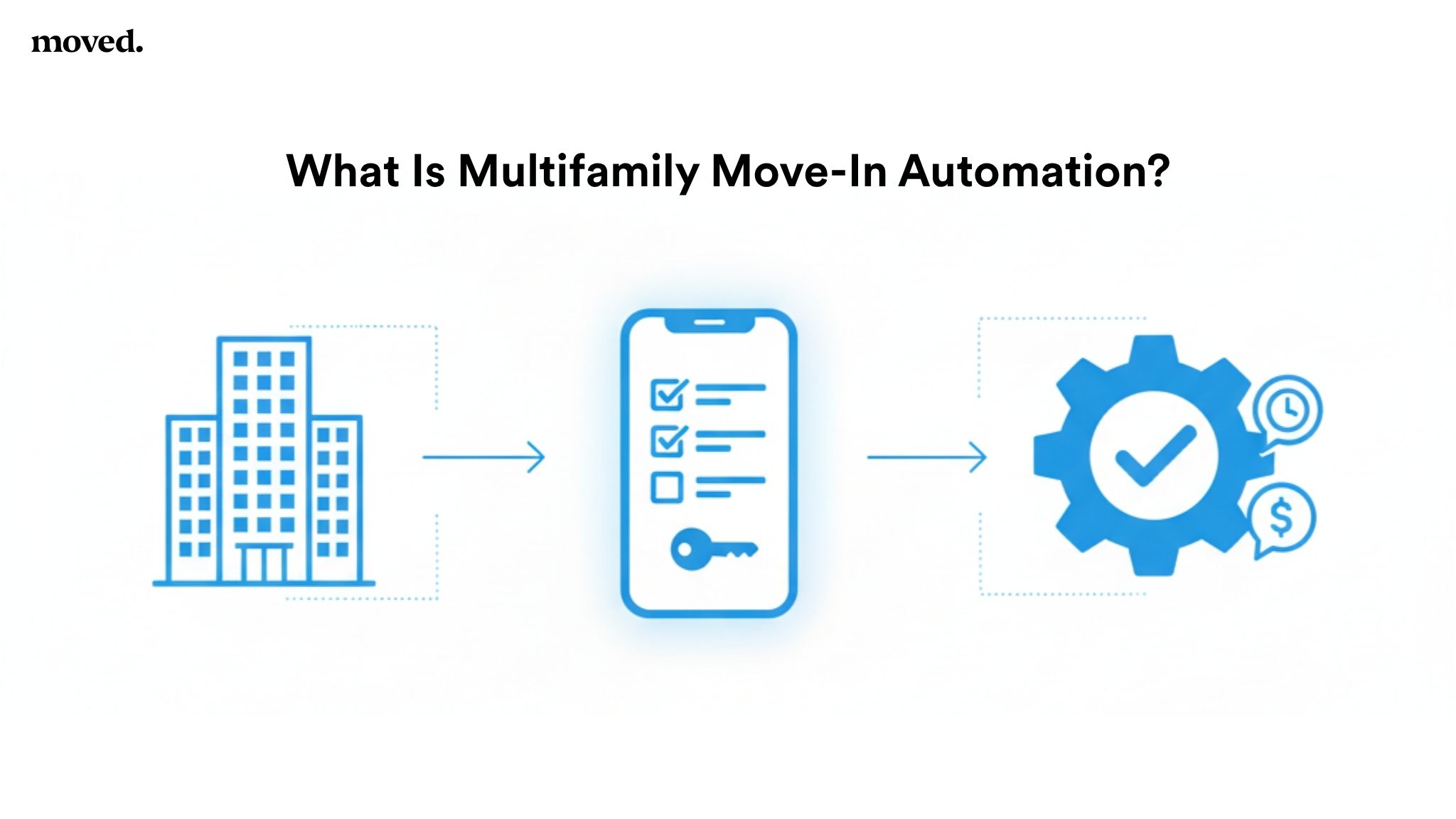
Multifamily move-in automation software is a digital system that manages everything that happens after a lease is signed and before a resident receives their keys.
It replaces manual follow-ups, scattered emails, paper forms, and disconnected tools with one structured workflow.
Instead of your team tracking move-ins through spreadsheets and reminders, the platform automatically guides residents through each required step — while giving property managers full visibility into progress.
In simple terms, it is software to automate apartment move-ins so nothing gets missed.
What Does Multifamily Move-In Automation Software Actually Handle?
Move-in automation focuses on the operational phase between lease approval and move-in day. That includes:
- Lease confirmation
- Welcome communication
- Deposit verification
- Rent payment setup
- Renters insurance verification
- Utility coordination
- Document uploads
- Move-in checklist completion
- Final move-in approval
This stage is often overlooked in traditional leasing systems. Many platforms stop at application approval or lease signing. Multifamily move-in automation software picks up where those systems leave off.
How Software to Automate Apartment Move-ins Differs From Online Leasing
It is important to understand the difference.
Online leasing systems handle:
- Applications
- Screening
- Lease generation
- E-signatures
Software to automate apartment move-ins handles:
- Task tracking after the lease is signed
- Resident onboarding steps
- Insurance and payment verification
- Utility setup guidance
- Move-in readiness confirmation
Think of online leasing as the approval phase.
Move-in automation is the execution phase.
Without automation, this execution phase becomes manual and reactive.
With multifamily move-in automation software, the process becomes proactive and structured.
Why Multifamily Move-In Automation Software Is Becoming Standard
In U.S. rental markets, residents expect clarity and speed. They want to know:
- What do I need to complete?
- When is it due?
- How do I upload documents?
- What happens next?
When these answers are unclear, your office receives more calls and emails. That means staff time shifts away from leasing, renewals, and resident retention.
By using software to automate apartment move-ins, property managers can:
- Reduce repetitive communication
- Provide residents with a clear checklist
- Track progress in real time
- Prevent last-minute move-in issues
Instead of reacting to problems, your team can monitor readiness from a dashboard.
For communities managing multiple properties or high move-in volume, this structured approach creates consistency across locations. You can also explore how Moved supports streamlined resident onboarding.
What Problem Does Multifamily move-in Automation Software Solve?
The core issue is not paperwork.
It is visibility and coordination.
When move-in tasks are scattered across inboxes and manual tracking sheets:
- Steps get skipped
- Requirements get overlooked
- Staff members duplicate work
- Residents become frustrated
Multifamily move-in automation software centralizes the process. Every task is assigned, tracked, and confirmed in one place.
That clarity protects your team’s time and improves the resident experience.
Why Traditional Move-In Processes Fail Without Multifamily Move-In Automation Software
Many property managers believe their current move-in process is “working.” Leases get signed. Residents move-in. Units get occupied.
But when you look more closely, traditional systems often rely on manual coordination, which creates hidden strain on staff and unnecessary friction for residents.
Without multifamily move-in automation software, the process depends heavily on human follow-up, memory, and scattered tools.
Let’s break down where it typically fails.
1. Manual Tracking Creates Gaps
In many communities, move-ins are tracked using:
- Spreadsheets
- Email threads
- Shared folders
- Paper checklists
When tasks are tracked manually, it becomes easy to miss something.
- Was renters’ insurance submitted?
- Did the resident set up electricity?
- Was the deposit fully paid?
If one item is incomplete, staff must stop what they are doing and follow up. Over time, these interruptions compound and reduce productivity.
Software to automate apartment move-ins eliminates this guesswork by tracking completion automatically and showing move-in readiness in real time.
2. Too Many Resident Touchpoints
Without automation, residents often receive:
- Multiple emails from different staff members
- Separate instructions for utilities
- Follow-up reminders that repeat information
- Last-minute requests before move-in day
This creates confusion.
From the resident’s perspective, the process feels disorganized — even if your team is working hard behind the scenes.
A structured system sends step-by-step instructions in one place, reducing duplicate communication and improving clarity.
3. Limited Visibility for Property Managers
Traditional processes rarely provide a clear dashboard view of:
- Who has completed the required steps
- Who is missing documentation?
- Which move-ins are fully ready
- Where delays are occurring
Instead, managers must piece together information manually.
Multifamily move-in automation software provides centralized visibility so you can monitor move-in readiness across your portfolio without chasing updates.
4. Move-In Day Surprises
One of the biggest risks in manual systems is last-minute discovery.
A resident arrives and:
- Insurance is missing
- Utilities are not active
- Payment was incomplete
- The required documents were never uploaded
Now your staff is solving problems under time pressure.
Software to automate apartment move-ins prevents these situations by requiring completion before clearance is granted. Move-in approval only happens when all steps are verified.
5. Staff Burnout and Turnover Risk
Move-in coordination is repetitive work. When it relies on manual follow-ups, it increases:
- Administrative load
- Task switching
- Stress during peak leasing periods
Over time, this affects morale and retention.
Automation does not replace your team. It removes repetitive administrative work so staff can focus on leasing, renewals, and resident relationships.
The Core Issue: Lack of Standardization
The biggest weakness in traditional systems is inconsistency.
Different staff members may handle move-ins differently. Processes vary across properties. Documentation standards shift.
Multifamily move-in automation software standardizes the process across every unit and every location.
That consistency protects your brand and ensures every resident receives the same professional onboarding experience.
How Multifamily Move-In Automation Software Works Step by Step
Understanding how multifamily move-in automation software works is essential before deciding whether to implement it. The goal is simple: create a structured, trackable move-in process that runs without constant manual oversight.
Here is what the workflow typically looks like in real-world property operations.
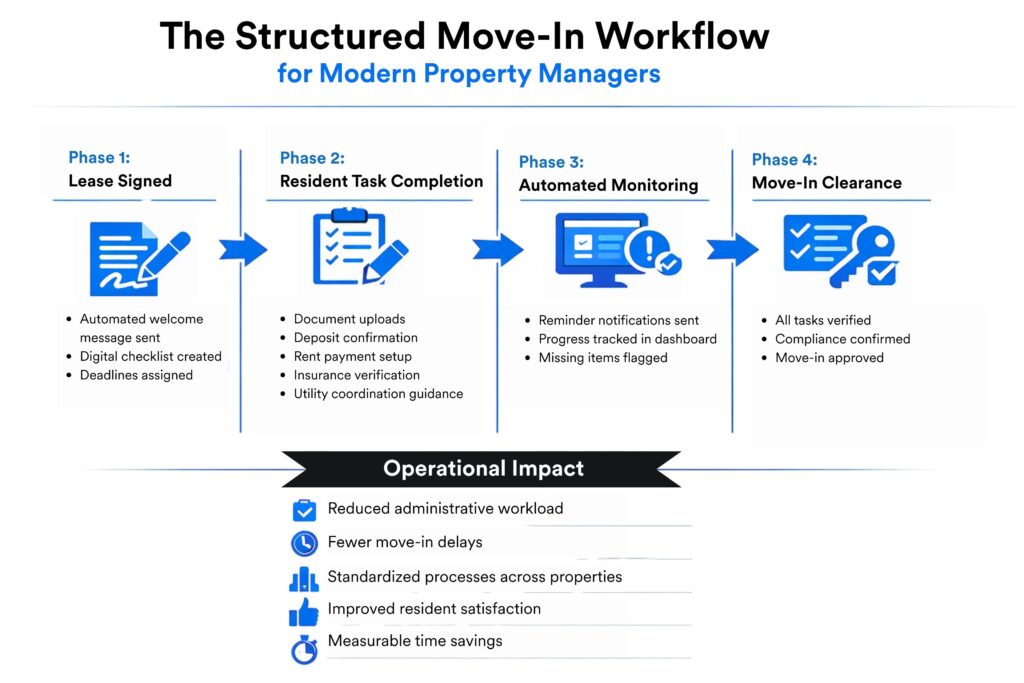
Step 1: Lease Signing Triggers the Automated Workflow
Once a lease is signed in your property management system, the multifamily move-in automation software activates the move-in sequence automatically.
Instead of your team sending manual welcome emails or task lists, the system:
- Sends a welcome message to the resident
- Creates a personalized move-in checklist
- Sets due dates for required items
- Outlines next steps clearly
This ensures the process begins immediately and consistently for every new resident.
Step 2: The Resident Receives a Clear Digital Checklist
The resident logs into a secure portal and sees exactly what needs to be completed.
Typical tasks include:
- Uploading required documents
- Confirming deposit payment
- Setting up recurring rent payments
- Submitting renters insurance
- Completing move-in acknowledgments
- Reviewing utility setup instructions
This structure removes confusion. Instead of calling the leasing office to ask what to do next, the resident follows a guided path.
Software to automate apartment move-ins ensures every requirement is visible and time-stamped.
Step 3: Automated Reminders Replace Manual Follow-Ups
If a task is incomplete, the system automatically sends reminders.
Property managers no longer need to:
- Draft reminder emails
- Track deadlines manually
- Call residents to chase documents
The multifamily move-in automation software handles follow-ups at scheduled intervals until completion.
This dramatically reduces repetitive communication and frees up staff time.
Step 4: Real-Time Tracking for Property Managers
On the management side, the dashboard provides instant visibility.
Property managers can see:
- Move-in readiness status
- Missing items
- Completed steps
- Upcoming move-ins
- Delayed tasks
Instead of searching through inboxes, managers have one clear view of operational readiness.
This visibility becomes especially valuable during peak leasing seasons or when managing multiple properties.
Step 5: Utility Coordination and Verification
Utility setup is one of the most common causes of move-in delays.
When software to automate apartment move-ins includes utility coordination guidance, residents receive:
- Clear instructions for required services
- Timelines for activation
- Confirmation checkpoints
This prevents move-in day issues caused by power or water outages.
Step 6: Final Move-In Clearance
The final stage is move-in approval.
Multifamily move-in automation software ensures clearance only happens once:
- All documents are uploaded
- Insurance is verified
- Payments are confirmed
- Required acknowledgments are complete
Only then is the move-in officially approved.
This reduces risk, protects compliance standards, and eliminates last-minute surprises.
Why This Structured Workflow Matters
Without structure, move-ins rely on staff memory and manual coordination.
With structure:
- Every resident follows the same path
- Every requirement is verified
- Every deadline is tracked
- Every move-in is documented
This is what transforms move-in coordination from a reactive task into a controlled operational process.
Key Features to Look for in Multifamily Move-In Automation Software
Not all systems are built the same. If you are evaluating multifamily move-in automation software, it is important to focus on practical features that directly improve efficiency and resident experience.
The goal is not more technology. The goal is fewer manual steps and better visibility.
Here are the essential features property managers should prioritize.
1. Centralized Dashboard for Move-In Visibility
The foundation of any strong system is a clear dashboard.
Property managers should be able to see:
- Upcoming move-ins
- Task completion status
- Missing documents
- Insurance verification status
- Payment confirmation
- Move-in clearance readiness
If your team still needs spreadsheets alongside the system, it is not solving the problem.
Effective software to automate apartment move-ins eliminates duplicate tracking.
2. Resident Self-Service Portal
Modern renters expect independence.
A strong multifamily move-in automation software platform allows residents to:
- Upload documents securely
- Track checklist completion
- View upcoming deadlines
- Receive updates in one place
This reduces inbound calls and creates transparency. When residents can see their progress, they feel more confident and prepared.
3. Automated Communication and Reminders
Manual follow-ups consume significant staff time.
Look for built-in:
- Scheduled reminders
- Welcome messages
- Deadline alerts
- Confirmation notifications
Automation should handle repetitive communication while keeping messaging professional and consistent.
4. Integration With Existing Property Systems
Move-in automation should complement your current leasing and management tools.
It should connect smoothly with:
- Your property management software
- Online leasing systems
- Payment platforms
If integration is limited, your team may still rely on manual data entry, which reduces efficiency.
5. Insurance Verification Tracking
Renters insurance compliance is one of the most common administrative pain points.
Strong multifamily move-in automation software tracks:
- Proof of coverage submission
- Policy expiration dates
- Minimum coverage requirements
This reduces compliance risk and ensures standards are met before move-in approval.
6. Utility Setup Coordination Support
Utility setup confusion is a frequent source of resident frustration.
Software to automate apartment move-ins should guide residents through:
- Required services
- Activation deadlines
- Confirmation checkpoints
Clear instructions prevent move-in day disruptions.
7. Customizable Workflows for Different Property Types
Not every community operates the same way.
Your system should allow adjustments for:
- Market-rate properties
- Student housing
- Affordable housing
- Mixed-use communities
Flexible workflows ensure that automation supports your operations rather than forcing rigid processes.
8. Reporting and Performance Insights
Operational leaders need measurable data.
Look for reporting that tracks:
- Average move-in completion time
- Task completion rates
- Common delay causes
- Staff time savings
This allows leadership teams to measure return on investment and identify areas for improvement.
Why Feature Evaluation Matters
Choosing the right multifamily move-in automation software is not just a technology decision. It is an operational decision that impacts:
- Staff workload
- Resident satisfaction
- Compliance consistency
- Portfolio scalability
When properly implemented, software to automate apartment move-ins becomes a core operational advantage — not just a convenience tool.
Benefits of Multifamily Move-In Automation Software for Property Managers
When evaluating multifamily move-in automation software, property managers often ask a practical question:
What does this actually improve in day-to-day operations?
The answer is measurable. Automation affects staffing efficiency, resident experience, compliance control, and portfolio scalability.
Here are the core benefits.
1. Reduced Administrative Workload
Move-ins involve repetitive steps:
- Sending welcome emails
- Requesting documents
- Following up on insurance
- Confirming deposits
- Reminding residents about utilities
Without structure, these tasks consume hours each week.
Software to automate apartment move-ins replaces manual reminders and checklist tracking with automated workflows. Your team no longer needs to chase incomplete items. The system handles follow-ups consistently.
The result:
- Fewer interruptions
- Less task switching
- More time for leasing and renewals
2. Faster Move-In Readiness
When every step is tracked digitally, delays become visible early.
Instead of discovering missing insurance the day before move-in, property managers can see incomplete items days in advance.
Multifamily move-in automation software ensures that move-in clearance only happens once all required steps are complete.
This reduces:
- Last-minute scrambling
- Resident frustration
- Day-of-move-in delays
Faster readiness also supports stronger occupancy flow and unit turnover efficiency.
3. Improved Resident Experience
The first interaction after lease signing sets expectations.
If the move-in process feels organized and clear, residents feel confident in your property management.
If it feels chaotic, frustration begins before move-in day.
Software to automate apartment move-ins creates a guided, transparent process. Residents can:
- See exactly what is required
- Track their own progress
- Complete tasks on their schedule
- Receive reminders automatically
This reduces confusion and builds trust early in the lease term.
4. Better Compliance Control
Insurance verification and document tracking are critical.
Manual processes increase the risk of:
- Missing documentation
- Expired policies
- Incomplete disclosures
Multifamily move-in automation software tracks verification before granting move-in approval. That consistency protects your property and reduces liability exposure.
5. Standardization Across Properties
For multi-location portfolios, inconsistency creates risk.
Different properties may:
- Follow different move-in steps
- Use different templates
- Apply different document standards
Automation creates a single standardized workflow across all locations.
This is especially valuable for regional managers overseeing multiple communities. Software to automate apartment move-ins ensures uniform execution regardless of staffing differences.
6. Scalable Growth Without Increasing Headcount
As portfolios grow, move-in volume increases.
Without automation, staff workload scales linearly with unit count.
With multifamily move-in automation software, the system absorbs repetitive tasks. That allows properties to grow without adding proportional administrative staff.
Operational efficiency becomes predictable and manageable.
7. Measurable Time Savings
Consider a simple scenario:
If your team spends two hours coordinating each move-in and you manage 30 move-ins per month, that equals 60 hours of administrative time monthly.
Even reducing that by 40–50% creates significant labor savings over a year.
Automation does not eliminate oversight. It reduces unnecessary repetition.
The Bigger Impact: Operational Control
At its core, multifamily move-in automation software provides control.
- Control over process timing
- Control over documentation
- Control over compliance
- Control over resident communication
Instead of reacting to problems, property managers operate from a position of visibility.
That shift from reactive to proactive management is where the real value lies.
How Software to Automate Apartment move-ins Improves the Resident Experience
Property managers often focus on operational efficiency, but resident experience is equally important.
The move-in period is emotional and stressful for renters. They are coordinating movers, changing addresses, transferring utilities, and managing expenses. If your onboarding process feels unclear, that stress increases.
Software to automate apartment move-ins reduces uncertainty and builds confidence from day one.
1. Clear Expectations From the Start
After lease signing, residents typically ask:
- What do I need to complete?
- When is everything due?
- What happens next?
Multifamily move-in automation software answers these questions immediately through a structured digital checklist.
Instead of relying on memory or multiple emails, residents see one clear dashboard outlining all required steps.
Clarity reduces anxiety.
2. Fewer Calls and Emails
When information is scattered, residents call the leasing office for confirmation.
“Did you receive my insurance?”
“Is my payment processed?”
“Am I approved for move-in?”
Automation eliminates guesswork.
The system confirms submissions, tracks status, and provides automatic notifications. Residents stay informed without needing direct follow-up.
This improves satisfaction while reducing staff workload at the same time.
3. Transparency Builds Trust
Trust is built through consistency.
When residents can log in and see:
- Completed tasks
- Pending requirements
- Deadlines
- Move-in clearance status
They feel confident that the process is under control.
Multifamily move-in automation software removes the uncertainty that often leads to frustration.
4. Fewer Move-In Day Surprises
Nothing damages first impressions faster than problems on move-in day.
If utilities are inactive or documentation is incomplete, residents immediately question the management organization.
Software to automate apartment move-ins verifies that all requirements are complete before final approval.
That means:
- Utilities are activated
- Insurance is verified
- Payments are processed
- Documents are submitted
Move-in day becomes predictable rather than reactive.
5. A Modern Digital Experience
Today’s renters are accustomed to digital onboarding in other industries:
- Online banking
- Travel bookings
- Retail purchases
They expect similar convenience in housing.
Multifamily move-in automation software aligns the rental experience with modern expectations. This is no longer considered an extra benefit — it is becoming a baseline expectation in competitive U.S. rental markets.
6. Stronger First Impression = Better Retention Potential
Resident satisfaction begins before occupancy.
A smooth move-in experience signals professionalism, organization, and responsiveness.
That first impression influences:
- Online reviews
- Renewal likelihood
- Referral behavior
- Overall satisfaction ratings
Software to automate apartment move-ins supports a positive start to the lease, which can impact long-term retention.
Why Resident Experience Matters Operationally
Improving the move-in process is not only about convenience.
It directly affects:
- Reputation management
- Review scores
- Retention strategy
- Brand perception
Multifamily move-in automation software strengthens operational structure while improving the human experience at the same time.
The ROI of Multifamily Move-In Automation Software
For property managers and ownership groups, every operational investment must deliver measurable value. The question is not whether multifamily move-in automation software improves processes — it is whether it improves financial performance.
When analyzed correctly, the return on investment becomes clear.
1. Direct Labor Savings
Move-in coordination is labor-intensive.
Without software to automate apartment move-ins, staff typically spend time on:
- Sending reminders
- Verifying insurance
- Confirming payments
- Tracking documents
- Answering repetitive resident questions
Let’s use a conservative example.
If your team spends 1.5–2 hours per move-in and your property handles 35 move-ins per month, that equals roughly 60–70 hours of administrative work monthly.
If automation reduces that time by even 40%, you recover approximately 25 hours per month. Over a year, that translates into 300 staff hours saved.
Those hours can be redirected toward leasing, renewals, and revenue-generating activities.
2. Reduced Move-In Delays
Delays can impact occupancy readiness and create scheduling challenges.
Common causes of delays include:
- Missing insurance documentation
- Unconfirmed utility activation
- Incomplete deposits
- Overlooked forms
Multifamily move-in automation software ensures that clearance occurs only after all required tasks are completed.
Fewer delays mean:
- Faster occupancy
- More predictable turnover schedules
- Reduced operational disruption
Even small improvements in readiness timing can influence annual occupancy performance.
3. Lower Risk Exposure
Compliance mistakes carry financial risk.
Missing renters’ insurance verification or incomplete documentation can expose properties to liability.
Software to automate apartment move-ins tracks these requirements consistently and reduces human oversight errors.
Risk reduction is harder to quantify, but its value is significant in protecting assets.
4. Improved Review Scores and Retention Impact
Resident experience affects online reputation.
A chaotic move-in experience often leads to negative early reviews. A smooth onboarding process improves perception from the beginning.
Higher satisfaction can contribute to:
- Stronger renewal likelihood
- Fewer early complaints
- Improved online ratings
Multifamily move-in automation software supports a controlled and professional experience that influences long-term resident relationships.
5. Scalable Efficiency for Growing Portfolios
For operators expanding from one property to several, manual systems become harder to manage.
Automation allows consistent processes across locations without increasing headcount at the same rate as portfolio growth.
This scalability creates long-term cost stability.
When Does Software to Automate Apartment Move-ins Make Financial Sense?
While automation benefits properties of many sizes, it becomes particularly valuable when:
- Properties exceed 100 units
- Move-in volume is high
- Staff turnover creates inconsistency
- Multiple properties operate under one management structure
- Leadership seeks standardized processes
If your team frequently scrambles before move-in day or relies on spreadsheets to track readiness, multifamily move-in automation software likely offers a measurable return.
Strategic Value Beyond Cost Savings
The strongest ROI often comes from operational control.
Automation provides:
- Predictable workflows
- Real-time visibility
- Standardized compliance
- Measurable performance data
Instead of operating reactively, property managers gain proactive oversight.
That operational clarity becomes a competitive advantage in modern multifamily management.
When Should You Implement Multifamily Move-In Automation Software?
Not every operational challenge requires new software. However, there are clear signs that multifamily move-in automation software is no longer optional but necessary.
If your team consistently experiences any of the following, automation should be evaluated.
1. Move-In Day Frequently Feels Rushed or Reactive
If staff regularly discover missing insurance, incomplete payments, or inactive utilities on move-in day, the process lacks structured oversight.
Software to automate apartment move-in shifts readiness verification earlier in the timeline, preventing last-minute surprises.
2. Your Team Relies on Spreadsheets to Track Move-Ins
Spreadsheets are useful tools, but they are not scalable systems.
If move-in tracking depends on manual updates, email reminders, or shared documents, the process is vulnerable to:
- Human error
- Missed deadlines
- Inconsistent communication
Multifamily move-in automation software centralizes tracking and eliminates duplicate data entry.
3. You Manage Multiple Properties
As portfolios grow, consistency becomes harder to maintain.
Different teams may follow slightly different move-in procedures. Documentation standards may vary. Compliance steps may not be uniform.
Software to automate apartment move-ins ensures standardized workflows across all communities, protecting brand consistency and operational reliability.
4. Staff Turnover Disrupts the Process
When move-in coordination depends heavily on individual staff knowledge, turnover creates risk.
New team members may not fully understand every requirement or timeline.
Multifamily move-in automation software builds the process into the system itself, reducing reliance on institutional memory.
5. Leadership Wants Measurable Operational Data
If ownership or regional leadership asks:
- How long does move-in readiness take?
- Where are delays happening?
- How much staff time is being used?
- Are compliance requirements consistently verified?
Manual systems rarely provide accurate answers.
Automation platforms provide reporting that supports operational transparency and data-driven decisions.
What Implementation Typically Looks Like
One common concern is disruption during rollout.
In practice, the implementation of multifamily move-in automation software usually follows these stages:
- Workflow Mapping – Identify current move-in steps and required documentation.
- System Configuration – Set up digital checklists and communication schedules.
- Integration Setup – Connect with property management and leasing systems.
- Staff Training – Ensure teams understand dashboard usage and oversight.
- Resident Rollout – Begin onboarding new leases through the automated workflow.
Because the system operates after lease signing, it typically does not interrupt the leasing process itself.
Why Moved Is Built for Multifamily Move-In Automation
At Moved, we focus specifically on simplifying move-in coordination for property managers.
Our platform is designed to:
- Guide residents step by step after lease signing
- Coordinate utility setup efficiently
- Track documentation and insurance verification
- Provide real-time visibility for property teams
- Standardize move-in workflows across portfolios
Multifamily move-in automation software should reduce operational strain, not add complexity. Our approach is built around clarity, structure, and measurable efficiency.
Final Takeaway
Multifamily move-in automation software is no longer a convenience tool. It is a structured operational solution that helps property managers:
- Reduce administrative strain
- Improve compliance consistency
- Deliver a smoother resident onboarding experience
- Scale efficiently across portfolios
As leasing cycles accelerate and resident expectations rise, software to automate apartment move-ins becomes a strategic advantage.
For property managers focused on operational control and resident satisfaction, automation is not about replacing people. It is about building a process that works every time.