At enterprise scale, multifamily operations stop being about properties and start being about systems.
Across thousands of units, every move-in, move-out, onboarding, and offboarding event creates operational load, financial exposure, and revenue opportunity. These are not isolated workflows – they are recurring, high-frequency portfolio events that directly impact NOI.
Yet most operators still rely on fragmented tools to manage them.
This gap creates a structural problem: revenue is not captured, risk is not controlled, and operations are not standardized.
Enterprise multifamily automation software must therefore evolve beyond task coordination. It must function as infrastructure.
Moved is built for this shift. It transforms the resident move lifecycle into a revenue-generating and risk-mitigating system embedded directly into operations, rather than a checklist layered on top.
The real problem: fragmented portfolio operations
Enterprise portfolios operate across multiple geographies, asset types, and teams. While acquisition strategies are centralized, move operations are often not.
This creates fragmentation at the exact moment where consistency matters most – when residents are entering or exiting the property.
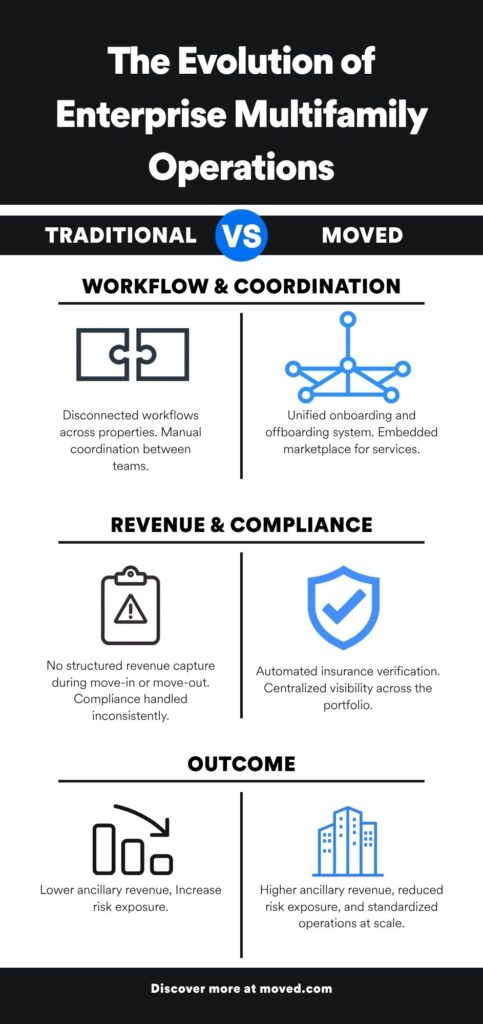
At the move-in stage, teams coordinate insurance, utilities, elevator bookings, and documentation manually. During move-outs, workflows often break down further, with little structure and almost no connection to revenue.
The result is predictable.
Revenue opportunities are missed because there is no system to capture resident spend during high-intent moments. Compliance gaps appear because insurance and documentation are not enforced consistently. Operational inefficiencies multiply because every property solves the same problem differently.
Over time, this does not just slow teams down – it creates measurable financial leakage across the portfolio.
The overlooked revenue layer in multifamily
Every resident move represents a moment of intent.
Residents are actively making purchasing decisions around moving services, packing, storage, insurance, utilities, and connectivity. These are not optional needs; they are required actions tied directly to the move lifecycle.
Traditional systems ignore this demand.
Moved integrates these services directly into onboarding and offboarding workflows. Instead of leaving residents to navigate external vendors, the platform embeds a curated marketplace into the process itself.
This shifts the model from passive coordination to active revenue generation.
The impact is not theoretical. When services are presented at the right moment – during move-in and move-out – conversion rates increase significantly because the timing aligns with real need. This is why ancillary revenue becomes scalable only when it is embedded into operational workflows, not treated as an add-on.
Why traditional automation tools fail at enterprise scale
Most automation tools in multifamily focus on efficiency. They introduce task lists, notifications, and workflow tracking. While useful, they address only the surface-level problem.
They do not change the financial structure of operations.
The limitation becomes clear at scale. Enterprise portfolios require systems that do more than coordinate tasks – they must standardize outcomes, enforce compliance, and capture revenue consistently across properties.
Traditional tools stop at “did the task get completed?”
Enterprise infrastructure asks a different question:
“Did this operational event generate revenue, reduce risk, and maintain consistency?”
That is the difference between software and infrastructure.
The Moved approach: building move infrastructure
Moved reframes the move lifecycle as a financial system rather than an operational checklist.
It embeds revenue-generating services – including movers, packing, storage, renters insurance, utilities, and internet – directly into the resident journey. At the same time, it enforces compliance through structured workflows and centralized verification.
This dual focus is intentional.
Revenue generation is the primary driver. Risk mitigation ensures that growth does not introduce exposure. Operational efficiency is supported by reducing manual coordination and standardizing execution.
This aligns with how enterprise operators evaluate systems: not based on features, but on financial outcomes and scalability.
Automating the full resident lifecycle
Enterprise automation must cover the entire move lifecycle – not just onboarding.
The move-in experience is where first impressions are formed and where the majority of ancillary revenue is captured. Moved provides a structured, property-branded environment where residents complete required tasks while simultaneously accessing embedded services. This ensures that compliance and revenue happen within the same flow, not as separate processes.
Explore how residents experience this
Move-outs, on the other hand, are often overlooked. Yet they present another high-intent moment. Residents still require services such as movers, storage, and logistics support. When structured properly, this stage becomes another revenue opportunity rather than a purely administrative process.
Transfers within a portfolio introduce an additional layer of value. By capturing residents before they exit to external platforms, operators retain demand within their own ecosystem. This reduces acquisition costs while maintaining revenue continuity.
Together, onboarding, offboarding, and transfers form a unified lifecycle – one that must be automated as a system, not managed as separate workflows.
Risk mitigation as a financial strategy
Risk in multifamily is often treated as compliance overhead. In reality, it is a direct financial variable.
Insurance gaps, incomplete documentation, and vendor-related liabilities can all translate into measurable loss. At enterprise scale, even small inconsistencies compound quickly.
Moved addresses this by embedding verification directly into the workflow.
Insurance is not simply requested – it is validated. Documentation is not stored in isolation – it is centralized and structured. Every step of the move lifecycle becomes traceable and enforceable.
This reduces exposure without adding operational burden.
More importantly, it aligns risk management with automation. Instead of relying on manual oversight, the system ensures that compliance is built into the process itself.
Operational efficiency as an outcome, not the goal
Efficiency is often positioned as the primary benefit of automation. In enterprise environments, it is better understood as a secondary outcome.
When workflows are standardized and centralized, manual coordination decreases naturally. Teams spend less time chasing tasks, following up with residents, or managing disconnected systems.
Moved delivers this through automated reminders, centralized dashboards, and seamless integrations with existing PMS platforms. Teams receive the information they need without having to constantly check multiple systems.
The measurable impact is significant. Teams save hours per move, while resident engagement remains consistently high.
However, these gains are a result of the system design – not the primary reason for it.
How enterprise deployment works
Enterprise adoption requires structured implementation.
Moved follows a phased approach that aligns with how large portfolios operate. Initial implementation focuses on integrating with existing systems and configuring workflows. Once live, the platform begins automating move events and capturing data.
Over time, this data becomes the foundation for optimization. After a defined period, operators can refine service offerings, improve conversion rates, and maximize revenue performance.
This approach ensures that value is realized quickly while still allowing for long-term scalability.
The financial impact on NOI
For enterprise operators, every system must tie back to financial performance.
The move lifecycle introduces a unique opportunity because it operates outside of traditional rent-based strategies. It enables NOI growth without relying on rent increases or occupancy changes.
The impact can be summarized as follows:
| NOI Driver | Impact on Portfolio |
| Ancillary revenue | Creates new income streams tied to resident behavior |
| Risk mitigation | Reduces potential financial losses and liabilities |
| Operational efficiency | Lowers labor costs and improves scalability |
| Resident experience | Supports retention and long-term value |
For a deeper breakdown of how the move lifecycle affects revenue
The shift is happening in multifamily
Enterprise multifamily is undergoing a structural shift.
Operators are moving away from fragmented tools toward unified systems that can scale across portfolios. At the same time, financial pressure is increasing the need for alternative revenue streams and stronger risk controls.
This is changing how technology is evaluated.
It is no longer enough for software to improve workflows. It must improve economics.
Moved sits at the center of this shift by turning a previously overlooked operational layer – the move lifecycle – into a measurable, scalable financial system.
Conclusion: enterprise automation must drive outcomes
Enterprise multifamily portfolios cannot rely on fragmented systems to manage their most frequent operational event.
The move lifecycle is too important.
It touches revenue, risk, operations, and resident experience simultaneously. Treating it as a checklist limits its potential. Treating it as infrastructure unlocks measurable financial impact.
Moved is designed for this reality.
It embeds revenue-generating services – including movers, packing, storage, insurance, utilities, and connectivity – directly into onboarding and offboarding workflows, helping operators increase ancillary income while mitigating compliance risk.
If your portfolio is still managing moves as isolated workflows, you are not capturing their full value.
FAQs
What is enterprise multifamily automation software?
It is a system designed to standardize and automate operations across large portfolios. Modern platforms like Moved extend this by embedding revenue generation and compliance directly into the move lifecycle.
Why is the move lifecycle important for NOI?
Because it is a high-frequency event tied to real resident spending behavior. When structured correctly, it creates new revenue streams without increasing rent.
How does Moved differ from traditional tools?
Traditional tools focus on task management. Moved integrates revenue-generating services and compliance workflows into a single system, transforming operations into infrastructure.
Can Moved work with existing systems?
Yes. Moved integrates with existing PMS platforms, allowing operators to enhance their current stack rather than replace it.
How quickly can enterprise portfolios see results?
Most portfolios begin seeing operational and revenue impact shortly after implementation, with optimization improving performance over time.