PMS platforms have spent two decades building reliable systems of record. They manage leases, ledger data, resident records, and operational reporting exceptionally well. But the resident journey extends far beyond lease execution.
The move-in and move-out lifecycle has become one of the most operationally sensitive and commercially important moments in multifamily housing. Movers, storage, renters insurance, internet activation, utility setup, elevator reservations, and compliance workflows all converge during the resident transition process.
As resident expectations rise, leading PMS platforms are increasingly looking to integrate with specialized move automation platforms rather than attempting to rebuild these operational layers internally. The opportunity is not simply workflow efficiency — it is creating a more controlled, connected, and operationally consistent resident onboarding experience while opening the door to ancillary revenue opportunities tied to resident moves.
Industry research attributed to Entrata COO Chase Harrington estimates that ancillary income accounts for approximately 4.4% of scheduled monthly charges across multifamily portfolios, reinforcing the growing financial importance of resident-service infrastructure.
PMS evolution: From systems of record to connected resident lifecycle platforms
The first generation of PMS platforms digitized leasing and accounting workflows. The second generation expanded into resident portals, payments, communications, and CRM functionality. The next phase of platform evolution focuses on supporting more of the resident lifecycle related to the lease itself.
Several major PMS providers have already moved in this direction.
- Yardi RentCafe Resident Services introduced resident service workflows tied to insurance, utilities, and move coordination.
- Entrata Homebody launched through a partnership with Red Ventures to support renters’ insurance, internet, and financial products.
- AppFolio Stack expanded its certified partner ecosystem to allow operational platforms to integrate alongside the PMS environment.
These developments validate a broader industry trend: PMS platforms are increasingly operating as centralized hubs connected to specialized operational partners rather than attempting to own every resident workflow directly.
The strategic opportunity is not to turn the PMS into a moving company or service marketplace. The opportunity is to create a connected resident lifecycle infrastructure in which specialized platforms handle operational depth, while the PMS remains the system of record.
Why move-in and move-out automation matters operationally
Move-ins and move-outs create operational complexity for both residents and on-site teams.
Without structured workflows, teams often manage:
- Manual renters insurance verification
- Elevator reservation coordination
- Utility setup tracking
- Vendor COI collection
- Key pickup scheduling
- Resident communication follow-ups
- Move-out compliance tasks
The result is fragmented coordination, inconsistent resident experiences, and operational inefficiency across portfolios.
Modern move-automation platforms help centralize these workflows into a property-branded experience, where residents can complete move-related tasks in a structured sequence. At the same time, operational teams maintain visibility into compliance and approvals.
This is especially important at scale, where consistency across multiple properties directly impacts operational efficiency, staffing pressure, and resident satisfaction.
According to Moved’s operational positioning, resident onboarding and offboarding are not simply checklist events — they are operationally complex lifecycle moments tied to revenue opportunities, compliance management, and resident experience outcomes.
The hub-and-spoke integration model
The multifamily software industry is increasingly adopting a hub-and-spoke integration structure.
In this model:
- The PMS acts as the operational hub
- Specialized platforms manage specific operational workflows
- APIs and integrations connect the systems
Buildium Marketplace, AppFolio Stack, Yardi SIPP integrations, and Entrata partner integrations all reflect this broader architectural direction.
Move-in and move-out automation fits naturally within this framework because resident move coordination spans multiple operational categories simultaneously:
- Compliance management
- Resident communication
- Ancillary service activation
- Scheduling coordination
- Vendor management
- Operational approvals
Building all of this internally requires significantly more than software engineering resources. It also requires:
- Vendor partnership management
- Resident support infrastructure
- Marketplace operations
- Insurance workflows
- Service-provider relationships
- Operational escalation handling
For most PMS providers, integrating with a specialized move infrastructure platform is faster, more scalable, and more operationally efficient than building a complete resident-service ecosystem internally.
AppFolio Stack, Entrata Homebody, and Yardi’s resident-service direction
Each major PMS provider is approaching resident-service infrastructure differently.
AppFolio Stack
AppFolio Stack represents one of the clearest examples of the industry’s partnership-oriented integration strategy. Rather than operating every workflow internally, Stack allows specialized operational vendors to connect through a structured ecosystem.
This creates flexibility for operators while enabling AppFolio to expand platform capabilities without rebuilding each operational category.
Entrata Homebody
Entrata Homebody, developed in partnership with Red Ventures, focuses on resident services, including renters insurance, internet setup, and financial products.
The strategy validates growing demand for centralized resident-service experiences tied to leasing and onboarding workflows. At the same time, the broader resident move lifecycle often extends beyond insurance and utilities into moving logistics, storage, compliance workflows, and operational coordination.
Yardi RentCafe and ResidentShield
Yardi’s ResidentShield and RentCafe initiatives demonstrate a similar push toward more connected resident onboarding experiences.
The platform supports resident service coordination tied to insurance, utilities, and move-related workflows while maintaining Yardi’s core role as the system of record.
Across all three examples, the industry direction is consistent:
- PMS platforms remain the operational foundation
- Specialized workflow platforms integrate alongside them
- Resident lifecycle coordination becomes increasingly centralized
Why operators want more control over onboarding workflows
Historically, many resident-service workflows have been fragmented across disconnected vendors, manual processes, and third-party communications.
As operators focus more heavily on resident experience and operational standardization, there is growing demand for:
- Property-branded onboarding experiences
- Centralized compliance workflows
- Consistent resident communication
- Better visibility into move coordination
- More structured vendor interactions
This is particularly relevant around renters insurance verification, utility coordination, and move scheduling, where inconsistent workflows can create operational friction for both residents and site teams.
A centralized move-automation layer helps operators maintain greater control over the resident onboarding experience while integrating preferred vendors and services into a single operational workflow.
What PMS platforms should look for in a move automation partner
Not all move-in and move-out platforms are designed the same way.
One of the most important strategic questions for PMS providers and multifamily operators is whether move coordination is the vendor’s core product or simply a secondary feature.
Platforms built specifically around move infrastructure typically invest more heavily in:
- Resident workflow reliability
- Service-provider network management
- Operational support teams
- Marketplace integrations
- Compliance automation
- Resident communication infrastructure
- Product roadmap depth
By contrast, lightweight onboarding tools or secondary workflow features often remain limited to checklist functionality without deeper operational orchestration.
For operators, this distinction matters because move events directly impact:
- Resident satisfaction
- Team workload
- Compliance exposure
- Portfolio consistency
- Ancillary service engagement
The strongest operational partnerships are typically the ones where:
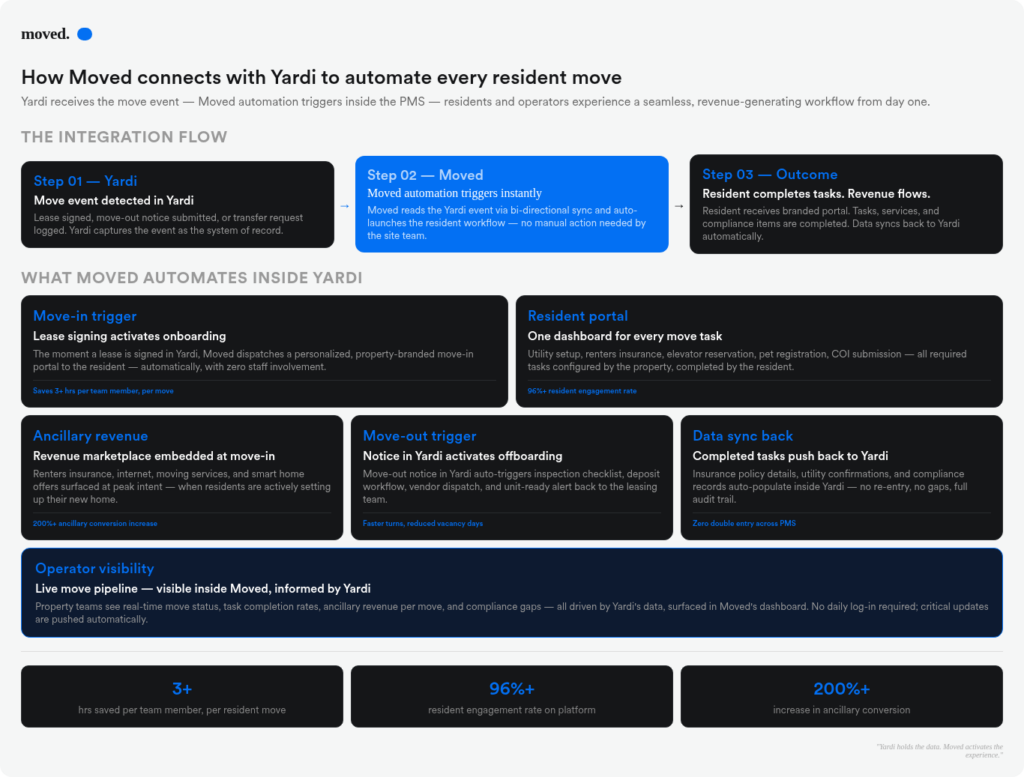
- The PMS remains the system of record
- The move platform manages workflow orchestration
- Residents receive a consistent branded experience
- Site teams avoid fragmented manual coordination
This structure allows operators to modernize resident onboarding and offboarding workflows without forcing PMS platforms to become service operators themselves.
How move automation supports ancillary revenue opportunities
Move events naturally create service activation opportunities because residents are already making time-sensitive purchasing decisions.
These may include:
- Movers
- Storage
- Packing supplies
- Internet setup
- Utility activation
- Renters insurance
- Smart-home services
When these workflows are coordinated inside a centralized resident experience, operators can create more consistent engagement opportunities tied to the move lifecycle.
Importantly, the operational value is not simply monetization. The larger benefit is workflow standardization and resident coordination. Ancillary revenue becomes a byproduct of creating a more structured operational experience around resident transitions.
According to Moved’s positioning framework, resident move workflows represent both operational infrastructure and revenue infrastructure opportunities for multifamily operators.
Should PMS platforms build move automation internally or partner with external providers?
For most PMS providers, the strategic question is not whether move automation matters. The question is whether it makes sense to build operational infrastructure internally.
A complete resident move workflow requires:
- Compliance infrastructure
- Vendor coordination systems
- Resident communication workflows
- Service-provider integrations
- Marketplace management
- Operational support resources
These are operational businesses layered on top of software businesses.
That is why much of the multifamily ecosystem has moved toward integration-based partnership models. PMS platforms maintain the leasing and accounting foundation while specialized providers manage operational lifecycle infrastructure alongside it.
For operators, this structure often creates:
- Faster implementation timelines
- More mature resident experiences
- Reduced operational burden
- Better workflow consistency
- Greater flexibility across portfolios
Frequently asked questions
How does move-in and move-out automation integrate with PMS platforms?
Move automation platforms typically connect alongside PMS platforms through bidirectional APIs and event-driven integrations. Lease approvals, resident records, and lifecycle events sync between systems while each platform maintains its operational role.
How do PMS platforms support resident move workflows?
Most PMS providers support move workflows through partner integrations, resident portals, and operational APIs, allowing specialized move platforms to coordinate onboarding and offboarding processes alongside the PMS environment.
Why are multifamily operators investing in move automation?
Operators are increasingly focused on operational efficiency, consistency in resident experience, compliance visibility, and centralized onboarding coordination across portfolios.
What services are commonly included in move automation workflows?
Typical workflows include renters insurance verification, utility setup, elevator reservations, moving coordination, storage services, internet activation, and move-related compliance tasks.
Should operators replace their PMS to modernize move workflows?
No. Most modern move automation platforms are designed to integrate alongside existing PMS systems rather than replace them.
Conclusion
The multifamily software industry is shifting toward connected operational ecosystems where specialized platforms work alongside PMS providers to support more of the resident lifecycle.
Move-in and move-out automation is becoming a critical part of that evolution because resident transitions simultaneously impact operational efficiency, compliance management, resident experience, and ancillary service engagement.
For PMS platforms, the opportunity is not to become moving-service operators themselves. The opportunity is to create a stronger operational infrastructure by integrating alongside platforms purpose-built for resident move coordination.
For multifamily operators, this creates a more scalable, centralized, and resident-friendly approach to onboarding and offboarding across the portfolio.
Learn more about resident onboarding automation, explore Moved’s multifamily platform, or contact the Moved team to see how move automation integrates with your existing PMS infrastructure.
Relevant positioning and terminology aligned with the Moved brand and operational messaging standards.