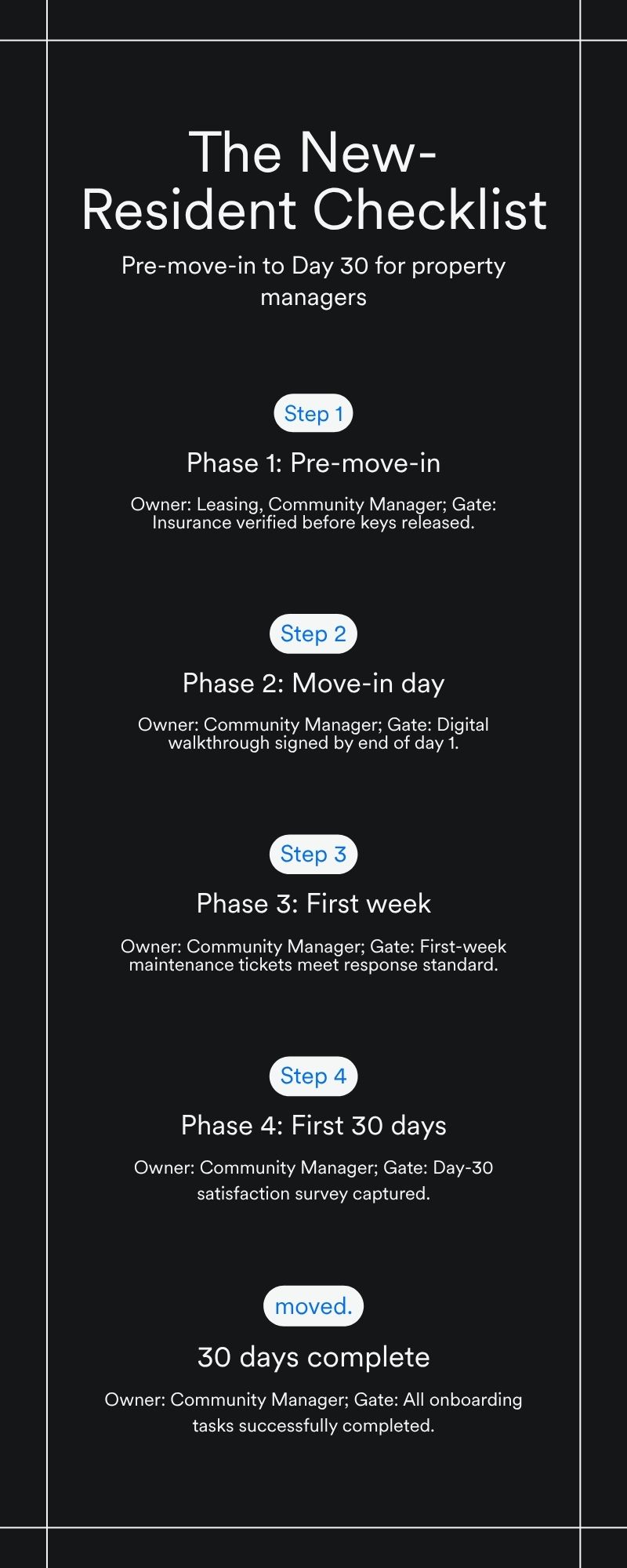
New-resident onboarding checklist for property managers, showing four phases from pre-move-in to day 30, with owner and compliance gating for 10,000+ unit operators.
The first 30 days of a lease are the most financially significant stretch of the entire resident relationship, and at 10,000+ unit operators, they are also the most variable. Onboarding that runs cleanly at one property and loosely at the next shows up in satisfaction scores, ancillary revenue, insurance compliance, and renewal rate. This checklist is the standardized new-resident onboarding workflow that 10,000+ unit operators apply across every property, from lease signing through day 30. We cover the broader operating model in our guide to ancillary revenue in multifamily.
The stakes are concrete. Residents scoring 9 to 10 on NPS renew at 70 to 80% versus under 30% for those scoring 0 to 6, and satisfaction is set in the first 30 days, per BubbleGum BI’s multifamily NPS research. The 30-day move-in mark is also where resident sentiment first breaks down, with an average of 3.7 out of 5, per Retently’s 2026 Property Management CX Gap study. Onboarding is the operator’s one chance to bend that curve before it costs a renewal.
Why onboarding needs a standardized checklist
At portfolio scale, onboarding that lives in individual managers’ heads does not travel. The checklist must deliver the same new-resident experience across markets, asset classes, and on-site teams.
A standardized checklist does three things at once. It captures the ancillary revenue that concentrates in the move window, as residents book movers, packing, storage, utilities, internet, and renters insurance through a single flow. It closes the largest financial-risk gap in the resident relationship by verifying insurance at the front door, where the industry baseline of correctly verified renters insurance has historically sat near 55% against a 90%+ achievable standard, per Foxen’s renters insurance compliance research. And it sets the satisfaction trajectory that decides renewal. The pressure on the insurance gate has only grown, with property insurance premiums up 14%, 22%, and 45% over the past three years, per NAA’s Premium Pulse research.
The onboarding checklist: pre-move-in to day 30
The workflow runs in four phases. Each phase has an owner and a compliance gate that produces a clean record at the asset management layer.
Phase 1: Pre-move-in (lease signing to the day before keys)
Owner: Leasing team during application, then community manager once the lease is signed.
Resident tasks, all orchestrated through a single resident portal:
- Sign the lease and pay the security deposit
- Upload the renter’s insurance certificate with the property named as an additional interested party
- Set up utilities (power, gas, water, internet)
- Book movers, packing services, and storage if needed
- Schedule the key pickup window
- Complete address-change tasks (USPS forwarding, DMV, employer)
- Acknowledge community rules and the pet policy
- Receive welcome materials and amenity access information
Property tasks:
- Verify insurance compliance against lease minimums before keys are released
- Confirm the unit is rent-ready 72 hours before move-in
- Send move-in day instructions 48 hours before
- Prepare the welcome box for hand-off
Compliance gate: Keys are released only after renters insurance is verified, with the correct liability limit, the property named as additional interested party, and valid coverage dates. When mail forwarding and address updates are part of onboarding, moving services come first in the sequence because that is where resident value and operator economics converge.
Phase 2: Move-in day (move-in plus 24 hours)
Owner: Community manager with on-site team support.
Resident tasks:
- Complete the move-in walkthrough digitally, with photos and timestamped damage notes
- Acknowledge the unit condition report
- Confirm utilities are live before signing off
- Confirm move-in checklist completion in the portal
Property tasks:
- Hand off keys or activate the smart lock
- Walk the resident through the unit and amenities
- Deliver the welcome box
- File the move-in inspection report into the resident record
- Trigger the day-one satisfaction touchpoint
Compliance gate: The walkthrough is completed and signed digitally before the end of day 1, so any unit-condition issue is logged at the front of the lease rather than disputed at move-out.
Phase 3: First week (day 1 to day 7)
Owner: Community manager.
This is the most fragile stretch of the relationship, because move-in is where the gap between what was toured and what was delivered becomes the resident’s daily reality, per Retently’s 2026 study.
Resident touchpoints:
- Day 1: Welcome message from the community manager
- Day 3: Check-in on any open move-in issues
- Day 7: Invitation to the new-resident welcome event
Property tasks:
- Resolve any unit-condition disputes by day 7
- Confirm utility transfers are progressing
- Open and track every maintenance ticket against the published response standard (commonly 24 hours for non-emergency, 4 hours for emergency)
Compliance gate: Every first-week maintenance ticket meets the published response standard, since slow maintenance response is one of the most common reasons residents later decline to renew, per NAA’s summary of the Zego resident experience data.
Phase 4: First 30 days (day 8 to day 30)
Owner: Community manager.
Resident touchpoints:
- Day 14: Two-question satisfaction survey (anything broken, anything missing)
- Day 21: Reminder of amenity access and the community events calendar
- Day 30: First satisfaction survey
Property tasks:
- Confirm all utility transfers are complete
- Complete first community event participation if possible
- Route any detractor score to the community manager as a same-day alert for action
Compliance gate: All maintenance tickets opened in the first 30 days are resolved within the published response standard, and the day-30 survey is captured for every new resident.
The onboarding verification checklist
Five gates produce a clean compliance trail at the asset management layer:
- Insurance verified against lease requirements at execution before keys are released
- Move-in walkthrough completed digitally with photos by end of day 1
- First-week maintenance tickets resolved within the response standard
- Day-30 satisfaction survey captured for every new resident
- Revenue-generating services activated through one resident portal
Text should anchor time-sensitive onboarding messages, as it is the most preferred resident channel across all generations, at 68-76%. At the same time, the portal ranks lowest on its own, at 8.4% to 12.8%, per the 2025 SatisFacts Online Renter Study.
What this checklist compounds into at a 10,000+ unit portfolio
A standardized onboarding workflow run consistently across 10,000+ units compounds into four operator outcomes: stronger ancillary revenue capture in the move window, reduced financial exposure from insurance verified at the front door, lower turn cost from issues caught early, and a higher renewal rate from satisfaction managed in the first 30 days.
The sizing for any specific portfolio depends on baseline performance, asset class, rent profile, and market mix. The framing of how these outcomes flow into NOI and asset value at the portfolio scale is in the Moved CEO’s RevGen newsletter on the third pillar of residential real estate and the RevGen leak map.
How Moved fits
Moved is the move-in and move-out infrastructure platform that runs this onboarding checklist at portfolio scale. Traditional tools focus on task tracking and administrative coordination. Moved embeds revenue-generating services, including movers, packing, storage, utilities, internet, and insurance, directly into the onboarding workflow, while verifying insurance at the front door.
For 10,000+ unit operators, residents will not log in to two or three portals, so consolidating the resident-facing experience within the Moved resident experience ensures the onboarding checklist reaches the resident at all. At the same time, the asset management team uses the same platform as its reporting layer. Moved is built on flexible commercial structures designed to align with property financial goals.
To see how this onboarding workflow runs at portfolio scale, book a walkthrough with our team or visit the Moved multifamily product page.
FAQs
What is the single most important onboarding step? Insurance verification at lease execution. Unverified renter’s insurance is the largest single financial risk exposure in the resident relationship, and the industry baseline has historically sat near 55%, per Foxen.
Why does the first 30 days matter so much? Satisfaction is set there and directly predicts renewal, per BubbleGum BI, and the 30-day mark is where sentiment first breaks, per Retently.
What maintenance response standard should we hold during onboarding? A common operator benchmark is 24 hours for non-emergency tickets and 4 hours for emergencies, measured per property.
Who owns the onboarding checklist at a 10,000+ unit operator? The checklist sits at the asset management layer. On-site community managers execute it. The reporting layer rolls up to operations leadership.
How is this different from the property management system’s built-in onboarding? The property management system is the system of record. This checklist is the operating workflow that uses it as the data layer and adds the resident-facing experience, revenue service activation, and compliance verification on top.
The bottom line
A standardized new-resident onboarding checklist from pre-move-in through day 30 is one of the highest-return operational changes available to a 10,000+-unit operator without raising rent or adding headcount. The four-phase workflow captures the ancillary revenue in the move window, verifies insurance at the front door, and sets the satisfaction trajectory that decides renewal, consistently across the portfolio.
For the full operator playbook, see our breakdown of how move-in and move-out workflows have become a property management revenue engine, as well as our ultimate guide to resident onboarding automation.