The multifamily resident communication SOP outlines five lifecycle stages, the primary channel, and the message owner for 10,000+ unit operators.
Resident communication is the connective tissue of the move-in and move-out experience, and at 10,000+ unit operators, it is also the most uneven part of the operation. The same portfolio can run a polished communication flow at one property, and an improvised one at the next, and the difference shows up in satisfaction scores, ancillary revenue capture, insurance compliance, and renewal rate. We cover the broader operating model in our guide to ancillary revenue in multifamily.
This guide is the standardized communication SOP used by 10,000+ unit operators across all properties. It defines the channels, cadence, message owners, and compliance touchpoints that turn resident communication into a reliable revenue- and risk-management workflow rather than a property-by-property guess.
Why resident communication needs an SOP
At portfolio scale, communication that lives in individual managers’ heads does not travel. The standard has to produce the same resident experience across markets, asset classes, and on-site teams with different tenures.
The renter data makes the stakes concrete. Text messaging is the most preferred channel across all generations, at 68-76%, while the community portal ranks lowest, at 8.4-12.8%, per the 2025 SatisFacts Online Renter Study. Residents also expect speed: 63.3% expect a response within two business days or less, per the same study. And poor communication carries a direct reputation cost, with 56.4% of renters leaving a negative review after unexpected fees or weak communication on price changes.
The financial picture is just as direct. Property managers post an NPS of 35 with the owners who pay them and only 10 with the residents who live in the units, a 25-point gap that is structural to the business, per Retently’s 2026 Property Management CX Gap study. Resident sentiment declines most sharply at two communication-driven moments: the 30-day move-in mark, where satisfaction averages 3.7 out of 5, and the renewal window, where it can drop to 3.0 out of 5, per the same study. Both moments are won or lost on communication.
The communication SOP framework
Every resident communication flow at a 10,000+-unit operator spans five lifecycle stages. Each stage has a primary channel, a message owner, and a defined cadence. The standard below is the minimum viable version.
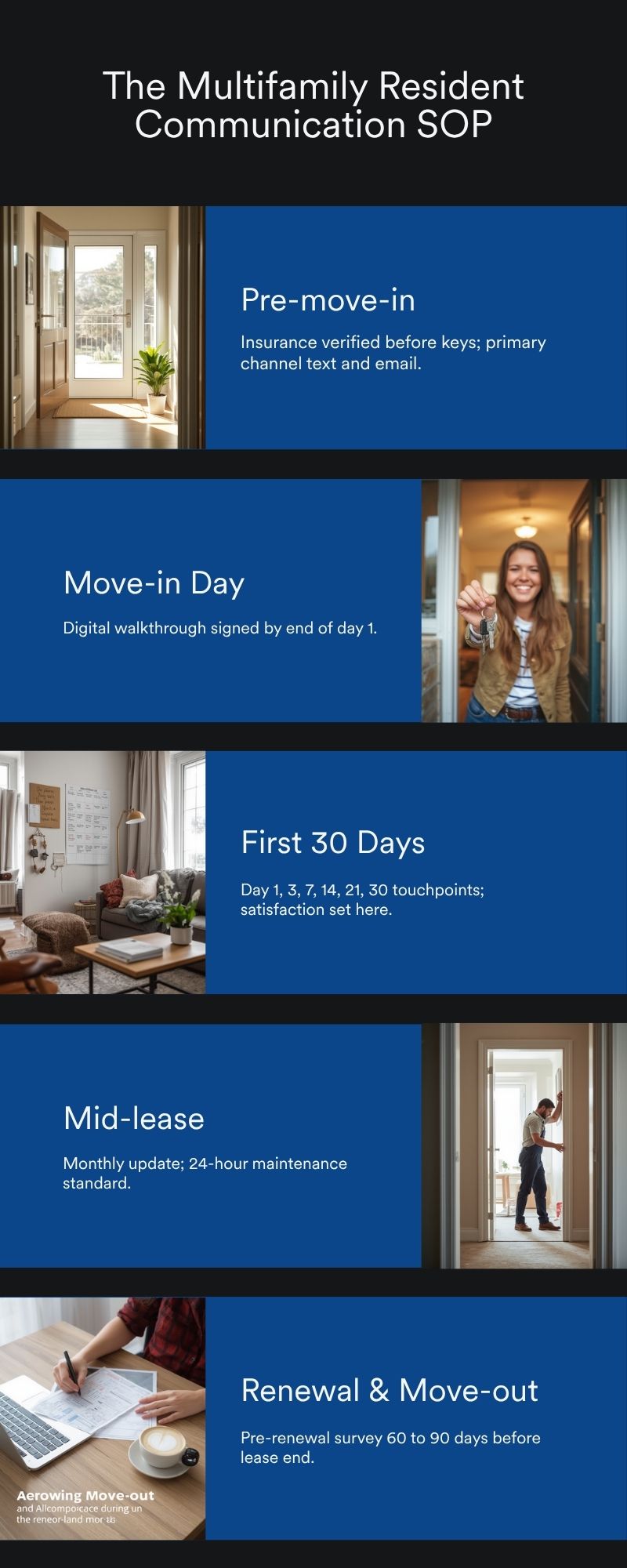
Stage 1: Pre-move-in communication
Window: Lease signing through the day before move-in.
Owner: Leasing team at application, then community manager once the lease is signed.
Primary channel: Text for time-sensitive nudges, email for documents and confirmations, all surfaced inside a single resident portal so residents have one place to act.
This is the highest-value revenue window in the entire lifecycle, and the communication has to do double duty. Alongside the lease and deposit, the resident sees and books the revenue-generating services that accompany every move: movers, packing, storage, utility setup, internet activation, and renters insurance. When mail forwarding and address updates are part of the welcome flow, the moving services remain first in the sequence because that is where both resident value and operator economics are concentrated.
The pre-move-in flow also conveys the lease’s most important compliance message. The communication makes clear that keys are released only after renter’s insurance is verified against the lease minimums, with the property named as an additional interested party. Framing insurance verification as a non-negotiable front-door step is the single largest reduction of financial risk in the workflow.
Stage 2: Move-in day communication
Window: Move-in day plus the following 24 hours.
Owner: Community manager with on-site team support.
Primary channel: In-person handoff plus portal confirmations.
Move-in day is the first satisfaction cliff, so the communication is concrete and immediate: key handoff or smart-lock activation, a guided walkthrough, a digital condition report with timestamped photos, and confirmation that utilities are live. A short day-one satisfaction touchpoint goes out before the end of the day so any unit-condition issue is logged at the front of the lease rather than disputed at move-out.
Stage 3: First 30 days communication
Window: Move-in day through day 30.
Owner: Community manager.
This stretch sets the resident’s view of the property for the rest of the lease, which is why the 30-day move-in score is the first place sentiment breaks in Retently’s 2026 study. A defined touchpoint schedule keeps the relationship from drifting:
- Day 1: Welcome message from the community manager
- Day 3: Check-in on any open move-in issues
- Day 7: Invitation to the new-resident welcome event
- Day 14: Two-question satisfaction survey
- Day 21: Reminder of amenity access and the events calendar
- Day 30: First satisfaction survey
The cadence works because it is consistent and because the team acts on what it hears. A low score routes to the community manager as a same-day alert for action.
Stage 4: Mid-lease communication
Window: Day 31 through the start of the renewal window.
Owner: Community manager.
Most operators undercommunicate during the quiet months and overcommunicate in the renewal window. The SOP flips that curve. A monthly community update with maintenance news, event reminders, and a short note from the community manager keeps residents engaged when retention investment is at its least expensive. Maintenance communication carries a published response standard, typically 24 hours for non-emergency tickets and 4 hours for emergencies, because slow maintenance response is one of the most common reasons residents decline to renew, per NAA’s summary of the Zego resident experience data.
Stage 5: Renewal and move-out communication
Window: 90 days before lease end through the resident’s last day.
Owner: Community manager with leasing support on turnover.
The renewal window is the second satisfaction cliff, so communication starts early. A pre-renewal satisfaction survey 60 to 90 days before expiry gives the team time to close gaps before the renewal decision is locked in, a practice that the strongest operators run deliberately, per Retently’s 2026 study. For residents who move on, the move-in and move-out flow stays symmetrical: re-verify renters insurance is in force through the last day, schedule the digital pre-vacate inspection, send the move-out instructions packet, and confirm the forwarding address for the deposit return.
The communication channel and compliance standard
A standardized flow produces a clean record at the asset management layer. Five communication standards hold across every property:
- Text for time-sensitive items, email for documents, portal as the single source of truth
- A response standard published to residents and measured per property
- Insurance verification messaged as a hard gate at move-in and re-confirmed at move-out
- Lifecycle surveys at the 30-day and pre-renewal moments, with detractor alerts routed to a person
- Revenue-generating services surfaced inside the same portal residents already use
What this SOP compounds into at a 10,000+ unit portfolio
A standardized communication SOP run consistently across 10,000+ units compounds into four operator outcomes across the lease cycle: stronger ancillary revenue capture as residents book movers, packing, storage, utilities, internet, and insurance through one flow; reduced financial exposure from insurance verified correctly at the front door; lower turn cost from issues caught and resolved early; and a higher renewal rate from sentiment managed at the moments that decide it.
The sizing for any specific portfolio depends on baseline performance, asset class, rent profile, and market mix. The framing of how these operational outcomes flow into NOI and asset value at the portfolio scale is in the Moved CEO’s RevGen newsletter on the third pillar of residential real estate and the RevGen leak map. Both are operator references for building the case for standardized communication.
How Moved fits
Moved is the move-in and move-out infrastructure platform that runs this communication SOP at portfolio scale. Traditional tools focus on task tracking and administrative coordination. Moved embeds revenue-generating services and insurance verification directly into the resident communication flow, turning the move into structured revenue infrastructure.
For 10,000+ unit operators, residents will not log into two or three portals. Consolidating the resident-facing experience within the Moved resident experience is what enables the communication cadence to reach the resident at all. At the same time, the asset management team uses the same platform as its reporting layer. Moved is built on flexible commercial structures designed to align with property financial goals.
To see how this SOP runs at portfolio scale, book a walkthrough with our team or visit the Moved multifamily product page.
FAQs
Which channel should anchor resident communication? Text for time-sensitive items, as it is the most preferred channel across all generations at 68 to 76%, per the 2025 SatisFacts study. Email handles documents, and the portal holds the single source of truth.
What response time should we commit to? Most residents expect a response within 2 business days. For maintenance, the published 24-hour non-emergency and 4-hour emergency standards are the common operator benchmarks.
When should the renewal conversation start? 60 to 90 days before lease end, with a pre-renewal satisfaction survey so the team can act on feedback before the decision is locked in.
Who owns the communication SOP at a 10,000+ unit operator? The SOP sits at the asset management layer. On-site community managers execute it. The reporting layer rolls up to operations leadership.
How is this different from the property management system’s messaging? The property management system is the system of record. This SOP is the operating workflow that uses it as the data layer and adds the resident-facing experience, revenue service activation, and compliance verification on top.
The bottom line
A standardized resident communication SOP at 10,000+ unit operators is one of the highest-return operational changes available without raising rent or adding headcount. The five-stage framework produces a consistent resident experience across the portfolio, captures ancillary revenue in the move window, verifies insurance at the front door, and manages sentiment at the two moments that determine renewal.
For the full operator playbook, see our breakdown of how move-in and move-out workflows have become a property management revenue engine, as well as our ultimate guide to resident onboarding automation.