The NAA Apartmentalize conference is often treated as an industry gathering. In reality, it is one of the highest-intent decision-making environments in residential real estate.
For multifamily operators, every conversation, demo, and session represents a potential shift in how revenue is generated across the portfolio. The challenge is that most teams enter the event without a structured strategy.
This leads to event overwhelm, scattered conversations, and missed opportunities.
Preparation is not about organizing your calendar. It is about defining how your portfolio will grow revenue, reduce risk, and scale operations through the right partnerships.
The hidden cost of poor preparation
Apartmentalize brings together hundreds of vendors across categories. Without a clear framework, operators default to surface-level evaluation.
They focus on features, interfaces, and short-term operational benefits. What gets overlooked is the long-term financial impact.
This is where most portfolios lose value.
Move-ins and move-outs are among the highest-intent moments in the resident lifecycle. Yet they are still treated as administrative processes rather than as structured revenue opportunities.
This disconnect results in:
- Lost ancillary revenue from movers, storage, and utilities
- Lack of control over insurance compliance
- Fragmented vendor relationships with no monetization strategy
These are not minor inefficiencies. They are systemic revenue leaks.
Reframing your objective before attending
Before planning your sessions or meetings, you need clarity on one thing.
You are not attending Apartmentalize to explore tools. You are attending to identify infrastructure that drives financial outcomes.
This means focusing on systems that embed revenue directly into the move lifecycle.
Modern multifamily platforms are evolving beyond task coordination. They are integrating services such as moving, packing, storage, utilities, insurance, and connectivity into a single workflow that generates income at scale.
This shift changes how you should evaluate everything at the event.
Understanding where revenue is lost today
Most operators underestimate how much revenue is lost during resident transitions.
The issue is not demand. Residents are already purchasing services during a move. The issue is that these transactions happen outside the operator’s ecosystem.
When residents independently book movers, activate utilities, or purchase insurance, the property has zero visibility and zero participation in that spend.
Over time, this creates a significant gap between operational effort and financial return.
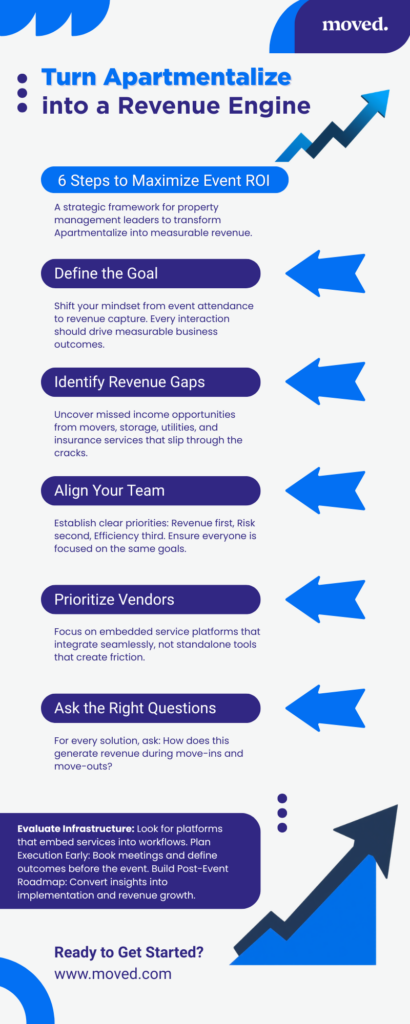
To prepare effectively for Apartmentalize, you need to identify these gaps within your own portfolio.
Start by analyzing how your current move workflow operates. In most cases, it is fragmented, manual, and disconnected from revenue generation. A deeper breakdown of this problem is covered in the guide on move-in and move-out process revenue opportunities.
Aligning your internal team before the event
One of the most overlooked aspects of conference preparation is internal alignment.
Different teams attend Apartmentalize with different priorities. Leasing teams focus on experience. Operations teams focus on process efficiency. Leadership focuses on cost control.
Without alignment, vendor conversations become inconsistent, and outcomes become unclear.
You need a unified evaluation lens that prioritizes financial impact.
At a strategic level, every solution you evaluate should answer three questions.
First, does it generate revenue during high-intent moments such as move-ins and move-outs?
Second, does it reduce risk through compliance, insurance verification, or liability management?
Third, does it improve operational consistency across the portfolio?
This hierarchy ensures your team is not distracted by features that do not contribute to NOI growth.
Identifying the right vendor categories in advance
Walking into Apartmentalize without predefined categories creates unnecessary noise.
Instead of exploring everything, define what matters to your portfolio.
Focus on categories that directly impact revenue and risk.
These typically include:
- Move infrastructure platforms that embed services
- Marketplace-driven solutions that enable ancillary monetization
- Insurance and compliance systems that reduce liability
- Utility and connectivity partnerships integrated into workflows
By narrowing your focus, you ensure that every conversation contributes to a measurable outcome.
Building a structured meeting strategy
Top-performing operators do not rely on discovery at the event. They plan their engagement in advance.
This means identifying vendors, scheduling meetings, and defining objectives before arriving.
When your schedule is structured, your conversations become more focused and more valuable.
Each meeting should have a clear purpose tied to a specific gap in your portfolio.
Without this structure, conversations tend to remain high-level and rarely translate into implementation.
Asking financially relevant questions
Most vendor conversations at conferences are driven by feature discussions.
This approach limits your ability to evaluate long-term value.
Instead, shift your questions toward financial outcomes and operational impact.
You should be focused on understanding how a solution integrates into your revenue model and how it performs at scale.
This includes evaluating how services are embedded, how transactions are monetized, and how compliance is enforced across properties.
When conversations stay at the feature level, you miss the bigger picture.
Evaluating infrastructure instead of tools
There is a fundamental shift happening in multifamily technology.
Traditional solutions operate as standalone tools. They manage tasks but do not create financial value.
Modern platforms function as infrastructure. They integrate directly into the move lifecycle, transforming it into a revenue-generating system.
Moved is an example of this shift. It embeds services such as movers, storage, utilities, insurance, and connectivity directly into resident workflows, enabling operators to capture value during high-intent moments.
If you want to understand how this connects with automated onboarding, refer to the resident onboarding automation guide.
Mapping sessions to strategic outcomes
The conference agenda is extensive. Not every session will contribute to your portfolio’s financial performance.
Most operators make the mistake of attending sessions based on popularity or broad themes. This leads to information overload without actionable direction.
Instead, every session you attend should map directly to a strategic outcome.
Start by aligning sessions with your core objectives. These typically include revenue expansion, risk control, and portfolio scalability. If a session does not support one of these outcomes, it should not be prioritized.
Focus on sessions that explore how operators are monetizing resident journeys, especially during high-intent moments such as move-ins and move-outs. These sessions often reveal how leading portfolios are structuring ancillary revenue streams rather than simply improving workflows.
You should also prioritize discussions around embedded service ecosystems. These include partnerships for movers, storage, utilities, and insurance that are integrated directly into the resident experience.
When evaluating sessions, think in terms of implementation, not inspiration.
How to navigate the event floor without distraction
The exhibition floor is where most operators lose focus.
The density of vendors, live demos, and conversations creates constant context switching. Without a structured approach, it becomes difficult to distinguish between solutions that drive revenue and those that simply improve usability.
Your goal is not to explore. Your goal is to validate.
Approach the floor with a predefined shortlist of vendors aligned to your revenue gaps. This allows you to move with intent rather than reacting to what is presented in the moment.
Conversations should be direct and outcome-oriented. Instead of asking vendors to walk you through their platform, guide the discussion toward how they impact your business financially.
Pay attention to how solutions position themselves. If the conversation centers on features, dashboards, or ease of use without a clear link to revenue generation, it is unlikely to be a high-impact solution.
High-value platforms will consistently tie their capabilities to measurable outcomes such as ancillary income growth, compliance enforcement, and operational standardization.
Capturing insights in a structured way
One of the most overlooked aspects of Apartmentalize is post-conversation clarity.
Operators often leave with notes that are fragmented and difficult to compare. This makes it challenging to prioritize vendors after the event.
To avoid this, you need a consistent documentation structure.
After each conversation, capture insights in three dimensions.
First, document how the solution generates revenue. This includes understanding what services are embedded and how transactions are monetized.
Second, assess how the platform mitigates risk. This should include insurance verification, compliance enforcement, and liability reduction.
Third, evaluate how the solution scales operationally across your portfolio.
This structure allows you to compare vendors objectively rather than relying on memory or subjective impressions.
Turning conversations into implementation
The real value of Apartmentalize is not in the conversations themselves. It is in what happens after.
Most operators fail at this stage because there is no clear transition from evaluation to execution.
To bridge this gap, you need to define the next steps before the event ends.
Every meaningful conversation should result in one of the following outcomes:
- A follow-up demo with key stakeholders
- A pilot discussion for a subset of properties
- A commercial conversation aligned with portfolio goals
Without this clarity, conversations lose momentum and rarely convert into action.
It is important to involve decision-makers early in the process. Delayed internal alignment is one of the primary reasons implementations stall after conferences.
Building a post-event revenue roadmap
Once the event concludes, your focus should shift to consolidation and prioritization.
Start by reviewing all vendor conversations through a financial lens. Identify which solutions have the strongest potential to impact ancillary revenue and reduce operational risk.
From there, build a structured roadmap.
This roadmap should outline how selected solutions will be evaluated, piloted, and scaled across the portfolio.
It should also define timelines, ownership, and expected outcomes.
The key is to move quickly while the event’s context is still fresh.
For operators looking to understand how move-in and move-out workflows can be structured into revenue systems, this breakdown of move-in and move-out revenue strategy provides a useful foundation.
Connecting conference learnings to operational systems
The most effective operators do not treat Apartmentalize as a standalone event. They integrate what they learn into existing systems and workflows.
This requires a shift in perspective.
Instead of adopting isolated tools, the focus should be on building a connected ecosystem where revenue-generating services are embedded directly into the resident journey.
This includes integrating movers, storage, utilities, insurance, and connectivity into a unified workflow that operates consistently across all properties.
To understand how this can be implemented at scale, explore how resident onboarding automation connects with revenue generation.
For a broader view of how these systems support portfolio-wide performance, refer to the multifamily platform overview.
The bigger picture: from event strategy to revenue infrastructure
Apartmentalize is not just an event. It is an opportunity to redefine how your portfolio operates.
The most successful operators leave with more than insights. They leave with a clear direction.
They understand how to transition from fragmented workflows to structured systems that generate revenue, enforce compliance, and scale efficiently.
Moved represents this shift in the industry.
It is not a task management tool. It is a move infrastructure platform that embeds revenue-generating services, including movers, packing, storage, utilities, insurance, and connectivity directly into the resident onboarding workflow.
This approach allows operators to capture value during the most critical moments of the resident lifecycle while maintaining control over compliance and operational consistency.
Conclusion: preparing for Apartmentalize with intent
Preparation determines outcome.
When you approach Apartmentalize with a clear framework, aligned priorities, and defined revenue goals, the event becomes a strategic advantage.
You move from passive participation to active decision-making.
You shift from exploring tools to building infrastructure.
And most importantly, you position your portfolio to capture revenue that would otherwise be lost during resident transitions.
If you are evaluating how to implement these strategies in your portfolio, the next step is to align your team and explore solutions that support revenue generation and risk mitigation.
FAQs
What should multifamily operators focus on at Apartmentalize?
Operators should focus on identifying solutions that generate ancillary revenue, reduce compliance risk, and scale across their portfolio. This includes platforms that embed services like movers, storage, utilities, and insurance into the resident workflow.
How can Apartmentalize help increase ancillary revenue?
The conference provides access to vendors and strategies that enable operators to monetize high-intent moments such as move-ins and move-outs. The key is selecting solutions that integrate directly into operational workflows.
What is the biggest mistake operators make at Apartmentalize?
The most common mistake is focusing on features instead of financial outcomes. Without a clear evaluation framework, operators often select tools that improve efficiency but do not contribute to revenue growth.
How should operators follow up after the conference?
Operators should prioritize vendors based on revenue impact, schedule follow-up discussions, and build a structured implementation roadmap to ensure insights translate into measurable results.