In residential real estate, few moments carry as much transactional intent as a resident move.
Move-ins and move-outs are not just operational events. They are concentrated financial windows where residents actively spend on movers, packing, storage, utilities, insurance, and connectivity.
Despite this, most operators fail to capture that value.
Significant investment is made in leasing, marketing, and acquisition. But once a lease is signed, the financial strategy drops off. The move process becomes a checklist rather than a monetized lifecycle stage.
This creates a structural gap.
Revenue-generating activity continues, but it happens outside the operator’s ecosystem.
The Real Problem: Revenue Leakage Hidden Inside Move Workflows
Every move triggers predictable, high-value transactions:
- Movers and logistics
- Packing supplies and storage
- Utility activation
- Internet setup
- Renters insurance
These are not optional decisions. They are required actions tied directly to the move timeline.
Yet nearly all of them happen externally.
Residents turn to third-party marketplaces, comparison tools, and vendor platforms. Those platforms capture both the transaction and the margin.
The operator captures nothing.
This is not an efficiency issue. It is a systemic revenue leakage problem.
Across a portfolio, thousands of moves occur annually. Each one represents multiple monetizable actions. When these are consistently externalized, the financial loss compounds significantly.
Why Traditional Move Processes Fail to Capture Value
Traditional move workflows were designed for completion, not monetization.
Property management systems can:
- Record lease events
- Store documentation
- Track occupancy
But they do not influence or capture transaction behavior during the move lifecycle.
As a result:
- Transactions occur outside the system
- Vendor decisions remain invisible
- Revenue opportunities are lost
Manual coordination further weakens the process.
Site teams rely on emails, reminders, and follow-ups. Execution varies by property. There is no standardized structure to guide or capture resident actions.
This creates two critical gaps:
- No visibility into the services residents choose
- No control over where transactions occur
Without a structured framework, operators remain coordinators instead of participants in the move economy.
Reframing Move-Ins and Move-Outs as Revenue Infrastructure
The shift begins by redefining the move lifecycle.
Moves are not operational checkpoints. They are structured financial events.
A revenue-generating move, infrastructure embeds services directly into the workflow instead of allowing them to occur externally.
These services include:
- Movers and logistics
- Packing and storage
- Utilities and connectivity
- Renters insurance
When embedded, transactions move from external platforms into a controlled system.
Operators gain:
- Visibility into resident decisions
- Participation in transaction revenue
- Control over execution and compliance
This is where Moved operates.
Moved is a move infrastructure platform that embeds revenue-generating services — including movers, packing, storage, insurance, utilities, and connectivity — directly into the resident onboarding workflow, helping operators increase ancillary income while mitigating compliance risk.
Explore how this works from a resident perspective.
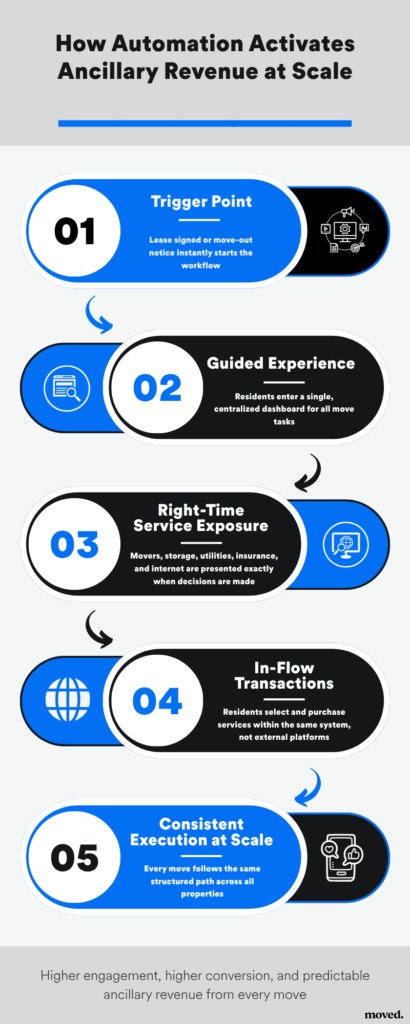
How Automation Activates Ancillary Revenue at Scale
Automation is the mechanism that converts intent into captured revenue.
When a lease is signed or a move-out notice is submitted, workflows are triggered instantly. Residents enter a guided, centralized system where every required step is presented in sequence.
Timing is critical.
Revenue is captured when services are presented at the exact moment of decision-making.
Instead of sending residents to external platforms:
- Movers are offered within the workflow.
- Utilities are activated within the system.
- Insurance is completed as part of onboarding.
This reduces friction while aligning resident actions with property-level economics.
At scale, this creates consistency.
Every resident follows the same structured path. Every transaction opportunity is captured within the ecosystem.
Moved enables this through:
- Automated workflow triggers
- Centralized service marketplace
- Structured resident journey
The result is high engagement and significantly increased ancillary conversion across portfolios.
Risk Mitigation: The Financial Layer Most Operators Overlook
Move workflows are not just operational. They carry financial risk.
Insurance verification is a clear example.
Without structured verification:
- Policies may be missing or invalid.
- Liability exposure increases
- Financial risk compounds over time
When embedded into the workflow:
- Insurance is verified before move-in
- Documentation is centralized
- Compliance is enforced consistently.
Additional risk controls include:
- Utility verification to prevent service gaps
- Centralized documentation for audit trails
- Standardized workflows across properties
These are not administrative improvements. They are financial safeguards.
Automation ensures risk is actively managed, not passively accepted.
Operational Efficiency Is the Outcome, Not the Objective
Efficiency improves once workflows are structured, but it is not the primary goal.
Traditional processes require:
- Manual follow-ups
- Task tracking across systems
- Repetitive communication
Automation removes this burden.
Workflows are triggered automatically. Tasks are completed within a centralized system. Residents are guided without constant intervention.
This results in:
- Reduced administrative workload
- Elimination of fragmented communication
- Consistent execution across properties
Operational efficiency becomes a natural byproduct of a system designed for revenue and risk control.
Resident Experience: From Fragmented to Guided
The move experience directly impacts satisfaction and retention.
In most cases, it is fragmented:
- Multiple emails
- Disconnected instructions
- External platforms
A centralized workflow replaces this with a guided experience.
Residents:
- See all tasks in one place.
- Complete steps in sequence
- Access services without leaving the platform
This reduces friction and improves completion rates.
A structured move experience sets the tone for the entire resident lifecycle.
Learn more about how operators deliver this at scale.
The Role of PMS Integration in Scaling the Model
Integration with property management systems is critical.
When connected:
- Lease events trigger workflows automatically.
- Task completion updates in real time.
- Data flows bidirectionally
This creates a unified system where:
- Execution is automated
- Data is synchronized
- Visibility is centralized
The PMS remains the system of record. The automation layer becomes the execution and revenue engine.
What a Fully Automated, Revenue-Enabled Move Workflow Looks Like
A fully automated workflow begins the moment a lease is signed or a move-out notice is submitted.
From there:
- Residents enter a centralized dashboard.
- Tasks, services, and compliance are unified.
- Transactions occur within the workflow.
- Documentation is collected and verified.
- Data syncs back into the PMS
Everything happens within a single structured system.
This replaces fragmented coordination with a scalable, high-performance process.
Strategic Impact: From Operations to Infrastructure
When move workflows are structured as infrastructure, the impact is significant.
Operators gain:
- Predictable ancillary revenue streams
- Standardized compliance across properties
- Portfolio-wide operational consistency
Moves become:
- Repeatable revenue events
- Controlled financial processes
- Scalable systems across portfolios
This creates a competitive advantage in a market where most operators still rely on fragmented workflows.
Also Read – What Is Ancillary Revenue In Real Estate?
Conclusion: The Future of Move Operations Is Revenue-Driven
Move-ins and move-outs are no longer just operational events.
They are high-intent financial opportunities.
Operators must decide where that value is captured:
- Inside their ecosystem
- Or outside it
A structured, automated approach ensures:
- Services are embedded
- Revenue is captured
- Risk is controlled
Moved enables this transformation.
It converts fragmented move activity into a revenue-generating, risk-managed infrastructure layer that scales across portfolios.
If you want to transform your move lifecycle into a revenue engine, contact us today.
FAQs
How does move-in automation generate ancillary revenue?
By embedding services such as movers, storage, utilities, and insurance directly into the workflow, automation ensures transactions occur within the operator’s ecosystem rather than on external platforms.
Can this integrate with existing PMS systems?
Yes. PMS events trigger workflows, and all task completion and service data sync back into the system in real time.
What risks are reduced through automation?
Automation enforces insurance verification, standardizes compliance, and centralizes documentation, reducing liability and operational risk.
Is this only for large portfolios?
No. While large portfolios benefit from scale, the structure applies equally to mid-sized operators looking to standardize workflows and capture revenue.
How does this improve resident experience?
It replaces fragmented communication with a single guided workflow, making the move process simpler, faster, and more structured.