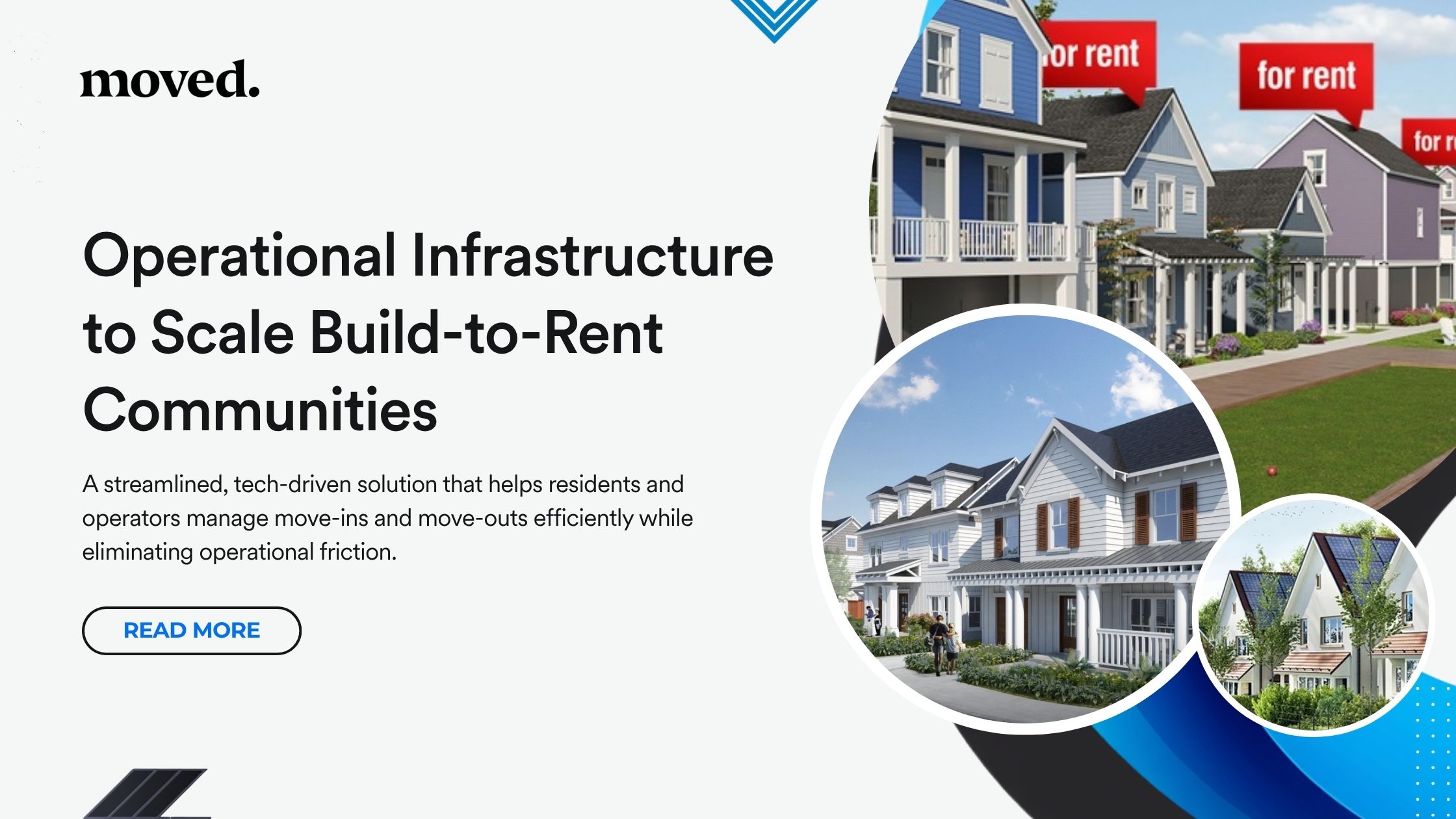
Build-to-Rent portfolios are expanding rapidly. Demand is strong, occupancy is stable, and institutional capital continues to flow into the sector.
Yet many operators struggle when moving from a few communities to a scaled portfolio.
The issue is not growth.
The issue is infrastructure.
Scaling BTR communities requires more than adding units. It requires building systems that support revenue generation, enforce compliance, and maintain operational consistency across properties.
Without this foundation, growth introduces complexity instead of efficiency.
The real problem: growth without infrastructure creates operational friction
At a small scale, BTR operations can function with manual coordination and fragmented systems.
At scale, this breaks down.
Operators begin to experience:
- Increased workload across on-site teams
- Inconsistent resident experiences across communities
- Lack of visibility into compliance and operational tasks
- Missed opportunities to generate ancillary revenue
These issues compound as portfolios grow.
What initially appears as operational inefficiency is actually an infrastructure gap.
Reframing BTR scaling: from operations to infrastructure
To scale effectively, operators need to shift their perspective.
Operations are how work gets done.
Infrastructure is how work gets standardized, automated, and monetized.
This distinction is critical.
Traditional approaches focus on improving workflows. Modern approaches focus on building systems that embed revenue and risk control directly into those workflows.
This is where move infrastructure becomes central.
Move-ins and move-outs are among the most operationally intensive and financially significant moments in BTR communities. When structured correctly, they become revenue-generating events rather than administrative burdens.
To understand how these workflows connect to revenue, explore the move-in and move-out revenue framework
The three pillars of scalable BTR infrastructure
Scaling BTR communities requires alignment across three core pillars.
Revenue generation must come first. Every operational workflow should be evaluated based on its ability to capture value.
Risk mitigation follows. Compliance, insurance verification, and liability control must be embedded into processes.
Operational efficiency supports both. It ensures consistency, reduces manual work, and enables scalability.
This hierarchy reflects how modern platforms are designed to support portfolio growth.
Why move workflows are central to BTR scaling
BTR communities experience frequent resident transitions.
Each move-in and move-out introduces multiple operational tasks and service needs.
Residents coordinate movers, set up utilities, purchase insurance, and manage logistics.
In most portfolios, these activities are disconnected from the operator’s systems.
This leads to:
- Lost ancillary revenue
- Increased coordination effort for on-site teams
- Limited control over compliance
When these workflows are structured into a unified system, they become predictable, scalable, and revenue-generating.
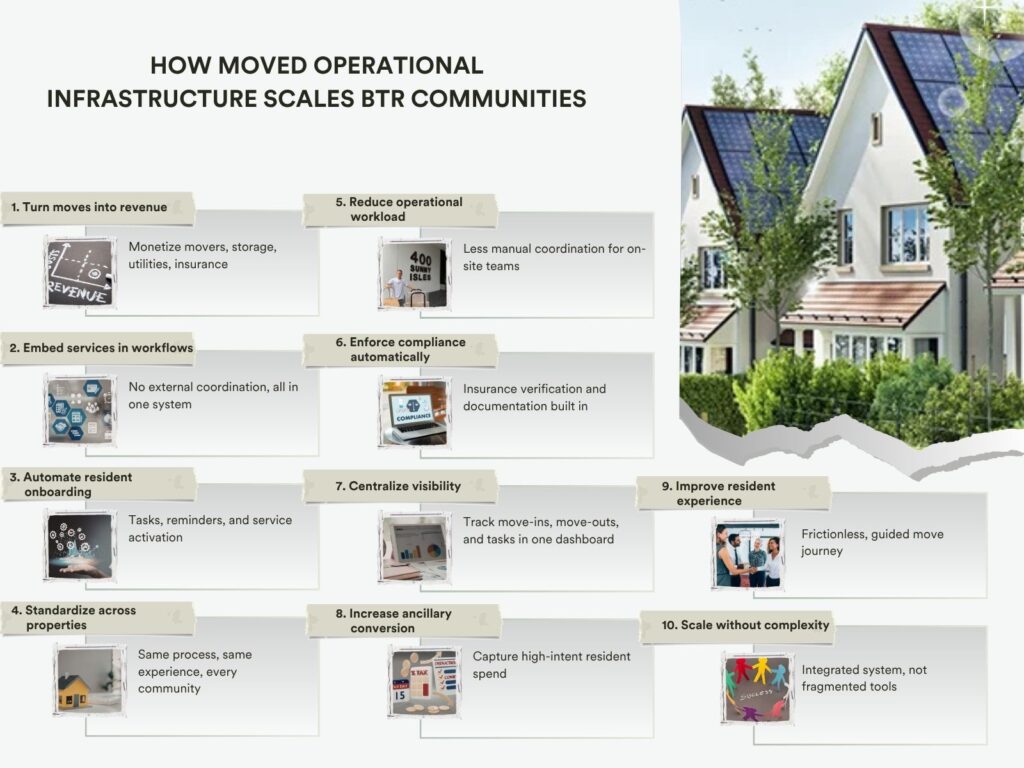
Step 1: Build revenue into the operational foundation
The first requirement for scalable infrastructure is revenue integration.
BTR operators should not treat services like moving, storage, and utilities as external activities.
These are high-intent transactions that should be embedded into the resident journey.
This includes integrating:
- Moving services such as movers, packing, and storage
- Utility activation and connectivity
- Renters insurance and verification
When these services are embedded, operators can capture ancillary income while improving the resident experience.
This approach transforms operational workflows into revenue engines.
Step 2: Standardize workflows across communities
Inconsistent processes are one of the biggest barriers to scaling.
When each community operates differently, it becomes difficult to maintain quality and efficiency.
Standardization is essential.
This involves creating unified workflows for:
- Resident onboarding and move-ins
- Move-outs and transfers
- Compliance and documentation
Standardized workflows ensure that every community operates within the same framework, reducing variability and improving performance.
To see how onboarding can be standardized at scale, review the resident onboarding automation guide
Step 3: Embed compliance and risk management into workflows
As portfolios scale, risk exposure increases.
Manual processes for insurance verification and compliance tracking become difficult to manage.
This creates gaps that can lead to financial and legal issues.
Scalable infrastructure requires embedding these controls directly into workflows.
This includes automated insurance verification, centralized documentation, and consistent compliance enforcement.
When risk management is integrated into the system, it becomes proactive rather than reactive.
Step 4: Reduce operational load through automation
Scaling should reduce operational burden, not increase it.
However, without the right infrastructure, growth often leads to more manual work.
Automation is critical.
This includes automating repetitive tasks such as:
- Resident communication and reminders
- Task tracking and completion
- Scheduling and coordination
Automation allows on-site teams to focus on higher-value activities while maintaining consistency across the portfolio.
Step 5: Create a unified resident experience across all properties
Resident experience is a key differentiator in BTR communities.
However, maintaining consistency across multiple properties is challenging without centralized systems.
A unified experience requires:
- Standardized onboarding processes
- Integrated service offerings
- Consistent communication workflows
When residents interact with the same system across properties, it creates familiarity and trust.
It also improves conversion rates for embedded services.
To understand how this experience is delivered, explore the resident platform overview.
Step 6: Ensure scalability through integration, not fragmentation
One of the most common mistakes operators make is adopting multiple standalone tools.
While each tool may solve a specific problem, together they create fragmentation.
This leads to:
- Data silos
- Inconsistent workflows
- Increased complexity
Scalable infrastructure requires integration.
Systems should connect seamlessly and operate as a unified platform.
This allows operators to maintain visibility and control across the entire portfolio.
Step 7: Move from fragmented tools to connected systems
As BTR portfolios grow, the biggest operational risk is fragmentation.
Many operators adopt multiple point solutions over time. Each tool solves a specific problem, but together they create disconnected workflows.
This leads to inefficiencies that compound at scale.
Teams are forced to switch between systems, data becomes siloed, and visibility across the portfolio decreases.
Scaling efficiently requires consolidation.
Operators need to transition from fragmented tools to connected systems where workflows, data, and services operate within a unified structure.
This is how infrastructure replaces complexity with consistency.
Step 8: Build visibility across the entire portfolio
Visibility is one of the most critical components of scalable infrastructure.
Without it, operators cannot make informed decisions.
At scale, it becomes difficult to track:
- Move-ins and move-outs across properties
- Compliance status and insurance verification
- Completion of operational tasks
This lack of visibility creates reactive operations.
A strong infrastructure provides centralized dashboards and reporting that allow operators to monitor activity across all communities in real time.
This enables proactive decision-making and reduces operational risk.
Step 9: Align infrastructure with revenue performance
Infrastructure should not be evaluated based on functionality alone.
It should be evaluated based on its impact on revenue.
Every system implemented across your BTR portfolio should contribute to:
- Capturing ancillary income
- Increasing conversion during resident transitions
- Reducing revenue leakage
Move workflows are a key driver of this.
When services such as movers, storage, utilities, and insurance are embedded into these workflows, they create consistent revenue streams.
To better understand how these workflows generate revenue, revisit the move-in and move-out revenue strategy
Step 10: Design infrastructure for operational consistency
Consistency is what allows BTR portfolios to scale without increasing complexity.
Without standardized systems, each community operates differently. This creates variability in performance and resident experience.
Infrastructure should enforce consistency by design.
This includes standardizing:
- Resident onboarding and move processes
- Communication workflows
- Compliance and documentation
When these elements are consistent, operators can replicate success across properties.
Step 11: Implement infrastructure with clear ownership and timelines
Implementation is where many scaling initiatives fail.
Even the best systems do not deliver value without proper execution.
Operators need to approach implementation with structure.
This includes defining ownership across teams, setting timelines, and establishing clear milestones.
Implementation should be phased.
Start with pilot communities, validate performance, and then scale across the portfolio.
This reduces risk and ensures that systems are optimized before full deployment.
Step 12: Measure performance and optimize continuously
Scaling is not a one-time effort.
It requires continuous optimization.
Operators should track performance metrics related to:
- Ancillary revenue growth
- Task completion rates
- Compliance adherence
- Resident engagement
These metrics provide insight into how effectively the infrastructure is performing.
They also highlight areas for improvement.
Continuous optimization ensures that the system evolves with the portfolio.
Step 13: Integrate resident experience with operational systems
Resident experience should not operate independently from infrastructure.
It should be embedded within it.
When systems are designed correctly, they guide residents through processes such as move-ins, service selection, and compliance tasks in a seamless way.
This reduces friction and increases engagement.
At the same time, it drives higher conversion for embedded services.
To see how this integration works in practice, explore the resident experience platform.
Step 14: Build infrastructure that supports long-term portfolio growth
The ultimate goal of infrastructure is to support sustained growth.
This requires systems that are flexible, scalable, and aligned with long-term objectives.
Operators should continuously evaluate whether their infrastructure supports:
- Expansion into new markets
- Increased unit count
- Evolving resident expectations
Infrastructure should not limit growth. It should enable it.
To understand how these systems scale across portfolios, refer to the multifamily solutions platform.
The bigger shift: from operations to revenue infrastructure
The BTR sector is evolving.
Operators are moving away from managing individual tasks and toward building integrated systems.
This shift is driven by the need to capture revenue, reduce risk, and scale efficiently.
Moved represents this evolution.
It is a move infrastructure platform that embeds revenue-generating services, including movers, packing, storage, utilities, insurance, and connectivity, directly into the resident workflow.
This approach transforms operational processes into structured revenue systems while maintaining compliance and consistency across the portfolio.
Conclusion: Infrastructure determines scalability
Scaling BTR communities is not about adding more resources.
It is about building the right infrastructure.
When systems are designed to generate revenue, enforce compliance, and standardize operations, growth becomes predictable and sustainable.
Operators who invest in infrastructure gain control over their portfolio.
They reduce complexity.
They increase revenue.
And they create a foundation that supports long-term success.
FAQs
What is the most important factor in scaling BTR communities?
The most important factor is having a strong operational infrastructure that supports revenue generation, risk mitigation, and scalability across the portfolio.
Why do BTR operators struggle with scaling?
Many operators rely on fragmented tools and manual processes, which create inefficiencies and limit scalability as the portfolio grows.
How do move workflows impact BTR scaling?
Move workflows are high-intent moments where residents purchase services. When these workflows are structured, they generate revenue and improve operational efficiency.
What role does automation play in BTR infrastructure?
Automation reduces manual workload, ensures consistency, and allows operators to scale operations without increasing headcount.
How can operators ensure long-term scalability?
By building integrated systems that embed revenue-generating services, enforce compliance, and standardize workflows across all properties.