The NAA Apartmentalize conference is one of the most concentrated environments for PropTech discovery. Hundreds of vendors compete for attention, each positioning their solution as essential for modern multifamily operations.
But the real challenge is not access to vendors.
It is making the right decision.
Most operators leave Apartmentalize with multiple vendor options but no clear framework to evaluate them. This leads to delayed decisions, poor implementation, and ultimately low ROI.
Vendor evaluation is not a tactical activity. It is a strategic function that directly impacts revenue, risk, and long-term portfolio performance.
If approached correctly, Apartmentalize becomes a decision accelerator. If not, it becomes a source of confusion.
You can explore the event context here: Apartmentalize 2026
The core problem: why most vendor decisions fail
Poor vendor decisions are rarely caused by bad technology.
They stem from weak evaluation frameworks.
Most operators evaluate PropTech solutions based on:
- Features and UI
- Ease of use
- Short-term operational benefits
These factors matter, but they are not enough.
They fail to answer the most important question.
How does this solution impact financial performance across the portfolio?
Without this clarity, operators often adopt tools that improve workflows but do not generate revenue or reduce risk.
Over time, this leads to:
- Increased operational complexity
- Limited scalability
- Missed ancillary revenue opportunities
The problem is not the vendor. It is the evaluation criteria.
Reframing vendor evaluation: from tools to infrastructure
To evaluate vendors effectively, you need to shift your perspective.
PropTech is evolving.
Traditional solutions function as tools. They help manage tasks but operate in silos.
Modern solutions function as infrastructure. They integrate into the resident lifecycle and create measurable financial impact.
This distinction is critical.
Infrastructure-level platforms embed revenue-generating services such as movers, storage, utilities, insurance, and connectivity directly into workflows.
This transforms vendor evaluation from feature comparison to financial assessment.
Understanding what matters before you step onto the floor
Before engaging with any vendor, you need clarity on what your portfolio actually needs.
This starts with identifying gaps in your current operations.
Most portfolios experience revenue leakage during resident transitions. Move-ins and move-outs are high-intent moments where residents spend money, but operators often fail to capture that value.
These gaps typically exist because services are fragmented and not embedded into a unified workflow.
To understand how these gaps impact revenue, review the move-in and move-out revenue breakdown.
This context is essential before evaluating any solution.
The foundation of a strong vendor evaluation strategy
Effective vendor evaluation is built on a clear hierarchy.
Revenue generation must be the primary filter.
Risk mitigation should follow.
Operational efficiency should support both.
This order is non-negotiable.
Many vendors position efficiency as the primary value. While efficiency improves workflows, it does not directly increase NOI unless it is tied to revenue or risk reduction.
When evaluating vendors at Apartmentalize, your framework should consistently prioritize financial impact.
What high-performing operators do differently
Top-performing operators approach vendor evaluation with precision.
They do not explore broadly. They filter aggressively.
They enter Apartmentalize with predefined criteria, aligned teams, and a clear understanding of what success looks like.
They focus on solutions that:
- Generate ancillary revenue during resident transitions
- Embed services into operational workflows
- Enforce compliance and reduce liability
This approach reduces noise and accelerates decision-making.
It also ensures that every conversation contributes to a measurable outcome.
Step 1: Evaluate revenue generation first
The most important question you should ask any vendor is simple.
How does this solution generate revenue?
If a vendor cannot clearly explain how their platform creates income, it is unlikely to deliver ROI.
Focus on whether the solution embeds services such as movers, packing, storage, utilities, insurance, and connectivity.
These services represent real spend during the move lifecycle.
When integrated correctly, they become structured revenue streams.
This is where modern platforms differentiate themselves from traditional tools.
Step 2: Assess how services are embedded into workflows
Revenue generation alone is not enough.
You need to understand how services are delivered.
Standalone partnerships do not scale. Embedded workflows do.
The key question is whether the platform integrates services directly into the resident journey or requires manual coordination.
Embedded systems drive higher conversion because they align with resident behavior during high-intent moments.
This also improves the resident experience.
To see how this works in practice, explore the resident platform experience.
Step 3: Evaluate risk mitigation and compliance
Risk is often overlooked during vendor evaluation.
This is a mistake.
Insurance verification, compliance enforcement, and liability management are critical components of portfolio performance.
A strong vendor should provide structured systems for:
- Renters insurance verification
- Documentation and compliance tracking
- Risk visibility across properties
Without these capabilities, operational exposure increases.
Modern platforms integrate these elements directly into workflows, ensuring consistency and control.
Step 4: Analyze scalability across your portfolio
A solution that works for one property but cannot scale across the portfolio has limited value.
Scalability should be evaluated early.
This includes understanding how the platform integrates with existing systems and how it standardizes processes across properties.
You should also assess how quickly the solution can be implemented and how it adapts to different property types.
To understand how scalability connects with automation, review the resident onboarding automation guide.
Step 5: Validate real-world performance
Vendor claims are not enough.
You need to validate performance through real-world outcomes.
This includes understanding how the platform performs across multiple properties and what results it delivers in terms of revenue growth and operational improvement.
This helps you separate marketing narratives from operational reality.
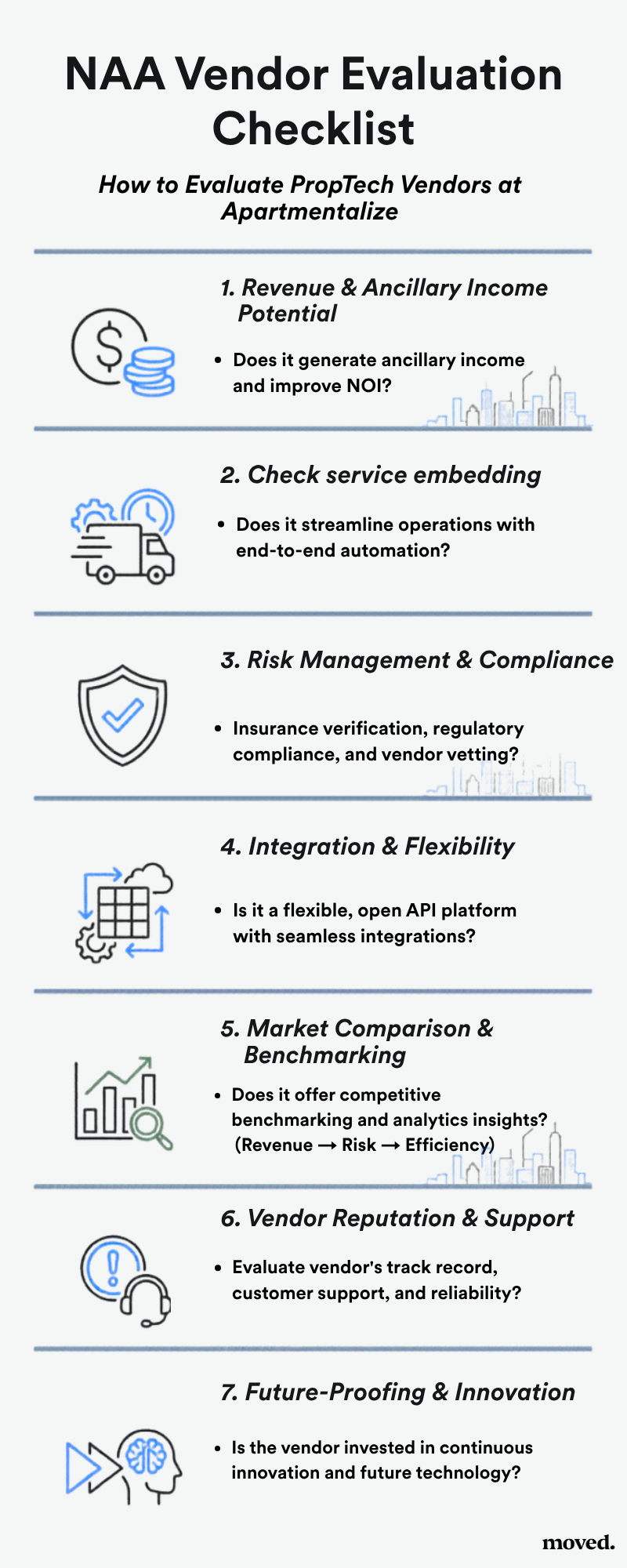
Step 6: Build a structured vendor evaluation checklist
By the time you reach the middle of Apartmentalize, the biggest challenge is not discovery. It is clarity.
You will have spoken to multiple vendors offering similar capabilities. Without a structured checklist, these conversations start blending together, making it difficult to differentiate between high-impact solutions and low-value tools.
This is where a vendor evaluation checklist becomes essential.
Your checklist should not be feature-driven. It should be outcome-driven.
It should allow you to assess whether a vendor contributes to revenue growth, reduces operational risk, and scales across your portfolio.
At a strategic level, every vendor should be evaluated against consistent criteria tied to financial outcomes.
What your vendor checklist should actually measure
A strong checklist is built around impact, not interface.
Instead of asking what the platform does, you should evaluate what the platform delivers.
Your checklist should assess how the solution integrates into the move lifecycle and whether it captures value during high-intent resident interactions.
It should also evaluate how the vendor supports compliance, reduces liability, and standardizes operations across properties.
To understand how these elements connect within the move lifecycle, revisit the move-in and move-out revenue framework.
This context ensures your checklist is aligned with real financial outcomes.
Step 7: Compare vendors using a consistent scoring model
Once you have a checklist, the next step is comparison.
Most operators rely on intuition when comparing vendors. This leads to biased decisions and inconsistent outcomes.
Instead, apply a structured scoring model.
Each vendor should be evaluated across three core dimensions.
Revenue generation should carry the highest weight. This reflects the platform’s ability to monetize services such as movers, storage, utilities, insurance, and connectivity.
Risk mitigation should be evaluated next. This includes insurance verification, compliance enforcement, and liability reduction.
Operational scalability should follow. This measures how effectively the solution can be implemented across your portfolio.
This model ensures that decisions are based on measurable criteria rather than subjective impressions.
Step 8: Identify red flags early
Not all vendors are positioned to deliver long-term value.
One of the most important aspects of evaluation is identifying red flags early in the conversation.
Common indicators of low-impact solutions include:
- Lack of clarity on how revenue is generated
- Overemphasis on features without financial outcomes
- Limited ability to scale across multiple properties
- No structured approach to compliance or risk management
These signals indicate that the solution may improve workflows but will not significantly impact portfolio performance.
Recognizing these early prevents costly implementation mistakes.
Step 9: Prioritize vendors based on portfolio fit
Not every strong vendor is the right fit for your portfolio.
Evaluation should always consider alignment with your operational model, asset class, and strategic goals.
A solution that performs well in isolation may not integrate effectively within your existing systems.
This is why prioritization is critical.
Focus on vendors that align with your revenue strategy and can be implemented without disrupting your current operations.
To understand how solutions scale across portfolios, refer to the multifamily platform overview.
This helps contextualize vendor capabilities within real-world portfolio environments.
Step 10: Turn evaluation into confident decision-making
The purpose of vendor evaluation is not to gather information. It is to make decisions.
Many operators leave Apartmentalize with a shortlist of vendors but delay final decisions due to uncertainty.
This delay reduces momentum and weakens ROI.
To avoid this, your evaluation process should lead to clear outcomes.
Each vendor should fall into one of three categories:
- High priority for immediate follow-up
- Potential fit requiring further validation
- Not aligned with portfolio goals
This structure simplifies decision-making and ensures that your team moves forward with clarity.
Step 11: Transition from selection to implementation
Selecting the right vendor is only part of the process.
Implementation determines whether the expected ROI is realized.
This requires early alignment between internal teams and the vendor.
The transition should include defining timelines, assigning ownership, and setting clear performance expectations.
Solutions that embed services into workflows typically require coordination across operations, leasing, and leadership teams.
This is why alignment is critical.
To understand how implementation connects with onboarding workflows, explore the resident onboarding automation strategy.
Step 12: Build a long-term vendor strategy, not one-time decisions
Apartmentalize should not be treated as a one-time vendor selection event.
It should be part of a broader strategy to build a scalable, revenue-generating infrastructure.
This means continuously evaluating how vendors contribute to:
- Ancillary revenue growth
- Risk mitigation
- Operational consistency
Over time, your vendor ecosystem should evolve into an integrated system where services are embedded directly into the resident journey.
This is how leading operators move from fragmented tools to structured infrastructure.
Connecting vendor evaluation to revenue infrastructure
The ultimate goal of vendor evaluation is not optimization. It is a transformation.
When done correctly, it enables operators to shift from managing processes to building systems that generate revenue and reduce risk.
Moved represents this evolution.
It embeds services such as movers, packing, storage, utilities, insurance, and connectivity directly into the resident workflow, turning move-ins and move-outs into structured revenue opportunities while maintaining compliance and operational control.
This is the benchmark for evaluating modern PropTech solutions.
Conclusion: Better evaluation leads to better outcomes
Vendor decisions define portfolio performance.
At Apartmentalize, the volume of options can either create confusion or drive clarity.
The difference lies in your evaluation framework.
When you prioritize revenue, assess risk, and validate scalability, you move beyond surface-level comparisons.
You make decisions that impact financial outcomes.
You build systems rather than adopt tools.
And most importantly, you position your portfolio to capture value during the most critical moments of the resident lifecycle.
FAQs
What is the most important factor in evaluating PropTech vendors?
The most important factor is the ability to generate revenue. Vendors should demonstrate how their platform captures ancillary income during high-intent moments such as move-ins and move-outs.
Why do many vendor evaluations lead to poor decisions?
Poor decisions often result from focusing on features instead of financial outcomes. Without a structured evaluation framework, operators select tools that improve workflows but do not impact revenue or risk.
How can operators effectively compare multiple vendors?
Operators should use a consistent scoring model based on revenue generation, risk mitigation, and scalability. This ensures objective comparison and better decision-making.
What role does compliance play in vendor evaluation?
Compliance is critical for reducing liability and ensuring operational consistency. Vendors should provide systems for insurance verification and documentation management.
How should operators follow up after Apartmentalize?
Operators should prioritize vendors, schedule follow-up discussions, and initiate pilot programs. This ensures that vendor evaluations translate into real implementation and measurable ROI.