For most multifamily operators, attending the NAA Apartmentalize conference is categorized as a marketing or networking expense.
That framing is flawed.
Apartmentalize is one of the few environments where high-intent vendor discovery, strategic planning, and operational transformation happen simultaneously. The operators who extract ROI from this event do not treat it as attendance. They treat it as a revenue strategy execution window.
The difference is not in the budget. It is an approach.
Without a defined ROI strategy, teams leave with ideas. With the right framework, they leave with revenue infrastructure.
The real problem: why most operators fail to generate ROI
Low ROI from Apartmentalize is not caused by a lack of opportunity. It is caused by a lack of structure.
Most teams attend sessions, explore booths, and collect contacts. But they fail to connect these activities to measurable business outcomes.
This leads to three major gaps.
- No clear definition of what ROI means for the portfolio
- Vendor conversations that focus on features instead of financial impact
- No post-event execution plan
As a result, the event becomes informational rather than transformational.
At the same time, revenue leakage continues across the portfolio.
Move-ins and move-outs remain underutilized despite being high-intent transaction moments. Residents are already spending on movers, storage, utilities, and insurance, but operators are not capturing that value.
This is where ROI is lost before the conference even begins.
Redefining ROI in the context of Apartmentalize
To maximize ROI, you need to redefine how you measure it.
ROI is not:
- Number of vendors met
- Number of sessions attended
- Number of contacts collected
ROI is:
- Increase in ancillary revenue
- Reduction in operational risk
- Improvement in portfolio-wide consistency
This aligns directly with how modern move infrastructure platforms operate.
Instead of treating move workflows as administrative tasks, they embed revenue-generating services directly into the resident journey.
This is the lens through which every decision at Apartmentalize should be made.
Understanding where ROI actually comes from
ROI is generated when high-intent moments are monetized.
In multifamily operations, there are few moments more valuable than resident transitions.
During a move, residents actively purchase:
- Moving services
- Packing and storage
- Utility activation
- Renters insurance
- Internet and connectivity
The problem is not demand. The problem is disconnection.
Most portfolios allow these transactions to happen outside their ecosystem.
This results in:
- Zero revenue participation
- No control over service quality
- Increased compliance risk
To understand how this impacts your operations, review the breakdown of move-in and move-out revenue opportunities
Apartmentalize is where you identify solutions to fix this gap.
Step 1: Set a revenue-driven objective before attending
The first step in maximizing ROI happens before the event.
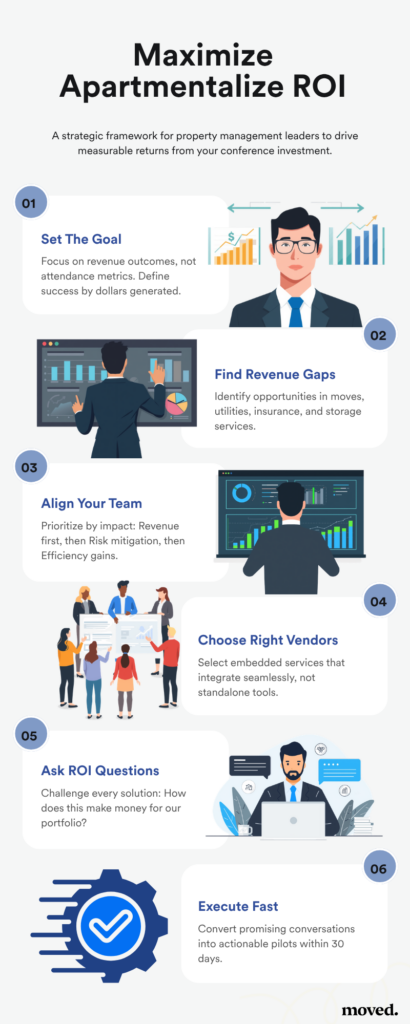
You need a clear objective tied to financial outcomes.
This objective should answer one question.
How will we increase revenue through the move lifecycle?
Without this clarity, every conversation becomes exploratory instead of strategic.
Your objective should be tied to:
- Capturing ancillary income from resident transitions
- Embedding services into operational workflows
- Reducing revenue leakage across properties
This ensures that every interaction at the conference contributes to a measurable goal.
Step 2: Build a vendor evaluation strategy focused on ROI
Most operators evaluate vendors based on usability and features.
This approach limits ROI.
Instead, vendors should be evaluated based on their ability to generate revenue and reduce risk.
At a strategic level, every vendor should be assessed across three dimensions.
Revenue generation should always come first. The solution must demonstrate how it monetizes high-intent moments.
Risk mitigation should come next. This includes insurance verification and compliance enforcement.
Operational efficiency should support the above. It should not be the primary value driver.
This hierarchy aligns with how revenue infrastructure platforms are designed.
Step 3: Focus on high-impact vendor categories
Apartmentalize includes a wide range of solutions. Not all contribute to ROI.
To maximize outcomes, prioritize categories that directly impact revenue.
These include:
- Platforms that embed moving services such as movers, packing, and storage
- Utility and connectivity partnerships integrated into workflows
- Insurance verification systems that reduce liability
- Marketplace-driven solutions that enable ancillary monetization
These categories align with revenue generation and risk mitigation.
Avoid spending excessive time on solutions that focus only on communication or task tracking without a financial impact.
Step 4: Align internal stakeholders before the event
ROI is not driven by individuals. It is driven by alignment.
If your leasing, operations, and leadership teams evaluate vendors differently, decision-making becomes inconsistent.
This leads to delays in implementation and reduced ROI.
Before attending Apartmentalize, align your team on:
- What defines a high-value solution
- What metrics will be used to evaluate ROI
- Who owns each vendor conversation
This ensures that insights collected at the event translate into actionable decisions.
Step 5: Shift conversations from features to financial outcomes
Vendor conversations are where ROI is either created or lost.
Most conversations stay at the feature level. This limits your ability to assess long-term value.
Instead, your discussions should focus on financial outcomes.
Ask how the solution integrates into your revenue model. Understand how services are embedded and monetized. Evaluate how compliance is enforced.
This shift changes the quality of information you receive.
It also makes it easier to compare vendors after the event.
Step 6: Connect ROI with resident experience
Revenue generation and resident experience are often treated as separate priorities.
In reality, they are deeply connected.
When services such as movers, utilities, and insurance are embedded into a seamless workflow, residents experience less friction.
At the same time, operators capture value from these transactions.
To understand how this connection works in practice, explore the resident experience platform
This is where ROI and experience converge.
Step 7: Navigate the event floor with an ROI lens
Once you enter the exhibition floor, your strategy should shift from preparation to validation.
The environment is designed to capture attention. Every booth, demo, and conversation competes for time. Without a clear ROI lens, it becomes easy to engage in discussions that feel valuable but do not translate into measurable outcomes.
Your focus should remain anchored to revenue generation.
Every interaction should answer a simple question. How does this solution improve financial performance across the portfolio?
This requires discipline.
Instead of exploring broadly, move intentionally between pre-identified vendors. Keep conversations structured and focused on outcomes. Avoid being pulled into extended demos that do not align with your core objectives.
High-value vendors will immediately connect their solution to revenue, risk reduction, and scalability. If that connection is not clear, the solution is unlikely to contribute to ROI.
Step 8: Compare vendors using a structured framework
After multiple conversations, differentiation becomes difficult.
Many solutions present similar capabilities on the surface. Without a structured comparison model, decisions become subjective.
To avoid this, evaluate each vendor across consistent criteria.
Focus on how each solution performs across revenue generation, risk mitigation, and operational scalability.
You should be looking for clarity in how revenue is generated. This includes understanding which services are embedded, how transactions are monetized, and how conversion is driven during resident transitions.
At the same time, assess how risk is managed. This includes insurance verification, compliance enforcement, and liability reduction.
Operational scalability should be evaluated last. The solution should demonstrate how it integrates across multiple properties without increasing complexity.
This structured comparison allows you to prioritize vendors based on impact rather than perception.
Step 9: Capture insights in a way that supports decision making
The value of Apartmentalize is not in the volume of conversations. It is in the quality of insights you take back.
Most operators rely on scattered notes and informal summaries. This makes it difficult to translate conversations into decisions.
Instead, your documentation should be consistent and outcome-focused.
After each vendor interaction, capture:
- How revenue is generated through the platform
- What services are embedded within the workflow
- How compliance and risk are managed
This creates a standardized dataset that can be reviewed post-event.
It also allows leadership teams to make informed decisions without needing to attend every conversation.
Step 10: Turn vendor conversations into actionable next steps
The biggest gap in ROI realization happens after the event.
Operators leave with strong conversations but no clear path forward.
To prevent this, every meaningful vendor interaction should end with defined next steps.
These next steps should be tied to implementation, not exploration.
This includes scheduling deeper product walkthroughs, aligning stakeholders, and discussing pilot opportunities.
Without this transition, momentum is lost.
The goal is to move from conversation to evaluation while the context is still fresh.
Step 11: Build a post-event ROI execution plan
Once Apartmentalize concludes, your focus should shift to execution.
This is where ROI is realized.
Start by reviewing all vendor insights through a financial lens. Identify which solutions have the strongest potential to impact ancillary revenue and reduce risk.
From there, create a structured plan that outlines how selected solutions will be evaluated and implemented.
This plan should include timelines, ownership, and expected outcomes.
It should also define how success will be measured across the portfolio.
To understand how move workflows can be transformed into structured revenue systems, refer to the move-in and move-out revenue strategy guide.
Step 12: Integrate solutions into a unified revenue infrastructure
The final step in maximizing ROI is integration.
Adopting isolated tools will not create a meaningful impact. The goal is to build a connected system where revenue-generating services are embedded into the resident journey.
This includes integrating movers, storage, utilities, insurance, and connectivity into a single workflow that operates consistently across properties.
When done correctly, this approach transforms move-ins and move-outs into structured revenue engines.
To see how this aligns with automated onboarding systems, explore the resident onboarding automation framework.
For a broader understanding of how these systems scale across portfolios, visit the multifamily solutions platform.
The bigger shift: from conference ROI to portfolio performance
Apartmentalize should not be viewed as a standalone event.
It is part of a larger shift in how multifamily portfolios operate.
The industry is moving from fragmented workflows to integrated systems that generate revenue, enforce compliance, and scale efficiently.
Operators who recognize this shift use Apartmentalize as a catalyst.
They do not just gather insights. They implement change.
Moved represents this evolution.
It is a move infrastructure platform that embeds revenue-generating services, including movers, packing, storage, utilities, insurance, and connectivity, directly into the resident onboarding workflow. This enables operators to capture value during high-intent moments while maintaining control over compliance and operational consistency.
Conclusion: ROI is determined by execution
Maximizing ROI from Apartmentalize is not about how much you attend. It is about how effectively you execute.
When you approach the event with a revenue-first strategy, aligned teams, and a clear execution plan, the outcome changes.
You move beyond exploration.
You build infrastructure.
You create systems that generate revenue during the most critical moments of the resident lifecycle.
If your goal is to turn insights into measurable outcomes, the next step is to evaluate solutions that align with your portfolio’s financial strategy.
FAQs
How can operators measure ROI from Apartmentalize?
ROI should be measured based on increases in ancillary revenue, improvements in compliance and risk management, and the ability to scale solutions across the portfolio. Metrics should be tied to financial outcomes rather than activity levels.
What type of vendors deliver the highest ROI?
Vendors that embed revenue-generating services such as movers, storage, utilities, and insurance into operational workflows typically deliver the highest ROI. These solutions capture value during high-intent resident interactions.
Why do most operators struggle to generate ROI from conferences?
Most operators focus on features and networking instead of financial outcomes. Without a structured evaluation and execution plan, insights from the conference do not translate into measurable results.
How soon should operators act after Apartmentalize?
Operators should begin follow-up actions immediately after the event. This includes scheduling demos, aligning stakeholders, and initiating pilot programs while insights are still fresh.
How does resident experience impact ROI?
A seamless resident experience increases conversion rates for embedded services such as movers and utilities. This improves both satisfaction and revenue generation, making experience a key driver of ROI.