Onboarding and offboarding don’t happen occasionally. They happen constantly.
Across any meaningful portfolio, moves are one of the few operational events that repeat with both frequency and financial intensity. Every unit turnover triggers a chain of decisions that residents cannot delay. They need to move belongings, set up utilities, secure insurance, and get connected immediately.
That urgency matters.
Because urgency is what drives conversion, residents are not browsing during a move. They are deciding. Quickly.
And yet, most operators never enter that decision window.
Leasing is optimized down to the smallest detail. Pricing, funnels, conversion rates – all tightly managed. Then the lease is signed, and the system shifts into execution mode. At that point, the financial conversation effectively stops, even though the resident is about to spend across multiple categories.
That disconnect is where the opportunity sits.
Revenue leakage does not come from a lack of demand.
The demand already exists. It is predictable, repeatable, and tied directly to the move timeline.
Every resident will arrange some combination of movers, packing, storage, utilities, insurance, and connectivity. Not some residents. All of them. The variation is only in how much they spend and where they spend it.
Right now, that spending happens elsewhere.
External marketplaces, comparison platforms, and service providers step in at the exact moment of need. They capture the transaction because they are present when the decision is made. The property, in most cases, is not.
So the outcome is consistent.
The resident spends.
The operator does not participate.
At the portfolio scale, this is not a minor inefficiency. It is a systematic transfer of revenue away from the property.
Most onboarding workflows were never designed to capture value.
Look closely at how onboarding and offboarding are structured today.
The process is built around completion. Documents submitted. Keys scheduled. Steps checked off. Once everything is done, the workflow is considered successful.
But completion is not the same as value capture.
Residents are making real purchasing decisions during this process, yet the workflow does nothing to guide or retain those decisions within the operator’s environment. The system records that a move is happening, but it does not influence how the move unfolds.
That gap is where value escapes.
Property management systems reinforce this limitation. They are designed to store information, not to shape behavior. They know when a lease is signed. They do not control what happens next.
So execution falls back to manual coordination.
Emails go out. Follow-ups begin. Teams track progress across multiple tools. Some residents move quickly. Others miss steps. Consistency depends on effort, not structure.
Fragmentation creates two problems at once.
It is easy to label this as an efficiency issue. That framing misses the bigger picture.
Fragmentation affects both revenue and risk simultaneously.
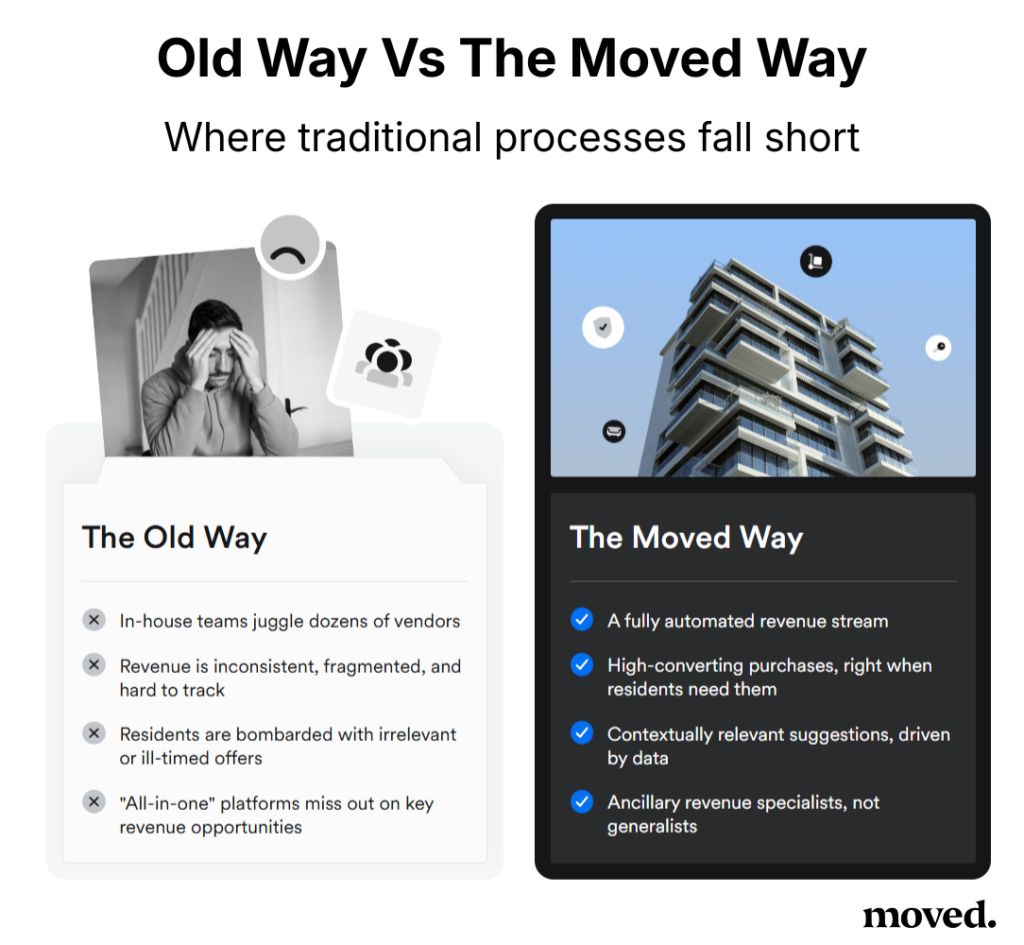
Revenue loss is the more visible side. Service transactions move outside the ecosystem, and the property has no role in them. Movers are booked elsewhere. Utilities are set up independently. Insurance is purchased through external providers.
At the same time, risk quietly increases.
Insurance may not be verified correctly. Documents can sit incomplete. Approvals are delayed or missed. These are not edge cases. They are common outcomes when workflows rely on manual follow-up instead of structured enforcement.
Nothing breaks immediately. That is what makes it harder to detect.
But over time, the impact accumulates. More moves mean more gaps. More gaps mean more exposure.
The issue is not execution quality.
Teams are not underperforming. In most cases, they are doing exactly what the system allows them to do.
The limitation is structural.
Onboarding and offboarding are positioned as administrative tasks rather than financial systems. The goal is to move residents in and out smoothly, not to manage the economic activity tied to those moves.
As long as that framing stays in place, improvements will remain incremental. You can optimize communication. You can reduce delays. You cannot fundamentally change the outcome.
Because the system itself is not designed to capture value.
A different way to look at the move lifecycle.
Instead of separating onboarding and offboarding, it helps to view them as part of a single, continuous process.
Residents arrive. They make decisions. They complete tasks. Eventually, they leave – and repeat a similar set of decisions again. The pattern does not change. Only the direction does.
What changes outcomes is not the behavior. It is how that behavior is structured.
When services are left outside the workflow, every decision becomes an external transaction. When those same services are embedded, the entire flow shifts inward.
Movers, packing, and storage stop being separate actions. Utilities and connectivity are handled within the same system. Insurance is both purchased and verified as part of the process.
Now the move is no longer a collection of tasks. It becomes a controlled environment.
One where decisions are guided, transactions are visible, and outcomes are consistent.
Also Read – Managing High-Volume Move-Ins and Move-Outs in Student Housing
Where Moved fits into this model
Moved is built around that exact shift.
It does not treat onboarding and offboarding as task lists. It treats them as a unified move infrastructure where revenue generation, compliance, and execution are connected.
Services are embedded directly into the workflow. Residents complete what they need without leaving the system. Operators gain visibility into decisions that were previously external.
That is where the financial model changes.
Revenue is no longer dependent on external platforms. It is captured within the move lifecycle itself, consistently, across every property.
You can explore. If you want to see how this experience is structured from the resident side
Revenue is captured when the workflow controls the moment of decision
The difference between missed revenue and captured revenue is not awareness. It is timing and placement.
Residents do not wait to be guided. When a move begins, decisions happen immediately. Movers are booked within days. Utilities are scheduled before arrival. Insurance is secured before keys are picked up. These actions are driven by necessity, not exploration.
If the workflow does not intercept that moment, the decision is made elsewhere.
That is exactly what happens in most onboarding environments today. Instructions are sent. Tasks are listed. But the system does not engage at the point where financial decisions are actually made. By the time the operator re-enters the conversation, the transaction is already complete.
A structured onboarding workflow changes that dynamic.
Instead of reacting after decisions are made, the workflow becomes the environment where those decisions happen. The resident is not navigating between emails, vendor sites, and internal instructions. Everything sits in one place, aligned with the timing of the move.
That shift – subtle on the surface – is what turns activity into revenue.
Onboarding works differently when it begins at the lease event
Most onboarding processes start with a delay.
A lease is signed, then someone initiates communication. Instructions are sent, sometimes immediately, sometimes later. From there, progress depends on follow-ups and reminders. The system moves forward, but not as a single, continuous flow.
That gap matters more than it seems.
It creates a break between intent and execution. Residents begin making decisions before the workflow even starts. By the time onboarding catches up, key transactions have already been completed outside the system.
When onboarding is triggered directly from the lease event, that gap disappears.
The process begins at the exact moment intent is highest. The resident is immediately introduced to a structured workflow, without waiting for manual initiation. There is no transition period where decisions happen in isolation.
Everything starts inside the system.
From that point forward, the workflow becomes the primary interface for the move.
A centralized workflow changes how residents behave
Behavior follows structure.
When onboarding is fragmented, residents build their own path. They search for movers independently. They compare utility providers on external platforms. They complete insurance through whatever channel is most convenient at the time.
When onboarding is centralized, that behavior shifts.
The workflow presents each step in sequence. Not as a checklist, but as a guided progression. What needs to be done is clear. When it needs to be done is clear. More importantly, where it should be done is also defined.
That last part is what changes outcomes.
Because services are embedded directly into the workflow, decisions no longer require leaving the environment. Movers, packing, storage, utilities, and insurance are presented in the same flow as the tasks being completed.
The resident does not have to search.
They act within the system.
And when that happens consistently, across every move, the impact compounds quickly.
Revenue builds through repetition, not one-time conversion
It is tempting to think about ancillary revenue as a conversion problem. Improve the offer, improve the conversion rate, and revenue increases.
That framing is incomplete.
What matters more is consistency.
If service exposure depends on individual teams, timing will vary. Some residents will see options early. Others will see them too late. Some will engage. Others will already have completed decisions elsewhere.
The result is unpredictable performance.
A structured onboarding workflow removes that variability.
Every resident is exposed to the same services, in the same sequence, at the same moment in their decision process. There is no dependency on manual effort. There is no reliance on timing guesswork.
The system handles it.
Over time, that consistency does more than improve conversion. It stabilizes revenue.
Instead of sporadic ancillary income, operators begin to see repeatable patterns tied directly to move volume. Each onboarding event becomes a predictable opportunity rather than an uncertain outcome.
Offboarding is the second revenue window most operators overlook
The focus on onboarding makes sense. It is the beginning of the resident relationship. It receives attention by default.
Offboarding, on the other hand, is often treated as a closing task.
That perspective misses a second, equally valuable transaction window.
Residents moving out go through the same decision cycle again. They need movers. They may require storage. They often need logistics support depending on where they are going next. The urgency is just as high, and the decisions are just as immediate.
Yet in most cases, there is no structured system to capture that activity.
The process focuses on closing out the lease, collecting keys, and finalizing documentation. Service-related decisions are left entirely to the resident, outside the operator’s visibility.
That is another missed revenue stream.
When offboarding is structured in the same way as onboarding, the pattern changes. The workflow does not end with administrative completion. It continues through the move-out process, guiding decisions and capturing transactions within the same environment.
Revenue is not limited to entry. It extends to the exit.
Transfers introduce a third layer of opportunity
There is another category that often goes unnoticed: internal transfers.
Residents moving within the same portfolio already have a relationship with the operator. Retention is higher. Trust is established. The likelihood of engagement is significantly stronger compared to new acquisitions.
Yet the move itself is often treated as a gap between two leases.
Without a connected workflow, service activity during transfers remains unstructured. The resident still needs movers, logistics support, and coordination. The operator still does not participate in those transactions.
A unified system changes that.
Transfers become part of the same lifecycle. The workflow continues across properties, maintaining visibility and consistency. Service decisions remain within the ecosystem instead of resetting externally.
This is where revenue continuity begins to take shape.
Instead of isolated events, onboarding, offboarding, and transfers form a continuous cycle of structured opportunities.
What changes when onboarding and offboarding are treated as infrastructure
At this point, the distinction becomes clear.
When onboarding and offboarding are treated as tasks, outcomes depend on execution. When they are treated as infrastructure, outcomes are defined by the system itself.
Infrastructure introduces consistency.
It ensures that every move follows the same path. Every resident encounters the same structured environment. Every transaction opportunity is presented at the right time.
That consistency is what allows revenue to scale.
Not because individual conversions improve, but because variability is removed from the process.
What was previously dependent on timing, effort, and coordination becomes system-driven.
And once that shift happens, the move lifecycle ceases to be an operational obligation.
It becomes a controlled, repeatable revenue channel.
Risk does not appear suddenly in move operations
In most portfolios, the risk associated with onboarding and offboarding is neither dramatic nor visible. It does not show up as a single failure that immediately draws attention.
Instead, it builds quietly.
A missing insurance policy here. An incomplete document there. A delayed approval that never gets revisited. Individually, these gaps seem manageable. Over time, they create exposure that is difficult to track and even harder to reverse.
The challenge is not awareness. Most operators understand that these risks exist.
The problem is consistency.
When processes rely on manual coordination, outcomes depend on follow-through. Some residents complete everything correctly. Others do not. Some teams enforce every step. Others move forward under time pressure.
That variability is where risk takes hold.
Insurance verification is a financial control, not an administrative step
Renters’ insurance is often treated as a requirement to check off before move-in.
That framing underestimates its importance.
Without verified coverage, the property absorbs exposure. Any incident – damage, liability, or loss – can translate directly into financial impact. The risk is not theoretical. It is immediate.
Manual verification introduces uncertainty.
Policies may be outdated. Coverage details may be incomplete. Documentation can be submitted, but has not been properly reviewed. Even when processes exist, enforcement varies across properties.
Embedding insurance into the workflow changes how it is handled.
Instead of relying on reminders and follow-ups, verification becomes part of the progression. The resident cannot move forward without completing the requirement. Coverage is not assumed. It is confirmed within the system.
This creates a consistent standard across every move.
More importantly, it shifts insurance from a passive requirement to an active financial control.
Documentation gaps are a hidden source of operational exposure
Insurance is only one layer.
Move workflows also involve a range of documents – approvals, confirmations, compliance records, and resident submissions. In fragmented systems, these are often stored across emails, shared drives, or disconnected platforms.
That creates ambiguity.
When information is spread across multiple locations, it becomes difficult to confirm what has been completed. Teams spend time searching, verifying, and reconciling details instead of operating from a single source of truth.
The issue becomes more pronounced when something goes wrong.
Disputes, audits, or compliance checks require clear records. Without centralized documentation, reconstructing the sequence of events becomes time-consuming and unreliable.
A structured workflow eliminates that fragmentation.
All documentation is collected within the same system where tasks are completed. Each step is recorded as it happens. There is no need to cross-reference multiple tools or rely on memory.
This does not just improve organization. It creates defensibility.
When every action is tracked and accessible, the property has a clear record of compliance across the entire move lifecycle.
Standardization reduces variability across the portfolio
One of the more overlooked drivers of risk is inconsistency between properties.
Without a defined system, onboarding and offboarding processes evolve differently at each location. Some teams enforce strict completion standards. Others adapt based on time constraints or resident behavior.
At a small scale, this variation is manageable.
Across a growing portfolio, it becomes a problem.
Different processes lead to different outcomes. Some residents complete every requirement. Others move forward with gaps. Over time, this creates uneven exposure that is difficult to monitor centrally.
A standardized workflow removes that variability.
Every resident follows the same sequence. Every requirement is enforced in the same way. The process does not depend on individual interpretation or effort.
This consistency is what allows risk to be controlled at scale.
Risk management improves when it is embedded, not monitored
Traditional approaches to compliance rely on oversight.
Teams monitor progress, check documentation, and follow up when something is missing. This creates a reactive system where issues are addressed after they occur.
A structured workflow shifts that model.
Instead of monitoring compliance, the system enforces it.
Steps cannot be skipped. Requirements are tied to progression. Documentation is collected as part of the process, not after it. The workflow itself ensures that conditions are met before moving forward.
This reduces the need for intervention.
More importantly, it reduces the likelihood of gaps forming in the first place.
Financial impact becomes visible over time
The benefit of structured risk management is not always immediate.
There is no single moment where risk disappears. Instead, the effect shows up gradually through fewer inconsistencies, fewer missed steps, and fewer situations that require correction.
Across a portfolio, that change is measurable.
Fewer compliance issues. More complete documentation. Greater confidence in insurance coverage. Reduced reliance on manual checks.
Each improvement may seem incremental. Together, they create a more stable operating environment.
That stability has financial value.
It reduces the probability of costly incidents, simplifies audit processes, and ensures that standards are maintained across properties without constant oversight.
Revenue and risk are not separate systems
One of the more important shifts in this model is how revenue and risk interact.
In traditional workflows, they are treated independently. Revenue is tied to leasing and rent. Risk is managed through compliance checks and operational controls.
During the move lifecycle, those two elements intersect.
The same workflow that captures service-related revenue also enforces compliance. Insurance is both a transaction and a requirement. Utility setup affects both resident experience and operational readiness.
When these elements are managed within a single system, alignment improves.
Revenue is captured without losing control. Compliance is enforced without adding friction. The process remains structured from both a financial and operational perspective.
Why this layer matters before scaling operations
Scaling a portfolio without structured risk management introduces compounding complexity.
More properties mean more variation. More variation increases the likelihood of gaps. More gaps lead to higher exposure.
Without a system in place, growth amplifies inconsistency.
A structured move workflow stabilizes that foundation.
It ensures that onboarding and offboarding follow the same standards regardless of property size or location. Risk is managed consistently, not individually.
That consistency becomes critical as portfolios expand.
Because at scale, small gaps do not stay small.
A structured system begins before coordination is needed
In most operations, onboarding or offboarding begins when someone sends instructions. An email goes out. A checklist is shared. From there, the process depends on follow-ups and reminders.
A structured system works differently.
It starts at the moment a key event occurs.
A lease is signed. A move-out notice is submitted. That event immediately activates the workflow. There is no delay, no manual kickoff dependency, and no gap between intent and execution. The process begins exactly when the resident is ready to act.
That timing is not a small improvement. It determines whether decisions occur within the system or outside it.
The resident experience becomes guided, not fragmented
From the resident’s perspective, the difference is noticeable almost immediately.
Instead of navigating multiple emails, portals, and instructions, everything is presented in one place. A single interface shows what needs to be completed, what is already done, and what comes next. There is no need to search for information or piece together steps from different sources.
That clarity changes behavior.
Residents are more likely to complete tasks on time because the sequence is already defined. They are not deciding what to prioritize. The system guides them through it.
More importantly, service decisions happen within that same flow.
When movers, storage, utilities, or insurance are needed, options are already embedded into the workflow. There is no transition to external platforms, no need to compare multiple sources independently. The decision is made in the same place where the task exists.
Execution, revenue, and compliance operate in one continuous flow
What makes this model effective is not just centralization. It is integration.
Tasks are not handled separately from services. Compliance is not treated as a follow-up layer. Everything exists within a single flow where each action connects to the next.
A resident schedules movers, completes insurance, sets up utilities, and coordinates logistics within the same system. At the same time, documentation is collected, requirements are enforced, and progress is tracked automatically.
There is no handoff between systems. No switching between tools. No loss of visibility.
From an operational standpoint, this creates a level of control that is difficult to achieve with fragmented workflows.
From a financial standpoint, it ensures that both revenue and compliance are captured within the same structure.
Data flows back into the system without manual effort
One of the more practical advantages of a structured workflow is how information is handled.
As residents move through onboarding or offboarding, every action is recorded in real time. Task completion, document uploads, and service selections are not stored in separate tools. They are captured within the same system and synced back into the property management system.
That eliminates a common source of operational friction.
Teams no longer need to reconcile data across platforms or manually update status. The information is already aligned with the system they use daily. What they see reflects what is actually happening.
This is where the distinction becomes clear.
The property management system remains the system of record.
The move workflow becomes the system of execution.
Together, they create a closed loop where data and action stay connected.
Explore to understand how this fits within broader portfolio operations.
Operational efficiency improves, but it is not the objective
Once the workflow is structured, efficiency follows naturally.
The need for constant follow-ups is reduced. Teams are not tracking progress across emails or answering the same questions repeatedly. The system handles progression, and visibility is built in.
That changes how teams operate.
Instead of chasing completion, they monitor execution. Instead of reacting to gaps, they work within a process that prevents them. The workload does not disappear, but it becomes more predictable and manageable.
It is important to recognize that this is a byproduct.
The primary outcome is not time saved. It is control gained over revenue, compliance, and execution.
Efficiency is simply what happens when those elements are aligned.
What changes at the portfolio level
At a single-property level, the benefits are clear. Better visibility, more consistent execution, improved resident experience.
At the portfolio level, the impact is different.
Consistency becomes the defining factor.
Every property operates within the same framework. Every resident follows the same structured journey. Revenue opportunities are presented the same way every time. Compliance requirements are enforced without variation.
That consistency creates predictability.
Revenue tied to move activity becomes more stable. Risk exposure becomes easier to manage. Operational performance becomes less dependent on individual teams.
As portfolios grow, this matters more.
Because without structure, growth increases variability. With structure, growth becomes scalable.
The shift from process to infrastructure
At a certain point, onboarding and offboarding stop behaving like processes.
They start functioning as infrastructure.
Processes require management. Infrastructure runs consistently.
When moves are structured this way, they no longer depend on coordination to succeed. The system itself defines how they operate. Every step, every decision, and every outcome follows a controlled path.
That is what enables scale without adding complexity.
Operators are not solving the same problems repeatedly. They are working within a model that already accounts for them.
Conclusion: streamlining is not about reducing steps; it is about controlling outcomes
Onboarding and offboarding have always been critical moments in the resident lifecycle. What has changed is how much value is tied to them.
Residents are already spending during these moments. They are already making decisions that affect both revenue and risk. The only question is where those decisions are captured.
Without structure, they happen externally.
With the right system, they happen within the operator’s environment.
That shift does not require adding more steps. It requires connecting the existing steps.
When revenue, compliance, and execution are aligned within a single workflow, onboarding and offboarding stop being coordination tasks. They become controlled, repeatable systems that contribute directly to portfolio performance.
Moved enables that transition.
It brings together embedded services, automated workflows, and system integration into a single layer that works alongside your existing infrastructure. The result is a move lifecycle that is not only managed but structured for revenue and risk control from the start.
If you want to evaluate how this model applies to your portfolio, contact us
FAQs
How does streamlining onboarding and offboarding increase revenue
Streamlining onboarding and offboarding increases revenue by embedding services such as movers, storage, utilities, and insurance directly into the workflow. Residents complete these decisions within the system, allowing operators to participate in transactions that would otherwise occur externally.
How does this approach reduce financial risk?
Risk is reduced by enforcing compliance within the workflow itself. Insurance verification, documentation, and approvals are completed as part of the process rather than through manual follow-ups, which minimizes gaps and inconsistencies.
Can this work with existing property management systems
Yes. The workflow integrates with property management systems, using lease events to trigger onboarding and offboarding while syncing all activity back into the system in real time.
Is this only effective for large portfolios?
The structure applies at any scale. Larger portfolios benefit from consistency across properties, while smaller portfolios gain control, visibility, and the ability to standardize execution early.
How does this improve the resident experience?
Residents interact with a single, guided workflow instead of multiple disconnected systems. Tasks are clearly sequenced, and service decisions are integrated into the process, making the move simpler and more predictable.