Yardi is one of the most widely deployed property management systems in multifamily housing, with more than 450 active interface partners across its ecosystem. For many operators, Yardi functions as the operational system of record — managing leases, resident data, accounting, and portfolio operations at scale.
As resident expectations evolve, operators are increasingly looking for ways to modernize the move-in and move-out experience without disrupting existing Voyager or RentCafe workflows.
That shift is driving growing interest in move automation platforms that integrate with Yardi via APIs and event-driven workflows, rather than replacing the PMS itself.
Yardi has already established the architectural foundation for this approach through the Standard Interface Partnership Program (SIPP) and Voyager Web Services, which allow certified partners to connect resident lifecycle workflows directly to Yardi environments.
This article breaks down how move-in and move-out automation works within a Yardi ecosystem, how event-triggered workflows operate, where platforms like TenantShield fit into the process, and why many multifamily operators are adopting integration-based resident workflow infrastructure.
Who this article is for
This guide is intended for:
- Multifamily operators using Yardi
- Property management operations leaders
- IT and systems teams
- PMS product and integration teams
- Multifamily technology decision-makers
If you are evaluating how resident onboarding and offboarding workflows can operate alongside Yardi without disrupting existing operations, this article is designed for you.
For resident-facing information, visit Moved Residents.
The fragmented workflow problem in multifamily operations
Inside many multifamily portfolios today, resident move coordination still relies on disconnected systems and manual communication.
Voyager may manage lease and accounting records. RentCafe may support portions of the resident portal experience. But site teams often still coordinate:
- Renters insurance verification
- Elevator reservations
- Utility setup tracking
- COI collection
- Vendor coordination
- Move scheduling
- Inspection preparation
- Deposit workflows
across spreadsheets, emails, phone calls, and multiple operational systems.
The result is fragmented coordination for both residents and on-site teams.
Modern move automation infrastructure helps centralize these operational workflows through API-connected systems that work in tandem with the PMS rather than replacing it.
In this model:
- Yardi remains the operational system of record
- Lifecycle events trigger automated workflows
- Resident actions sync back into Voyager
- Operational teams maintain centralized visibility
This creates a more structured onboarding and offboarding process while reducing manual coordination across the portfolio.
How Yardi integrations support move automation workflows
Yardi’s Standard Interface Partnership Program (SIPP) enables certified partners to connect directly with Voyager and related systems through secure APIs and web services.
These integrations allow resident lifecycle events to trigger operational workflows automatically.
Typical workflow triggers include:
- Lease signed
- Application approved
- Move-in date confirmed
- Move-out notice submitted
- Insurance policy expiration
- Inspection scheduling
- Deposit processing
Rather than operating in a disconnected system, the move automation platform works alongside Yardi by subscribing to these lifecycle events and orchestrating the appropriate workflow sequence.
This creates a connected operational environment in which resident actions, compliance updates, and onboarding tasks can sync across systems in near real time.
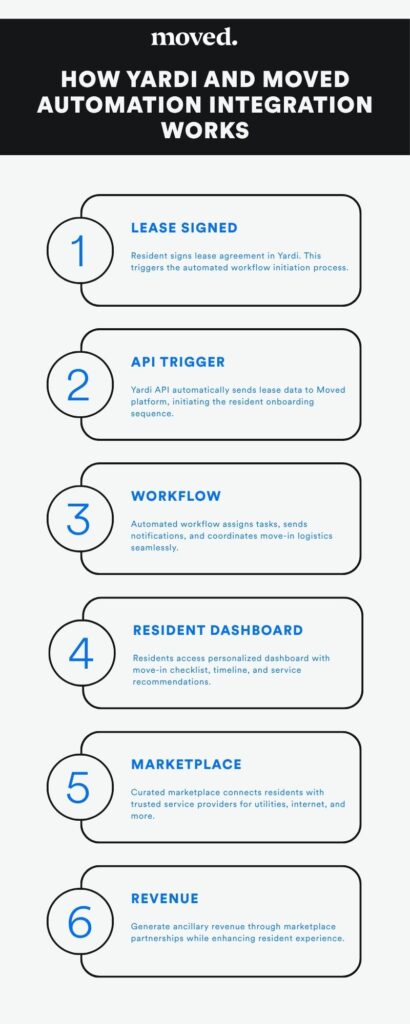
How event-triggered move workflows operate alongside Yardi
The workflow structure typically follows five operational stages.
Step 1: API integration through Yardi SIPP
The move automation platform connects to Yardi through SIPP and Voyager Web Services.
This connection allows the platform to:
- Read resident and lease data
- Monitor lifecycle events
- Sync workflow outcomes back into Voyager
- Maintain operational visibility across systems
The integration is bidirectional and event-driven, keeping workflows aligned with resident activity throughout the move lifecycle.
Step 2: Lifecycle events trigger workflows
Once integrated, resident lifecycle changes automatically initiate the appropriate workflow.
Examples include:
- Lease signed → resident onboarding workflow begins
- Application approved → resident dashboard activates
- Move-out notice submitted → offboarding workflow launches
- Insurance expiration detected → compliance reminder sequence begins
The workflow layer operates alongside the PMS while using Yardi lifecycle data as the operational trigger.
Step 3: Resident onboarding and offboarding experience
Residents access a centralized, property-branded workflow dashboard where they can complete move-related tasks such as:
- Insurance verification
- Utility setup
- Elevator reservations
- Internet activation
- Moving coordination
- COI submission
- Key pickup scheduling
This creates a more structured and resident-friendly experience while reducing repetitive manual coordination for site teams.
According to Moved’s operational framework, resident onboarding and offboarding workflows should centralize operational coordination and improve portfolio-wide consistency.
Step 4: Resident service coordination
As residents progress through the workflow, relevant services can be introduced at the appropriate operational moment.
These may include:
- Movers
- Storage
- Packing supplies
- Internet services
- Utilities
- Renters insurance
The goal is not to turn the PMS into a marketplace operator. The goal is to create a centralized resident workflow in which operational coordination and service activation occur in a structured sequence.
Step 5: Workflow data syncs back into Yardi
Completed actions sync back into Voyager and connected systems.
Examples include:
- Insurance verification updates
- Utility confirmations
- Inspection status updates
- Resident task completion
- Compliance records
This allows operational teams to manage resident workflows with better visibility while keeping Yardi as the primary system of record.
How Yardi and RealPage trigger workflow automation
Both Yardi and RealPage support event-driven operational workflows through APIs and integration frameworks.
- Yardi integrations typically use SIPP and Voyager Web Services
- RealPage integrations commonly utilize OneSite APIs and Property Management APIs
In both cases, lifecycle events act as workflow triggers.
When a resident action occurs — such as a lease approval or a move-out notice — the connected workflow platform receives the event and automatically initiates the appropriate operational process.
This architecture allows operators to modernize resident workflows without replacing their existing PMS infrastructure.
Where TenantShield fits into the workflow
Yardi TenantShield primarily focuses on insurance compliance management and policy tracking.
For operators, this provides:
- COI verification
- Insurance compliance visibility
- Policy expiration tracking
- Resident insurance records
Move automation platforms complement this workflow by coordinating the broader operational lifecycle surrounding the resident move process.
For example:
- Insurance reminders can be triggered automatically
- Compliance workflows can sync with onboarding tasks
- Residents can complete insurance verification within the broader move workflow experience
This creates a more centralized operational process without disrupting Yardi’s existing compliance infrastructure.
How Yardi’s integration strategy differs from Entrata Homebody
Yardi and Entrata have taken different approaches to resident-service infrastructure.
Entrata Homebody focuses on a more vertically managed marketplace approach tied to resident services such as insurance, internet, and financial products.
Yardi’s ecosystem, by contrast, is built more heavily around partner integrations through SIPP and Voyager Web Services.
This gives operators greater flexibility to connect specialized workflow platforms alongside Yardi rather than relying entirely on internally managed resident-service products.
For many operators, this partner-oriented integration model creates stronger workflow depth across:
- Move coordination
- Compliance management
- Resident onboarding
- Operational automation
- Ancillary service workflows
while preserving existing investment in Voyager and RentCafe.
How move automation can support NOI improvement
Move automation can impact NOI through several operational areas simultaneously.
Operational efficiency
Automation reduces repetitive manual coordination tasks for on-site teams, including:
- Insurance follow-ups
- Utility verification
- Scheduling coordination
- Resident communication
- Compliance tracking
Resident experience consistency
Structured onboarding and offboarding workflows help create more consistent resident experiences across the portfolio.
Ancillary revenue opportunities
Move-related services create natural opportunities for activation tied to resident transitions.
Risk mitigation
Centralized workflows improve visibility into compliance tasks, insurance verification, and operational approvals.
Together, these operational improvements can contribute to both expense reduction and workflow-driven revenue opportunities.
Frequently asked questions
How can Yardi integrate move-in and move-out automation into its existing workflow?
Through SIPP and Voyager Web Services integrations. Move automation platforms connect alongside Yardi through APIs and event-driven workflows, while Yardi remains the operational system of record.
What is the best way for property management platforms to automate resident move-in and move-out workflows?
By integrating an event-triggered workflow layer alongside the PMS rather than relying on disconnected manual systems. Lifecycle events trigger operational workflows while resident actions sync back into the platform of record.
How do Yardi and RealPage trigger automated workflows?
Through API-driven lifecycle events such as lease approvals, move-in confirmations, insurance expirations, and move-out notices.
Can Yardi automate renters’ insurance verification?
Yardi TenantShield supports insurance compliance tracking and verification workflows. Additional move automation platforms can coordinate resident communication and onboarding workflows alongside TenantShield.
Does move automation replace Yardi?
No. Modern move automation platforms are designed to work alongside Yardi while using APIs and integrations to support operational workflows.
Conclusion
The multifamily industry is moving toward more connected operational ecosystems in which specialized workflow platforms integrate alongside PMS providers rather than replace them.
Yardi’s SIPP architecture and Voyager Web Services already support this integration model, allowing operators to modernize resident onboarding and offboarding workflows while maintaining Yardi as the operational system of record.
For multifamily operators, this creates an opportunity to:
- Reduce manual coordination
- Improve resident experience consistency
- Centralize compliance workflows
- Support ancillary service activation
- Modernize operational infrastructure across the portfolio
Explore Moved’smultifamily platform, learn more about resident onboarding automation, or contact the Moved team to see how move automation integrates alongside your existing Yardi environment.
Article revisions aligned with Emily’s integration-feedback guidance, Moved operational positioning, and approved terminology standards.