Property management teams have invested heavily in modern property management software over the last decade. Platforms like Yardi, RealPage, and Entrata now manage leasing, accounting, payments, maintenance, and resident records across millions of units.
But even with these systems in place, many property teams still manage move-ins and move-outs manually.
Site teams often coordinate renters’ insurance verification, elevator reservations, utility confirmations, move scheduling, key pickup instructions, and resident reminders through spreadsheets, emails, PDFs, and phone calls. That creates operational delays, inconsistent resident experiences, and additional workload for onsite staff.
This is why many multifamily operators are now evaluating where move automation fits inside their existing PMS stack.
The goal is not to replace existing systems. The goal is to improve the operational layer around resident onboarding and offboarding while keeping core property management software in place.
For operators managing growing portfolios, the move process has become more than an administrative task. It directly affects operational efficiency, compliance tracking, resident satisfaction, and even ancillary revenue opportunities tied to insurance, internet setup, movers, storage, and utilities.
As discussed in this guide on move-in and move-out automation, modern multifamily operations increasingly rely on connected workflows to reduce manual coordination and create greater consistency across properties.
What Yardi, RealPage, and Entrata are designed to do
Modern property management software platforms are built to help operators manage the core functions of multifamily operations at scale. For many portfolios, systems like Yardi, RealPage, and Entrata serve as the operational foundation for leasing, accounting, maintenance, payments, and resident management.
Each platform brings different strengths to property operations.
Yardi
Yardi is widely used across enterprise multifamily portfolios for accounting, lease administration, reporting, and operational management. Many operators also rely on Yardi’s integration capabilities to connect additional systems supporting resident communication, automation, and workflow management.
RealPage
RealPage is commonly used for leasing operations, revenue management, resident data management, and portfolio reporting. Large operators often use RealPage to centralize operational visibility across multiple properties and regions.
Entrata
Entrata is known for its resident-facing tools, leasing workflows, payment systems, and flexible Entrata integrations that support broader operational workflows across multifamily portfolios.
While these platforms are essential to daily property operations, they are primarily designed to function as systems of record. They manage core resident and operational data very effectively, but many move-related workflows still occur outside the platform.
That creates operational gaps during move-ins, move-outs, and resident transfers.
For example, many property teams still manually coordinate:
- Insurance verification
- Elevator reservations
- Utility confirmations
- Resident reminders
- Vendor approvals
- Move scheduling
- Key pickup coordination
This is why many operators are now evaluating dedicated move-workflow solutions that work alongside their existing PMS rather than replacing it.
A growing number of multifamily teams are prioritizing more structured resident onboarding and offboarding workflows because the move process directly affects staffing efficiency, compliance consistency, and resident experience outcomes. This shift is explored further in Moved’s guide to resident onboarding automation.
The operational gap that most PMS platforms do not fully solve
Even with advanced property management software in place, many multifamily teams still manage move-related operations through disconnected workflows.
A resident may sign a lease digitally, but the actual move process often becomes fragmented immediately afterward.
Site teams may still send manual emails for renters’ insurance reminders, track elevator reservations in spreadsheets, verify utility setup through uploaded PDFs, and coordinate move-day logistics through multiple systems that do not communicate with each other.
This creates operational inefficiencies that become harder to manage as portfolios grow.
Common operational challenges include:
- Incomplete renters insurance documentation
- Missed resident tasks before move-in day
- Delayed move-out coordination
- Inconsistent onboarding experiences across properties
- Heavy administrative workload for onsite teams
- Lack of centralized visibility into move status
For many operators, the biggest issue is not leasing activity itself. The challenge begins after the lease is signed.
A leasing agent may spend valuable time answering repetitive resident questions about:
- Utility activation
- Parking instructions
- Elevator booking
- Insurance requirements
- Key pickup timing
- Move-in approvals
When these tasks are managed manually, consistency across multiple communities becomes difficult.
This is one reason many operators are reevaluating how move workflows fit into the broader PMS stack.
Modern move automation platforms help standardize the operational aspects of resident onboarding and offboarding by centralizing communication, task management, compliance workflows, and resident coordination into a single process.
That operational structure becomes especially important for portfolios focused on improving resident satisfaction while reducing manual workload for site teams.
Insurance verification is one area where operators continue to face operational and compliance challenges during resident moves. Moved’s breakdown of renters insurance verification at move-in and move-out explains why many portfolios are prioritizing more standardized workflows around documentation and verification.
Does Yardi handle move-in and move-out automation?
Many property managers ask an important operational question: Does Yardi handle move-in and move-out automation completely on its own?
The answer depends on how much workflow automation a portfolio expects during the resident move process.
Yardi is highly effective at managing core operational data, such as:
- Resident records
- Lease information
- Accounting workflows
- Payments
- Maintenance operations
- Portfolio reporting
However, many multifamily operators still rely on additional systems to manage the operational complexity of resident onboarding and offboarding.
This is where Yardi integration workflows often become important.
For example, many operators want automated workflows for:
- Resident move-in instructions
- Renters insurance verification
- Utility setup confirmation
- Elevator reservations
- Key pickup scheduling
- Move reminders
- Vendor coordination
- Move-out communication
Without a dedicated move workflow layer, many of these tasks are still handled manually by onsite teams.
A connected move automation platform can work alongside Yardi by automatically triggering resident workflows after:
- Lease signing
- Application approval
- Move scheduling
- Notice to vacate
This reduces repetitive communication and gives property teams more visibility into resident progress before move day arrives.
According to the Moved platform materials, invitation workflows can be triggered automatically via PMS integrations, supporting insurance verification, utility documentation, and resident task coordination.
For larger portfolios, the operational value is often less about replacing existing property management software and more about creating consistency across every move workflow.
That consistency becomes increasingly important as operators scale across multiple communities and onsite teams.
Many ownership groups are also evaluating how structured move coordination affects staffing efficiency, operational visibility, and long-term portfolio performance. Moved explores this operational shift further in its article on why asset managers own the move-in and move-out workflow.
Why do many operators add specialized move automation on top of RealPage
Many multifamily operators using RealPage already have strong leasing, accounting, and resident management systems in place. But even with those systems, move coordination often remains highly manual.
That is why many portfolios add a separate move automation layer alongside their existing PMS environment.
One reason is operational consistency.
Large property portfolios often want every resident to experience the same onboarding process across every community. That includes:
- Standardized communication
- Insurance verification workflows
- Move scheduling
- Utility setup coordination
- Move-out procedures
- Resident reminders
Without a centralized workflow system, onsite teams may manage these tasks differently from property to property.
This creates inconsistencies that affect both residents and operations teams.
Many operators also want better visibility into resident progress before move day arrives. Instead of relying on email chains or spreadsheets, dedicated move workflow systems help teams track whether residents have:
- Uploaded insurance documents
- Completed required tasks
- Scheduled elevators
- Confirmed utilities
- Reviewed property instructions
For enterprise operators, this visibility becomes increasingly valuable during busy leasing seasons and high-turnover periods.
Moving automation platforms also helps reduce repetitive administrative work for on-site staff. Automated reminders and centralized workflows reduce the number of manual follow-ups leasing teams need to handle daily.
Importantly, these systems are not designed to replace RealPage. They are designed to support operational workflows around the resident move lifecycle.
That operational layer can also influence the resident experience itself. A fragmented move process often creates frustration before a resident even fully settles into the community.
Moved discusses how onboarding and offboarding experiences influence satisfaction and renewals in its guide on how the move-in and move-out experience shapes resident retention.
Do you need a separate tool for resident onboarding if you use Entrata?
For many multifamily operators, the question is not whether Entrata can support resident workflows. The question is whether the existing workflow is scalable, consistent, and operationally efficient across an entire portfolio.
Entrata already supports many important operational functions, including leasing, payments, resident communication, and property operations. Its broad ecosystem of integrations also allows operators to connect additional platforms that support specialized workflows.
But resident onboarding often includes operational tasks that extend beyond standard leasing workflows.
For example, many property teams still manually coordinate:
- Renters insurance collection
- Utility verification
- Elevator scheduling
- Move-day instructions
- Vendor approvals
- Key pickup timing
- Move-out reminders
On a smaller property, those tasks may be manageable by hand.
In a larger portfolio, manual coordination often places operational strain on on-site teams.
This is why many operators add dedicated move automation systems alongside Entrata rather than trying to force every move workflow into the PMS itself.
A specialized onboarding platform can help standardize resident communication and automate repetitive tasks that consume the leasing and operations teams’ time every day.
It also creates a more consistent resident experience across multiple properties.
For operators focused on operational efficiency, resident satisfaction, and visibility into compliance, the value often comes from centralizing the move process into a single structured workflow.
That workflow becomes especially important during high-turnover periods when onsite teams are already managing leasing activity, resident communication, maintenance coordination, and operational reporting simultaneously.
Many property managers are now prioritizing more connected onboarding systems because fragmented move coordination can directly affect staffing workload and operational performance. Moved explores this shift further in its guide to automating the resident move-in and move-out process.
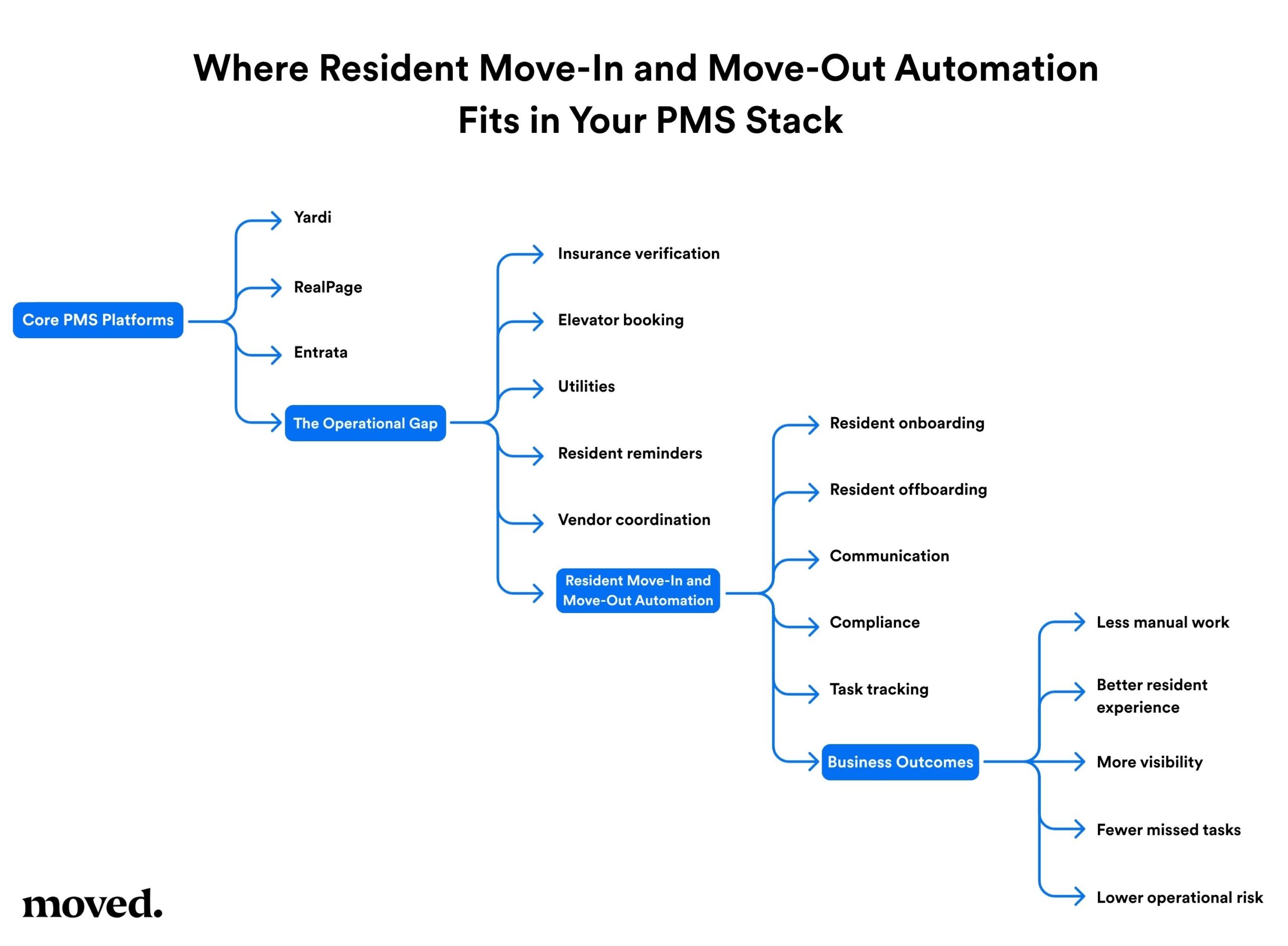
Where Resident Move-In and Move-Out Automation fits inside the PMS stack
The modern multifamily technology stack is becoming more connected.
Most operators no longer rely on a single platform to handle every operational workflow. Instead, property teams use specialized systems that work together to improve leasing operations, resident communication, compliance tracking, and operational visibility.
In this structure, property management software remains the operational foundation of the portfolio.
The PMS manages:
- Resident records
- Lease data
- Accounting
- Payments
- Maintenance workflows
- Reporting
Resident Move-In and Move-Out Automation sits above that operational layer, managing the resident move-in and move-out experience.
Instead of replacing the PMS, a Resident Move-In and Move-Out Automation platform helps coordinate workflows surrounding:
- Resident onboarding
- Resident offboarding
- Transfers
- Compliance tasks
- Resident communication
- Vendor coordination
A modern multifamily operations stack
| Layer | Primary Function |
| Property management software | Leasing, accounting, and resident records |
| CRM and leasing systems | Lead and leasing management |
| Resident Move-In and Move-Out Automation | Resident onboarding and offboarding |
| Vendor services | Movers, utilities, internet, insurance |
| Resident communication tools | Notifications, reminders, approvals |
This structure allows each system to focus on what it does best.
For example, the PMS may automatically trigger a resident onboarding workflow after lease execution or upon receipt of a notice to vacate. The Resident Move-In and Move-Out Automation layer then guides residents through required tasks while giving onsite teams centralized visibility into approvals, scheduling, and resident progress.
According to the Moved platform documentation, workflow automation can include renters’ insurance verification, elevator scheduling, utility setup confirmation, operational calendars, and centralized resident tasks.
For property teams, the operational outcome is often:
- Fewer missed tasks
- Reduced manual communication
- Better visibility into resident onboarding and offboarding
- More consistent workflows across properties
- Lower administrative workload for onsite teams
As multifamily portfolios continue to scale, many operators are treating resident onboarding and offboarding as core operational processes rather than as disconnected administrative tasks.
That operational shift is also closely connected to NOI performance and operational efficiency across larger portfolios. Moved discusses this further in its article on how to increase multifamily NOI without raising rent.
Why resident onboarding impacts retention, operations, and revenue
For many multifamily operators, resident onboarding is no longer viewed as a simple administrative process.
The move-in experience directly affects residents’ perceptions of the property before they fully settle into the community. Delays, missing communication, unclear instructions, or manual coordination problems can create frustration early in the resident relationship.
That is why many operators are investing more heavily in Resident Move-In and Move-Out Automation workflows that create a more organized and consistent experience.
A fragmented onboarding process can lead to:
- Increased resident complaints
- More support requests for onsite teams
- Delayed move-ins
- Missing compliance documentation
- Operational bottlenecks
- Lower resident satisfaction
At the same time, onsite teams often experience additional administrative pressure when move workflows are handled manually across multiple systems.
Leasing teams may spend hours coordinating:
- Insurance reminders
- Elevator approvals
- Utility confirmations
- Move-day scheduling
- Vendor communication
- Resident follow-ups
As portfolios scale, those operational inefficiencies become more expensive.
This is one reason many operators now view resident onboarding and offboarding as an operational performance issue rather than only a leasing workflow.
The resident move process also creates important ancillary revenue opportunities tied to:
- Renters insurance
- Internet setup
- Utility activation
- Professional movers
- Packing services
- Storage solutions
When these workflows are centralized, operators gain better visibility into both resident progress and operational activity during the move lifecycle.
Moved positions this operational model as part of a broader revenue and risk management strategy for multifamily operators.
Many operators are also evaluating how resident onboarding affects long-term portfolio performance, resident satisfaction, and operational consistency across communities. This topic is explored further in Moved’s article on what ancillary revenue is in multifamily.
What property managers should evaluate before choosing a Resident Move-In and Move-Out Automation platform?
Not every Resident Move-In and Move-Out Automation platform is built the same way.
Some systems focus only on basic task checklists, while others are designed to support broader operational workflows, including resident onboarding, compliance tracking, communication, and portfolio-wide visibility.
For property managers evaluating new operational systems, the goal should be to find a platform that integrates with existing property management software without adding additional complexity for on-site teams.
Before selecting a platform, operators should evaluate several key areas.
Integration compatibility
The platform should support integrations with existing property management software platforms such as Yardi, RealPage, and Entrata.
Strong integration workflows help reduce duplicate work and improve operational visibility across systems.
Resident experience simplicity
Residents should be able to complete onboarding and offboarding tasks easily from any device.
Many operators now prefer web-based workflows that do not require residents to download another app. According to the Moved platform materials, reducing app friction is a major factor in improving onboarding engagement.
Operational visibility
Property teams should have centralized visibility into:
- Insurance verification status
- Move scheduling
- Pending approvals
- Resident task completion
- Elevator reservations
- Move-out coordination
Workflow automation
A strong Resident Move-In and Move-Out Automation platform should reduce repetitive manual work by automating:
- Resident reminders
- Task notifications
- Compliance tracking
- Scheduling workflows
- Approval coordination
Scalability across portfolios
Operational consistency becomes increasingly important as portfolios grow.
Property managers should evaluate whether the platform can support standardized onboarding and offboarding workflows across multiple communities while still allowing flexibility at the property level.
For many operators, the long-term value comes from reducing operational friction while improving consistency for both residents and onsite teams.
Teams evaluating operational improvements across larger multifamily portfolios can also explore Moved’s overview of multifamily resident operations workflows.
Conclusion: The future of multifamily operations is connected, not disconnected
Multifamily operations are becoming increasingly connected.
Property management software platforms like Yardi, RealPage, and Entrata continue to serve as critical operational systems for leasing, accounting, payments, and resident management.
But resident onboarding and offboarding introduce a different operational challenge.
The move process involves communication, scheduling, compliance verification, vendor coordination, and resident task management across multiple touchpoints. When those workflows remain disconnected, onsite teams often absorb the operational burden through manual coordination.
That is why more operators are investing in Resident Move-In and Move-Out Automation systems that work alongside existing PMS platforms instead of attempting to replace them.
For many portfolios, the long-term operational value comes from:
- More consistent resident onboarding
- Reduced manual workload
- Better compliance visibility
- Improved resident experience
- Centralized move coordination
- Stronger operational efficiency across communities
As multifamily portfolios continue to scale, connected operational workflows are becoming increasingly important for both resident satisfaction and onsite team performance.
The future of multifamily operations is not about replacing core systems. It is about connecting the right systems to create a more efficient resident lifecycle experience from move-in through move-out.
Operators looking to improve resident onboarding, operational consistency, and portfolio-wide workflow visibility can learn more through Moved’s resident operations platform or connect directly with the team through the Moved contact page.
Frequently asked questions
Does Yardi handle move-in and move-out automation?
Yardi supports many important operational workflows related to leasing, accounting, resident records, and property management. However, many operators still use additional Resident Move-In and Move-Out Automation platforms to manage onboarding workflows, insurance verification, resident communication, elevator scheduling, and move coordination more efficiently.
What is the best Resident Move-In and Move-Out Automation platform that integrates with RealPage?
The best platform depends on the portfolio size, operational complexity, and workflow goals. Many multifamily operators look for platforms that integrate with RealPage while helping automate resident onboarding, compliance tracking, move scheduling, and resident communication across properties.
Do I need a separate resident onboarding platform if I use Entrata?
Many Entrata users still add specialized resident onboarding and offboarding systems to reduce manual coordination for on-site teams. These platforms can help centralize insurance verification, utility confirmations, resident reminders, approvals, and operational visibility during resident moves.
Why are multifamily operators investing in Resident Move-In and Move-Out Automation?
Many property teams are trying to reduce repetitive manual tasks while improving consistency across resident onboarding and offboarding workflows. Resident Move-In and Move-Out Automation can help improve operational visibility, simplify communication, reduce compliance gaps, and create a more organized resident experience.
Can Resident Move-In and Move-Out Automation improve resident retention?
For many operators, the move experience plays an important role in resident satisfaction. Clear communication, organized onboarding workflows, and smoother move coordination can improve the resident experience early in the lease lifecycle, potentially positively affecting long-term retention and satisfaction.
How does Resident Move-In and Move-Out Automation support operational efficiency?
Automation helps reduce manual administrative work for onsite teams by centralizing:
- Resident communication
- Task reminders
- Insurance verification
- Move scheduling
- Vendor coordination
- Compliance workflows
This allows property teams to manage resident onboarding and offboarding more consistently across larger portfolios.