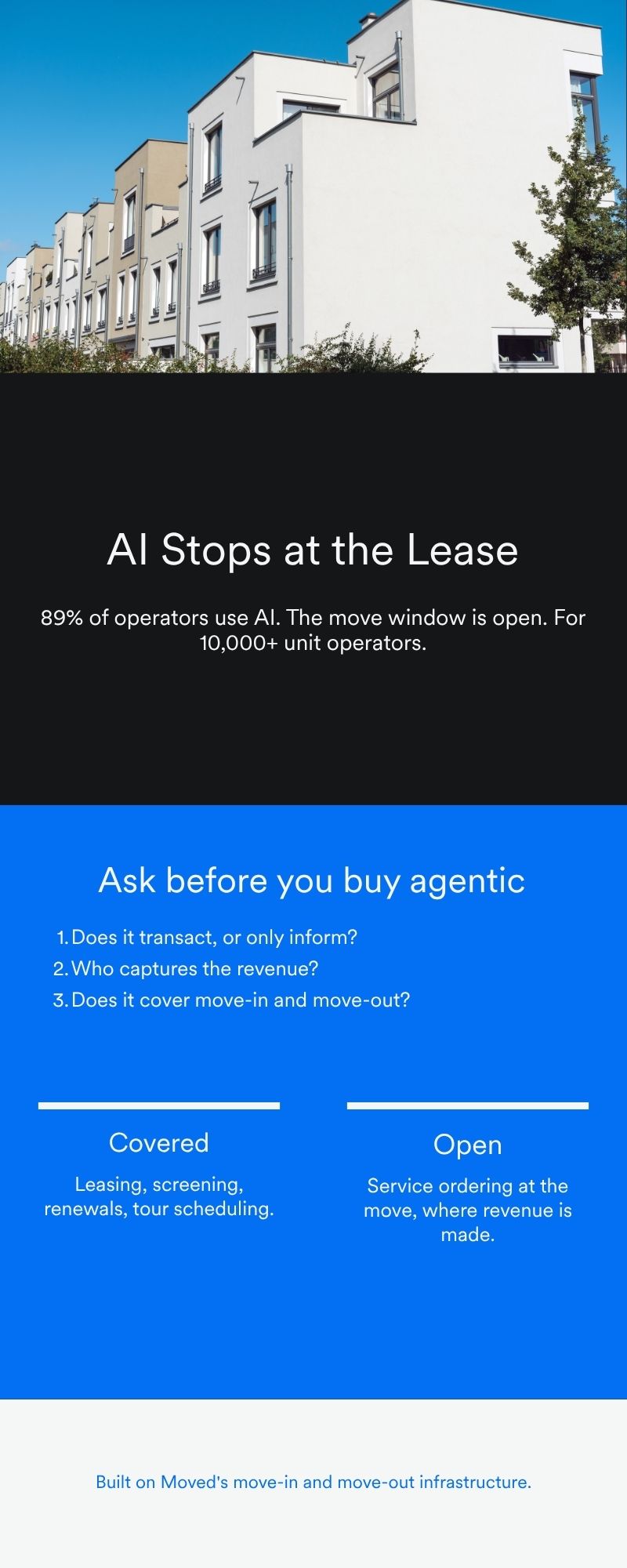
Almost every multifamily operator now uses AI, and almost all of it points at leasing. Tour scheduling, lead qualification, renewal outreach, and screening are well covered. The move itself, where a resident orders movers, packing, storage, utilities, and insurance, is largely untouched by the same technology.
That gap matters because the move window is where non-rent revenue is created. An industry that has automated the path to a signed lease and left the path from lease to move-in manual has automated the cost side of the funnel and skipped the earning side. This article covers where AI adoption actually stands, why service ordering at the move is the untouched ground, and what operators in residential real estate should require before buying anything labeled agentic.
Where adoption actually stands
The headline number is close to saturation. A survey of 350 United States multifamily decision-makers found that 89 percent of operators now use AI in their operations, reported in the 2026 State of AI in U.S. Multifamily. Adoption climbed from 21 percent in 2024 to 34 percent in 2025 before reaching that level, which is one of the faster technology curves this industry has run.
Depth tells a more useful story than breadth. Only about a third of operators have fully embedded AI into daily operations, and adoption skews heavily by portfolio size: 47 percent of operators managing more than 5,000 units use AI against 28 percent of the smallest, per the same research covered in EliseAI’s report on multifamily AI adoption. Most operators have AI somewhere. Far fewer have it running a workflow end to end.
The reported returns cluster where the tools were pointed. Among operators actively using AI, 85 percent have seen measurable improvements in lead-to-lease conversion and 77 percent report moderate to significant reductions in operating expenses. Both are leasing-funnel and cost outcomes. Neither measures non-rent revenue, because almost nothing in the current tool set is aimed at it.
The revenue case for automating the move
Between lease signature and key handoff, a resident makes a short sequence of purchasing decisions: who moves them, whether they need packing help, whether anything goes into storage, which utility providers to activate, and which insurance policy satisfies the lease. Every one of those is a transaction, and every one currently happens somewhere the operator can see or somewhere the operator cannot.
This is the difference between automating a cost and automating an earning. Lead qualification reduces the labor required to fill a unit. Automated service ordering at the move creates income that did not exist, which is why it belongs first in any evaluation. Moved’s work with large operators is built around a target of $15 per unit per month in non-rent revenue, and that figure only compounds when the move runs as one instrumented flow rather than a set of emailed reminders. The mechanics are covered in the move-in and move-out revenue workflow.
Efficiency follows, and it is real. Coordinating movers, dock and elevator bookings, utility activation, and insurance verification by hand consumes site-team hours at exactly the point in the month when leasing is busiest. Automating that sequence returns those hours. The order matters though: the revenue is the reason, the hours are the dividend.
What agentic service ordering changes
AI-native commerce is shifting how people buy. Assistants are increasingly the interface through which a consumer researches and orders services, and a resident preparing to move is exactly the profile that behaves this way. For operators, that raises a question worth settling before it settles itself.
If a resident asks an assistant to arrange their move, the operator is in one of two positions. Either the property’s own service flow is where that request resolves, with the operator’s vendors, pricing, and revenue share intact. Or the request resolves in the open market, and the move happens around the property rather than through it. The outcome is decided by whether the operator has an instrumented flow at that moment.
Nothing about that requires predicting how the assistant market develops. It requires owning the moment. A property that already presents movers, packing, and storage inside a structured move flow is positioned regardless of which interface the resident starts from. A property that relies on a PDF checklist emailed at lease signing is not.
What to require before buying anything called agentic
The word is doing heavy lifting in this market right now. Five questions separate a real workflow from a chat layer on top of an existing product.
| Question | What a weak answer looks like | What a strong answer looks like |
|---|---|---|
| Does it transact, or only inform? | Answers resident questions about moving | Completes a booking and records the transaction |
| Who captures the revenue? | Unclear, or the vendor keeps the take rate | The operator’s revenue share is explicit |
| Does it write back to the PMS? | Read-only, reconciled manually | Verified write-back with attribution intact |
| Does it handle move-out? | Move-in only | Move-in and move-out as one flow |
| Does it verify compliance? | Separate insurance tool | Insurance verification inside the same step |
The compliance line is the one most often skipped in demos. Verifying renters insurance at the move mitigates the financial risk of an uninsured resident-caused loss, and it only creates leverage when it sits in the sequence that releases keys. A tool that automates service ordering while leaving verification in a separate system has automated the easy half.
Where this leaves the operator
The competitive read is straightforward. Leasing AI is a contested, well-funded category where the incumbents are strong and the differentiation is thin. The move window has almost no coverage, sits closer to revenue, and is the part of the resident lifecycle the operator actually controls end to end.
Traditional tools focus on task tracking and administrative coordination. Moved embeds revenue-generating services and insurance verification directly into the workflow, which is what makes automated service ordering at the move possible rather than aspirational. Operators standardizing this across a portfolio can see how the flow is assembled in the guide to resident onboarding automation, and how a move infrastructure built for multifamily operators keeps the transaction, the record, and the resident experience in one place.
Frequently asked questions
How many property management companies use AI?
A 2026 survey of 350 United States multifamily decision-makers found 89 percent of operators use AI in some form, though only about a third have fully embedded it into daily operations.
What is AI mostly used for in property management today?
Leasing-funnel work: lead qualification, tour scheduling, renewal outreach, and screening. Reported gains concentrate there, with 85 percent of AI users citing better lead-to-lease conversion.
Does portfolio size affect AI adoption?
Substantially. Roughly 47 percent of operators managing more than 5,000 units use AI, against 28 percent of the smallest operators.
What does agentic service ordering mean at the move?
A flow that completes transactions rather than answering questions: booking movers, packing, and storage, activating utilities, and verifying insurance, with the record written back to the system of record.
Why automate the move rather than more of leasing?
Leasing automation reduces the cost of filling a unit. Move automation creates non-rent revenue, and the move window is the part of the lifecycle with almost no competitive coverage.
Own the moment the resident transacts
If your AI roadmap stops at the signed lease, the most commercially valuable moment in the resident lifecycle is still running on email reminders. To see how service ordering, utility activation, and insurance verification run as one automated move-in and move-out workflow across a 10,000+ unit portfolio, contact Moved.