A holding deposit is money an approved applicant pays to take an apartment off the market until the lease is signed or the move-in date arrives. If the applicant moves in, the deposit is usually credited to the first month’s rent or the security deposit. If the applicant backs out, whether the property can keep it depends on state law and the written terms given at the time of payment.
Across a 10,000+ unit portfolio, holding deposits are taken at hundreds of leasing offices, often with different terms. This guide covers what state law requires, how a holding deposit differs from a security deposit, a written policy your team can adopt, and how to connect the deposit to a structured move-in and move-out process in residential real estate.
Why The Holding Deposit Matters To The Move-In Date
A holding deposit is the first commitment a new resident makes. It locks in a move-in date, which sets the deadline for the make-ready, the utility start, and every service the resident will need on day one.
When that commitment falls through, the unit goes back on the market. Turnover has cost about $3,872 per resident, according to an earlier Zego report covered by Multifamily Dive, including marketing, repairs, concessions, and lost rent, so every lost week of a held unit adds to that figure.
A clear policy protects both sides. The applicant knows exactly when the money is refunded or applied, and the property knows when it can release the unit to the next applicant.
Holding Deposit vs. Security Deposit
| Question | Holding deposit | Security deposit |
|---|---|---|
| When it is paid | After approval and before the lease is signed or the move-in date | At lease signing or move-in |
| What it secures | The applicant’s promise to sign the lease and move in | Unpaid rent, damage beyond normal wear and tear, and other lease obligations |
| What happens at move-in | Credited to the first month’s rent or the security deposit, where state law requires | Held through the tenancy |
| When it can be kept | Only under the written conditions given at payment and state law | Only for lawful deductions after move-out |
A state’s definition of security can also reach other charges collected at the start of a tenancy. California Civil Code section 1950.5, for example, defines security broadly, caps it at one month’s rent for most landlords, and bars any lease provision calling security nonrefundable, so review California holding deposit terms with counsel.
What State Law Says About Holding Deposits
Some states regulate holding deposits directly, and others restrict any charge collected before a tenancy begins. The three examples below show how different the rules can be.
Washington
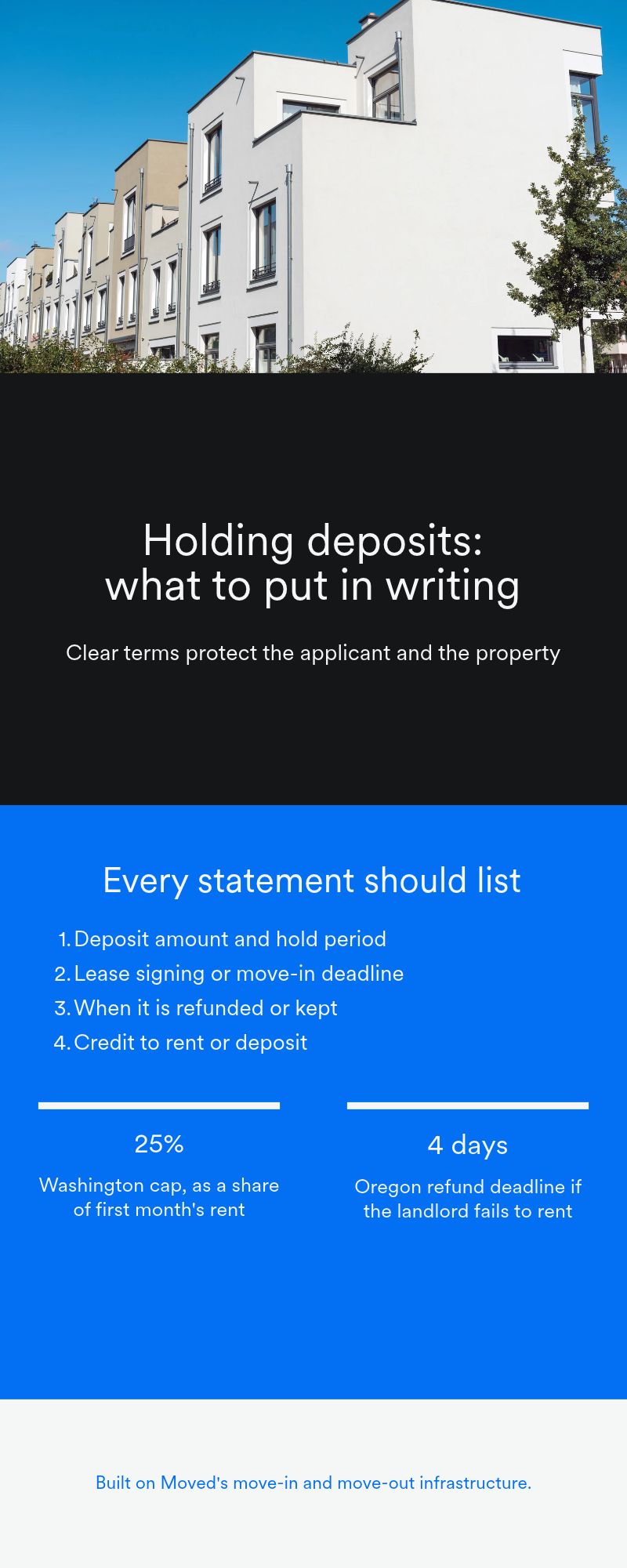
Under RCW 59.18.253, a landlord who charges a fee or deposit to hold a unit after offering it to an applicant must give a receipt and a written statement of the conditions under which the deposit may be kept, immediately upon payment. The deposit may not exceed 25 percent of the first month’s rent.
If the applicant moves in, the deposit must be credited to the first month’s rent or the security deposit. If the applicant does not move in, the landlord may keep up to the full amount only as the written statement allows, and the law prohibits any fee or deposit for being placed on a waiting list.
The deposit may not be withheld if the unit fails a tenant-based rental assistance inspection. A landlord who violates the section can owe the amount of the deposit plus up to twice that amount, and the prevailing party may recover court costs and attorneys’ fees.
Oregon
ORS 90.297 allows a deposit to secure the execution of a rental agreement only after the application is approved and before the agreement is signed. The landlord must give a written statement of the rent, fees, and deposits, the terms of the agreement to sign, and the conditions for refunding or keeping the deposit.
If the lease is signed, the deposit is applied to amounts due or refunded immediately. If the applicant fails to sign as agreed, the landlord may keep it, and if the landlord fails to rent as agreed, the deposit must be returned within four days, with a remedy of the deposit plus $150 for violations.
New York
New York Real Property Law section 238-a bars landlords from demanding any payment, fee, or charge before or at the beginning of a tenancy, other than those provided for by statute or regulation and background and credit check fees of no more than the actual cost or $20, whichever is less. Review any New York holding deposit practice with counsel before collecting one.
A Holding Deposit Policy For Multifamily Operators
- Collect a holding deposit only after the application is approved and the unit is offered.
- Set the amount within each state’s limit and apply the same amount to every approved applicant for the unit type.
- Give a written statement at payment that lists the amount, the hold period, the move-in or lease-signing deadline, and the conditions for refund or retention.
- Issue a receipt immediately, by the method the applicant chose.
- Credit the deposit to the first month’s rent or the security deposit at move-in, and show the credit on the move-in statement.
- If the property cannot deliver the unit, refund the deposit within the state deadline or sooner.
- Record every hold, refund, and retention with the reason, by property.
Consistency matters for fair housing as well as accounting. The same amount, terms, and deadlines should apply to every approved applicant for the same unit type, and any exception should be documented.
Common Holding Deposit Mistakes
- Taking a deposit before the application is approved, or to place someone on a waiting list.
- Giving no written terms, or terms that do not say when the deposit can be kept.
- Charging more than the state allows, such as more than 25 percent of the first month’s rent in Washington.
- Forgetting to credit the deposit at move-in, so the resident pays twice.
- Keeping the deposit when the property, and not the applicant, caused the lease to fall through.
- Leaving the hold open with no deadline, so the unit sits off the market.
The Revenue Case: The Holding Deposit Starts The Move-In
Once the deposit is paid, the property has a confirmed resident and a move-in date. That is the right time to offer movers, packing, and storage, because the resident is planning the move and comparing costs.
The move-in and move-out revenue workflow sends those services along with the lease documents and move-in instructions. The same flow can schedule utility activation so power and water are on when the resident arrives.
The deposit date also feeds the make-ready schedule. Moved’s apartment make-ready checklist shows how to set turn tasks against a confirmed move-in date.
A Strong First Impression: Paylode, a Moved Company
The weeks between the holding deposit and move-in are when a new resident forms a first view of the community. A welcome that offers something of value sets the tone for the lease.
Paylode is a Moved company. Moved acquired Paylode in November 2025, adding a perks and rewards platform that helps brands increase loyalty and retention through personalized perks and action-based rewards. Zego’s 2026 Resident Experience Management Report found that 31 percent of renters would be much more likely to renew if their community offered a renter rewards program.
Pairing perks with the welcome letter to new tenants gives the resident a reason to engage before the first rent payment is due.
Disclosure And Insurance Before Move-In
A holding deposit is one of several charges an applicant sees before move-in, and each should be disclosed with the others. The Federal Trade Commission’s advance notice of proposed rulemaking on rental housing fees asks about fees charged at the beginning or end of a lease term, and Moved’s guide to the FTC rental fee rulemaking covers how to present those charges in one place.
The same window is the best time to confirm the resident’s insurance. Moved’s guide to capturing renters insurance requirements at move-in explains how to verify a policy before keys are released.
Running Holding Deposits Across A 10,000+ Unit Portfolio
- One written holding deposit statement per state, with the amount limit and refund terms built in.
- Deposits accepted only through the approved payment channel, with automatic receipts.
- A hold deadline on every unit, with automatic release when the deadline passes.
- Credits applied to the first month’s rent or security deposit and shown on the move-in statement.
- Refunds tracked against each state’s deadline.
- Holds, conversions to leases, refunds, and retentions reported by property.
Traditional tools focus on task tracking and administrative coordination. Moved embeds revenue-generating services and insurance verification directly into the workflow, transforming move coordination into structured revenue infrastructure.
Moved is a move infrastructure platform that embeds revenue-generating services, including movers, packing, storage, insurance, utilities, and connectivity, directly into the resident onboarding workflow. It helps property operators increase ancillary income while mitigating compliance risk, and the guide to resident onboarding automation shows how that workflow is built.
For residents, clear deposit terms are part of the resident experience from the first payment. For operators, Moved for multifamily operators shows how the same process runs across a portfolio.
Frequently Asked Questions
What is a holding deposit for an apartment?
A holding deposit is money an approved applicant pays to reserve an apartment until the lease is signed or the move-in date. It is usually credited to the first month’s rent or the security deposit when the resident moves in.
Is a holding deposit refundable?
It depends on state law and the written terms given at payment. In Washington, the property may keep it only under the written conditions provided, and in Oregon, the property must return it within four days if the property fails to rent the unit as agreed.
How much can a holding deposit be?
Limits vary by state. Washington caps a holding deposit at 25 percent of the first month’s rent, and New York restricts charges collected before or at the start of a tenancy.
What is the difference between a holding deposit and a security deposit?
A holding deposit secures the applicant’s promise to sign and move in. A security deposit is held during the tenancy to cover unpaid rent and damage beyond normal wear and tear.
Does a holding deposit go toward rent?
In Washington, it must be credited to the first month’s rent or the security deposit if the applicant moves in. In Oregon, it must be applied to amounts due under the lease or refunded once the lease is signed.
Turn Every Hold Into A Confirmed Move-In
A clear holding deposit policy protects the applicant and the property, and a planned move-in protects the turn. To see how deposits, move services, and onboarding run as one move-in and move-out workflow across a 10,000+ unit portfolio, book a walkthrough with the Moved team.