When a resident’s utility account is not live before keys change hands, the unit stays on the property’s meter. That gap costs the operator several hundred dollars per month per unit in avoidable utility spend, creates a billing dispute at the first statement, and delays the point at which the move can start earning non-rent revenue.
Most operators treat utility activation as a resident task with a reminder attached. At portfolio scale it behaves like an operational control: when it works, the property stops paying for occupied units and the move-in window opens clean. When it fails, the cost lands on the property and nobody notices until the bill arrives. This article covers what the gap actually costs, why activation slips, and how operators in residential real estate close it inside the move-in and move-out workflow.
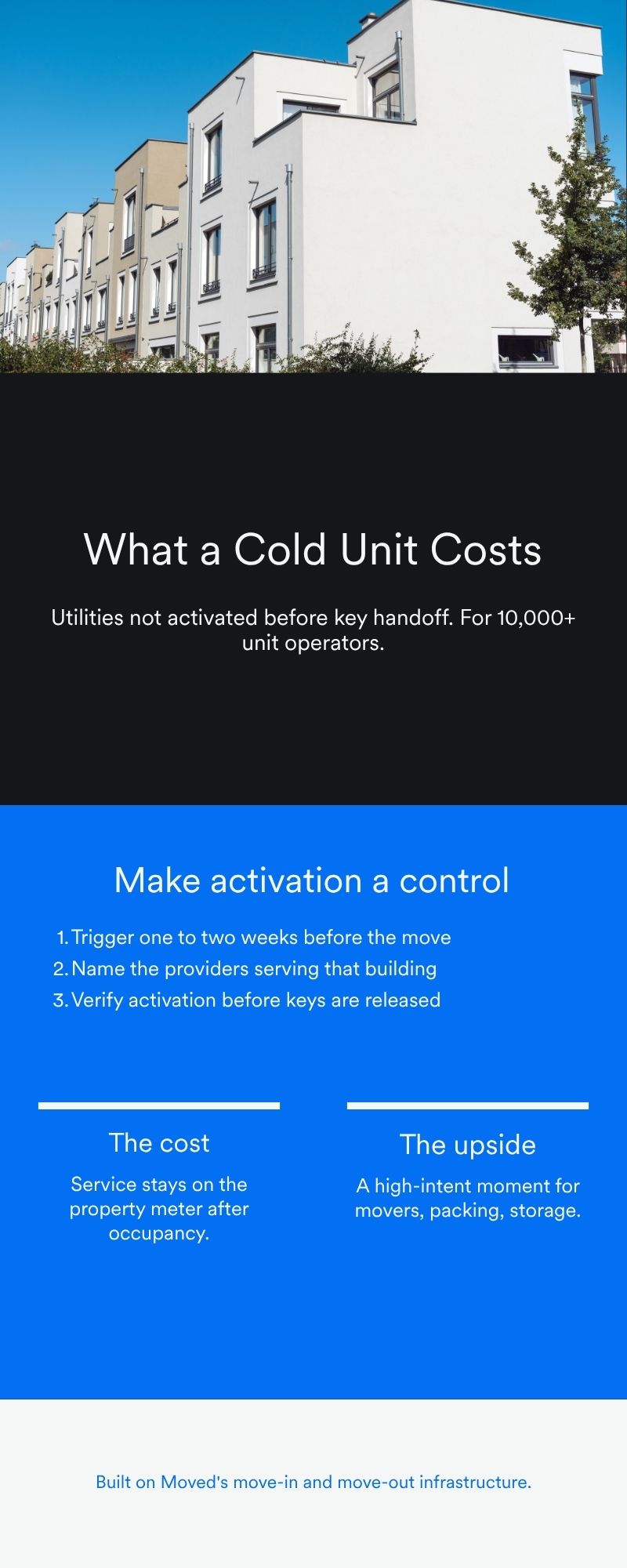
What a cold unit costs
The direct cost is the utility bill the property absorbs. RealPage puts it plainly in its analysis of vacant cost recovery: when residents do not transfer accounts into their name, the costs “can get very expensive, and it can be several hundred dollars per month,” as covered in RealPage’s breakdown of vacant cost recovery and apartment utility costs. That figure is per unit, and it accrues for every day between move-in and activation.
For context on the size of the underlying bill, national estimates put average apartment utilities between $150 and $300 per month excluding internet, according to RentCafe’s apartment utilities breakdown. A handful of days of unrecovered service per move is small. Multiplied across the annual move volume of a 10,000+ unit portfolio, it is a recurring line nobody has assigned to an owner.
The indirect cost is larger. A resident who arrives to a unit where service is not in their name starts the tenancy with an administrative problem. That is the moment the property was supposed to be selling movers, packing, and storage, and it is instead resolving a billing question.
| Where the cost lands | What happens | Who absorbs it |
|---|---|---|
| Utility spend | Service stays on the property meter after occupancy | The property |
| Recovery effort | Back-billing the resident, often disputed | Site staff |
| Revenue timing | The paid-services window opens late or not at all | The portfolio |
| Resident experience | First interaction is an administrative correction | Renewal odds |
The revenue case comes before the cost case
Utility activation is usually pitched as cost recovery. That framing undersells it. The activation step is the moment a resident is actively setting up their home, which is the highest-intent moment in the entire lifecycle for offering the services that generate non-rent income.
A resident confirming their electricity start date is a resident who has not yet booked movers, has not sorted packing, and has not decided what goes into storage. Presenting those options inside the same flow is how the move-in and move-out revenue workflow converts an administrative step into an earning one. Treating activation purely as a cost-avoidance chore leaves the revenue side of the same moment untouched.
This is also where the scale argument lives. Moved’s own work with large operators is built around a target of $15 per unit per month in non-rent revenue. The point of that number is not the number. It is that it only compounds when every move runs through the same instrumented flow, and utility activation is one of the reliable triggers that flow depends on.
Why activation slips
Activation fails for four repeatable reasons, and none of them are resident negligence.
The request arrives too early or too late: Providers need lead time, and residents act on utility setup roughly one to two weeks before the move date. A reminder sent at lease signing is forgotten; one sent on move-in day is already late.
The resident does not know which providers serve the building: In deregulated markets there may be several electricity suppliers, and in others a single municipal provider with its own portal. A generic instruction to “set up utilities” puts the research burden on the resident.
Proof of activation is never captured: Most properties ask residents to confirm activation by email or a form. Nothing verifies the account exists, so the property learns about the gap from its own bill.
Nobody owns the number: Utility activation rate is not on the site scorecard, so a property running at sixty percent activation looks identical to one running at ninety-five.
Activation as a measured control
The fix is to treat activation the way leasing treats applications: as a step with a completion rate, a deadline, and an owner. Three properties make it measurable.
First, timing. Trigger the activation step in the window when residents actually act, roughly one to two weeks before the move date, rather than at lease signing.
Second, specificity: Present the actual providers serving that building with direct links, so the resident is choosing rather than researching.
Third, verification: Capture confirmation of activation before keys are released, the same way a compliant move-in captures renters insurance. Insurance and utilities are the two verifications that protect the asset at the front door, and both belong in one step. Verifying renters insurance at move-in mitigates the financial risk of an uninsured resident-caused loss; verifying utility activation mitigates the certainty of an unrecovered bill.
Traditional tools focus on task tracking and administrative coordination. Moved embeds revenue-generating services and insurance verification directly into the workflow, which is what turns activation from a reminder into a control with a number attached. Operators standardizing this across a portfolio can see how the underlying flow is built in the guide to resident onboarding automation.
What good looks like at portfolio scale
An operator running activation as a control can answer four questions at any time: what percentage of move-ins had utilities live before key handoff, which properties are below standard, how many days of unrecovered service the portfolio absorbed last month, and how many residents took a paid service during the activation step.
The fourth question is the one that changes the conversation with ownership. It reframes the activation step from an expense-control measure into part of the revenue system, which is how a move infrastructure built for multifamily operators is meant to work. The same flow that protects the resident experience at the front door produces the income that the expense-control framing never captures.
Frequently asked questions
What are apartment utilities, and who pays them at move-in?
Apartment utilities typically cover electricity, gas, water, sewer, trash, and internet. Responsibility transfers to the resident on the lease start date, but only if the resident has opened an account. Until then the service usually remains billed to the property.
How much does a unit cost the property if utilities are not activated?
Industry guidance puts unrecovered vacant and post-occupancy utility costs at several hundred dollars per month per unit, against average apartment utilities of roughly $150 to $300 per month excluding internet.
When should residents set up utilities?
Roughly one to two weeks before the move date. Providers need lead time to schedule connection, and earlier reminders tend to be forgotten.
Can an operator require proof of utility activation before releasing keys?
Many operators do, and it is the single most effective control available. Capturing proof at the same point as renters insurance verification keeps both checks in one step.
Does utility activation actually generate revenue?
Indirectly and directly. It stops unrecovered spend, and because it lands at a high-intent moment it is a natural place to present movers, packing, and storage.
Close the gap at the front door
If your properties cannot report a utility activation rate, the cost of cold units is already in your operating expenses and the revenue at that moment is already going somewhere else. To see how activation, insurance verification, and paid services run as one move-in and move-out workflow across a 10,000+ unit portfolio, contact Moved.