A welcome letter to a new tenant confirms the move-in details, introduces the team, and tells the resident what to finish before keys are released: utilities, renters insurance, and move-day logistics. For a large portfolio it is the first standardized message of the tenancy, and it sets the tone the renewal decision is measured against months later.
Most welcome letters are written once, at one property, and copied until nobody remembers why a paragraph is there. The result is a letter that thanks the resident warmly and leaves out the things they need most in the days before a move. This guide covers what a welcome letter should include, when to send it, a ready-to-use template, and how to run one standard letter across a 10,000+ unit portfolio. Landlords often say tenant and Moved says resident, so this article uses both.
Why the welcome letter matters
Feeling welcome is part of what keeps residents. In the NMHC and Grace Hill Renter Preferences Survey, based on responses from more than 172,000 renters, 52 percent said feeling welcomed by community staff contributed to a positive sense of community, second only to neighbors respecting community rules at 66 percent. The same research found email was renters’ clearly preferred channel for communicating with their community, which makes a well-built welcome email the natural first touchpoint.
The retention stakes are rising. Zego’s 2026 Resident Experience Management Report, based on surveys of more than 1,000 renters and 600 multifamily companies, found average retention fell to 57 percent from 60 percent in 2024, while 59 percent of property managers still expect retention to improve. A strong welcome letter sets the first impression the rest of the tenancy is judged against, which makes it one of the simplest retention tools a portfolio controls.
The revenue side of a welcome letter
The welcome letter usually arrives while the resident is still booking movers, deciding on packing help, and working out whether anything needs to go into storage. That makes it the first place the property can present those services, along with utility setup and the renters insurance requirement. Moved’s newsletter The RevGen Leak Map describes move-in as the point where the resident is overwhelmed and needs logistics help and time-sensitive services before day one. A welcome letter that links straight into those services meets that need at the moment it exists, and it is where the move-in and move-out revenue workflow starts working for the property.
What to include in a welcome letter to a new tenant
The sections below cover what residents need before move-in, in the order they need it.
| Section | What it covers | Why it belongs in the letter |
|---|---|---|
| Welcome and team contacts | A short welcome, the community manager’s name, office hours, and the best way to reach the team | Residents want a named person, and staff welcome drives a sense of community |
| Move-in date and key handoff | Date, arrival window, where to collect keys, and what to bring | Answers the most common move-week questions before they are asked |
| Movers, packing, and storage | Links to book movers, packing help, and storage | Presents the services residents need earliest, at the moment they decide |
| Move-day logistics | Loading dock, elevator reservation, and parking for moving trucks | Prevents move-day collisions between residents |
| Utilities and internet | The providers that serve the building and a request to activate before key handoff | Keeps the unit off the property’s utility account after occupancy |
| Renters insurance | The lease requirement, minimum coverage, and how to submit proof | Mitigates the financial risk of an uninsured loss |
| Resident perks | The community’s rewards or perks program and how to access it | Supports renewal from the first week |
| Community guidelines | Quiet hours, pets, trash, parking, and amenity rules | Neighbors following rules is the top driver of community feeling |
| How to get help | Maintenance requests, payments, and who to contact for what | Matches each task to the channel residents prefer |
Resident perks deserve their own line. Zego’s 2026 research found 31 percent of renters would be much more likely to renew if their community offered a renter rewards program. Paylode, a perks and rewards platform that became a Moved company when Moved acquired Paylode in November 2025, runs these programs for residential real estate operators. Naming the program in the welcome letter puts it in front of residents from their first week, well before the renewal conversation.
Channel matters for the help section as well. The same Zego research found 49 percent of renters prefer digital-only rent payments and 43 percent prefer digital-only maintenance tracking, while 35 percent want a person for neighbor or noise complaints. The welcome letter should say which channel handles which task.
When to send the welcome letter
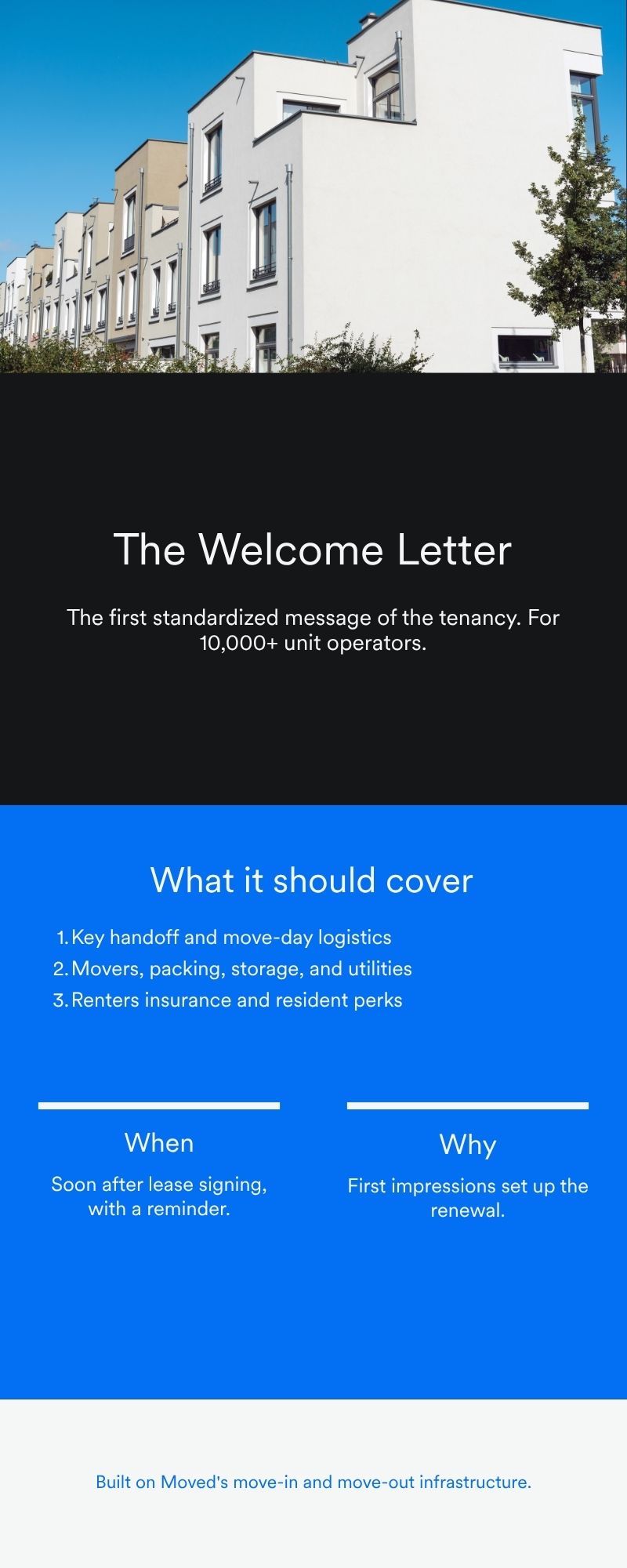
Send it soon after lease signing, far enough ahead of the move date for the resident to book movers, arrange packing and storage, and activate utilities before key handoff. A second, shorter message a few days before move-in should repeat the arrival details and flag anything still outstanding, such as proof of renters insurance. A letter that arrives on move-in day confirms the details too late for the resident to act on them.
Welcome letter template
Adapt the template below at portfolio level and fill in the bracketed fields for each property. Keep the section order, since it follows the order in which residents need the information.
Subject: Welcome to [Community name], [Resident first name]
Hi [Resident first name],
Welcome to [Community name]. We are glad you chose us for your new home, and we want your move to go smoothly. I am [Community manager name], your community manager, and you can reach our team at [phone] or [email] during [office hours].
Your move-in details
Your lease begins on [date]. Please plan to arrive between [time window] and collect your keys from [location]. Bring a photo ID and [any other items].
Before you move
To keep move day simple, please complete these steps before [date]:
- Book movers, packing help, or storage here: [link]
- Reserve the loading dock and elevator for your move time: [link or instructions]
- Set up electricity, gas, water, and internet with the providers that serve our building: [providers and links]. Please start service in your name on your lease date.
- Upload proof of renters insurance with at least [coverage requirement] in liability coverage, as your lease requires: [link]
Your resident perks
As a resident, you have access to [perks program name], with rewards and discounts from local and national partners. Find it here: [link]
Living here
A few community guidelines to know from day one: [quiet hours, pet policy, trash and recycling, parking]. The full resident handbook is here: [link]
Getting help
Submit maintenance requests at [link] and pay rent at [link]. For anything else, call or email the office and we will reply within [response time].
We look forward to meeting you on [date].
[Community manager name]
[Community name]
Running one welcome letter across a 10,000+ unit portfolio
- One master template. Owned centrally, with property-level fields for contacts, providers, dock rules, and insurance minimums.
- Live links for every step. Each step links into the digital flow, so the resident acts from the letter and the property sees what was completed.
- Triggered sending. The letter goes out automatically at lease signing, with the reminder scheduled against the move date.
- Completion tracking. Utilities activated, insurance verified, and services booked are visible before key handoff, property by property.
- A matching move-out message. The same standard applies at notice to vacate, with movers, packing, and storage offered again for the departing resident.
The welcome letter is one step in a longer sequence. Moved’s new resident onboarding checklist for property managers covers the full run from lease signing through day 30.
Traditional tools focus on task tracking and administrative coordination. Moved embeds revenue-generating services and insurance verification directly into the workflow, so the welcome letter becomes the front door to a flow the property can measure. That turns a courtesy email into the start of a consistent resident experience. How the flow is built is covered in the guide to resident onboarding automation, and the portfolio view in Moved’s move infrastructure for multifamily operators.
Frequently asked questions
What should a welcome letter to a new tenant include?
A welcome and team contacts, the move-in date and key handoff details, links for movers, packing, and storage, move-day logistics, utility setup, the renters insurance requirement, resident perks, community guidelines, and how to get help.
When should you send a welcome letter to a new tenant?
Soon after lease signing, with a short reminder a few days before move-in. Early sending gives the resident time to book services and activate utilities before key handoff.
Should the welcome letter mention renters insurance?
Yes. State the lease requirement, the minimum coverage, and how to submit proof, so verification is complete before keys are released.
Should the welcome letter be an email or a printed letter?
Email first, since renters in the NMHC and Grace Hill survey clearly preferred email for communicating with their community. A printed copy waiting in the unit on move-in day is a good complement.
Can one welcome letter template work across a whole portfolio?
Yes, with a centrally owned master template and property-level fields for contacts, providers, and building rules.
Make the first message count
If each property writes its own welcome letter, residents get a different first week depending on where they sign. To see how a standardized welcome flow connects movers, utilities, insurance verification, and resident perks across a 10,000+ unit portfolio, book a walkthrough with the Moved team.