Parking sits in an unusual position. It is one of the most common non-rent charges in residential real estate, it is named by regulators more often than almost any other fee, and there is almost no statute anywhere that governs how a parking fee may be set.
That combination puts the risk in disclosure and consistency rather than in the amount. This guide covers what regulators have actually said about parking fees in 2026, the accessible parking obligation that overrides a first-come policy, how towing rules differ by state, and how to run permits and fees across a 10,000+ unit portfolio as part of a structured move-in and move-out process.
Where Parking Revenue Sits In The Operating Statement
Parking is a recognized ancillary category. The National Apartment Association, in the Income and Expense IQ benchmarking it publishes with IREM and BOMA, defines other revenue as “monies received, including amenity fees, parking fees, laundry, pet fees, storage and (‘other’).”
That definition is also the reason parking performance is hard to see. Parking is folded into a single other income line alongside five unrelated categories, so no benchmark exists for parking on its own, and most operators cannot say what parking produced last quarter at a property level without rebuilding it by hand.
Regulators Have Started Naming Parking Fees Specifically
Two 2026 developments moved parking from a general fee question to a named one.
The FTC advance notice names parking twice
The Federal Trade Commission published its advance notice of proposed rulemaking on rental housing fee practices in the Federal Register on March 13, 2026, with comments due by April 13, 2026. Parking appears in the Commission’s list of proliferating mandatory charges: “lifestyle fees, amenity fees, maintenance fees, common area maintenance fees, pest control fees, parking fees, technology fees, smart home fees,” and on through a much longer list.
It appears again in the question that matters most to operators. Question 58(a) asks whether a rule “should require total rent to include all mandatory recurring fees and charges (for example, mandatory administration fees, common area maintenance fees, estimated utilities, or parking).”
The distinction the Commission is drawing is between mandatory and optional. A parking space a resident must take and pay for is part of the price of the unit. A space the resident may decline is a service.
Arizona settled a case that names parking fees in the restitution notice
On May 13, 2026 the Arizona Attorney General announced settlements with Greystar over hidden rental charges, entered as Assurances of Discontinuance in Maricopa County Superior Court. The restitution notice names the charge type directly: consumers at two named communities “who believe they were inaccurately charged fees in addition to base rent, such as parking fees, valet trash services, or HOA dues,” may file a claim.
The Attorney General’s framing was that the operator “misled consumers by advertising deceptively low rental prices that omitted a host of mandatory fees, which sometimes amounted to hundreds of extra dollars each month.”
The injunctive terms read as a disclosure checklist. The operator must refrain from misrepresenting the total monthly leasing price, must “more prominently disclose the total monthly leasing price” whenever it advertises base rent, and must “clearly and conspicuously provide details about all fees, including the amount and purpose of the fee and whether it is mandatory.”
State Pricing Laws Reach Parking Only When It Is Mandatory
A correction worth making, because it is widely reported the other way. Colorado’s House Bill 25-1090, effective January 1, 2026, does not mention parking anywhere in its text. It reaches parking only through the definition of total price, which covers amounts that “MUST BE PAID TO PURCHASE, ENJOY, OR UTILIZE A GOOD, SERVICE, OR PROPERTY” or that “ARE NOT REASONABLY AVOIDABLE BY THE PERSON.”
Minnesota works the same way through a different phrase. Minnesota Statutes section 504B.120 requires that “a landlord must disclose all nonoptional fees in the lease agreement” and that “a unit advertised for a residential tenancy must disclose the nonoptional fees included with the total amount for rent in any advertisement or posting,” with treble damages and attorney fees for a violation.
The practical test in both states is the same. If the resident cannot rent the unit without paying for parking, the parking charge belongs in the advertised number. If the resident can genuinely decline it, it does not.
Accessible Parking Overrides A First-Come Policy
This is the one hard legal obligation in parking, and the Fair Housing regulations spell it out with a worked example rather than leaving it to interpretation.
Under 24 C.F.R. section 100.204, it is unlawful “to refuse to make reasonable accommodations in rules, policies, practices, or services, when such accommodations may be necessary to afford a handicapped person equal opportunity to use and enjoy a dwelling unit, including public and common use areas.”
The regulation’s second example is a parking case. A 300 unit complex with 450 spaces available “on a first come first served basis” receives a request from a mobility-impaired applicant “that a parking space near his unit be reserved for him.” The regulation states that “it is a violation of section 100.204 for the owner or manager of Progress Gardens to refuse to make this accommodation,” and that “the accommodation is reasonable because it is feasible and practical under the circumstances.”
Three consequences follow for policy. A first-come-first-served rule must yield to an accommodation request. The accommodation is a reserved space near the unit rather than merely a space. And feasibility is the only defense, which means the operator needs a documented process for assessing it.
The leasing office is a separate question. A rental establishment is a place of public accommodation under the ADA regulations, and “creating designated accessible parking spaces” is an enumerated barrier removal measure under 28 C.F.R. section 36.304, with first priority given to access “from public sidewalks, parking, or public transportation.”
Towing Rules Vary More Than Operators Expect
Washington is the example worth knowing, because it runs opposite to the common assumption. RCW 46.55.070 requires posted signage before an unauthorized vehicle may be impounded from nonresidential private property, then exempts residential property entirely: “The requirements of subsection (1) of this section do not apply to residential property. Any person having charge of such property may have an unauthorized vehicle impounded immediately upon giving written authorization.”
Washington separately prohibits booting under RCW 46.55.300. Other states run the other way and impose strict signage, notice, and storage requirements on residential lots, with penalties for noncompliant tows.
The operating conclusion is to post signage as policy everywhere, whatever the local rule requires, because a resident whose car disappears without warning becomes a review and a legal question at the same time.
What Belongs In A Parking Policy
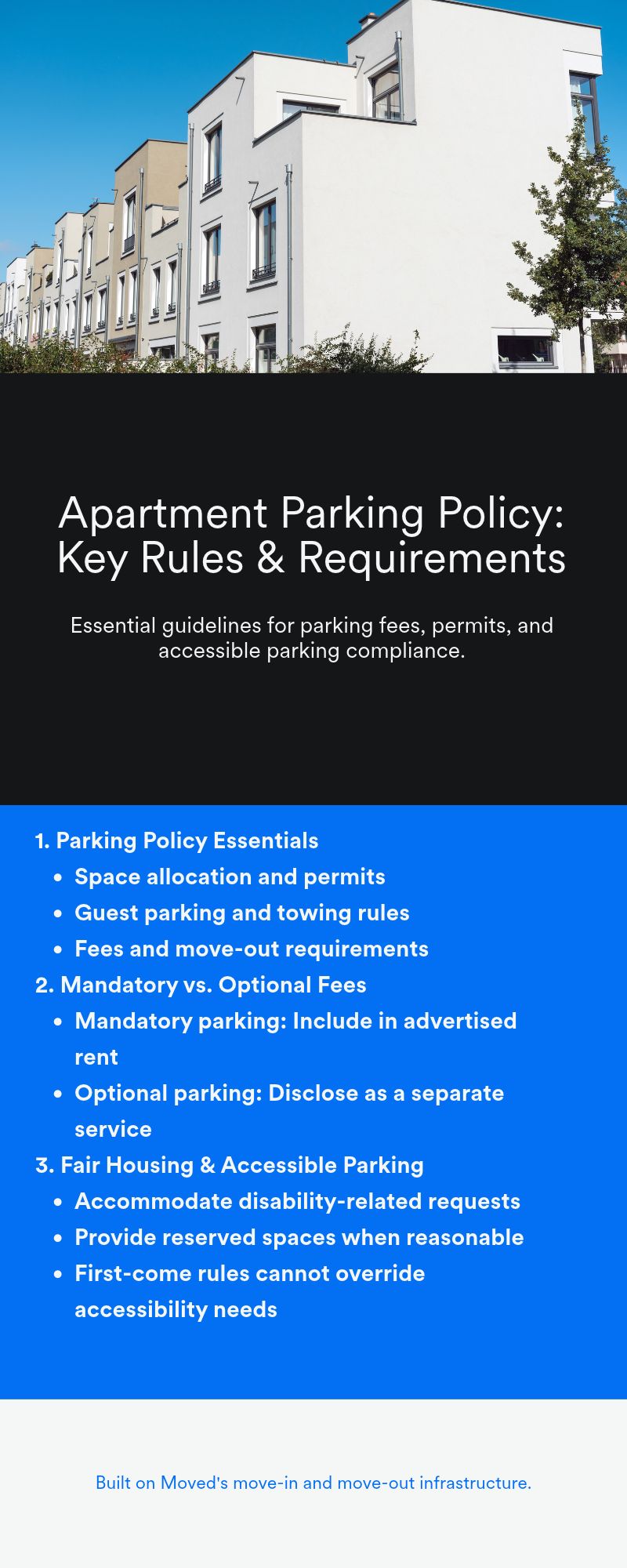
- Whether parking is mandatory or optional for each unit type, stated explicitly, because that single word decides how the fee must be advertised.
- The fee, listed separately from rent, with the purpose of the charge named.
- How spaces are allocated: assigned, first-come, waitlist, or by unit type.
- The accessible parking request process, who reviews it, and the response time.
- Permit issuance, display requirements, replacement cost, and return at move-out.
- Guest parking rules, time limits, and how guest permits are issued.
- The towing policy, the signage in place, and the towing operator’s name, phone number, and redemption address.
- Rules on inoperable vehicles, oversized vehicles, trailers, and electric vehicle charging.
- What happens to a permit and a reserved space at move-out.
Running Parking Across A Portfolio
- Classify every property’s parking as mandatory or optional, and fix the advertising for any property where a mandatory charge sits outside the advertised rent.
- Standardize one permit format and one guest policy per region so the rules do not change between two communities on the same street.
- Record accessible parking requests, decisions, and reasons in one place, with the feasibility assessment attached.
- Confirm the towing requirements for each state, and post compliant signage even where the state does not require it.
- Track parking separately in the ledger rather than inside a blended other income line, at the property and period level.
- Issue and reclaim permits inside the move-in and move-out workflow so a departing resident’s space is released on the vacate date.
Common Parking Policy Mistakes
- Advertising base rent at a property where a parking charge is mandatory, which is the exact conduct the Arizona settlement addressed.
- Treating an accessible parking request as an amenity request rather than a reasonable accommodation.
- Running different guest rules at neighboring communities, which generates disputes the regional team then arbitrates case by case.
- Towing from a residential lot on the assumption that the state’s nonresidential signage rule applies, or failing to post where it does.
- Leaving parking revenue inside a blended other income line, so nobody can say what it produced.
- Forgetting the permit at move-out, which leaves a former resident holding access to the lot.
The Revenue Case: Parking Is Already A Service, So Treat It As One
Parking is one of the few ancillary categories where the resident has an active preference, a willingness to pay, and a decision point that lands at exactly the same moment as every other move decision.
Captured inside the move-in and move-out workflow, the parking selection happens alongside movers, packing, storage, insurance, utilities, and connectivity, on a schedule the operator already controls. The space is assigned before keys change hands, the permit is issued with the keys, and the charge appears in the same disclosed total as everything else.
Handled as a separate conversation at the leasing desk, it becomes an inconsistent charge that a regulator reads as a hidden fee.
Traditional tools focus on task tracking and administrative coordination. Moved embeds revenue-generating services and insurance verification directly into the workflow, transforming move coordination into structured revenue infrastructure.
Disclosure And Insurance Alongside The Policy
Every mandatory charge, parking included, belongs in one disclosed total presented more prominently than base rent. That is what the enforcement orders require of the parties bound by them, and it is the direction the FTC rulemaking points.
Vehicle damage in a parking structure is also a reminder that renters insurance belongs in the move workflow as financial risk mitigation, verified before keys change hands rather than chased after occupancy.
Frequently Asked Questions
Do parking fees have to be included in advertised rent?
If the parking charge is mandatory, state pricing laws that require a single total price will reach it, and the FTC advance notice asks whether a federal rule should do the same. If the resident can decline parking without penalty, it is an optional service and sits outside the advertised total.
Can a property refuse a reserved accessible parking space?
Only where the accommodation is not feasible and practical. The Fair Housing regulations give a parking example in which refusing a reserved space near the unit is a violation, so a general first-come policy is not by itself a reason to refuse.
Can we tow from our own lot without posting a sign?
It depends entirely on the state. Washington exempts residential property from its signage requirement and allows immediate impound on written authorization. Other states require posted notice and impose penalties for noncompliant tows, so check before relying on either position.
How should guest parking be handled?
With a written rule, a defined time limit, and a permit process that is the same at every community in the region. Inconsistency between neighboring properties is the most common source of parking disputes.
Is there a benchmark for parking revenue per unit?
Not from the main industry benchmarking source, which folds parking into a combined other income category along with amenity fees, laundry, pet fees, and storage. Any parking-specific per-unit figure circulating in industry content is not traceable to that survey.
Make Parking A Disclosed Service, Not A Surprise Charge
Parking carries little statutory risk on price and considerable risk on presentation. To see how parking selection, permits, and disclosure run inside one move-in and move-out workflow across a 10,000+ unit portfolio, reach out to our team.
Moved is a move infrastructure platform that embeds revenue-generating services, including movers, packing, storage, insurance, utilities, and connectivity, directly into the resident onboarding workflow. It helps property operators increase ancillary income while mitigating compliance risk, and the guide to resident onboarding automation shows how that workflow is built.
For residents, knowing where to park on day one is part of the resident experience. For operators, Moved for multifamily shows how the same process runs across a portfolio, and the move-in and move-out revenue workflow shows where the services attach.