A late fee policy sets what a property charges when rent arrives after the due date, when the charge can be applied, and how it is disclosed. State law decides most of it: the maximum amount, the number of days that must pass first, whether the fee has to appear in the lease, and what happens to the operator who gets it wrong.
Across a 10,000+ unit portfolio the real exposure sits in the lease clause rather than in the fee. A single noncompliant clause can be void in every unit in that state, and in some states it carries a per-violation penalty on top. This guide covers the caps and grace periods in three states, what belongs in the policy, a template your team can adapt, and how late fees fit a structured move-in and move-out process in residential real estate.
Why The Late Fee Is A Retention Decision As Well As A Collections One
A late fee lands on a resident who has already had a difficult month. Zego’s 2026 Resident Experience Management Report found that average resident retention has fallen to 57 percent, down from a peak of 60 percent in 2024, and that renters rank rent being too expensive as the single largest reason they do not renew.
Fees that feel arbitrary compound that. SatisFacts found in its 2025 Biennial Online Renter Study that 56.4 percent of renters say unclear or unexpected fees would prompt a negative review, the highest of any reason it tested.
So the policy has two jobs. It has to be enforceable, and it has to be predictable enough that a resident who pays late once does not start looking elsewhere.
Caps And Grace Periods In Three States
The three states below each publish a statutory cap, and each handles the grace period differently. Confirm every rule with counsel for each property before changing lease language, and check local ordinances, which can be stricter.
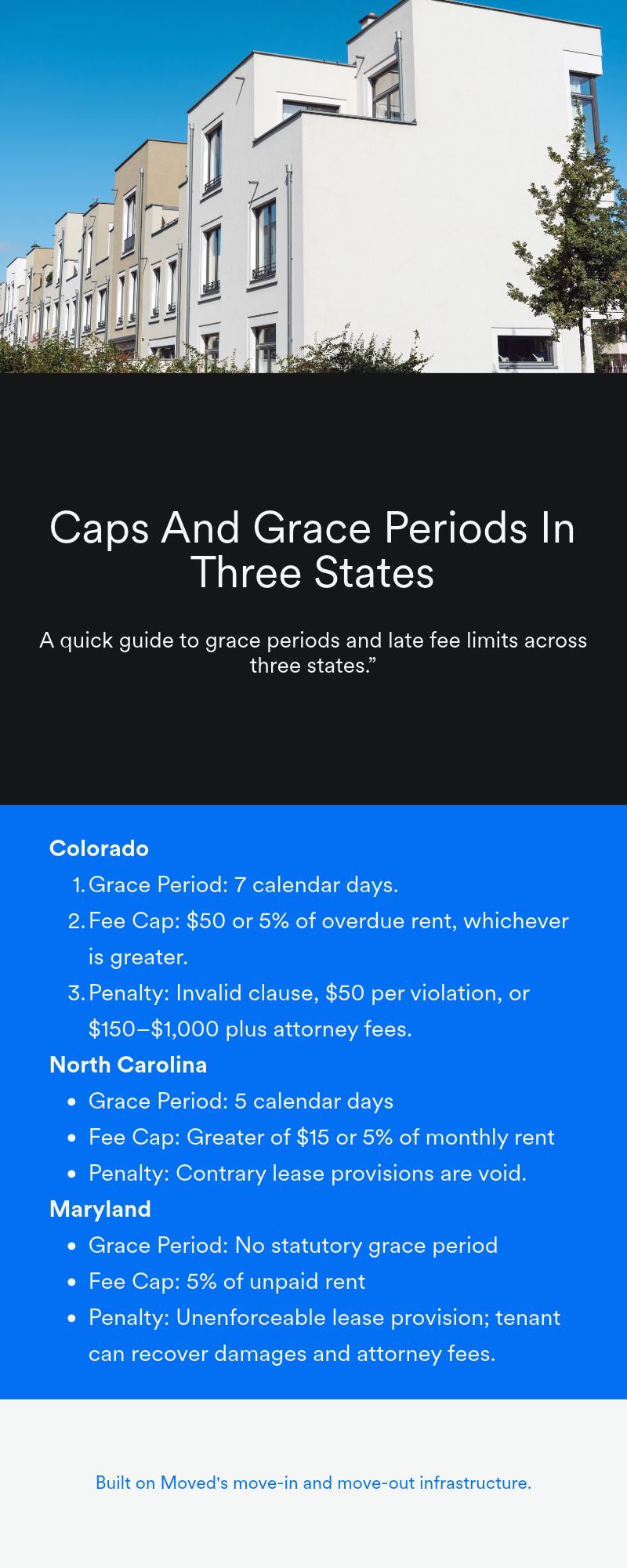
Maryland is the one most commonly reported wrongly. There is no statutory grace period in the Maryland provision, and the cap is drafted as a restriction on what a lease may contain rather than on what a landlord may charge. That is a different compliance posture from Colorado and North Carolina, and it means the review happens at lease drafting.
Colorado
Colorado Revised Statutes section 38-12-105 is the most prescriptive of the three. A landlord shall not “charge a tenant or home owner a late fee unless a rent payment is late by at least seven calendar days,” and shall not charge a fee “in an amount that exceeds the greater of: (I) Fifty dollars; or (II) Five percent of the amount of the past due rent payment.”
Two further requirements catch operators out. The fee must be disclosed in the rental agreement, and the landlord may not charge it “unless the landlord provided the tenant or home owner written notice of the late fee within one hundred eighty days after the date upon which the rent payment was due.” A fee discovered during an annual ledger cleanup is already out of time.
The statute also separates late fees from rent. “A late fee is distinct from rent, and a rental agreement may not classify a late fee as rent,” and a landlord may not “initiate a court process for the removal or exclusion of a tenant from a dwelling because the tenant fails to pay one or more late fees.” Where a resident receives a subsidy, no late fee may be imposed on the portion “that a rent subsidy provider, rather than the tenant or home owner, is responsible for paying.”
North Carolina
North Carolina General Statutes section 42-46 puts the grace period and the cap in a single sentence. A late fee is “chargeable only if any rental payment is five calendar days or more late, with the first day being the day after the rent was due,” and where rent is due monthly “a landlord may charge a late fee not to exceed fifteen dollars ($15.00) or five percent (5%) of the monthly rent, whichever is greater.”
The anti-stacking rule matters for ledger design. A late fee “may be imposed only one time for each late rental payment,” and it “may not be deducted from a subsequent rental payment so as to cause the subsequent rental payment to be in default.” Charging the fee out of the next month’s rent and then calling that month short is the error the statute was written to stop.
For subsidized units, “any fee charged pursuant to this section shall be calculated on the tenant’s share of the contract rent only, and the rent subsidy shall not be included.”
Maryland
Maryland Code, Real Property section 8-208 prohibits a lease containing a provision that “provides for a penalty for the late payment of rent in excess of 5% of the amount of unpaid rent due for the rental period for which the payment was delinquent.” For weekly rent the limit is “more than $3 per week or a total of no more than $12 per month.”
The remedy runs against the lease rather than the charge. Any prohibited provision “shall be unenforceable by the landlord,” and where the landlord “tenders a lease containing such a provision or attempts to enforce or makes known to the tenant an intent to enforce any such provision, the tenant may recover any actual damages incurred as a reason thereof, including reasonable attorney’s fees.”
The section also sets a floor rather than a ceiling for local law, so Montgomery County and Baltimore City requirements layer on top.
What The FTC Rulemaking Does And Does Not Cover
The Federal Trade Commission opened an advance notice of proposed rulemaking on rental housing fee practices on March 13, 2026, and the comment period closed on April 13, 2026. It is worth being precise about its scope, because the coverage has been loose.
The advance notice addresses fees in advertised rent and at application. It does not address late fees. A late fee is contingent on the resident’s conduct rather than mandatory, so it falls outside the “total price” concept that the advertised-rent statutes use.
Colorado’s own pricing statute makes the same distinction. Section 6-1-737, effective January 1, 2026, requires the total price to be disclosed as a single number, and defines total price as the amounts that “MUST BE PAID TO PURCHASE, ENJOY, OR UTILIZE A GOOD, SERVICE, OR PROPERTY” or that “ARE NOT REASONABLY AVOIDABLE.” The same statute does prohibit a landlord from charging a fee “RELATED TO THE OVERDUE PAYMENT OF A FEE, CHARGE, OR AMOUNT THAT IS NOT RENT,” which rules out late fees on late fees and on ancillary charges.
Minnesota goes further on disclosure. Minnesota Statutes section 504B.120 requires that “the sum total of rent and all nonoptional fees must be described as the Total Monthly Payment and be listed on the first page of the lease,” with treble damages and attorney fees for a violation.
What Belongs In A Late Fee Policy
- The grace period for each state, stated in calendar days and counted from the day after rent is due.
- The cap, expressed the way the state expresses it, including whether it is the greater or the lesser of a dollar amount and a percentage.
- A statement that the fee is charged once per late payment and is not applied to a later month’s rent.
- For subsidized units, a statement that the fee is calculated on the resident’s share only.
- The disclosure location in the lease, and for Colorado, the notice deadline.
- Whether the fee is treated as rent, which several states prohibit.
- The waiver authority: who can waive a fee, on what grounds, and how the waiver is recorded.
- A contact name and number for a resident who disputes the charge.
Late Fee Policy Template
Adapt this to each state and city, and have counsel approve the final version before it is used.
Rent is due on the first day of each month. A late fee will be assessed only if rent has not been received by the end of the [grace period] day of the month, counted from the day after the due date. The late fee is [cap, stated as the state requires], and is charged once for each late rental payment. The late fee is not rent and will not be deducted from a future rent payment. Where any portion of rent is paid by a subsidy provider, the late fee is calculated on the resident’s share only. To request a waiver, contact [name] at [phone and email] before [date].
Running Late Fees Across A Portfolio
- Build one lease clause per state, with the grace period, cap, and disclosure language written to that state’s statute.
- Record for every property the state, any local ordinance, and whether the unit is subsidized.
- Configure the ledger so the fee cannot post before the grace period ends and cannot post twice for one late payment.
- Set a notice rule that sends the fee notice well inside any statutory deadline, such as Colorado’s 180 days.
- Give regional managers a documented waiver authority so that discretion is consistent and recorded.
- Report late fee volume, waiver rate, and the share of residents who incur a fee more than twice a year, by property.
Six Errors That Make A Late Fee Unenforceable
- Applying one grace period nationally, when Colorado requires seven days, North Carolina five, and Maryland none.
- Reading the cap in the wrong direction. Colorado and North Carolina use the greater of the dollar figure and the percentage. Other states use the lesser.
- Charging the fee on the full contract rent for a subsidized unit rather than the resident’s share.
- Deducting a late fee from the next rent payment and then treating that month as short.
- Classifying the late fee as rent in the lease, which several states prohibit outright.
- Posting a fee months later during a ledger review, after a statutory notice window has closed.
The Revenue Case: A Late Fee Is A Signal, And The Move Is What Follows
A resident who pays late repeatedly is a resident at elevated risk of not renewing. The operator usually learns this from the ledger rather than from a conversation, and by the time notice to vacate arrives the household is already booking movers, packing, and storage.
Treating the delinquency signal as the start of a retention conversation, and the notice as the start of a service conversation, turns two unplanned events into one planned process. The move-in and move-out revenue workflow puts those services in front of the resident at the moment the decision is made, and gives the property a confirmed move date it can schedule against.
Traditional tools focus on task tracking and administrative coordination. Moved embeds revenue-generating services and insurance verification directly into the workflow, transforming move coordination into structured revenue infrastructure.
Rewarding On-Time Payment: Paylode, a Moved Company
A late fee penalizes the behavior after it happens. A rewards program can price the behavior before it happens, which is the cheaper side of the same problem.
Paylode is a Moved company. Moved acquired Paylode in November 2025, adding a perks and rewards platform built to increase loyalty and retention through personalized perks and action-based rewards. Zego’s 2026 research found that 31 percent of residents offered a rewards program would be much more likely to renew, and that on-time rent payment is already among the most commonly rewarded actions where programs exist.
The same research found that 67 percent of residents have never received any reward from their property, which means the mechanism is underused rather than exhausted.
Disclosure And Insurance Alongside The Policy
Recurring fees should be shown separately from rent and disclosed in the same place the rent is disclosed. The FTC advance notice asks how fees are presented to renters, and the safest posture is one page that shows every charge, marked mandatory or optional.
A delinquency review is also a sensible moment to confirm that the resident’s renters insurance is still active, since coverage lapses and payment problems tend to travel together. Insurance belongs in the workflow as financial risk mitigation rather than as an afterthought.
Frequently Asked Questions
How much late fee can a landlord charge?
It depends on the state. Colorado allows the greater of $50 or 5 percent of the past due rent. North Carolina allows the greater of $15 or 5 percent of monthly rent. Maryland caps the lease provision at 5 percent of the unpaid rent.
Is there a required grace period before a late fee?
In some states. Colorado requires at least seven calendar days and North Carolina five. Maryland’s statute contains no grace period, so the lease and any local ordinance control.
Can a late fee be treated as rent?
Colorado prohibits it expressly and bars eviction proceedings based on unpaid late fees. Several other states draw the same line, so the lease should state that the fee is distinct from rent.
Do late fees have to be included in advertised rent?
No jurisdiction we reviewed requires it, because advertised-rent rules reach mandatory charges and a late fee is contingent. Mandatory recurring fees are a different question and belong in the advertised total.
What happens if the lease clause exceeds the cap?
In all three states the provision is void or unenforceable. Colorado adds a per-violation penalty and attorney fees, and Maryland allows the resident to recover actual damages and fees where the landlord tries to enforce the clause.
Get The Clause Right Once, In Every State You Operate
A late fee policy is a small clause with an outsized failure mode, because the error repeats in every lease in the state. To see how fee disclosure, delinquency signals, and move services run as one move-in and move-out workflow across a 10,000+ unit portfolio, reach out to our team.
Moved is a move infrastructure platform that embeds revenue-generating services, including movers, packing, storage, insurance, utilities, and connectivity, directly into the resident onboarding workflow. It helps property operators increase ancillary income while mitigating compliance risk, and the guide to resident onboarding automation shows how that workflow is built.
For residents, a predictable fee policy is part of the resident experience. For operators, Moved for multifamily shows how the same process runs across a portfolio, and the move-in and move-out revenue workflow shows where the services attach