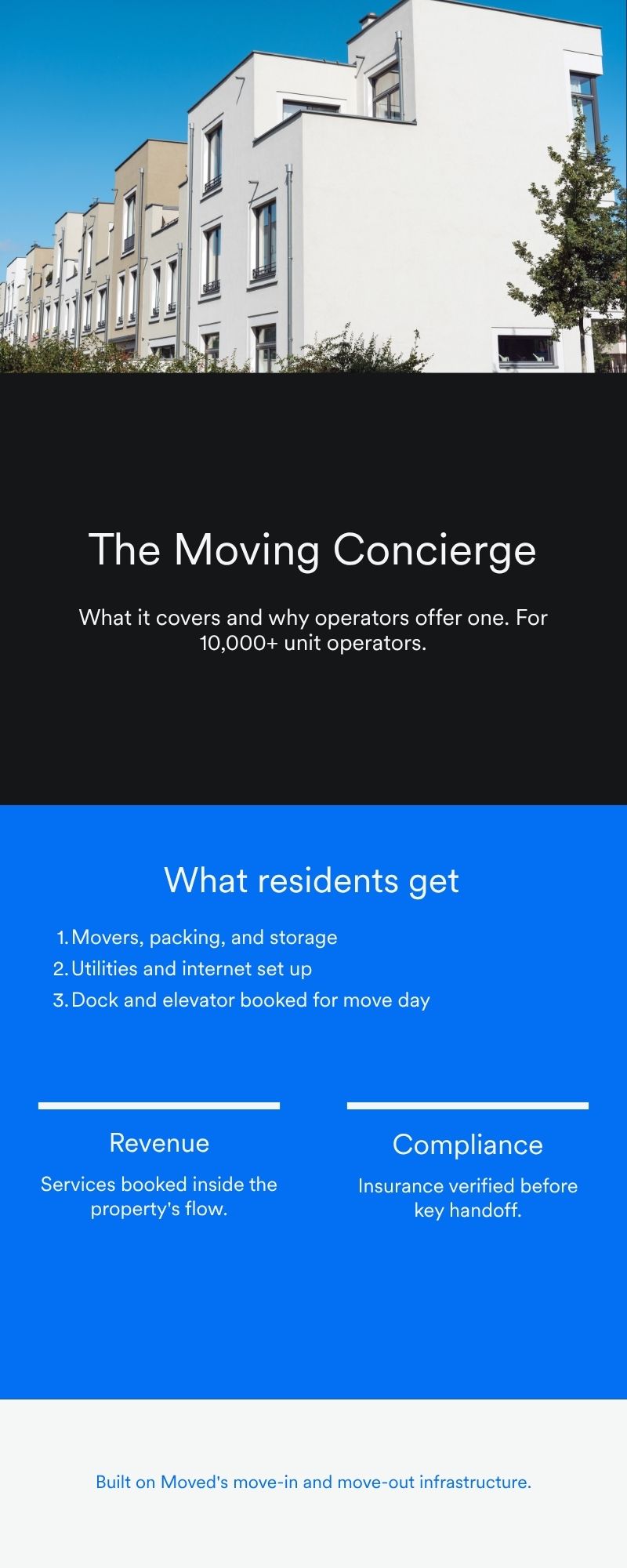
A moving concierge service coordinates the logistics of a move for the resident: booking movers, packing, and storage, setting up utilities and internet, confirming renters insurance, and updating addresses. For apartment operators, offering one turns a stressful week for the resident into a managed step inside the move-in and move-out workflow.
The term covers very different offerings. Some are local companies that coordinate a single household move. Some are property staff with a checklist and a phone. Some are platforms built into the property’s own resident flow. For a 10,000+ unit operator, the differences matter more than the label, because each model produces a different resident experience, a different revenue picture, and a different compliance record. This article explains what a moving concierge service covers, why residents increasingly expect one, and what operators should require before offering one across a portfolio.
What a moving concierge service covers
At its core, a moving concierge handles the tasks a resident would otherwise research, compare, and book one by one. The table below lists the standard scope and why each item matters to the property.
| Service | What the concierge handles | Why it matters to the operator |
|---|---|---|
| Movers | Quotes, booking, and move-day timing | The first service most residents look for once the lease is signed |
| Packing | Packing help and supplies, scheduled ahead of the move date | Usually decided in the same moment as movers |
| Storage | Short-term storage between homes or for overflow belongings | Common when move dates and lease dates do not line up |
| Utilities and internet | Provider options for the building and activation before key handoff | Keeps the unit off the property’s utility account after occupancy |
| Renters insurance | Coverage that meets the lease requirement, verified before keys | Mitigates the financial risk of an uninsured resident-caused loss |
| Address changes | Mail forwarding and account updates | Removes a task residents often leave until after the move |
| Move-day logistics | Loading dock, elevator, and parking reservations | Keeps an outbound move and an inbound move from colliding |
Movers, packing, and storage sit at the top of that list for a reason. They are the services residents need earliest, and they are booked in a short window between lease signing and move day. A concierge that presents them at the right moment keeps that spending inside the property’s own flow.
Why residents expect it
Resident expectations have been climbing. In an earlier edition of Zego’s Resident Experience Management Report, 75 percent of property managers surveyed said resident expectations had risen year over year, and 49 percent said residents now expect added concierge services, as covered by Multifamily Dive. That survey drew on 630 property managers at communities of 250 units or more.
Retention pressure sharpens the point. Zego’s 2026 Resident Experience Management Report found average retention fell to 57 percent, down from 60 percent in 2024, based on surveys of more than 1,000 renters and 600 multifamily companies. The same research found renters have clear, task-specific channel preferences: 49 percent prefer digital-only rent payments and 43 percent prefer digital-only maintenance tracking, while 35 percent want a person for neighbor or noise complaints. Moving logistics look much more like rent payments and maintenance tracking than like a noise complaint: structured, multi-step, and easy to complete digitally when the flow is clear.
First impressions carry weight too. In the NMHC and Grace Hill Renter Preferences Survey, 52 percent of more than 172,000 renters said feeling welcomed by community staff contributed to a positive sense of community. A concierge that makes the move week easier is one of the most direct ways to deliver that welcome.
Why operators offer a moving concierge
Revenue: the move is where services are bought
Between lease signing and key handoff, a resident makes a short run of purchasing decisions. Each one happens either inside the property’s flow or somewhere the property cannot see. Moved’s newsletter The RevGen Leak Map frames the lifecycle the same way: at move-in the resident is overwhelmed and needs logistics help and time-sensitive services before day one, and at move-out, easy transition offers and moving services preserve goodwill. A concierge built into the move-in and move-out revenue workflow meets the resident at both moments.
Risk: compliance in the same step
A concierge that confirms renters insurance and utility activation before key handoff closes two exposures at once. Coverage verification mitigates the financial risk of a resident-caused loss, and confirmed activation keeps the utility bill off the property’s books. When both checks run inside the concierge flow, the property gets a dated record of each.
Efficiency: fewer calls for the site team
Move coordination lands on site teams at the busiest point of the month. Every question a concierge answers is a call, email, or front-desk visit the team no longer has to handle, and every dock or elevator booking made in the flow is one less scheduling conflict to untangle on move day.
Three ways to offer a moving concierge
Operators generally choose between three models. The trade-offs show up most clearly at portfolio scale.
| Staff-run concierge | Local third-party concierge | Concierge built into the move flow | |
|---|---|---|---|
| Coverage | Depends on each team’s capacity | Varies by market and provider | The same service at every property |
| Consistency across the portfolio | Low; changes with staff turnover | Low; different providers in different markets | High; one standard everywhere |
| Revenue visibility | Rarely tracked | Usually outside the property’s view | Every transaction recorded against the resident |
| Insurance and utility verification | Manual follow-up | Usually out of scope | Verified before key handoff |
| Move-out coverage | Often skipped | Sometimes | Part of the same flow |
The staff-run model works at a single property with a strong team and strains as the portfolio grows. The local third-party model can deliver a good individual move, yet it leaves the property with no record and no share of the transaction. The built-in model behaves the same way at property one and property four hundred.
Moved runs the built-in model at scale. More than 1 million residential units were on the platform by October 2025, with partnerships across half of the NMHC Top 15 Owners and Managers, according to Moved’s milestone announcement.
What to require before offering one across a portfolio
- Both ends of the tenancy. Coverage for move-in and move-out, so departing residents get movers, packing, and storage as well.
- Building-specific options. The actual utility providers, dock rules, and elevator reservation process for each property.
- Verification before keys. Renters insurance and utility activation confirmed inside the flow, with a dated record.
- Transparent resident choice. Services presented as clear options with plain terms, so residents feel helped at the moment they decide.
- Portfolio reporting. Uptake by service and by property, visible to the team that owns non-rent revenue.
- Flexible commercial structures. Terms that fit how the portfolio operates, agreed up front.
Traditional tools focus on task tracking and administrative coordination. Moved embeds revenue-generating services and insurance verification directly into the workflow, which is what lets a concierge run as infrastructure across residential real estate portfolios. Residents experience it as Moved’s moving concierge for residents, and operators manage it through a move infrastructure built for multifamily operators. How the underlying flow is assembled is covered in the guide to resident onboarding automation.
Frequently asked questions
What is a moving concierge service?
A service that coordinates a move on the resident’s behalf: movers, packing, storage, utilities and internet, renters insurance, address changes, and move-day logistics such as elevator and dock reservations.
Is a moving concierge the same as a moving company?
A moving company transports belongings. A moving concierge coordinates the whole move, including booking the moving company, and handles the setup tasks around it.
Do apartment communities offer moving concierge services?
Many do, through site staff, a local provider, or a platform built into the resident flow. Resident expectations for added concierge services have been rising, according to Zego’s survey of property managers.
Does a moving concierge help with move-out as well?
It should. Departing residents need movers, packing, and storage again, and the move-out moment is a chance to preserve goodwill. Look for coverage of both move-in and move-out.
Who pays for a moving concierge in an apartment community?
Arrangements vary. Many operators offer the concierge as a resident amenity, and commercial structures differ by provider and by portfolio.
Offer the concierge at every property
If your residents arrange their moves one call at a time, the services and the goodwill of the move are happening outside your flow. To see how a moving concierge runs inside the move-in and move-out workflow across a 10,000+ unit portfolio, contact the Moved team.