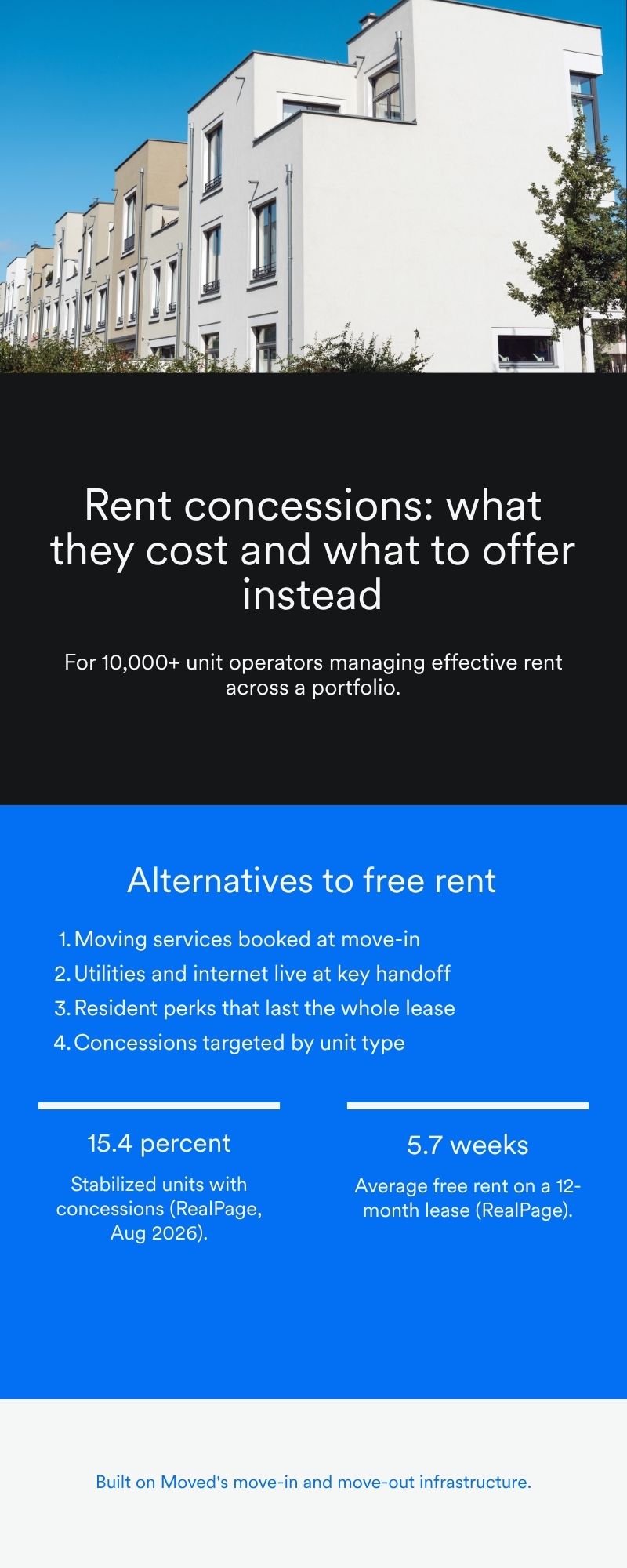
A rent concession is an incentive a property offers to secure a lease, such as weeks of free rent, a reduced monthly rate, or waived move-in fees. In August 2026, RealPage found concessions on 15.4 percent of stabilized U.S. apartments, with the average discount equal to about 5.7 weeks free on a 12-month lease.
For a 10,000+ unit operator, concessions are a recurring cost that shows up in effective rent, renewal pricing, and asset value. This guide explains what rent concessions are, how common they are in 2026, what they cost beyond the headline discount, and which move-in services and resident perks can stand in for part of the free rent.
What are rent concessions?
A rent concession lowers what a resident pays, either upfront or across the lease. Zillow’s April 2026 rental report describes concessions as incentives such as free rent, waived fees, and discounted move-in costs.
| Concession type | How it works | Effect on the property |
|---|---|---|
| Free weeks or months | Rent is waived for part of the lease, usually at the start | Cash arrives later, and effective rent falls |
| Reduced monthly rent | Rent is set below asking for the whole term | Lower effective rent and a lower base for the renewal |
| Waived fees | Application, administration, or amenity fees are removed | Lower move-in income, with disclosure rules still in force |
| Move-in credits | A credit or gift card at lease signing | An upfront cost with no change to the rent roll |
| Renewal concessions | A discount offered to keep a current resident | Offsets part of the renewal increase |
The common measure across all of these is effective rent: the total rent collected over the lease after the concession, divided by the number of months. For example, one month free on a 12-month lease puts effective rent about 8 percent below asking rent.
How common rent concessions are in 2026
RealPage tracks concessions on stabilized apartments. Its August 2026 concessions update found that usage peaked at 17 percent in both March and May before easing to 15.4 percent in August, while the average discount held near 11 percent of asking rent.
Usage varies by asset class. In August, RealPage measured concessions on 19.7 percent of Class C units, 13.7 percent of Class B units, and 12.9 percent of Class A units, and efficiencies carried the deepest average discount at 12.1 percent.
Listing data shows a wider spread. Zillow found that 39.8 percent of rentals on its platform offered a concession in April 2026, up five percentage points from a year earlier, with the highest shares in Denver, Charlotte, and Dallas.
The two figures measure different things: RealPage counts stabilized units, while Zillow counts active listings, which are units still being leased. Both point in the same direction, and Zillow reports a national rental vacancy rate of 7.3 percent, up from 5.6 percent in 2021.
Depth is the other half of the picture. Colliers research cited by Multifamily Dive puts concessions at 7.2 percent of asking rent in the first quarter of 2026, against 9.2 percent at the peak of the global financial crisis.
What concessions cost beyond the discount
The headline discount is the visible cost. Other costs are easier to miss at portfolio scale, because they appear months after the lease is signed.
- Renewal pricing. A resident who moved in with weeks free often faces a larger step up at renewal, when the lease resets to full rent. Zego’s 2026 Resident Experience Management Report found that renters begin reconsidering renewal at an average increase of 8 percent.
- Turnover. A resident who chose a property mainly for the discount may leave when it ends. Each turn has cost about $3,872 in marketing, repairs, concessions, and lost rent, according to an earlier Zego report covered by Multifamily Dive.
- Services bought elsewhere. Free rent lowers rental income, and it has no effect on the services a resident still buys during the move, such as movers, packing, storage, and internet setup.
- Inconsistent offers. When each property sets its own concessions, the portfolio loses track of what it pays for each lease and what that lease returns.
A discount addresses the price of the lease. The rest of the leasing decision depends on how easy the move-in feels, and that is where the alternatives below come in.
What to offer alongside or instead of free rent
The goal is to reduce the free rent a lease needs while keeping the offer competitive. The move-in window is where the alternatives sit, because the resident is already arranging and paying for the move.
| Alternative | What the resident gets | Why it can reduce reliance on free rent |
|---|---|---|
| Moving services through the property | Movers, packing help, and storage booked at move-in | Addresses a cost the resident faces in the same weeks as the first rent payment |
| Utility and internet setup | The building’s providers, with service active before key handoff | Removes a task and avoids a cold unit |
| Resident perks and rewards | Ongoing discounts and rewards from partner brands | Value continues through the lease and into renewal |
| Flexible move-in date | A lease start aligned with the resident’s move | Reduces the days of paying rent in two places |
| Targeted concessions | Free rent only on unit types and classes under the most pressure | Puts the discount where market data shows it is needed |
Pricing discipline still decides most of the outcome. These options change what the resident sees at the moment of decision, and several of them keep value inside the property’s own move-in and move-out revenue workflow.
Resident perks as a retention offer: Paylode, a Moved company
Perks extend the value of a lease beyond move-in day. Zego’s 2026 research found that 31 percent of renters would be much more likely to renew if their community offered a renter rewards program.
Paylode is a Moved company. Moved acquired Paylode in November 2025, bringing a perks and rewards platform that helps brands increase loyalty and retention through personalized perks and action-based rewards. Paylode’s clients have included Equity Residential and FirstKey Homes.
Paired with Moved’s move-in and move-out infrastructure, a perks program gives leasing teams an offer that lasts through the lease. A free month ends with the first rent statement, while a rewards program keeps adding value until renewal. Moved’s guide to turning resident perks into a measurable revenue line covers how to track the results.
Disclosure and risk when offering concessions
Concession offers sit inside fee transparency rules. The Federal Trade Commission’s advance notice of proposed rulemaking on rental housing fees examines advertised rent that excludes mandatory fees, so an offer of free weeks should appear alongside every mandatory charge the resident will pay.
Moved’s guide to the FTC rental fee rulemaking covers how to disclose move-in charges cleanly. The same standard applies to concession advertising and lease documents.
Insurance verification belongs in the same step. A resident who receives free rent still needs active renters insurance before keys are released, because a resident-caused loss is a financial risk that a concession does nothing to offset.
A concession playbook for 10,000+ unit operators
- Set concessions by unit type and asset class, since RealPage data shows that usage and discount depth vary widely by class and floor plan.
- Prefer targeted offers on units with long vacancy over blanket discounts across a community.
- Give every concession an end date and a written renewal plan, so the step to full rent is planned before move-in.
- Pair each offer with moving services, utility setup, and resident perks presented in the same move-in flow.
- Disclose every mandatory fee next to the concession in all advertising and lease documents.
- Track concession cost, renewal outcome, and service uptake by property, so the portfolio can see which offers pay back.
Traditional tools focus on task tracking and administrative coordination. Moved embeds revenue-generating services and insurance verification directly into the workflow, transforming move coordination into structured revenue infrastructure.
Moved is a move infrastructure platform that embeds revenue-generating services, including movers, packing, storage, insurance, utilities, and connectivity, directly into the resident onboarding workflow. It helps operators in residential real estate increase ancillary income while mitigating compliance risk, and the guide to resident onboarding automation shows how that workflow is built.
For residents, the result is one clear move-in process in place of several separate tasks, which strengthens the resident experience. For operators, Moved for multifamily operators shows how the same process runs across a portfolio.
Frequently asked questions
What are rent concessions?
Rent concessions are incentives a property offers to secure a lease, such as free weeks of rent, a reduced monthly rate, waived fees, or move-in credits.
How do rent concessions work?
A concession lowers what the resident pays, either upfront or across the lease. The property’s effective rent is the total rent collected after the concession, divided by the number of months in the lease.
How common are rent concessions in 2026?
RealPage found concessions on 15.4 percent of stabilized U.S. apartments in August 2026. Zillow found concessions on 39.8 percent of rental listings on its platform in April 2026.
What is the difference between asking rent and effective rent?
Asking rent is the advertised monthly rate. Effective rent is what the property collects per month after concessions, averaged across the lease term.
What can operators offer instead of free rent?
Moving services through the property, utility and internet setup before key handoff, resident perks and rewards, a flexible move-in date, and concessions targeted only at the units that need them.
Make every concession count
Concessions are likely to stay part of leasing through 2026, and each one is a cost that the portfolio should be able to measure. To see how move-in services, resident perks, and insurance verification run as one move-in and move-out workflow across a 10,000+ unit portfolio, book a walkthrough with the Moved team.