Go-live day feels like the finish line. The contract is signed, the platform is configured, and the announcement email has gone out to residents and staff. For most multifamily operators, that is exactly the moment the real work begins and exactly the moment many technology investments quietly start losing momentum.
A successful launch date is not the same thing as successful adoption. Property management technology rollouts routinely stall in the ninety days after go-live, long after the vendor has moved on to the next deal. Staff revert to spreadsheets. Residents ignore the new portal. Ancillary revenue programs that were supposed to activate automatically never get switched on. The platform still exists, but the financial outcomes it was purchased to deliver never materialize.
This is not a technology problem. It is an adoption and revenue-capture problem, and it is entirely predictable once you know where operators typically lose the thread.
The implementation myth
Most property management organizations treat implementation as a project with a defined end date: contract signed, data migrated, integrations connected, training completed, done. That framing sets leadership up to declare victory the moment the system is technically live, regardless of whether staff are using it correctly or whether residents are engaging with the services embedded inside it.
The reality is that implementation is not an event. It is the first phase of an ongoing operating change. A move coordination platform, for example, is not just replacing a checklist it is meant to convert every move-in and move-out into a resident onboarding workflow that captures movers, packing, storage, insurance verification, and utility connections as structured revenue rather than scattered, manually tracked tasks. If the organization stops paying attention once the software is technically functional, none of that revenue potential gets realized.
Operators who treat go-live as the starting line rather than the finish line consistently see better long-term results. That means budgeting time and staff attention for the 30, 60, and 90 days after launch not just the weeks leading up to it.
Staff adoption
Frontline leasing and move coordination staff are the single biggest determinant of whether a technology rollout succeeds financially. If a leasing agent quietly reverts to a personal spreadsheet because it feels faster than the new system, every ancillary revenue opportunity tied to that resident’s move movers, packing, storage referrals, insurance verification disappears with it.
Staff resistance rarely comes from stubbornness. It usually comes from one of three sources:
- The new workflow adds visible steps without an obvious payoff for the person doing the work
- Staff were trained once, before the system was fully configured, and never retrained on the finished workflow
- Managers do not reinforce the new process in daily huddles or performance conversations, so the old habit remains the path of least resistance
Operators who see strong adoption tend to assign a single accountable “system owner” per property or portfolio segment someone whose job explicitly includes monitoring day-to-day usage, not just IT or the vendor’s customer success team. That person becomes the first line of defense against workflow drift.
It also helps to make the financial connection explicit for staff, not just for leadership. When a leasing agent understands that completing a move task inside the platform is what triggers movers, packing, storage, or insurance verification for that resident, the workflow stops feeling like extra administrative burden and starts feeling like the mechanism that captures revenue the property was counting on. Teams that never make this connection tend to treat the platform as a reporting tool rather than a revenue tool, which is precisely when shortcuts and workarounds start to creep back in.
Resident adoption
Even a perfectly configured backend fails financially if residents never engage with the move-related services presented to them. Resident adoption is where a meaningful share of ancillary revenue movers, packing, storage, insurance, and connectivity is either captured or quietly lost.
Three factors tend to drive resident engagement:
- Timing: services offered too early (before a move date is confirmed) or too late (after the resident has already booked movers independently) convert poorly.
- Framing: residents respond better when move services are presented as a convenience bundled into onboarding rather than an upsell bolted onto a lease.
- Channel: a single email buried in a welcome packet performs far worse than services surfaced directly inside the move task list the resident is already completing.
Because resident-facing adoption directly determines ancillary income, it deserves the same post-launch scrutiny as staff adoption not a one-time announcement, but an ongoing measurement of engagement rates by property and by move type.
It is also worth distinguishing between resident awareness and resident conversion. A property can report that every resident “saw” the move services screen and still capture very little ancillary revenue if the presentation does not prompt action. Operators who dig into this distinction typically find that small changes reordering which service appears first, or connecting insurance verification directly to lease compliance rather than presenting it as optional move conversion rates more than any amount of additional messaging volume.
Workflow design
A rollout can have enthusiastic staff and engaged residents and still underperform if the underlying workflow was never redesigned to match how the platform actually operates. Many operators implement new technology by mapping it onto their old process instead of rebuilding the process around the platform’s capabilities.
This shows up in a few common patterns: insurance verification steps that still route through email instead of the platform’s built-in compliance checks, move task lists that duplicate work already being automated, or property teams that keep a shadow tracking sheet “just in case.” Each of these adds friction, and friction is what erodes both staff and resident adoption over time.
Workflow design should be revisited, not just configured once. As a platform surfaces more of the move lifecycle movers, packing, storage, insurance, utilities the surrounding staff process needs to be simplified to match, not layered on top of what it replaced.
Training
Training delivered once, in the week before go-live, is one of the most consistent predictors of a stalled rollout. Staff turnover in property management is high, configurations often change in the weeks after launch, and a single training session cannot cover every edge case a leasing team will encounter during a real move season.
Operators who sustain adoption typically build training into an ongoing rhythm rather than a one-time event:
| Training checkpoint | Timing | Primary goal |
| Initial system training | Pre-launch | Build baseline familiarity with core workflows |
| Live-workflow refresher | 2–3 weeks post-launch | Correct habits formed during early, imperfect use |
| New-hire onboarding | Ongoing | Prevent adoption erosion from staff turnover |
| Seasonal peak-move training | Before high-volume move season | Reinforce process under volume pressure |
This kind of cadence keeps the workflow intact even as staff turn over, which matters enormously in an industry with above-average frontline turnover rates.
Integration issues
Technology adoption also fails for reasons that have nothing to do with people and everything to do with plumbing. When a move platform does not integrate cleanly with the property management system of record, staff end up duplicating data entry, which is exactly the kind of friction that drives them back to manual workarounds.
Integration problems are often invisible to leadership because they show up as staff complaints about “extra work” rather than as a labeled technical issue. Operators should treat integration health as an ongoing item to monitor, not a box checked once during implementation. A broken sync between the move platform and the property management system will quietly suppress both efficiency gains and ancillary revenue capture until someone traces the root cause.
Integration issues also tend to resurface after unrelated changes a property management system upgrade, a change in unit numbering conventions, or a new field added to the leasing workflow can all quietly break a sync that worked correctly at launch. Portfolios with dedicated IT or operations resources should schedule periodic integration health checks rather than waiting for staff complaints to surface the problem, since by the time a leasing agent flags it, weeks of manual workarounds and missed revenue capture may have already accumulated.
Measurement after launch
Perhaps the biggest gap in most rollouts is measurement. Many operators track whether the system is “live” but never define what success looks like ninety days later. Without a measurement framework, there is no way to distinguish a rollout that is working from one that has quietly stalled.
A useful measurement framework should prioritize revenue and risk indicators first, with operational metrics supporting them:
- Ancillary revenue capture rate per move (movers, packing, storage, insurance, utilities)
- Insurance verification completion rate, tied directly to liability exposure reduction
- Staff task completion inside the platform versus outside it (a proxy for workflow drift)
- Resident engagement rate with move services by property and by move type
- Time-to-completion for standard onboarding and offboarding tasks
Notice that revenue capture and risk mitigation metrics lead the list, with process-efficiency metrics supporting rather than driving the evaluation. That ordering matters: a platform that improves task completion time but fails to capture ancillary revenue or reduce insurance risk has not actually delivered the financial outcome it was purchased for.
Portfolio-wide comparison is where measurement becomes especially valuable. A single property’s numbers rarely tell you whether a rollout is succeeding they only tell you how that property is performing. Comparing ancillary revenue capture and insurance verification rates across similar properties in a portfolio surfaces which sites have strong adoption and which are quietly lagging, which is far more actionable than a single portfolio-wide average that hides the variance underneath it.
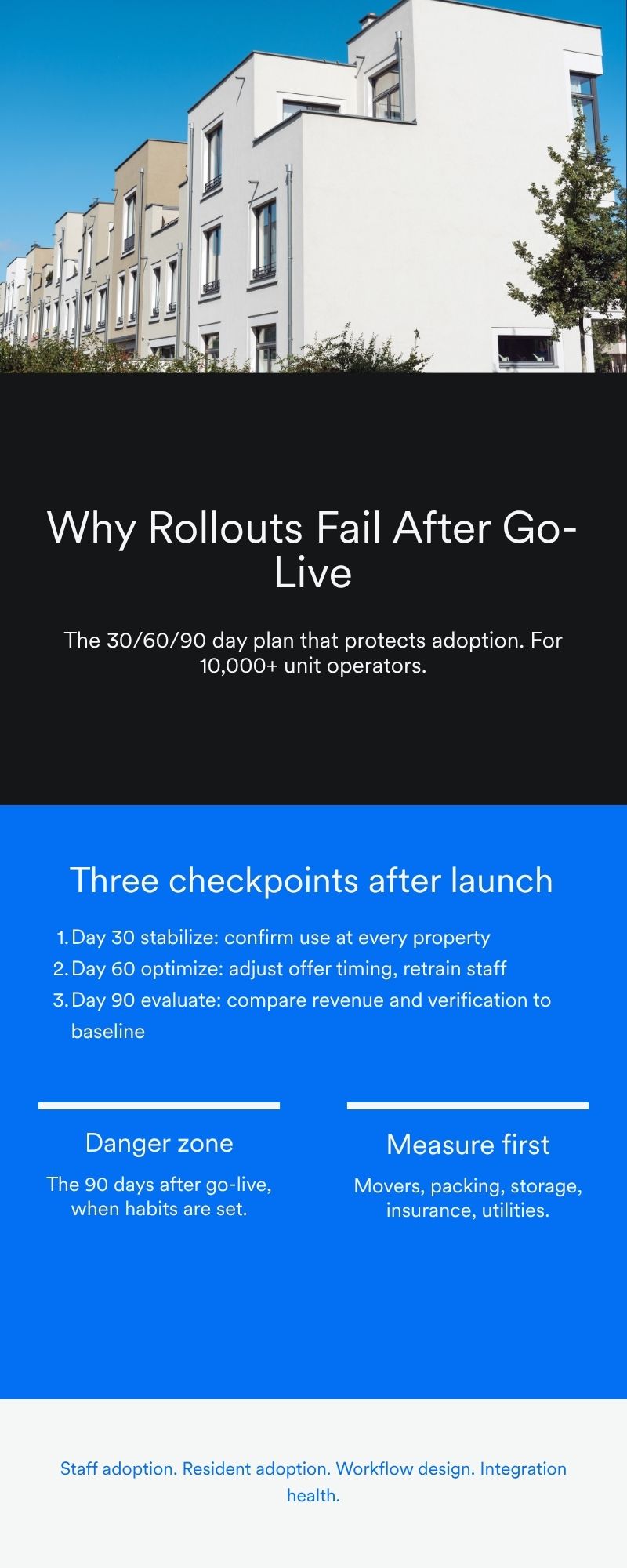
The 30/60/90-day optimization framework
Because the real determinant of ROI plays out after go-live, operators benefit from a structured checkpoint schedule rather than a single “launch and monitor” approach.
- Day 30 — Stabilize. Confirm every property is actively using the platform for new moves, identify any staff who have reverted to old habits, and fix any obvious integration gaps.
- Day 60 — Optimize. Review resident engagement data by property and move type, adjust the timing and framing of move-service offers, and refresh staff training based on real usage patterns.
- Day 90 — Evaluate. Compare ancillary revenue capture, insurance verification rates, and staff workflow compliance against pre-launch baselines. Use this checkpoint to decide what needs further optimization heading into the next high-volume move season.
This kind of structured post-launch review is what separates operators who realize the full financial value of a move infrastructure platform from those who simply have new software running in the background.
Turning go-live into revenue infrastructure
Technology rollouts do not fail because the software does not work. They fail because organizations stop paying attention exactly when attention matters most in the weeks and months after go-live, when staff habits are forming, resident engagement patterns are being set, and revenue capture rates are being determined for every future move.
For multifamily operators, treating implementation as the beginning of an operating change with dedicated staff accountability, resident-facing follow-through, integration monitoring, and a 30/60/90-day measurement framework is what converts a move coordination platform into structured, ongoing revenue infrastructure rather than a checklist tool that quietly falls out of use.
If your organization is evaluating how to strengthen adoption after a recent or upcoming rollout, reach out to the Moved team directly to walk through a post-launch optimization plan tailored to your portfolio.
Frequently asked questions
How do multifamily operators successfully implement new technology?
Successful implementation treats go-live as the start of an operating change rather than the end of a project. That means assigning a dedicated system owner per property, building a recurring training cadence instead of a single pre-launch session, redesigning workflows around the platform rather than layering it onto old processes, and monitoring integration health continuously.
Why do property management technology rollouts fail?
Rollouts typically fail due to staff reverting to old habits without reinforcement, low resident engagement with embedded services, workflows that were never redesigned around the new platform, one-time training that does not account for turnover, and unresolved integration gaps that create hidden manual work.
How should operators measure proptech adoption?
Adoption should be measured with revenue and risk indicators first ancillary revenue capture rate per move, insurance verification completion rate, and resident engagement with move services supported by operational metrics like staff task completion and time-to-completion, evaluated on a 30/60/90-day cadence after launch.