PMS platforms have spent two decades doing the same thing well. They book leases, post charges, store resident records, and produce the reports finance teams need. The product roadmap, in most cases, is a longer version of the same list. What this gets you is a stable system of record. What it does not get you is a position in the part of the resident journey where money is actually changing hands.
That part of the journey — the move-in and move-out lifecycle — is where ancillary revenue happens. Industry research attributed to Entrata’s COO Chase Harrington puts ancillary income at 4.4% of scheduled monthly charges across multifamily, with the fastest-growing slice concentrated in the days around a lease change. Movers. Packing. Storage. Internet. Renters insurance. Smart-home setup.
PMS platforms that figure out how to embed move-in and move-out automation as a product extension — not as a feature, not as a partner referral — capture that slice. PMS platforms that don’t, watch it leave the building. This article is for the product and strategy leaders deciding which side of that line their platform sits on.
| THE STRATEGIC SHIFT From system of record → system of engagement → system of monetization. The first two are table stakes. The third is where competitive separation now happens — and the move-in and move-out lifecycle is the natural anchor for it because the resident is already buying. |
PMS evolution: from system of record to system of monetization
The first generation of PMS platforms was about replacing paper. The second generation was about replacing the front office — resident portals, online payments, leasing CRMs, and communication tools. The third generation is about replacing the marketplace residents currently use to set up their lives around the lease.
Yardi has begun this with its Resident Services by ResidentShield bundle inside RentCafe — a built-in move-in checklist that funnels residents through Yardi-mediated insurance, utility, and elevator reservation workflows. Entrata launched Homebody with Red Ventures, an embedded marketplace covering renters insurance, internet, financial products, and rent reporting. AppFolio Stack opened the platform to certified partners through a marketplace architecture, with launch partners including ButterflyMX, Conservice, HappyCo, Knock, Lowe’s, and Property Meld.
These are the early moves. They confirm the direction. They are also incomplete — each platform’s bundle is built around the services its parent is positioned to offer, rather than the full resident-need surface for move-in and move-out. That is where the strategic opportunity lies for any PMS that wants to compete: build the lifecycle layer first, then own the marketplace within it, rather than bolting an insurance product onto a portal and calling it Homebody.
How can a PMS platform expand its product by embedding move-in and move-out automation without rebuilding its core leasing module?
Hub-and-spoke architecture (and why building from scratch is the wrong move)
The dominant industry frame in 2026 is the hub-and-spoke model. The PMS is the hub — the system of record for leases, ledger, and resident identity. Specialized partners are the spokes — each handling a specific lifecycle layer at depth. Buildium’s marketplace, AppFolio Stack, and Yardi’s Standard Interface Partnership Program all operate this way. Even Entrata’s Homebody is functionally a vertical spoke (insurance + utilities + financial) plugged into the Entrata hub.
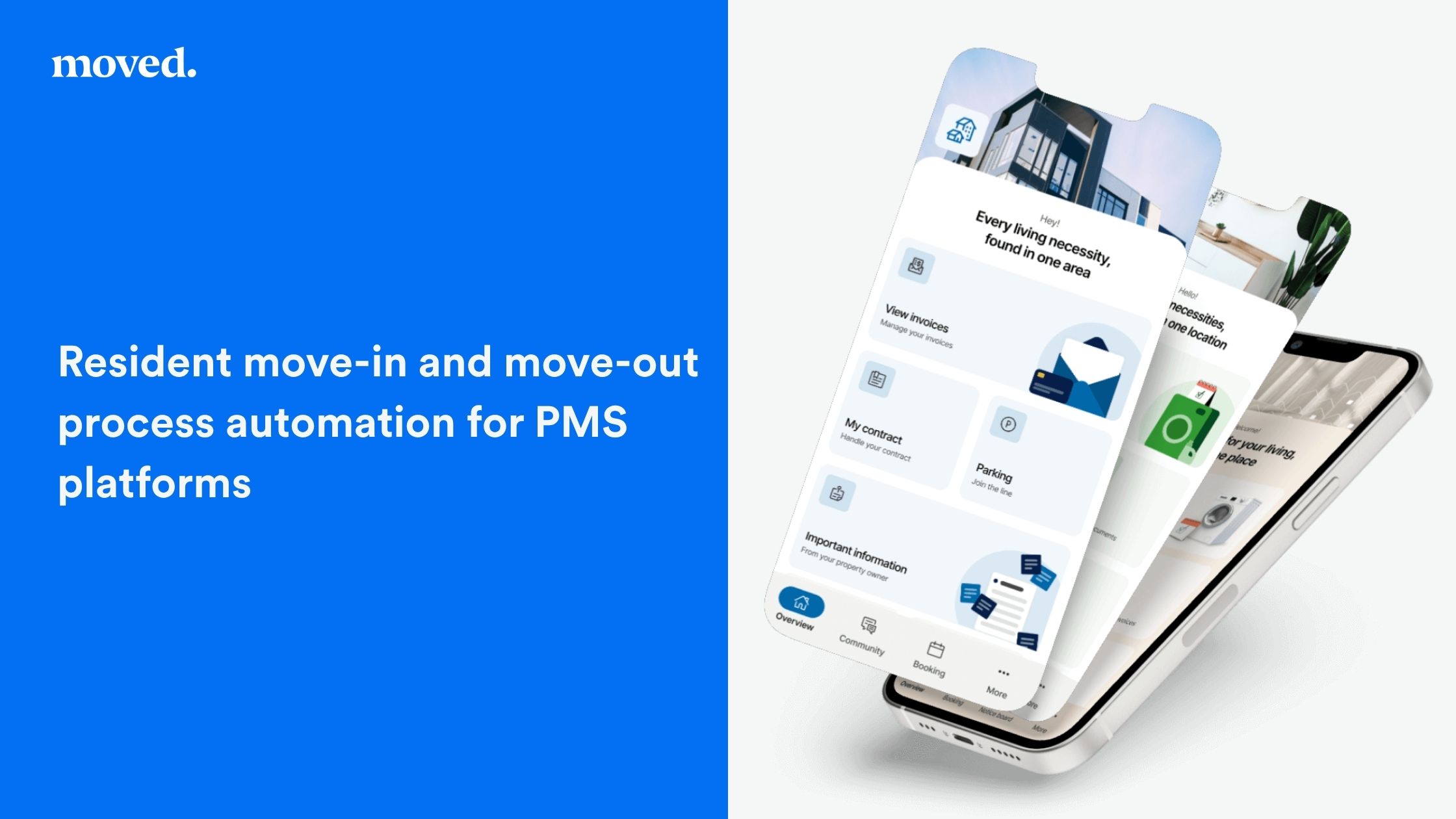
Building a move-in and move-out automation layer in-house, from scratch, requires the PMS to take on a marketplace business it has never run before — partner contracts with movers, networks of utility providers, insurance underwriting relationships, and content moderation for service quality. None of that is core to a leasing-and-ledger product, and none of it is fast. The faster path — and the path most successful platforms take — is to embed a partner that already runs that infrastructure, route the lifecycle through the partner via the integration layer, and earn through marketplace economics rather than marketplace operations. For the operational view of what that embedded layer actually does, see Resident move-in and move-out process automation for PMS platforms.
What is the best way for a PMS like Entrata or RealPage to add an embedded marketplace?
The Entrata Homebody case (and where the gaps are)
Entrata Homebody is the closest direct example in the market of a PMS-operator-built embedded marketplace. The Red Ventures partnership gives Entrata a credible content and provider layer for renters insurance, internet, financial products, and rent reporting. The architecture is sensible: surface the services from inside the resident portal, capture the transaction, and share the revenue. It is the right shape.
The gap, from a positioning standpoint, is what Homebody does not cover. The move-in and move-out moment is more than insurance and the internet. It is the truck, the boxes, the storage unit, the smart-home setup, the elevator reservation, the COI compliance check, and the deposit accounting. A complete move-in and move-out automation layer covers the full set, in sequence, inside one workflow. Homebody is a marketplace, not yet a workflow.
For other PMS platforms — RealPage, Yardi outside RentCafe, Buildium, ResMan — the strategic question is whether to build a Homebody-style vertical marketplace from scratch (slow, capital-intensive, off-strategy) or to embed a move-in and move-out automation partner that already orchestrates the workflow and marketplace.
AppFolio Stack and Yardi RentCafe ResidentShield
AppFolio Stack is the cleanest hub-and-spoke implementation in the market today. It does not pretend to be a marketplace operator. It is a partnership architecture, and the move-in and move-out automation layer is one of the most natural spokes a Stack partner can occupy.
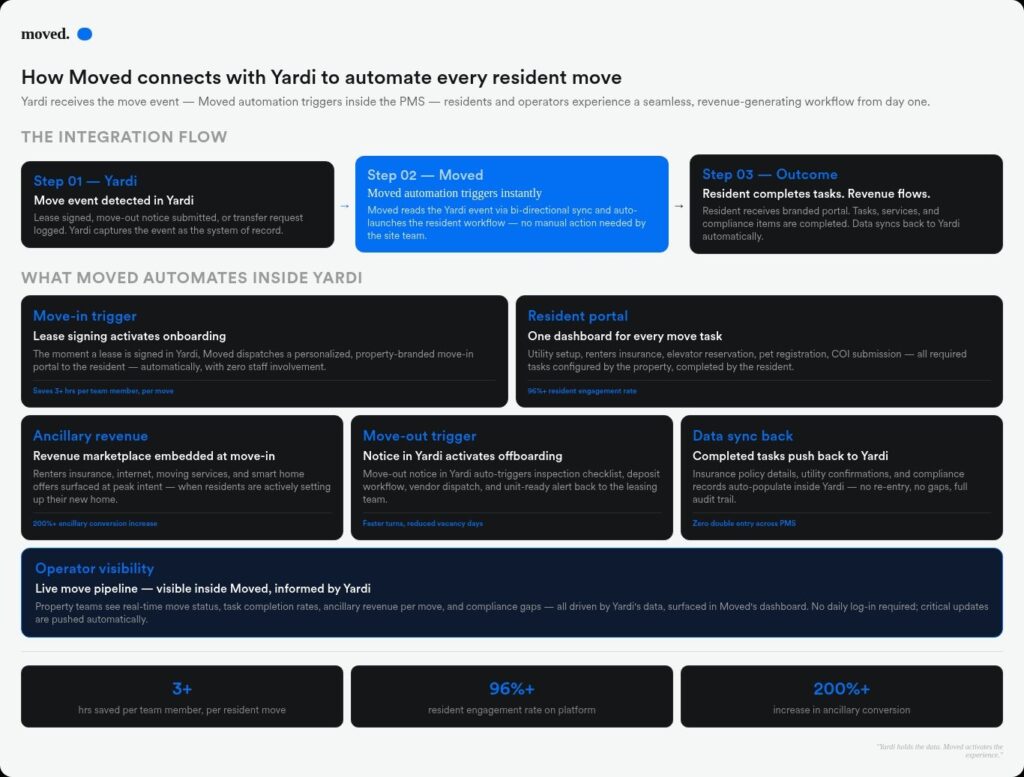
Yardi RentCafe with the ResidentShield bundle sits in the middle. The bundle is more vertical than Stack and less complete than a full move-in/move-out workflow. For Yardi customers who want end-to-end coverage of the lifecycle — and for Yardi’s own product roadmap — the embedded automation layer slots in alongside ResidentShield, not against it.
How do PMS platforms like Yardi and AppFolio generate ancillary revenue from move-in and move-out events?
The mechanism is the same regardless of the PMS. The lifecycle event triggers a workflow. The workflow surfaces a service when the resident is making the related decision. The transaction completes inside the workflow. Revenue flows back to the platform through partner commissions and activation fees. The platforms differ in how much of the lifecycle the marketplace covers and how directly it fits within the move-in and move-out workflow. Yardi ResidentShield covers a slice; AppFolio Stack covers more, depending on which partners the operator activates; an embedded move-in and move-out automation layer covers the full lifecycle by definition.
The portfolio-level math is straightforward: revenue scales with unit count and turnover. At the 4.4% ancillary benchmark, a platform’s effective revenue uplift compounds with each move-in and move-out event captured by the workflow.
What revenue model lets a PMS platform earn from resident services without becoming a service provider?
The dominant model is partner-based and conversion-driven. The PMS earns through:
- Partner commissions — a share of the service revenue when the resident transacts inside the workflow.
- Activation fees — a fixed payment when the partner successfully activates the service for the resident (utilities, internet).
- Tiered marketplace access — premium partners or enhanced placements offered to operators on higher-tier subscriptions.
None of these requires the PMS to operate the service, hold inventory, or underwrite. The PMS provides the surface and the transaction. The partner provides the service. The economics align with what the platform actually does — host the resident relationship and the system of record — and not with what it doesn’t do, which is run a moving company.
How does embedding move-in and move-out automation increase platform stickiness?
The stickiness argument is structural. A PMS that records leases is replaceable. The cost of switching is high but knowable. A PMS that records leases and manages the resident’s full move-in and move-out journey, including renters insurance binding, utility activation, and move scheduling, is materially harder to replace. The data, the partner integrations, the resident expectations, and the property team’s operating habits are all wired into the platform. The exit cost increases by an order of magnitude.
That stickiness shows up in two financial places. Net revenue retention increases because operators expand into the ancillary services already present on the platform. Gross retention improves because the platform is now embedded into more of the property team’s daily workflow than the system of record alone.
Should a PMS build move-in and move-out automation in-house or partner with a move infrastructure platform like Moved?
Build versus buy is a real question, and the honest answer depends on three things: whether move-in and move-out is on the company’s core product roadmap for the next four quarters, whether the engineering team can absorb a partner-network business as well as a software business, and whether the platform’s customer base is asking for end-to-end lifecycle coverage now or is willing to wait.
For most PMS platforms, the math favors partnership. The hub-and-spoke architecture is already the dominant industry frame. The leading platforms — AppFolio, Buildium, Yardi via SIPP — have built marketplace infrastructure precisely because building deep verticals in-house is slower than partnering and routing the value back to the operator. A move-in and move-out automation partner with an existing network of movers, insurance carriers, utility providers, and connectivity partners delivers in months what an in-house build would deliver in years.
For the small set of platforms with genuine resources to build vertically — Entrata’s Homebody is the live example — even those projects benefit from a partner-shaped move-in and move-out automation layer underneath the in-house marketplace, because the workflow orchestration is itself a deep specialty that takes years to build correctly.
| DECISION HEURISTIC Treat move-in and move-out automation as integration infrastructure first and as a marketplace second. Partner for the workflow. Co-build or build for the marketplace if and when scale justifies it. The opposite ordering — building the marketplace first and the workflow later — is what produces feature parity without revenue capture. |
Also Read – How Moved boosts revenue + Efficiency.
Frequently asked questions
What is the best way for a PMS platform to embed resident move-in and move-out workflows?
Through bidirectional API integration with a move-in and move-out automation partner, with lease and lifecycle events triggering the workflow inside the PMS. The resident interacts with a property-branded experience inside the platform. The partner runs the workflow, the marketplace, and the integrations. The PMS captures the data, the resident relationship, and a share of the revenue.
How do PMS platforms generate ancillary revenue through move-in and move-out automation?
Through partner commissions on services purchased inside the workflow, plus activation fees on successful service starts. The model scales with portfolio size and turnover, which makes ancillary revenue a function of operating volume rather than acquisition spend.
How does move-in and move-out automation integrate with systems like Yardi or Entrata?
Through Yardi’s SIPP and Voyager Web Services for Yardi customers, through Entrata’s partner endpoints for Entrata customers, through OneSite APIs for RealPage, and through Stack for AppFolio. Each path is bidirectional and event-driven.
How can PMS platforms monetize resident move-in and move-out events?
By owning the workflow surface where the resident is making purchasing decisions, presenting partner services in context, and earning a share of the resulting transactions. The mechanism converts an operational moment into a revenue moment without changing what the PMS itself sells.
How can multifamily operators generate ancillary revenue from move-in and move-out events?
By running their move-in and move-out lifecycle through a PMS with an embedded automation layer, every resident move flows through the same monetized workflow. The 4.4% benchmark is a portfolio-level outcome of doing this consistently across every property and every move event.
→ Increasing NOI without raising rent — the financial case for ancillary revenue at the portfolio level.
Want to see how an embedded move-in and move-out layer plugs into your PMS specifically? Book a Moved demo — we’ll show you the integration architecture, the marketplace economics, and a portfolio model sized to your unit count.