There is a clean way to test where the property management organization ends, and the asset management organization begins inside a multifamily operator: ask who owns the move-in and move-out workflow. At the average 5,000-unit operator, the answer is the on-site team. At an outperforming 10,000+ unit operator in 2026, the answer is asset management.
That distinction matters more than it sounds. It shapes which problems get treated as portfolio infrastructure versus property-level routine, which budgets flow where, and which investments compound across the hold period.
The NMHC 50 reality
The NMHC’s 2025 Top Owners list is concentrated. The top 50 owners collectively control 11% of the U.S. apartment stock, and the top 50 managers oversee 24%, per the NMHC 2025 Top Owners List. Greystar alone owned more than 122,000 units as of January 1, 2025, about 20,000 ahead of MAA in second place, according to coverage from the National Apartment Association.
For operators in that size bracket, the unit of analysis has to be the portfolio. Decisions made at one asset have to scale or compound across the book; otherwise, they are just isolated wins.
That is the asset management mindset. The move-in and move-out workflow has historically belonged to the property management organization and is among the highest-impact processes within the operating model; it should be moved to the asset management layer.
What the centralization wave is actually about
The industry’s centralization wave is well-documented. Funnel Leasing’s 2025 research found that 80% of third-party multifamily managers are centralizing operations, with leasing, renewals, and resident account management leading the shift. Owner-operators are already further along.
The narrative usually frames centralization as a cost story (fewer headcounts at the property, more shared services, lower payroll). That framing is incomplete. The greater value comes from standardizing the resident experience and the data layer that accompanies it, well beyond cost savings.
When everything operates centrally, the operator gets standardized data across the portfolio. That makes it possible to spot trends, compare properties fairly, and apply winning strategies across assets. Investment reporting becomes consistent. ESG metrics become measurable. NPS becomes comparable.
The move-in and move-out workflow is the single most data-rich event in a resident’s lease. It generates information about resident demographics, partnership revenue per move, deposit recovery rates, damage patterns, vendor performance, insurance compliance, and renewal correlation. When that data sits in property-level spreadsheets, it is invisible to asset management. When it sits in a portfolio platform, it becomes one of the most useful inputs in the asset management toolkit.
Why this belongs at the asset management layer
Three reasons.
Standardization at scale. A property manager looking at NOI sees a daily operating problem. An asset manager looking at the same NOI sees a portfolio infrastructure question. Move-in and move-out workflows fall into the second category. They exist above any single property and must remain consistent throughout the book.
Capital allocation. The infrastructure investment to run move-in and move-out workflows portfolio-wide is small relative to a refresh CapEx program, and the return profile is asset-management-grade. Partnership-based ancillary revenue carries minimal incremental cost, so most of every captured dollar flows into NOI. NOI growth, capitalized at a 5.5% cap rate, creates asset value that the property management organization cannot generate through better leasing alone.
Risk concentration. Renters insurance compliance, vendor liability for movers and packers, and unit damage exposure all live at the portfolio level. They get reported up to the asset management layer when something goes wrong. Building the infrastructure to manage them belongs at the same layer.
What the largest operators do differently
The operators in the NMHC 50 range tend to share three patterns.
They treat move-in and move-out as one continuous workflow. The same platform, the same data structure, the same vendor network, and the same resident communication cadence. A resident who moves in through the standardized flow leaves through the same flow, and the operator gets two clean data points from the same lease.
They centralize the vendor network. Movers, packing services, storage, insurance partners, and connectivity providers are negotiated on a portfolio-wide basis. This trades a small amount of local flexibility for materially better economics and consistent quality.
They put NPS and renewal correlation on the same dashboard. Resident satisfaction stops being a soft metric living in the marketing team’s deck and becomes a financial input in the asset management review.
The asset value created
For a 10,000-unit portfolio, the NOI math from a standardized move-in and move-out workflow comes to roughly $400,000 to $600,000 per year under conservative assumptions ($80 partnership revenue per lease cycle, modest renewal improvement, reduced turn cost on recaptured renewals). At 20,000 units, those numbers approximately double. At a 5.5% cap rate, this translates to $9M to $18M in asset value created on the smaller portfolio and $18M to $36M on the larger.
These are illustrative numbers. The actual outcome depends on baseline performance and market mix. The order of magnitude reflects what asset management teams are actually targeting at 10,000+ unit operators in 2026.
The build-versus-partner question, at the asset management layer
Operators in the 25,000+ unit range can build the platform internally. The economics support a dedicated team to negotiate with vendors, build the resident portal, and manage partnerships. Below that, the math is harder to defend.
For operators in the 10,000 to 25,000 unit range, the practical path is to partner with a move infrastructure platform that runs alongside the property management system. The platform handles the resident-facing experience and the vendor network. The asset management team owns the strategy, the standards, and the integration with the rest of the operating model.
A typical partnership setup centralizes the move-in and move-out experience without forcing a change to property management, allowing the operator to capture portfolio benefits without disrupting on-site teams or rebuilding leasing infrastructure.
The data layer is the real prize.
Most operators underestimate the value of consistent data. At the property level, every asset reports the same metrics differently. Move-out reasons are captured in free-text fields. Damage charges are inconsistent. Insurance compliance is a spreadsheet maintained by whoever is on-site that week.
At the portfolio level, that fragmentation makes cross-property analysis impossible. The asset management team cannot answer questions such as “which properties are losing the most NOI to bad move-outs?” or “where is insurance compliance trending toward zero?” because the underlying data are not comparable.
A standardized move-in and move-out workflow creates that data layer as a byproduct. Every move event flows through the same fields, the same vendor codes, the same compliance checks. The asset management team gets a clear view of the portfolio that did not exist before, which, on its own, is often worth more than the partnership revenue.
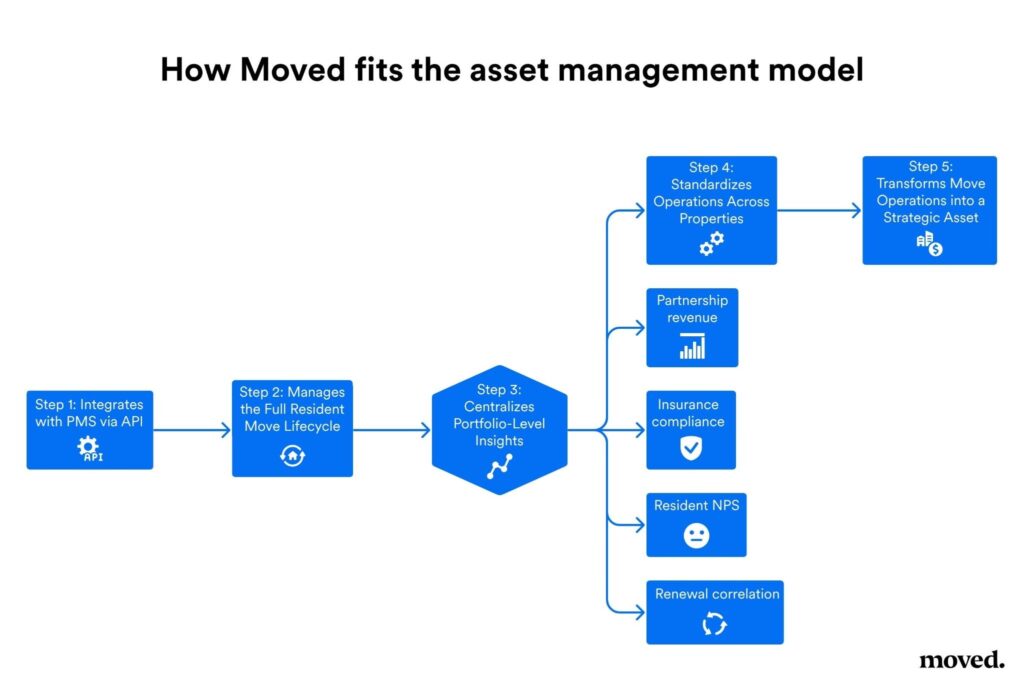
How Moved fits the asset management model
Moved is built for this layer. The platform integrates alongside the property management system via API, runs the resident-facing experience for the full move-in and move-out lifecycle, and surfaces portfolio-level data on partnership revenue, insurance compliance, NPS, and renewal correlation directly to the asset management team.
For a 10,000+ unit operator, move-in and move-out become a portfolio infrastructure asset (owned at the asset management layer, standardized across the book, and reporting to the same dashboards as the rest of the operating model).
To see what this looks like for your specific portfolio, book a walkthrough with our team or visit the Moved multifamily overview.
FAQs
Why should asset management own the move-in and move-out workflow rather than property management?
Because the value created (NOI growth, partnership revenue, renewal lift, risk reduction) accrues at the portfolio level. Property managers can execute the workflow on-site, and the standards, the vendor network, and the reporting belong at the asset management layer.
How does this fit alongside an existing property management organization?
It sits parallel to property management. The property management team continues to own the on-site experience. The move-in and move-out platform handles the resident-facing workflow and surfaces the data to asset management without changing the property management system.
What does the data layer actually deliver to asset management?
Standardized data across the portfolio on partnership revenue per move, NPS, renewal correlation, insurance compliance rates, deposit recovery, vendor performance, and turn cost recovery. This is the data that has historically lived in property-level spreadsheets and has been invisible to portfolio decision-making.
Is this consistent with industry centralization trends?
Yes. The same operators centralizing leasing, renewals, and resident account management are extending the same logic to move-in and move-out. The 80% centralization figure from Funnel Leasing’s 2025 research applies to every workflow that benefits from portfolio standardization.
How long does it take to roll out across the portfolio?
Typical rollouts run 60 to 120 days for operators in the 10,000 to 25,000 unit range, depending on the complexity of property management system integration and the number of distinct markets the portfolio operates in.
The bottom line
At 10,000+ unit operators, the move-in and move-out workflow is too important to leave at the property level. The decisions made inside that workflow shape NOI, retention, risk, and resident experience across the portfolio. Treating it as asset management infrastructure is how the outperforming operators are pulling ahead in 2026. Book a walkthrough with our team to see how this fits your portfolio.