A month-to-month lease is a rental agreement that renews automatically each month until the resident or the property gives written notice to end it. For operators, it offers flexibility on both sides and a less predictable move-out date. A clear policy sets when month-to-month terms apply, how they are priced and disclosed, and how much notice each side must give.
Across a 10,000+ unit portfolio, month-to-month residents can make up a meaningful share of occupied units at any time, especially after lease expirations pass without a renewal. This guide covers how month-to-month tenancies start, the notice and rent rules that apply, how to price them, and how to run each month-to-month move-out in residential real estate.
How A Lease Becomes Month-To-Month
Most month-to-month tenancies start in one of three ways: a resident signs a month-to-month agreement at the outset, a lease expires and the lease itself converts the tenancy to month-to-month, or a resident stays after the lease ends and the property accepts rent.
The third path is set by state law. In California, if a resident stays after the lease ends and the landlord accepts rent, the parties are presumed to have renewed on the same terms for up to one month when rent is paid monthly, under Civil Code section 1945.
In New York, accepting rent after a lease of more than one month ends creates a month-to-month tenancy starting the day after the term expires, unless the parties agree otherwise, under Real Property Law section 232-c. Accepting rent is therefore a decision with legal effect, and site teams should know that before processing a payment after a lease end date.
Notice And Rent Rules For Month-To-Month Tenancies
Notice periods vary by state and sometimes by how long the resident has lived in the unit. The table below shows two large markets as worked examples.
| Rule | California | Texas |
|---|---|---|
| Owner notice to end the tenancy | At least 60 days, or 30 days if the resident has lived there less than one year | One month after notice, unless the parties agreed in writing to a different period |
| Resident notice to end the tenancy | At least as long as the rental period, usually 30 days for monthly rent | One month after notice, unless the parties agreed in writing to a different period |
| Notice of a rent increase | At least 30 days for an increase of 10 percent or less, and 90 days for a larger increase | Set by the lease and any local rules |
The California notice rules come from Civil Code section 1946.1 and Civil Code section 827. The Texas rule comes from Property Code section 91.001. Some states and cities also limit the reasons an owner may end certain tenancies, so confirm local rules before sending an owner’s notice.
Month-To-Month Tenancies: What Operators Gain And Risk
| Factor | Benefit to the operator | Risk to manage |
|---|---|---|
| Flexibility | Rent can be adjusted with notice, without waiting for a lease end | Residents can also leave with short notice |
| Occupancy | Keeps a resident in place between leases | Move-outs become harder to forecast |
| Lease expirations | Gives time to offer a renewal | Expirations can bunch up in high-turnover months |
| Pricing | A month-to-month rate can reflect the added flexibility | The rate and any premium must be disclosed upfront |
A short notice period puts more pressure on the turn. Turnover has cost about $3,872 per resident, according to an earlier edition of Zego’s Resident Experience Management Report reported by Multifamily Dive. RealPage found concessions on 15.4 percent of stabilized U.S. apartments in August 2026, averaging about 5.7 weeks free on a 12-month lease, according to its August 2026 concessions update, which shows what a replacement lease can cost.
Pricing And Disclosing Month-To-Month Terms
Many operators set a month-to-month rate above the rate for a fixed-term renewal, to reflect the flexibility and the added vacancy risk. Whatever the rate, state it in the lease and repeat it in every renewal letter, so the resident sees it before the lease expires.
Fee transparency is under federal review. The Federal Trade Commission’s advance notice of proposed rulemaking on rental housing fees asks about fees charged at the beginning or end of a lease term and about lease renewals. Moved’s guide to the FTC rental fee rulemaking explains how to disclose charges cleanly.
The month-to-month option belongs in the renewal offer itself. Moved’s lease renewal letter template lists month-to-month terms alongside each fixed-term option, so the resident can compare them in one place.
Converting Month-To-Month Residents To Renewals: Paylode, A Moved Company
A month-to-month resident has already chosen to stay, which makes them a good candidate for a fixed-term renewal. Zego’s 2026 Resident Experience Management Report found that 31 percent of renters would be much more likely to renew if their community offered a renter rewards program.
Paylode is a Moved company. Moved acquired Paylode in November 2025, adding a perks and rewards platform that helps brands increase loyalty and retention through personalized perks and action-based rewards. Paylode’s clients have included Equity Residential and FirstKey Homes.
A renewal offer that includes perks for a longer commitment gives a month-to-month resident a concrete reason to sign.
The Revenue Case: Short Notice, Same Move
A month-to-month resident can give notice and leave within about a month. That move still needs movers, packing, and often storage, on a shorter timeline than a planned lease-end move-out. The unit then needs a new resident, who will book their own move, utilities, internet, and renters insurance.
Both moves belong in the move-in and move-out revenue workflow. When moving options are presented the day notice arrives, the resident can book early and the property keeps that service spending inside its own resident flow.
Spreading Lease Expirations To Limit Month-To-Month Risk
Month-to-month tenancies often build up when many leases expire in the same months and renewal offers go out late. Spreading expirations across the year, by offering lease terms that end in lower-demand months, keeps the number of residents on month-to-month terms manageable.
The renewal offer is the main tool. Sending it 90 to 120 days before lease end, with the month-to-month rate shown next to each fixed-term option, gives the resident time to choose a term before the lease converts.
Running Month-To-Month Tenancies Across A 10,000+ Unit Portfolio
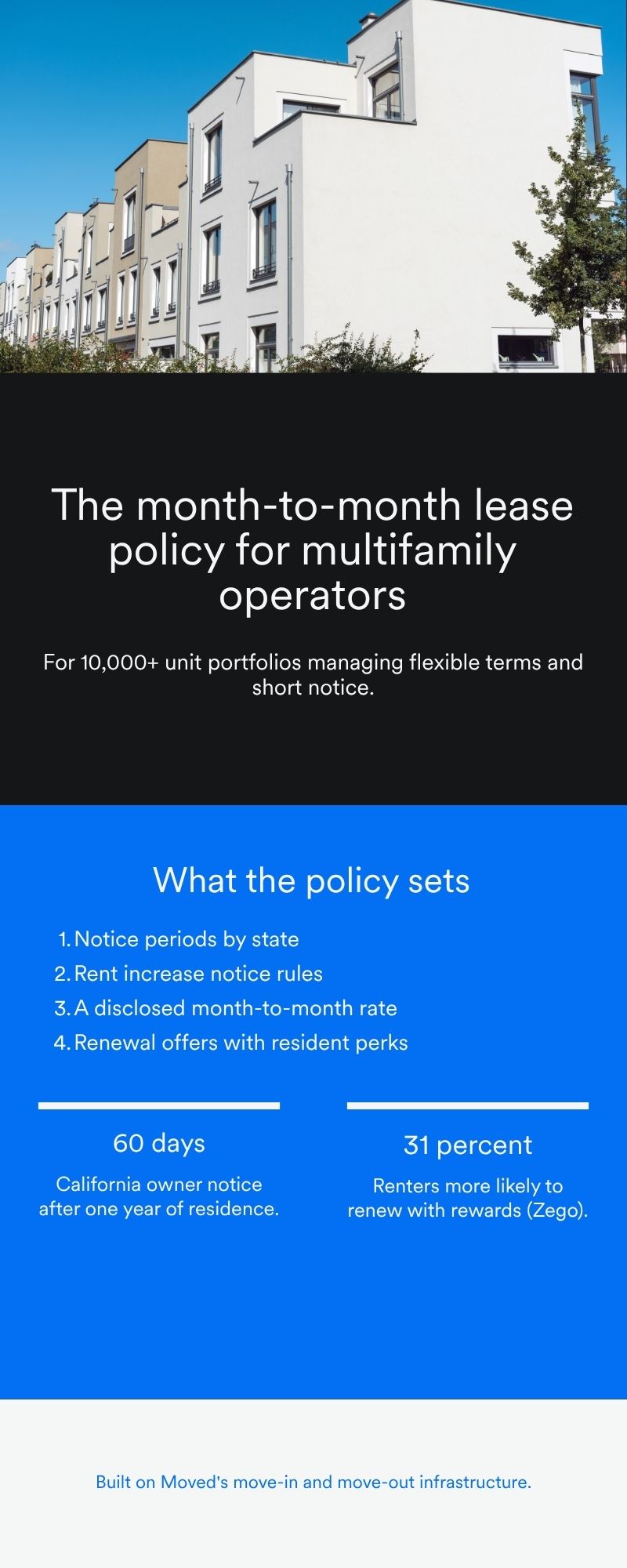
- One month-to-month policy, with state-specific notice periods and rent increase rules.
- Month-to-month rates set centrally, disclosed in the lease, and repeated in every renewal letter.
- Site teams trained on the legal effect of accepting rent after a lease ends.
- Renewal offers sent to month-to-month residents on a fixed schedule, with perks for longer terms.
- Moving services, insurance confirmation, and inspection scheduling triggered when notice is received.
- Month-to-month share, conversion to renewal, and average notice period reported by property.
Insurance stays part of the checklist. A month-to-month resident should keep renters insurance active until keys are returned, and Moved’s guide to capturing renters insurance requirements explains how to get notice of a cancelled policy.
Traditional tools focus on task tracking and administrative coordination. Moved embeds revenue-generating services and insurance verification directly into the workflow, transforming move coordination into structured revenue infrastructure.
Moved is a move infrastructure platform that embeds revenue-generating services, including movers, packing, storage, insurance, utilities, and connectivity, directly into the resident onboarding workflow. It helps property operators increase ancillary income while mitigating compliance risk, and the guide to resident onboarding automation shows how that workflow is built.
For residents, clear month-to-month terms are part of the resident experience. For operators, Moved for multifamily operators shows how the same process runs across a portfolio.
Frequently Asked Questions
What is a month-to-month lease?
A month-to-month lease is a rental agreement that renews automatically each month until the resident or the property gives written notice to end it.
How does a month-to-month lease work?
The resident pays rent monthly under the existing terms. Either side can end the tenancy, or the property can change the rent, by giving the written notice required by state law.
How much notice is needed to end a month-to-month lease?
It depends on the state. In California, an owner generally gives 60 days’ notice, or 30 days if the resident has lived there less than one year, and Texas defaults to one month.
Can rent go up on a month-to-month lease?
Yes, with proper notice. California requires at least 30 days’ notice for an increase of 10 percent or less and 90 days for a larger increase, and local rent rules may also apply.
Is a month-to-month lease more expensive?
Many operators set a higher monthly rate for month-to-month terms to reflect the flexibility. The rate should be stated in the lease and in the renewal offer.
Manage Flexibility Without Losing Control
Month-to-month residents keep units occupied, and they can leave on short notice. To see how renewal offers, insurance confirmation, and move services run as one move-in and move-out workflow across a 10,000+ unit portfolio, book a walkthrough with the Moved team.