Resident retention has moved from a property-level concern to a portfolio-level discipline at 10,000+ unit operators in 2026. The reason is structural. Yardi Matrix’s December 2025 report shows flat rent growth, ApartmentIQ flagged concessions returning to four to six weeks of free rent in primary markets, and the industry-wide retention rate sits at 58% against a 63% target, per CRE Daily’s mid-2025 survey. When residents have more options at similar rents, the operators with measurable retention programs win.
This guide covers the seven resident retention programs that consistently move the renewal number at 10,000+ unit operators, ranked by impact.
Why most retention programs fail
Three reasons retention programs underperform.
They are unmeasured. Most “retention programs” are activities (welcome boxes, holiday parties, renewal letters) without a measurement layer that ties activity to renewal rate. Activity without measurement is theater.
They are inconsistent across the portfolio. A welcome program that one community manager runs and another ignores produces lottery-level results at the asset management layer. Standardization is the multiplier.
They focus on the wrong stage of the lease. Most renewal investment happens in months 10-12, when the resident has already decided. The data make it clear that the renewal decision is shaped most heavily by the first 30 days and the maintenance experience throughout the lease, per Premier Placements’ onboarding research.
The 7 retention programs that actually work
-
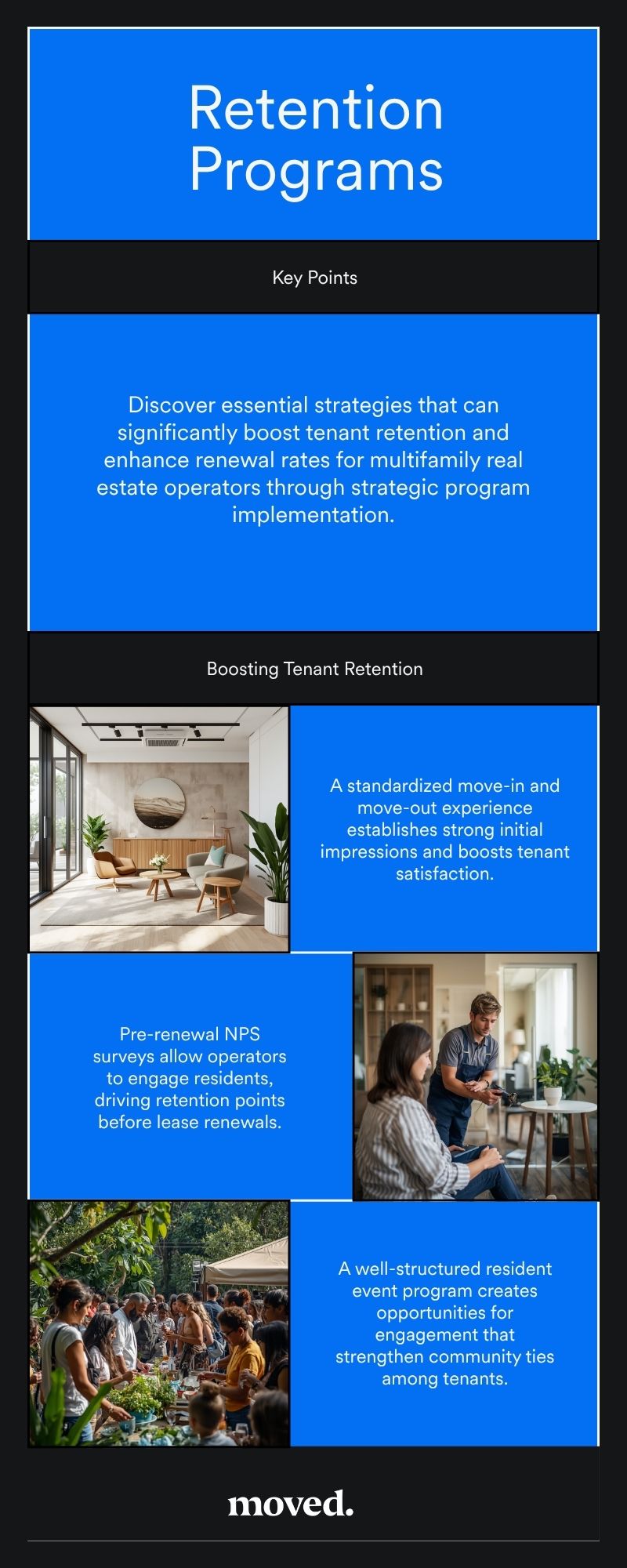
Standardized move-in and move-out experience
The single highest-impact retention program. NPS is set in the first 30 days of a lease, and BubbleGum BI’s multifamily NPS research shows that residents scoring 9-10 renew at 70-80%, versus less than 30% for those scoring 0-6.
A standardized move-in and move-out workflow that runs every resident through the same task orchestration, communication cadence, and service activation produces NPS scores 4 to 8 points higher than property-by-property improvisation. The compounding effect at a 10,000+ unit operator is meaningful: a 4-point NPS improvement translates to 4-6 retention points, and the resulting avoided turn cost and retained rent across the lease cycle is the largest single retention contribution available to the operator.
For the full operating model, see our breakdown of how move-in and move-out workflows became a property management revenue engine, as well as our ultimate guide to resident onboarding automation.
-
Pre-renewal NPS surveys with action loops
Most operators run NPS surveys, but few run them at the right time. The right time is 90 days before renewal. Surveys sent 30 days before renewal arrive after the decision has been made.
A pre-renewal NPS survey at day 270 of a 12-month lease gives the property team 90 days to act on detractor feedback before the renewal letter goes out. Operators who do this consistently outperform peers by 3-5 retention points, because they close maintenance, communication, and amenity gaps while the resident still has time to update their renewal decision.
The action loop matters more than the survey. Capture the score, escalate detractors to the community manager within 48 hours, document the resolution, and re-survey 30 days later. Without the loop, the survey is just a number.
-
A real resident event program
12 to 16 events per property per year, programmed across welcome events, quarterly anchors, seasonal events, wellness, education, amenity-driven events, and resident appreciation. Budget at a 10,000+ unit operator is sized against expected retention lift and avoided turn cost, rather than a fixed dollar figure, and pays back through retention alone.
-
Maintenance response standards with public commitments
Maintenance experience is the second-largest driver of churn after rent, per Zego’s 2025 Resident Experience Report summarized by NAA. Publish a 24-hour response standard for non-emergency tickets and a 4-hour standard for emergencies. Measure compliance per property. Tie a portion of the community manager bonus to the metric.
Operators who meet the response standard 90%+ of the time score 6-10 points higher on NPS than those who meet it 70% of the time. The bar matters less than the public commitment and the measurement.
-
Renewal incentive structure tied to lease length
The default renewal incentive (a small rent concession for a 12-month renewal) leaves money on the table. Tier the incentive by lease length: small concession on 12 months, larger concession on 18 months, larger still on 24 months. Pair with a refreshed apartment perk (carpet clean, paint touch-up, smart-home device).
This shifts the renewal mix toward longer leases and reduces churn frequency at the portfolio level. Operators using a tiered renewal structure see 10-15% of renewals shift to 18-month or longer terms, which reduces turn frequency proportionally.
-
Resident referral programs
Word of mouth is the highest-converting lead source in multifamily. A formal referral program with a clear payout (one month’s rent split between the referrer and the new resident, or equivalent) consistently produces 5-8% of new leases in portfolios that run it well.
The mechanics matter. Make the referral form a single field, pay out within 30 days, and surface it within the Moved residents experience so existing residents see it whenever they log in to the portal.
-
Community communication cadence
Most operators undercommunicate during the quiet months of the lease (months 4-9) and overcommunicate in the renewal window. Flip the curve. A monthly community newsletter with maintenance updates, event reminders, and short personal notes from the community manager during months 4-9 keeps residents engaged when retention investment is at its lowest cost.
Operators with a consistent monthly cadence score 3-5 points higher on NPS than operators with sporadic or renewal-window-only communication.
What this stack compounds into at a 10,000+ unit portfolio
Stacking the seven programs at a 10,000+ unit operator compounds into measurable retention lift, additional renewals per year, avoided turn cost, retained rent, and NOI uplift across the lease cycle. The sizing for any specific portfolio depends on baseline retention, asset class, rent profile, and program execution.
For the operator framing of how retention uplift converts into NOI and asset value at a portfolio of this size, the two definitive references are the Moved CEO’s RevGen newsletter on the third pillar of residential real estate and the RevGen leak map. Both walk through the structural argument for why retention investment is one of the highest-return categories available to a multifamily operator.
How Moved fits
The first program on the list (a standardized move-in and move-out experience) runs on Moved infrastructure. The other six (NPS surveys, events, maintenance standards, renewal incentives, referrals, communication) reside within the property management organization and the resident experience team, with the Moved resident portal serving as the operational layer that residents actually log in to.
For 10,000+ unit operators, the operational reality is that residents will not log into two or three different portals. Consolidating the resident-facing experience within the Moved resident experience is what enables the rest of the retention programs to reach the resident at all.
To see how this works at portfolio scale, book a walkthrough with our team or visit the Moved multifamily product page.
FAQs
Which retention program has the highest ROI for a 10,000+-unit operator?
A standardized move-in and move-out experience. NPS is set in the first 30 days, and directly predicts renewal. A multi-point NPS lift across a portfolio of this size compounds into the largest single retention contribution available to the operator.
When should we run the pre-renewal NPS survey?
Day 270 of a 12-month lease (90 days before renewal). This gives the property team time to act on detractor feedback before the renewal decision locks in.
Do resident referral programs actually drive renewals?
They drive new leases more directly than renewals, but the indirect effect on resident pride of place and renewal intent is measurable. Properties with active referral programs score 2-4 points higher on NPS.
How long does it take to see an improvement in retention after deploying these programs?
The first measurable lift typically appears 60-90 days into deployment, as new residents move through the standardized move-in and move-out flow. Full retention improvement compounds over 12-18 months as the renewal cycles turn over.
Can a property run these programs without changing the property management system?
Yes. Five of the seven programs are operational. Only the move-in and move-out workflow depends on dedicated software at portfolio scale.
The bottom line
Resident retention at 10,000+ unit operators is built on standardization, measurement, and timing. The seven programs above have the cleanest evidence base. Stacked together at a portfolio of this size, they generate measurable retention lift, avoided turn cost, and retained rent, with the largest single contribution from a standardized move-in and move-out workflow.
For the full operator playbook, see our breakdown of ancillary revenue in multifamily and our guide on how property managers automate the resident move-in and move-out process.