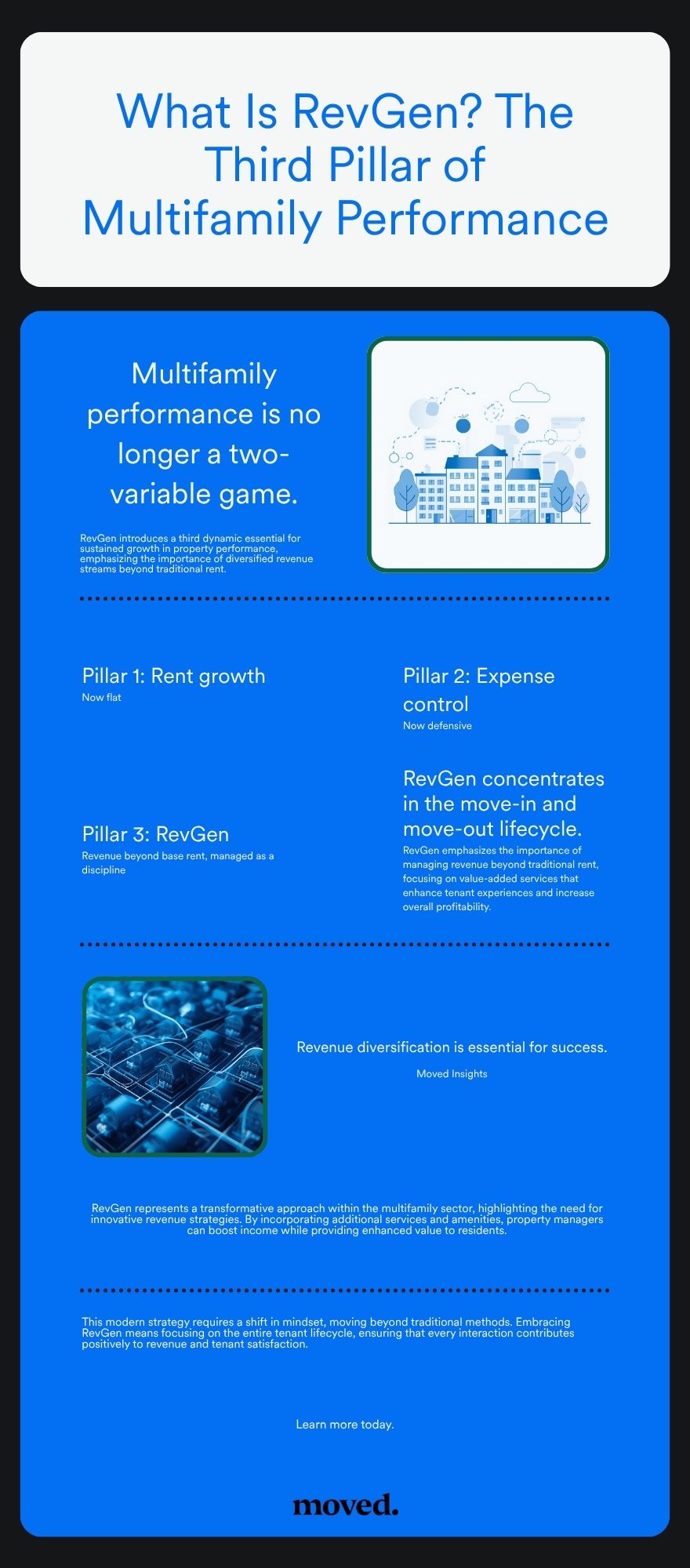
For two decades, multifamily performance came down to two variables. Grow rent. Control expenses. Every pro forma, every asset management review, and every quarterly investor update was built on those two numbers moving in the right direction. In 2026, both are constrained simultaneously, and a third variable has moved to the center of the conversation.
That third variable is RevGen: the revenue a property generates beyond base rent, managed as a discipline rather than a leftover line. The framing comes from the Moved CEO’s RevGen newsletter, which focuses on the third pillar of residential real estate.
This article defines RevGen, explains why it has become the third pillar of multifamily performance alongside rent growth and expense control, and shows where the largest uncaptured revenue lies for a 10,000+-unit operator.
The two-pillar model has run out of room.
Rent growth has stalled. National multifamily rent growth was roughly flat year-over-year heading into 2026, per Yardi Matrix’s December 2025 report, and concessions returned to four to six weeks of free rent in many supply-heavy primary markets, per ApartmentIQ’s Q1 2025 analysis.
Expenses have not cooperated. Property insurance premiums rose 14%, 22%, and 45% over the past three years, per NAA’s Premium Pulse research, putting steady pressure on the expense line.
When both traditional pillars are under pressure simultaneously, NOI growth must come from elsewhere. That somewhere is RevGen.
What RevGen actually is
RevGen is the income a property earns from everything residents do beyond paying for the unit itself. It includes parking, pet rent, storage, amenity fees, utility partnerships, renters insurance partnerships, internet and connectivity revenue, and partnership income from move-related services such as movers, packing, and storage.
The industry has historically filed all of this under a single accounting line called “other income.” That framing is the problem, and we cover it in depth in our companion guide on multifamily ancillary revenue. The short version is that “other income” treats a portfolio of distinct revenue streams as a single undifferentiated bucket, making the category impossible to manage with any precision.
Why RevGen is now a structural pillar
Three forces moved RevGen from optional to structural.
Rent growth is flat, so the first pillar cannot carry NOI alone. Operating costs keep climbing, so the second pillar is a defensive game rather than a growth one. And capital is disciplined, so refinancing windows and distributions depend on NOI that operators can actually produce without a market-cycle tailwind.
RevGen addresses all three at once. It grows income without raising rent, which sidesteps resident affordability ceilings and concession blowback. It requires far less capital than a renovation. And partnership-based RevGen carries minimal incremental operating cost, so it flows almost entirely to the bottom line. A dollar of partnership-based ancillary income is worth closer to a dollar of NOI than a dollar of rent, which is exactly why asset managers now treat it as a pillar rather than a footnote. For the full NOI argument, see our breakdown of how to increase multifamily NOI without raising rent.
Where RevGen concentrates: the move-in and move-out lifecycle
RevGen is not evenly distributed across the resident lifecycle. The highest-intent, highest-margin revenue clusters in the days surrounding move-in and move-out, when residents are actively making decisions about movers, packing, storage, utility activation, internet, and insurance. If the property is present at that moment, the partnership revenue is captured. If it is absent, a third party captures it instead.
This is why the move-in and move-out lifecycle keeps surfacing as the single highest-margin place to invest in RevGen infrastructure. Most ancillary categories are monetized once. Move-related revenue is monetized at every turn of every unit. We walk through the full mechanism in our piece on how move-in and move-out workflows became a revenue engine for property management.
What RevGen looks like at a 10,000+ unit portfolio
At portfolio scale, RevGen compounds across the lease cycle as every move event becomes a captured revenue moment rather than a missed one. The Moved CEO’s RevGen newsletter sizes the typically uncaptured non-rent opportunity at roughly $15 per unit per month and walks through how that recurring revenue translates into NOI and asset value for a portfolio of this scale. The companion RevGen leak map maps where that revenue leaks today and how operators close the gap. Both are the operator references for building the RevGen case.
The exact result for any portfolio depends on asset class, geography, and existing baseline performance. The pattern holds: RevGen captured consistently across the book is the cleanest source of NOI growth available without raising rent.
RevGen is infrastructure, and infrastructure has to be built.
The operators capturing RevGen consistently treat it as portfolio infrastructure managed at the asset management layer. The systems that capture it, including the move-in and move-out workflow, the partner network, the verification gates, and the reporting layer, live above any single property and stay consistent across the book. Operators who treat RevGen as a set of one-off property-level projects underperform because a pilot at one asset never changes the portfolio number.
For most operators in the 10,000+ unit range, the practical path is to partner with a move infrastructure platform rather than build the entire stack in-house. The platform runs the resident-facing experience, and the partner network, and the asset management team owns the strategy and the standards. Moved is built on flexible commercial structures designed to align with property financial goals.
How Moved fits
Moved is a move-in and move-out infrastructure platform built for the resident lifecycle. Traditional tools focus on task tracking and administrative coordination. Moved embeds revenue-generating services and insurance verification directly into the workflow, integrates alongside the property management system via API, and returns clean RevGen data to the asset management team. Resident perks, rewards, and partnerships run on Paylode. This Moved company Moved acquired in November 2025 to advance ancillary revenue automation, per the Moved announcement, for 10,000+ unit operators, which turns the highest-intent revenue moment in the resident experience into a managed, partnership-economics workflow.
To see what RevGen looks like across your specific portfolio, book a walkthrough with our team or visit the Moved multifamily product page.
FAQs
What does RevGen mean in multifamily? RevGen is revenue generation from sources beyond base rent, managed as a strategic discipline. It spans parking, pet rent, storage, amenity fees, utility and insurance partnerships, connectivity, and move-related partnership income.
Why is RevGen called the third pillar? Because the two traditional pillars of multifamily performance, rent growth and expense control, are both constrained in 2026. Rent is flat, and expenses are climbing, so NOI growth increasingly depends on the third pillar: revenue generated without raising rent.
Is RevGen the same as ancillary revenue? RevGen is the discipline of managing non-rent revenue as a pillar. Ancillary revenue is the category of income itself. RevGen is how you run it.
Where does RevGen concentrate? In the move-in and move-out lifecycle, where residents make the highest-intent decisions about movers, packing, storage, utilities, internet, and insurance inside a narrow window.
Who owns RevGen at a 10,000+ unit operator? It sits at the asset management layer, with on-site teams executing the workflow and the reporting rolling up to operations leadership.
The bottom line
Multifamily performance is no longer a two-variable game. Rent growth is constrained, and expense control is defensive, leaving RevGen as the third pillar that will determine whether NOI grows in 2026. The operators who treat it as infrastructure, concentrated in the move-in and move-out lifecycle and managed at the portfolio level, are the ones who will outperform.
For a deeper look at the revenue mechanics, see our breakdown of ancillary revenue in multifamily, and for the resident view, browse the Moved resident experience.