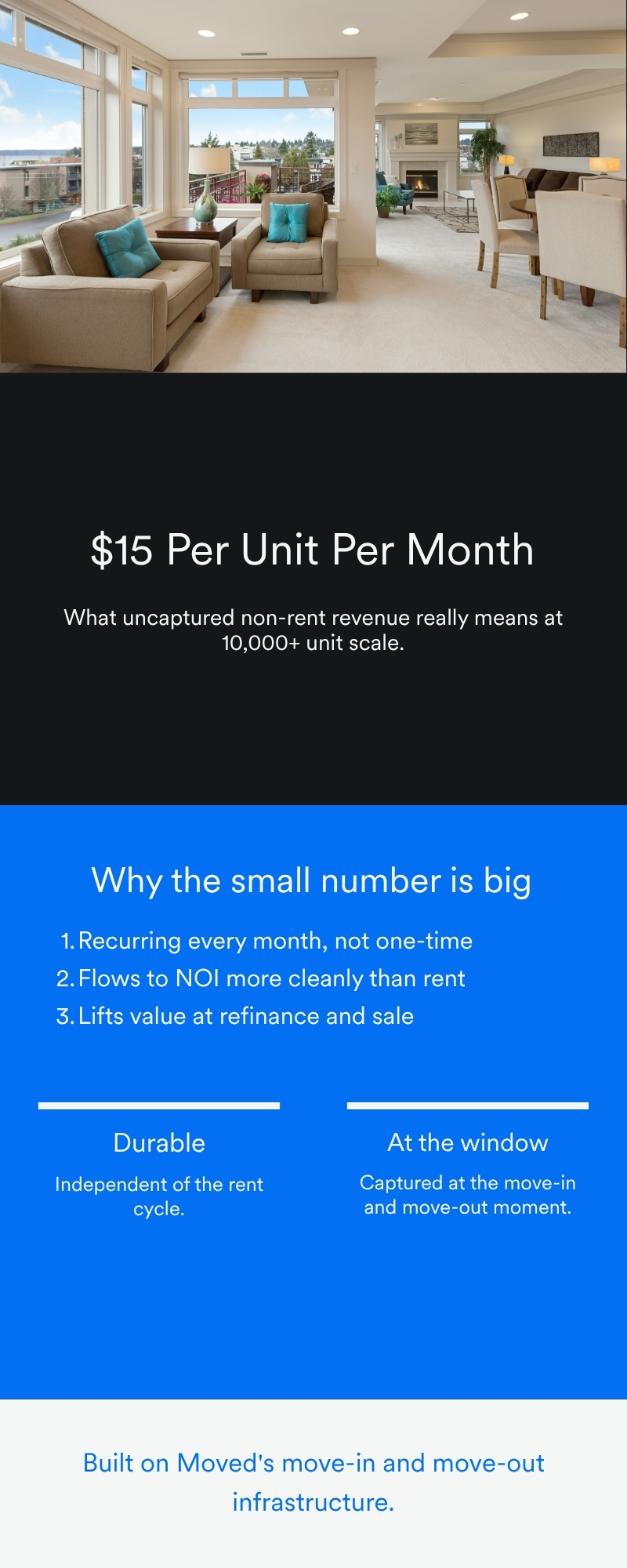
The Moved CEO’s RevGen work puts one number on the table for a 10,000+ unit operator: roughly $15 per unit per month in typically uncaptured non-rent revenue, most of it concentrated in the move-in and move-out window. The figure is small per unit and easy to wave off, and that is exactly why it is misread. This guide explains what $15 per unit per month actually means once you understand how that revenue behaves. The figure comes from the Moved CEO’s RevGen leak map.
For the broader model, see our guide to ancillary revenue in multifamily.
It is recurring, not one-time.
The first thing $15 per unit per month means is that it repeats. This is not a one-time fee at move-in. It is a monthly figure that recurs across the portfolio, month after month, and renews as residents cycle through the move-in and move-out window. Recurring revenue is worth far more than the same amount collected once, because it compounds across every unit and every turn.
It flows to NOI cleanly.y
The second thing it means is quality. Partnership-based non-rent revenue carries minimal incremental operating cost. Hence, a dollar of it lands closer to a dollar of net operating income than a dollar of rent does, which arrives carrying its share of operating expense. That is why asset managers treat well-captured non-rent revenue as some of the highest-quality income on the statement, not as a rounding line.
It shows up in value.
The third thing it means is the durability of value. Multifamily assets are valued on net operating income, so recurring income that flows cleanly to NOI also lifts the asset’s value at refinance and at sale. Revenue captured consistently across the book strengthens the number that lenders and buyers underwrite, which is why non-rent revenue has moved from a footnote to a line the capital markets pay attention to.
It does not depend on the rent cycle.
The fourth thing it means is independence from the market. Rent growth rises and falls with the cycle. The $15 per unit per month is captured from resident spend that is already happening during the move-in and move-out window, so it does not require a rent tailwind, a renovation, or a concession war to produce. It grows income without raising rent, which is exactly the pressure most operators are under. We make that case in our guide to increasing multifamily NOI without raising rent.
Why does it concentrate on the move-in and move-out window?
The reason the figure sits where it does is intentional. The move-in and move-out window is when residents are actively deciding on movers, packing, storage, utilities, internet, and insurance, making it the highest-intent, highest-margin moment in the resident lifecycle. Capture the window well, and the per-unit figure is realized. Miss it, and the same revenue walks out the door to a third party. We walk through the mechanism in our breakdown of how move-in and move-out workflows became a property management revenue engine and the onboarding mechanics in our ultimate guide to resident onboarding automation.
How Moved fits
Moved is the move-in and move-out infrastructure platform that captures the per-unit figure and returns it as measurable revenue. Traditional tools focus on task tracking and administrative coordination. Moved embeds revenue-generating services, including movers, packing, storage, utilities, internet, and insurance verification, directly into the resident workflow, then reports the result to the asset management team by property, stream, attach rate, and margin. Resident perks, rewards, and partnerships run on Paylode, a Moved company that Moved acquired in November 2025 to advance ancillary revenue automation, per the Moved announcement. The resident-facing experience lives inside the Moved resident experience. Moved is built on flexible commercial structures designed to align with property financial goals.
To see what the per-unit figure looks like across your own portfolio, book a walkthrough with our team or visit the Moved multifamily product page.
FAQs
What is the $ 15-per-unit-per-month figure?
It is the roughly $15 per unit per month in typically uncaptured non-rent revenue that the Moved CEO’s RevGen leak map identifies, most of it concentrated in the move-in and move-out window.
Why does a small per-unit figure matter?
Because it recurs monthly across the portfolio, flows cleanly to NOI, and lifts asset value, making it worth far more than the per-unit number suggests.
Why is it higher quality than rent?
Partnership-based non-rent revenue carries minimal incremental operating cost, so more of each dollar reaches net operating income.
Does it depend on rent growth?
No. It is captured from resident spend that already occurs during the move-in and move-out window, independent of the rent cycle.
Where is it captured?
At the move-in and move-out window, the highest-intent moment in the resident lifecycle.
The bottom line
In residential real estate, $15 per unit per month is not a small number; it is a recurring, high-quality, cycle-independent stream that flows to NOI and shows up in value. Understood correctly, it reframes the move-in and move-out window from an operational task to one of the cleanest sources of NOI for a 10,000+ unit operator.
For the resident view, browse the Moved resident experience.