Every 10,000+ unit operator has launched an ancillary program that looked strong in the deck and quietly faded six months later. The move-in and move-out window is full of these: a parking push, a pet program, an insurance partnership that started well and then stalled. The RevGen Triangle is the test that predicts, before launch, whether a program will compound or fade. The framing comes from the Moved CEO’s RevGen leak map.
This guide lays out the three-party test that every non-rent revenue program must pass, and why the move-in and move-out window is where it applies most. For the broader model, see our guide to ancillary revenue in multifamily.
Why do good programs stall
The usual explanation for a stalled program is that the offer was weak. That is rarely the real reason. Most programs stall because they were built to work for one party at the expense of another. A program that extracts value from residents to book short-term revenue starts fine, but then erodes retention and brand. A program that asks a partner to carry uneconomic acquisition costs loses the partner. A program that adds operator margin but creates friction for residents converts once and never again.
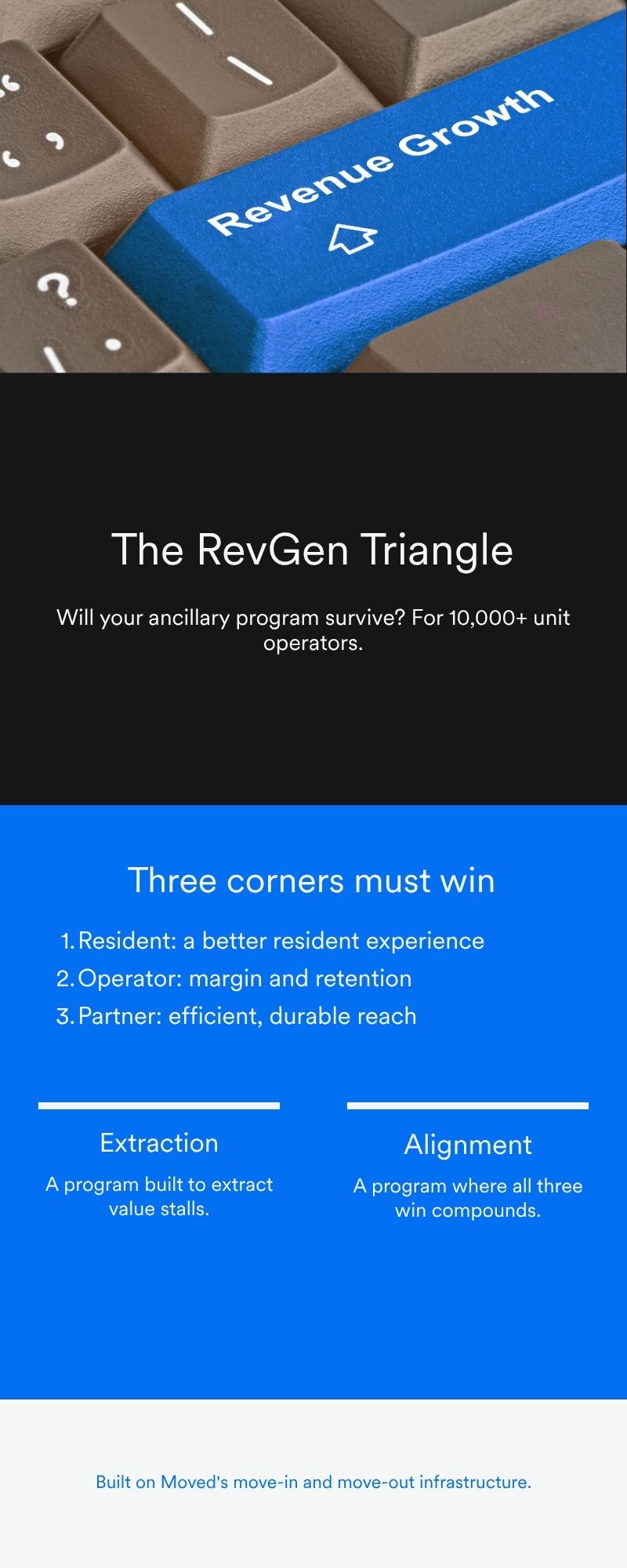
A program built for extraction stalls. A program built for alignment compounds. That is the whole test.
The three corners of the triangle
A non-rent revenue program that grows reliably has to work for three parties simultaneously. When any one corner is losing, the program is on borrowed time, even when the early numbers look acceptable.
The resident has to win.
The resident has to get real convenience, control, savings, or a measurably better resident experience. If the offer lands as friction or as a fee dressed up as a service, residents route around it, conversion falls, and the program reads as weak when the problem was alignment.
The operator has to win.
The operator has to get margin, retention, and brand reinforcement. Revenue that damages the resident relationship is not a win, as it shows up later in lower renewals. The best programs add margin and strengthen the resident experience in the same motion.
The partner has to win.
The service partner has to get efficient acquisition and durable scale. A partner network is a business in its own right, and a program that is uneconomic for the partner will not be supported for long. Durable partner economics are what keep the offer live across the portfolio.
Where to apply the triangle: the move-in and move-out window
The triangle is sharpest during the move-in and move-out window because all three parties have the most to gain at once. The resident is actively deciding on movers, packing, storage, utilities, internet, and insurance, and wants those decisions made easily. The operator captures the highest-intent, highest-margin revenue in the resident lifecycle. The partner reaches a ready buyer at the exact moment of need. When a program is designed so that all three win in that window, it compounds across every move. We walk through the mechanism in our breakdown of how move-in and move-out workflows became a property management revenue engine and the onboarding mechanics in our ultimate guide to resident onboarding automation.
How Moved fits
Moved is the move-in and move-out infrastructure platform built so all three corners of the triangle win. Traditional tools focus on task tracking and administrative coordination. Moved embeds revenue-generating services, including movers, packing, storage, utilities, internet, and insurance verification, directly into the resident workflow, giving the resident a better experience, the operator margin and retention, and the partner efficient reach at the moment of intent. Resident perks, rewards, and partnerships run on Paylode, a Moved company that Moved acquired in November 2025 to advance ancillary revenue automation, per the Moved announcement. The resident-facing experience lives inside the Moved resident experience. Moved is built on flexible commercial structures designed to align with property financial goals.
To pressure-test your own programs against the triangle, book a walkthrough with our team or visit the Moved multifamily product page.
FAQs
What is the RevGen Triangle?
It is a three-party test for whether an ancillary program will survive. The resident, the operator, and the partner all have to win. If anyone loses, the program is on borrowed time.
Why do ancillary programs fail even when the offer is good?
Because they are built to work for one party at the expense of another. Extraction stalls, alignment compounds.
How does the resident win?
Through real convenience, control, savings, or a measurably better resident experience, not a fee dressed up as a service.
Why apply the triangle at the move-in and move-out window?
Because that is where all three parties gain the most at once, making aligned programs compound with every move.
What is the single most common failure?
Designing for operator margin while creating friction for the resident, which converts once and erodes retention afterward.
The bottom line
In residential real estate, the programs that outperform on non-rent revenue are the ones that pass the triangle before launch. Design so that the resident, the operator, and the partner all win during the move-in and move-out window, and the program compounds rather than fades.
For the NOI picture, see our guide to increasing multifamily NOI without raising rent.