Ask a 10,000+-unit operator who owns the rent number, and the answer comes back in one sentence, with a name, a target, and a dashboard to back it up. Ask who owns the non-rent revenue number, and the room goes quiet. That silence is the first and most expensive leak in the RevGen system, and it is the one from which every other leak flows. The framing comes from the Moved CEO’s RevGen leak map.
This article is about the ownership leak: why non-rent revenue drifts when no single person is accountable for it, and the accountability model that closes the gap at portfolio scale. It has quietly become one of the defining performance questions in residential real estate.
The diagnostic question
Start with one question at your own operator. Who is the single named person whose compensation is tied to non-rent revenue?
If the answer is a committee, a shared responsibility, or a task that lives across leasing, operations, and finance without a clear owner, the number is already leaking. Revenue that belongs to everyone belongs to no one. Rent has an owner because the industry decided decades ago that it needed one. Non-rent revenue has become material enough to warrant the same, and most operators have not made that decision yet.
Why unowned revenue drifts
Non-rent revenue drifts for a structural reason. It is not a single line that one team manages. It is a portfolio of streams, parking, pet rent, storage, utilities, insurance, and the partnership income that concentrates in the move-in and move-out window, each touched by a different team at a different moment. When no one owns the total, each stream gets partial attention from a team whose primary job is something else.
The result is predictable. Programs launch and quietly fade. Attach rates plateau. The move-related revenue that falls within the move-in and move-out window goes uncaptured because no one is accountable for it. And because the number sits inside a bundled “other income” line, the drift never shows up as a miss. The economics category is included in our guide to ancillary revenue in multifamily.
The accountability model that closes the leak
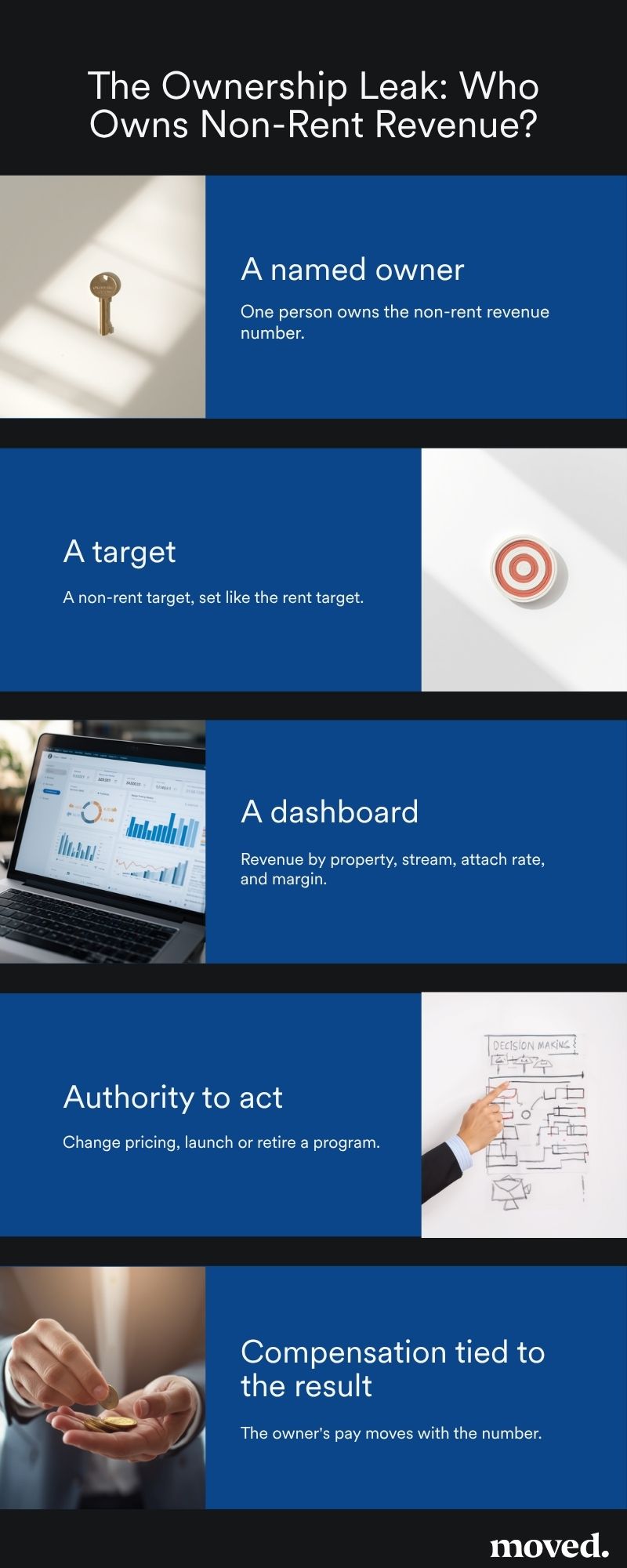
Closing the ownership leak takes five things, in order.
A named owner. One person carries the non-rent revenue number across the portfolio, and a committee cannot own it. The role can sit in asset management, operations, or a dedicated ancillary revenue function, but it has to be a person with a name.
A target. The owner carries a specific non-rent revenue target, sets the rent target, and reports on the same cadence.
A dashboard. The owner has a category-level view of non-rent revenue by property, stream, attach rate, and margin, rather than a single bundled number that hides where revenue is and is not being captured.
Authority to act. The owner can change pricing, launch or retire a program, and reallocate effort across streams without routing every decision through three other teams. Accountability without authority is only a title.
Compensation tied to the result. The owner’s compensation moves with the number. This is the step most operators skip, and it is the one that turns the number from a report into a result.
When those five are in place, the other RevGen leaks become fixable because someone is now accountable for fixing them.
Where should the owner start
The highest-return place for a new non-rent revenue owner to start is the move-in and move-out window. It is where the largest uncaptured revenue sits, where resident intent peaks, and where a standardized workflow can lift the number fastest across the portfolio. The Moved CEO’s RevGen leak map sizes the typically uncaptured non-rent opportunity at roughly $15 per unit per month, much of it concentrated in that window. We walk through the mechanism in our breakdown of how move-in and move-out workflows became a property management revenue engine, the onboarding mechanics in our ultimate guide to resident onboarding automation, and the NOI argument in our guide to increasing multifamily NOI without raising rent.
How Moved fits
Moved gives the non-rent revenue owner the infrastructure and the reporting to do the job. It is the move-in and move-out infrastructure platform that runs the resident-facing experience, captures move-related revenue, and returns it to the owner as category-level data by property, stream, attach rate, and margin. Traditional tools focus on task tracking and administrative coordination. Moved embeds revenue-generating services, including moving, packing, storage, utilities, internet, and insurance, directly into the workflow. Resident perks, rewards, and partnerships run on Paylode, a Moved company that Moved acquired in November 2025 to advance ancillary revenue automation, per the Moved announcement. For the owner, that turns the move window from an unowned leak into a measured, managed stream. Moved is built on flexible commercial structures designed to align with property financial goals.
To give your non-rent revenue owner the data and the workflow, book a walkthrough with our team or visit the Moved multifamily product page.
FAQs
What is the ownership leak in RevGen? It is the gap that opens when no single person is accountable for the non-rent revenue number. Revenue that belongs to everyone belongs to no one, so it drifts.
Who should own non-rent revenue at a 10,000+-unit operator? A single named person, in asset management, operations, or a dedicated ancillary revenue function, with a target, a dashboard, the authority to act, and compensation tied to the result.
Why does unowned non-rent revenue underperform? Because it is a portfolio of streams touched by different teams at different moments, and without a single owner, each stream gets partial attention from a team whose main job is something else.
Where should a new non-rent revenue owner start? The move-in and move-out window, where the largest uncaptured revenue sits, and a standardized workflow can lift the number fastest.
What is the one step operators skip? Tying the owner’s compensation to the number. It is the step that turns a report into a result.
The bottom line
The ownership leak is the first leak in the RevGen system, as all other leaks flow from it. Name an owner, give them a target, a dashboard, the authority to act, and compensation tied to the result, and point them first at the move-in and move-out window. That is how non-rent revenue stops drifting and starts compounding. For the resident view, browse the Moved resident experience.