For affordable housing operators, in a corner of residential real estate with the tightest compliance rules, the move-in and move-out moment is where financial and regulatory risk is concentrated. A single missing income certification, an out-of-date file, or an unverified renters insurance policy at lease execution can surface later as an audit finding, and at 10,000+ unit scale, that risk multiplies across every property in the portfolio. We cover the broader revenue model in our guide to ancillary revenue in multifamily.
This guide lays out the compliance-first move-in and move-out workflow that LIHTC and HUD-funded operators apply across the portfolio, with the certification gates, documentation standards, and verification checkpoints that keep the file audit-ready from the first day of the lease.
Why does the move-in and move-out moment carry the compliance risk?
At an affordable housing operator, the compliance obligation begins before the resident receives keys. Income eligibility must be certified at initial occupancy, and the file must include documentation proving it. Housing finance agencies inspect LIHTC properties on a defined cadence, reviewing at least 20% of a project’s low-income units and re-checking income certification at least once every three years, with the first review due by the end of the second calendar year after the last building is placed in service, per the IRS regulations summarized by the National Low Income Housing Coalition.
The exposure is personal for the compliance team. When a file is incomplete at move-in, the operator carries the finding, and the after-the-fact fix is far more expensive than getting it right at the front door. The move-in and move-out workflow is the one place where every certification, signature, and verification can be captured in a fixed sequence rather than reconstructed under audit pressure.
The problem: compliance documentation lives in too many places
Most affordable housing operators run move-in and move-out through a mix of the property management system, paper files, email threads, and on-site memory. That fragmentation is the root of most audit findings, and it is also where ancillary revenue quietly leaks, because the moved services residents are already buying happen outside the operator’s system.
- Income certifications get completed but not consistently filed against the resident record.d
- Renters insurance is collected at some properties and skipped at others
- Recertification deadlines drift because no single system tracks them
- The move-out file rarely closes with the same rigor with which the move-in file opens
Two properties in the same portfolio can run the same program and produce opposite audit outcomes, purely because one captured the documentation in a workflow and the other left it to individual staff.
The solution: a standardized workflow with compliance gates
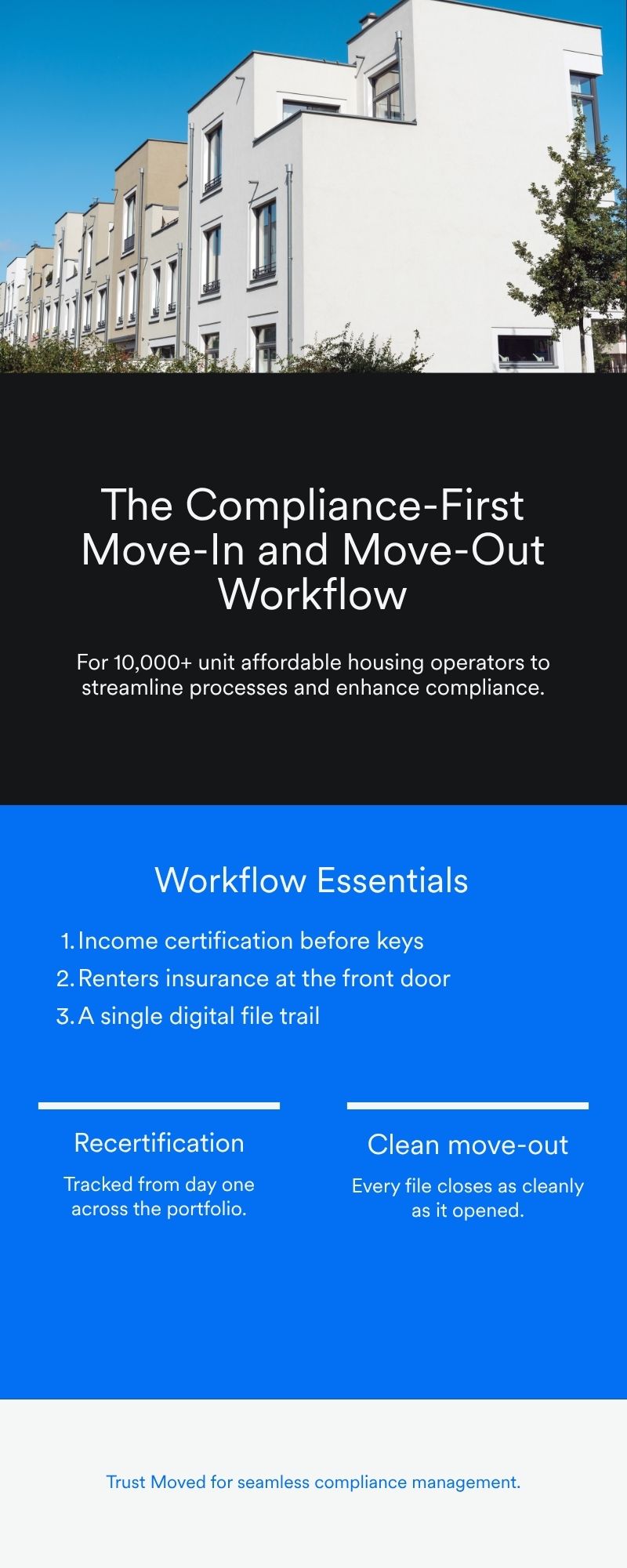
A compliance-first move-in and move-out workflow places the certification and verification steps as hard gates that cannot be skipped. It embeds the revenue-generating move services, movers, packing, storage, utilities, internet, and insurance into the same flow. The standard below is the minimum viable version for a 10,000+ unit operator.
Gate 1: Income certification verified before keys
The initial income certification is completed, reviewed, and filed against the resident’s record before keys are released. The workflow will not advance to key handoff until the certification and its supporting documentation are attached.
Gate 2: Renters’ insurance verified at the front door
Renters insurance is verified against the lease requirement before move-in, with the property named as an additional interested party. Framed correctly, this is financial risk mitigation rather than paperwork. The industry baseline for correctly verified renters insurance has historically sat near 55% against a 90%+ achievable standard, per Foxen’s renters insurance compliance research, and the cost of getting it wrong keeps climbing as property insurance premiums rise 14%, 22%, and 45% over the past three years, per NAA’s Premium Pulse research.
Gate 3: A single digital file trail
Every move-in and move-out document, from the income certification to the signed unit condition report, is captured in one digital record with timestamps. When the housing finance agency arrives, the file is already assembled rather than gathered from four systems.
Gate 4: Recertification tracked from day one
Annual recertification deadlines are set at move-in and tracked centrally, so the portfolio never drifts out of compliance because a single property lost track of a date.
Gate 5: A move-out file that closes as cleanly as it opened
The move-out workflow re-verifies that insurance is in force through the last day, completes the digital pre-vacate inspection with photos, and closes the resident record using the same documentation standard as when the move-in file was opened.
What this compounds into at a 10,000+ unit affordable portfolio
A standardized compliance-first workflow run consistently across 10,000+ affordable units captures the compliant ancillary revenue that lives in the move window through movers, packing, storage, utilities setup, and insurance placement, produces a clean audit trail at the asset management layer, and reduces the exposure that comes from missing or late documentation. The sizing for any specific portfolio depends on program mix, asset class, and baseline performance. The framing of how these outcomes flow into NOI and asset value at the portfolio scale appears in the Moved CEO’s RevGen newsletter on the third pillar of residential real estate.
How Moved fits
Moved is the move-in and move-out infrastructure platform that runs this workflow at portfolio scale. Traditional tools focus on task tracking and administrative coordination. Moved embeds revenue-generating services, including movers, packing, storage, utilities, internet, and insurance verification, directly into the resident workflow, and surfaces the compliance gates and documentation to the asset management team. Resident perks and rewards run on Paylode, a Moved company that Moved acquired in November 2025 to advance ancillary revenue automation, per the Moved announcement. For 10,000+ unit affordable operators, the property management system stays the system of record, and Moved adds the resident-facing experience and the compliance verification on top. Moved is built on flexible commercial structures designed to align with property financial goals.
To see how this compliance-first workflow runs at portfolio scale, book a walkthrough with our team or visit the Moved multifamily product page.
FAQs
When does LIHTC compliance risk begin in the resident lifecycle? Before keys are released. Income eligibility has to be certified at initial occupancy and documented in the file, so the move-in workflow is the first compliance gate.
How often do housing finance agencies review LIHTC files? They review at least 20% of a project’s low-income units and re-check income certification at least once every three years, with the first review due by the end of the second year after the last building is placed in service, per the IRS regulations.
Why verify renters’ insurance at move-in for affordable housing? Unverified renters insurance is a financial risk at every property, and the historical baseline for proper verification is near 55%, per Foxen.
Who owns the compliance workflow at a 110,000+-unitaffordable operator? The workflow sits at the asset management and compliance layer. On-site teams execute it, and the reporting rolls up to operations and compliance leadership.
Does a compliance-first workflow require replacing the property management system? No. The property management system remains the system of record. The move-in and move-out workflow adds the resident-facing experience and the compliance verification on top.
The bottom line
For affordable housing operators, a compliance-first move-in and move-out workflow captures the move-window revenue and reduces audit risk without adding headcount. Putting income certification, insurance verification, documentation, and recertification into hard gates that run the same way across every property turns the move moment from the biggest source of findings into a clean, audit-ready, revenue-generating record.
For the full operator playbook, see our breakdown of how move-in and move-out workflows have become a property management revenue engine, as well as our ultimate guide to resident onboarding automation. For the resident view, browse the Moved resident experience.