Every property management system serving multifamily is hearing the same request from its largest customers. The 10,000+ unit operators want move-in and move-out automation: the resident-facing workflow that orchestrates movers, packing, storage, utilities, internet, and insurance verification through the days around every lease start and end. The question for the platform is not whether to offer it. The question is whether to build it or partner for it.
This guide lays out why the build-versus-partner decision usually lands on partner, what building the move-in and move-out layer actually costs a platform, and how a platform instead adds the capability through integration. We cover the broader revenue model in our guide to ancillary revenue in multifamily.
Why are operators asking for it?
The demand is structural. Across residential real estate, the move-in and move-out window is where the highest-intent, highest-margin resident revenue concentrates, and it is also where the resident experience is made or lost. Operators running at 10,000+ units want that window automated and consistent across the portfolio, and they increasingly expect their property management system to deliver it. We walk through the mechanism in our breakdown of how move-in and move-out workflows became a revenue engine for property management.
Operators are also centralizing operations, which raises the bar for what the core platform has to support. Research from Funnel Leasing found that 80% of third-party multifamily managers are centralizing operations, and centralized teams need a standardized move workflow they can run from one place rather than on a property-by-property basis.
What does building the move-in and move-out layer actually cost a platform?
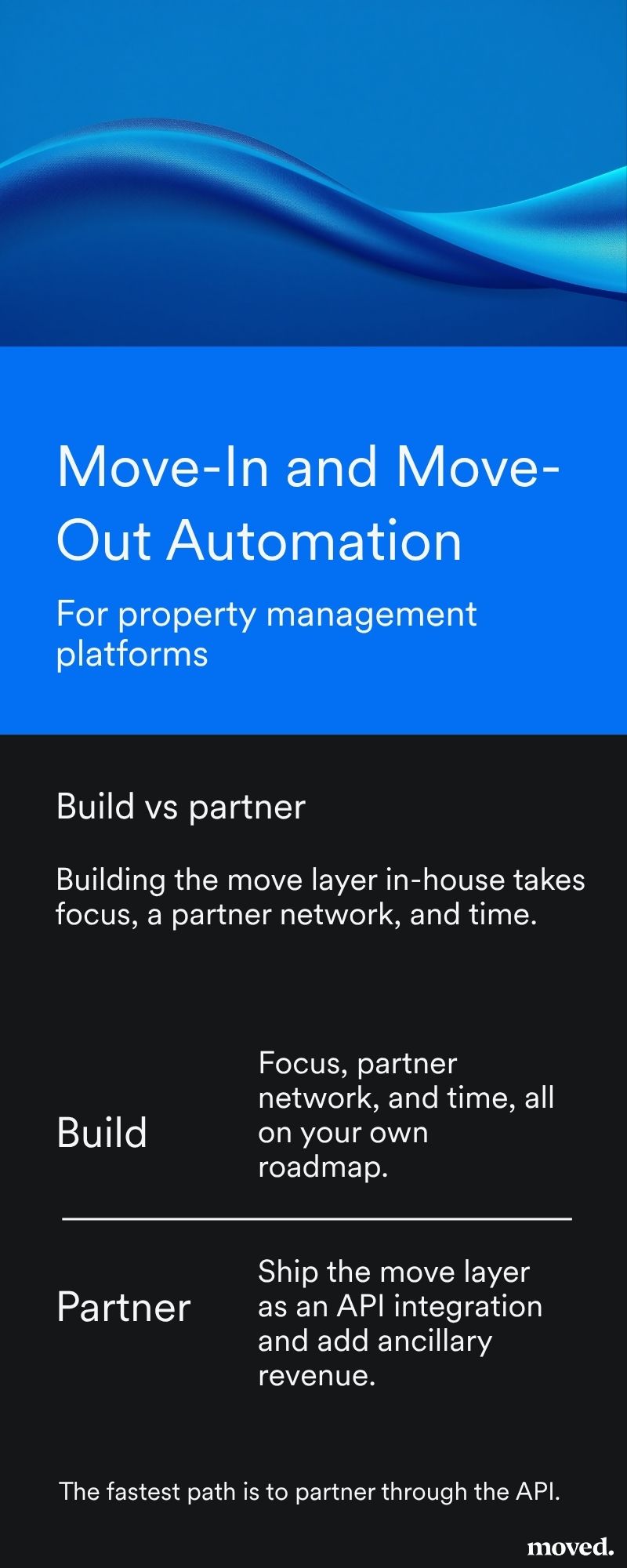
Building the move layer in-house looks straightforward until the platform team scopes it. The move-in and move-out workflow is not one feature. It is a resident-facing experience, a partner network spanning movers, storage, utilities, and insurance, a verification and compliance layer, and an ancillary revenue engine, all of which must remain current as partners, carriers, and utility providers change.
Three costs make building the wrong call for most platforms.
The first is focus. The property management system is the system of record for leasing, accounting, and operations. Every engineering cycle spent building and maintaining a mover and utility partner network is a cycle not spent on the core platform.
The second is the partner network itself. The value of the move layer is the breadth and quality of the service partners behind it, and assembling and maintaining that network is a business in its own right, separate from building software.
The third is time. Operators want the capability now, and a multi-quarter internal build ships long after the customer asked for it.
The partner path: integrate the move layer through the API
The faster path is to add the move-in and move-out layer through integration. A dedicated move infrastructure platform runs the resident-facing experience and the partner network and connects to the property management system via API, so data flows both ways. The operator gets the automation; the platform keeps its focus on the system of record; and the capability ships in a fraction of the time it would take for an internal build.
This is the same open-ecosystem pattern that platforms already support for other specialized workflows. We detail the specific integration approach in our piece on how PMS platforms like Yardi can integrate resident move-in and move-out automation.
What the platform gets from partnering
Partnering for the move layer gives the platform three things at once. It answers the customer request quickly with a resident experience that is already built and maintained. It adds an ancillary revenue stream tied to the move window without the platform having to build the partner network. And it keeps the platform’s engineering focused on the core system of record while the specialized workflow stays current on someone else’s roadmap.
The framing of how move-window revenue converts to operator NOI and asset value appears in the Moved CEO’s RevGen newsletter, on the third pillar of residential real estate, and in the RevGen leak map.
How Moved fits
Moved is the move-in and move-out infrastructure platform that integrates with the property management system through the API. Traditional tools focus on task tracking and administrative coordination. Moved embeds revenue-generating services, including moving, packing, storage, utilities, internet, and insurance verification, directly into the resident workflow, and returns the compliance and ancillary revenue data to the platform and the operator. Resident perks, rewards, and partnerships run on Paylode, a Moved company that Moved acquired in November 2025 to advance ancillary revenue automation, per the Moved announcement. For a platform, that means the move layer ships as an integration rather than a multi-quarter build, and the resident-facing experience lives inside the Moved resident experience. Moved is built on flexible commercial structures designed to align with the platform’s and the property’s financial goals.
To see how the integration works, book a walkthrough with our team or visit the Moved multifamily product page.
FAQs
Why do operators want move-in and move-out automation from their property management system? Because the move window is where the highest-intent resident revenue and the sharpest experience moments concentrate, and centralized operators want it standardized across the portfolio.
Why is building the move layer in-house usually the wrong call for a platform? Because it is not one feature. It is a resident experience, a partner network, a compliance layer, and a revenue engine that all have to stay current, which pulls engineering focus away from the core system of record and ships long after the customer has asked.
What does the partner path look like? A dedicated move infrastructure platform runs the resident experience and the partner network and connects to the property management system through the API, so the capability ships as an integration.
Does partnering add revenue for the platform? Yes. It adds an ancillary revenue stream tied to the move-in and move-out window without the platform building the partner network itself.
Does the platform remain the system of record? Yes. The property management system remains the system of record. The move layer integrates on top and returns data both ways.
The bottom line
The 10,000+ unit operators are asking their property management systems for move-in and move-out automation, and the fastest, most focused way to deliver it is to partner rather than build it in-house. Integrating a dedicated move layer via the API delivers the capability quickly, adds an ancillary revenue stream, and keeps the platform’s engineering focused on the core system of record.
For the full operator playbook, see our ultimate guide to resident onboarding automation.