At a 10,000+-unit operator, the move-in and move-out moment is where the highest-intent, highest-margin resident revenue is concentrated, and it is also where that revenue quietly leaks. The second leak in the RevGen system is the workflow leak: any non-rent revenue that depends on a leasing agent remembering to offer something during the busiest days of the resident lifecycle is already broken. The framing comes from the Moved CEO’s RevGen leak map.
This guide covers why memory-based revenue fails at portfolio scale, what it costs, and the embedded-workflow model that closes the gap across the move-in and move-out window. For the broader operating model, see our guide to ancillary revenue in multifamily.
Why revenue tied to memory fails at scale
Picture the move-in day at a busy lease-up. A leasing agent is handling keys, paperwork, questions, and three other residents at once. Somewhere in that rush, the agent is also supposed to remember to mention movers, renters insurance, utility setup, and internet. When the day is calm, some of it happens. When the day is busy, which is most days, it does not.
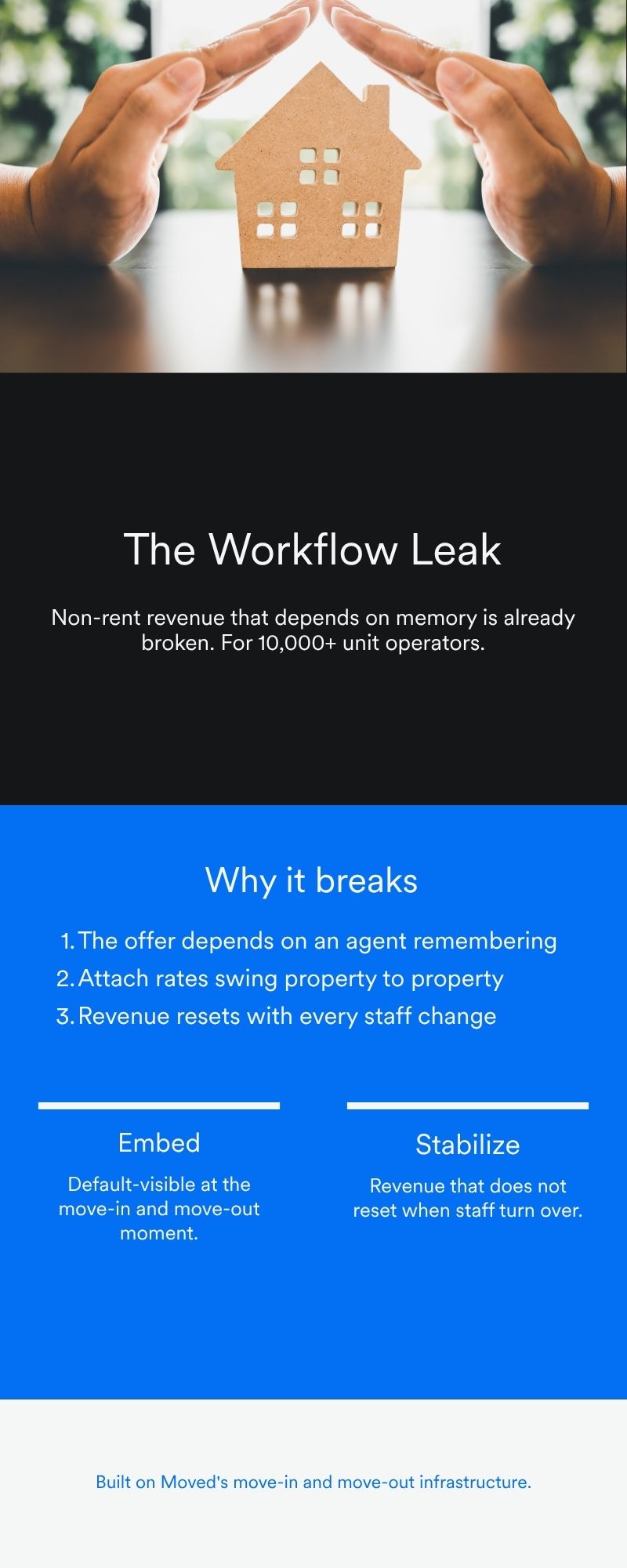
That is the workflow leak. The offer exists, the demand exists, and the resident is actively making these decisions, but the revenue depends on a person remembering to surface it at exactly the right moment. Across a portfolio of 10,000+ units and hundreds of staff, attachment rates swing wildly from property to property for no reason other than who was working that day.
The cost sits next to the leak.
The same manual coordination that leaks revenue also inflates cost. Apartment turnover runs close to $3,872 per resident, per Multifamily Dive’s reporting on Zego’s resident experience research, and a National Apartment Association survey found most operators put turn costs between $1,500 and $3,500 per unit, with nearly one in five above $3,500, per Multi-Housing News. The move-in and move-out window that drives those costs is the same window where non-rent revenue is captured or lost. Fixing the workflow addresses both at once.
Centralization raises the bar.
Operators are centralizing operations, with Funnel Leasing finding that 80% of third-party multifamily managers are centralizing. A centralized team cannot rely on hundreds of individual agents each remembering a script. It needs the offer built into a standardized workflow that runs the same way at every property, every move.
The fix: embed the offer in the workflow
A revenue system makes the offer default-visible within the workflow the resident is already moving through, timed to the moment of the move, with digital purchase flows and lifecycle-triggered prompts. Automation does more than lift revenue. It stabilizes the number so it does not reset every time a team member turns over.
- The move-in and move-out checklist presents movers, packing, storage, utilities, internet, and insurance at the moment the resident is deciding, not whenever an agent remembers.
- Every resident sees the same offer at the same step, so the attached rates no longer depend on individual staff members.
- The data flows back to the asset management team by property, stream, attach rate, and margin, so that the numbers can be managed.
This is the practical heart of Moved’s positioning, and we walk through the mechanism in our breakdown of how move-in and move-out workflows became a property management revenue engine, as well as in our ultimate guide to resident onboarding automation, which covers the onboarding mechanics.
What it captures at portfolio scale
Closing the workflow leak turns an inconsistent, staff-dependent number into a reliable one. The Moved CEO’s RevGen leak map sizes the typically uncaptured non-rent opportunity at roughly $15 per unit per month, much of it concentrated in the move window that the workflow leak leaves on the table. Risk drops too, because insurance verification and documentation become part of the same standardized flow rather than another thing someone has to remember.
How Moved fits
Moved is the move-in and move-out infrastructure platform that closes the workflow leak. Traditional tools focus on task tracking and administrative coordination. Moved embeds revenue-generating services, including movers, packing, storage, utilities, internet, and insurance verification, directly into the resident workflow, so the offer no longer depends on memory. Resident perks, rewards, and partnerships run on Paylode, a Moved company that Moved acquired in November 2025 to advance ancillary revenue automation, per the Moved announcement. The property management system remains the system of record, and the resident-facing experience lives inside the Moved resident experience. Moved is built on flexible commercial structures designed to align with property financial goals.
To see the embedded workflow run at portfolio scale, book a walkthrough with our team or visit the Moved multifamily product page.
FAQs
What is the workflow leak in RevGen? It is non-rent revenue that depends on a leasing agent remembering to offer a service during the move-in and move-out window. Because memory is unreliable at scale, the revenue leaks.
Why does memory-based revenue fail at 10,000+ units? With hundreds of staff and constant turnover, attachment rates swing from property to property based on who is working. A standardized, embedded workflow removes that dependency.
How does embedding the offer help? It makes the right offer default-visible at the right moment for every resident, so revenue is captured consistently and does not reset when a team member leaves.
Does closing the workflow leak also reduce cost? Yes. The move-in and move-out window that leaks revenue is the same one that drives turnover cost, so a standardized workflow improves both.
Who owns the workflow leak fix? The asset management and operations layer sets the standard, on-site teams execute it, and the platform ensures consistency across the portfolio.
The bottom line
In residential real estate, revenue that depends on a person remembering to offer it is already broken. Embedding the move-in and move-out offer into a standardized workflow turns an inconsistent, staff-dependent number into a reliable, managed stream. It lowers the cost of the same window.
For the reporting half of the problem, see our guide to increasing multifamily NOI without raising rent.