An apartment transfer policy sets the rules for a resident who wants to move to a different unit in the same community or portfolio. It covers who qualifies, what the transfer costs, how the old and new leases connect, and how the move is scheduled, so residents who need more space, less space, or a new city can stay.
For a 10,000+ unit operator, every transfer keeps a resident on the rent roll and creates a full move to coordinate. This guide covers why transfers belong in the retention plan, what a policy should include, how to set a transfer fee, and how to run transfers across a portfolio.
Why transfers belong in the retention plan
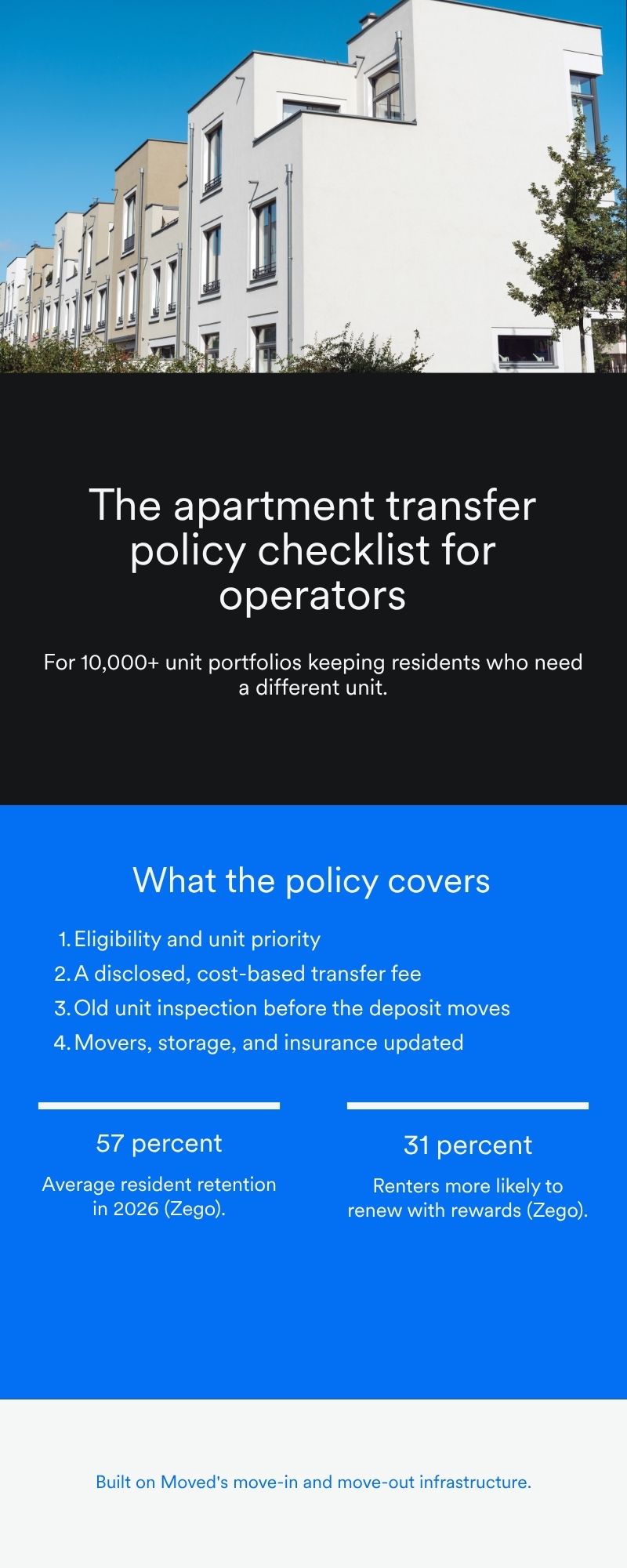
Retention is falling. Zego’s 2026 Resident Experience Management Report found that average retention dropped to 57 percent, down from 60 percent in 2024.
The same research found that property managers tend to attribute non-renewals to external factors such as job relocation and life changes, while renters point to rent increases, maintenance, and security. Whatever the main driver, some of every year’s move-outs come from residents whose needs changed, and a transfer policy gives them a reason to stay.
The alternative is a turn. Each turnover has cost about $3,872 per resident, according to an earlier Zego report covered by Multifamily Dive, and the replacement lease may need a concession. RealPage found concessions on 15.4 percent of stabilized apartments in August 2026, averaging about 5.7 weeks free, according to its August 2026 concessions update.
The revenue case: a transfer is a full move
A transfer keeps the lease in the portfolio and still requires a complete move. The resident needs movers or a truck, packing help, and sometimes storage between units, plus utilities moved, internet transferred, and renters insurance updated to the new address.
Presented in the same flow as a move-in, those services become part of the move-in and move-out revenue workflow for transfers as well. Moved automates resident onboarding, offboarding, and transfers, as described on Moved’s multifamily page, so a transfer runs with the same service options and checks as any other move.
Handled as a favor by the site team, a transfer depends on whoever is on shift. Run as a standard move, it keeps the resident, opens a service window, and produces a clean record for both units.
Rewarding residents who stay: Paylode, a Moved company
A resident asking for a transfer has already chosen to stay with the portfolio. That makes the transfer a natural point to recognize loyalty.
Paylode is a Moved company. Moved acquired Paylode in November 2025, adding a perks and rewards platform that helps brands increase loyalty and retention through personalized perks and action-based rewards.
A transfer can carry rewards the way a renewal does, from move-day perks to continuing discounts at the new unit. Zego’s 2026 research found that 31 percent of renters would be much more likely to renew if their community offered a renter rewards program.
What an apartment transfer policy should include
| Policy element | What to decide | Why it matters |
|---|---|---|
| Eligibility | Good standing, minimum time in residence, and no open balance | Keeps the policy fair and predictable |
| Reasons covered | Size change, relocation to another community, roommate change, and accessibility needs | Sets expectations and routes accommodation requests correctly |
| Unit priority | Whether current residents see available units before new applicants | Rewards residents who stay |
| Lease handling | New lease or amendment, term length, and rent for the new unit | Prevents gaps or overlaps in lease obligations |
| Transfer fee | Amount, what it covers, and when it is waived | Must be disclosed before the resident commits |
| Security deposit | Transferred, refunded, or replaced, and when | Avoids disputes over the old unit’s condition |
| Old unit inspection | A move-out inspection with photos before the deposit moves | Separates damage from ordinary wear and tear |
| Move timing | Overlap days between units and the key return date | Limits days of double rent and days of vacancy |
| Services and verification | Movers, packing, storage, utility and internet transfer, and renters insurance updated to the new unit | Keeps revenue and compliance consistent with every other move |
| Cross-property transfers | Rules for moving between communities in the portfolio | Keeps relocating residents inside the portfolio |
The old unit’s inspection follows the same standard as any move-out. Moved’s move-in and move-out inspection checklist sets out a room-by-room process that applies to transfers.
How to set an apartment transfer fee
A transfer fee should reflect the real cost of the transfer: the inspection, the turn of the old unit, and the administrative work. It should be stated in the policy and disclosed before the resident commits to the move.
Fee transparency is under federal review. The Federal Trade Commission’s advance notice of proposed rulemaking on rental housing fees asks about one-time fees charged at the beginning or end of a lease term, which is where a transfer fee falls. Moved’s guide to the FTC rental fee rulemaking explains how to disclose charges cleanly.
Requests linked to a disability need a separate path. Under the HUD and Department of Justice joint statement on reasonable accommodations, housing providers may not require persons with disabilities to pay extra fees or deposits as a condition of receiving a reasonable accommodation.
A transfer fee policy that holds up across a portfolio usually includes these terms:
- A flat fee tied to the documented cost of the inspection and the turn.
- No fee for a transfer requested as a reasonable accommodation, which goes through the accommodation process.
- No fee when the property initiates the transfer, such as for a renovation or a repair.
- A reduced fee or a perk for a resident who signs a longer lease with the transfer.
How to run an apartment transfer, step by step
- Receive the request through a single channel and record the reason.
- Check eligibility against the policy and confirm whether the request is an accommodation request.
- Match the resident to an available unit and place a hold with an expiry date.
- Issue the new lease or amendment, with the rent, the term, and every mandatory fee listed.
- Set the move date, the overlap days, and the key return date.
- Offer movers, packing, and storage, and schedule the utility and internet transfers.
- Confirm that renters insurance is updated to the new unit before keys are released.
- Inspect the old unit with photos and settle the deposit under the policy.
- Hand over keys for the new unit and close out the old one.
Each step has an owner and a record. When the steps run in one flow, the transfer looks the same at every property, and the resident experience stays consistent across the portfolio.
The insurance step matters most for risk. An uninsured resident-caused loss in the new unit is a financial exposure for the property, so coverage should move with the resident before the new keys do.
Cross-property transfers at 10,000+ units
A second retention opportunity sits between communities. A resident relocating for work can stay with the operator when the portfolio has a property in the new market and a process to move the resident there.
Cross-property transfers need portfolio-level visibility: available units across communities, a shared policy, and a record that follows the resident from one property to the next. For operators in residential real estate, this is where a standard process matters most.
Traditional tools focus on task tracking and administrative coordination. Moved embeds revenue-generating services and insurance verification directly into the workflow, transforming move coordination into structured revenue infrastructure.
Moved is a move infrastructure platform that embeds revenue-generating services, including movers, packing, storage, insurance, utilities, and connectivity, directly into the resident onboarding workflow. It helps property operators increase ancillary income while mitigating compliance risk, and the guide to resident onboarding automation shows how that workflow is built.
Frequently asked questions
What is an apartment transfer?
An apartment transfer is a move from one unit to another with the same operator, either in the same community or at another property in the portfolio, under a new lease or a lease amendment.
Do apartments charge a transfer fee?
Some operators charge a transfer fee to cover the inspection, the turn, and the administrative work. The fee should be stated in the policy and disclosed upfront, and it should not be charged as a condition of a reasonable accommodation.
Can a resident transfer to a different apartment in the same complex?
Yes, when the policy allows it and a suitable unit is available. Most policies require the resident to be in good standing and to have lived in the current unit for a minimum period.
Does an apartment transfer require a new lease?
A transfer needs a new lease or a lease amendment for the new unit. The policy should say which one applies, and how the term and rent are set.
What happens to the security deposit during a transfer?
The policy decides whether the deposit is transferred, refunded, or replaced. In each case, the old unit should be inspected with photos first, so any deduction is documented.
Keep residents moving within your portfolio
A transfer policy turns a likely move-out into a move within the portfolio. To see how transfers, insurance updates, and move services run as one move-in and move-out workflow across a 10,000+ unit portfolio, book a walkthrough with the Moved team.