A lease non-renewal letter is a written notice from the property telling a resident that the lease will not be renewed when its current term ends. It states the end date, the move-out expectations, and what happens next with the security deposit. In many places the letter is simple, but several states limit when a property may decline to renew and set specific notice periods, stated reasons, or relocation payments.
Across a 10,000+ unit portfolio, a non-renewal decision is also the start of a move-out, a turn, and a new move-in. This guide covers when state law restricts non-renewal, what the letter should include, a template your team can adapt, and how to run the decision inside a structured move-in and move-out process in residential real estate.
Why Non-Renewal Decisions Need A Process
Every non-renewal ends a tenancy that the property would otherwise have to replace. Zego’s 2026 Resident Experience Management Report found that average retention fell to 57 percent, down from 60 percent in 2024, so each planned exit adds to a vacancy count that is already rising.
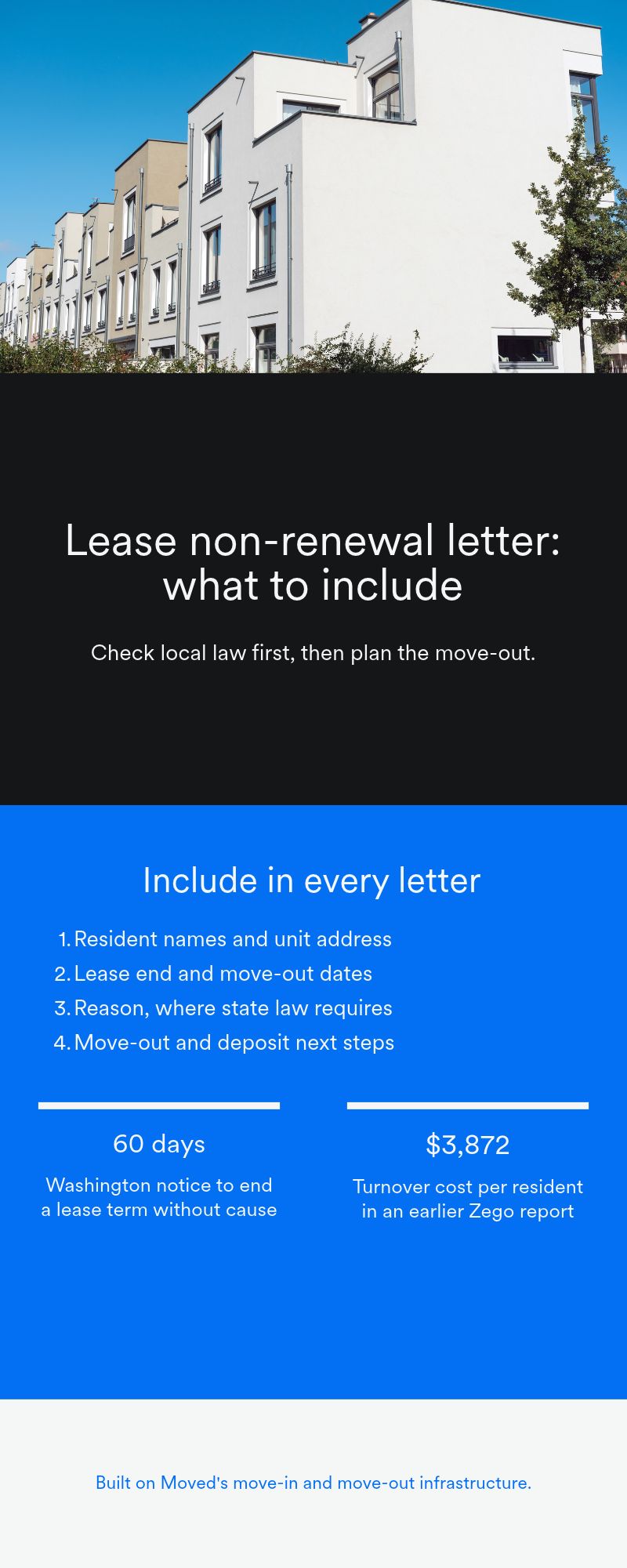
Turnover has cost about $3,872 per resident, according to an earlier Zego report covered by Multifamily Dive, including marketing, repairs, concessions, and lost rent. A non-renewal can still be the right call, and a documented process makes sure it is a deliberate one.
The letter also carries legal risk. A notice that misses a required reason, payment, or deadline can be void in some states, which can leave the property with a resident it planned to replace and a unit it has already promised to someone else.
When State Law Limits Non Renewal
In many states, a fixed-term lease simply ends on its stated date unless the parties renew. Some states restrict that rule for longer tenancies, so check the property’s state and city before any letter is sent. The table below summarizes three examples.
| State | What the law requires | Notice and payment |
|---|---|---|
| California | After a tenant has lawfully occupied the unit for 12 months, the owner may not terminate the tenancy without just cause stated in the written notice (Civil Code section 1946.2) | For a no-fault just cause, the owner must provide relocation assistance equal to one month’s rent or waive the final month’s rent in writing, and the notice must tell the tenant of that right |
| Washington | A landlord may not refuse to continue a tenancy except for causes listed in RCW 59.18.650 or the limited end-of-term rules in that section | A qualifying fixed term may end without cause only with at least 60 days’ written notice; otherwise the tenancy becomes month-to-month at the end of the term |
| Oregon | After the first year of occupancy, a fixed-term lease converts to month-to-month at expiration unless an exception in ORS 90.427 applies | Qualifying landlord reasons require at least 90 days’ written notice stating the reason, and many landlords must also pay one month’s rent |
These summaries are starting points. Each statute has exemptions, local ordinances may add stricter rules, and the details below should be reviewed with counsel for every property in scope.
California
Under California Civil Code section 1946.2, a resident’s refusal, after a written request, to sign an extension or renewal for a similar term with similar provisions is one of the listed at-fault just causes. When the cause is no-fault, such as an owner move-in or a withdrawal of the unit from the rental market, any relocation payment is due within 15 calendar days of service of the notice.
The statute states that failure to comply strictly with the relocation requirements makes the notice void. It also exempts some housing, including units issued a certificate of occupancy within the previous 15 years, and it defers to qualifying local just-cause ordinances.
Washington
RCW 59.18.650 lets a landlord end a fixed term without cause only when the tenancy began with a term of 12 months or more, or has run on successive terms of six months or more, has never been month-to-month, and the landlord gives at least 60 days’ written notice before the term ends. One listed cause applies when a resident stays past expiration without signing a proposed new agreement that was offered at least 30 days before the lease ended and has reasonable terms.
A landlord who removes a tenant in violation of the section can owe the greater of the tenant’s economic and noneconomic damages or three times the monthly rent, plus reasonable attorneys’ fees and court costs. A revised version of the section takes effect January 1, 2028, so confirm which version applies on the notice date.
Oregon
ORS 90.427 allows a no-cause end of a fixed term only when the term ends within the first year of occupancy, with at least 30 days’ written notice. After that, the qualifying landlord reasons include demolition or conversion, certain repairs or renovations, owner or immediate family occupancy, and a sale to a buyer who will live in the unit.
Those notices must give at least 90 days and state the reason and supporting facts. The landlord must also pay one month’s rent unless an exemption applies, such as owning four or fewer units, and a violation can cost three months’ rent plus actual damages.
Rules That Apply Everywhere
Even where no just-cause law applies, a non-renewal decision is still covered by fair housing and retaliation rules. The federal Fair Housing Act, 42 U.S.C. 3604, makes it unlawful to refuse to rent, or otherwise make housing unavailable, because of a protected characteristic.
Many states also restrict retaliation. California Civil Code section 1942.5, for example, limits a landlord’s ability to end a tenancy within 180 days after a tenant exercises certain legal rights, such as complaining about habitability.
The safest practice is to apply written, consistent criteria to every non-renewal, document the reason, and route each decision through one reviewer before the letter goes out.
What To Include In A Lease Non-Renewal Letter
- The date of the letter and the names of every adult resident on the lease.
- The unit address and the current lease end date.
- A clear statement that the lease will not be renewed and the date by which the unit must be vacated.
- The reason, where state or local law requires one, with any supporting facts the law calls for.
- Any relocation payment or rent waiver the law requires, with the amount and timing.
- Move-out instructions, including the inspection process, key return, and forwarding address request.
- How the security deposit will be handled and when the resident can expect the itemized statement.
- A contact name and phone number for questions.
Serve the letter by the method your lease and state law allow, and keep proof of delivery with the lease file. Moved’s guide to the 60-day notice to vacate window explains why the weeks after notice are the most useful time to plan the move-out with the resident.
Lease Non-Renewal Letter Template
Adapt this template to each state and city, and have counsel approve the final version before it is used.
[Date]
Dear [Resident names],
This letter is notice that your lease for [unit address], which ends on [lease end date], will not be renewed. Please plan to vacate the unit and return all keys by [move-out date].
[If required by law: The reason for this notice is [reason and supporting facts]. You are entitled to [relocation payment or rent waiver], which will be provided by [date and method].]
Before you move, you may request a pre-move-out inspection by contacting [office contact]. Please send us your forwarding address so we can mail your security deposit statement within the time required by law.
If you need help with movers, packing, or storage, our move-out team can share options when you confirm your move date. Thank you for living at [community name].
Sincerely, [Name, title, phone, email]
For the opposite decision, Moved’s lease renewal letter template covers how to time and word a renewal offer.
Common Non-Renewal Mistakes
- Sending the same letter in every state, without the reason or payment some states require.
- Counting notice days from the wrong date, or serving the letter by a method the lease does not allow.
- Applying non-renewal criteria differently from one resident to the next.
- Promising the unit to a new applicant before the move-out date is confirmed.
- Leaving the resident without a plan, so the move-out runs late and the turn slips.
A late move-out can become a holdover, and Moved’s guide to holdover tenant prevention explains how confirmed move dates reduce that risk.
The Revenue Case: Plan The Move-Out The Day The Letter Goes Out
A non-renewal letter gives the property a fixed move-out date weeks in advance. That is the best time to offer the departing resident movers, packing, and storage, because the resident has a deadline and needs help meeting it.
The move-in and move-out revenue workflow places those services in the move flow at the moment they are needed. A resident who books a mover early is also more likely to leave on time, which protects the make-ready schedule and the next move-in date.
The same date drives the next resident’s move-in. When the turn is planned from the non-renewal date, the incoming resident can receive move-in services, utility setup, and insurance verification before keys are released.
Keeping The Residents You Want: Paylode, a Moved Company
Non-renewal is a decision about a small share of residents. The larger retention task is keeping the residents the property wants to renew.
Paylode is a Moved company. Moved acquired Paylode in November 2025, adding a perks and rewards platform that helps brands increase loyalty and retention through personalized perks and action-based rewards. Zego’s 2026 report found that 31 percent of renters would be much more likely to renew if their community offered a renter rewards program.
Running rewards throughout the lease gives operators a renewal tool that does not depend on a rent concession. It also makes the non-renewal list shorter, because fewer residents reach the end of the term already planning to leave.
Disclosure And Insurance At The End Of A Lease
Move-out fees and charges should match what was disclosed in advertising and in the lease. The Federal Trade Commission’s advance notice of proposed rulemaking on rental housing fees asks about fees charged at the beginning or end of a lease term, and Moved’s guide to the FTC rental fee rulemaking covers how to present charges in one place.
Insurance matters on both sides of the turn. The departing resident’s coverage should stay in force through the move-out date, and Moved’s guide to capturing renters insurance requirements at move-in explains how to confirm the incoming resident’s policy before keys are released.
Running Non-Renewals Across A 10,000+ Unit Portfolio
- One approved letter template per state and city, with the required reasons, payments, and notice periods built in.
- Written non-renewal criteria applied the same way at every property, with one reviewer approving each decision.
- Notice deadlines calculated from each lease end date and tracked in one calendar.
- Relocation payments, where required, scheduled when the letter is served.
- Move-out services offered as soon as the move-out date is confirmed.
- Non-renewal reasons, disputes, and move-out timing reported by property.
Traditional tools focus on task tracking and administrative coordination. Moved embeds revenue-generating services and insurance verification directly into the workflow, transforming move coordination into structured revenue infrastructure.
Moved is a move infrastructure platform that embeds revenue-generating services, including movers, packing, storage, insurance, utilities, and connectivity, directly into the resident onboarding workflow. It helps property operators increase ancillary income while mitigating compliance risk, and the guide to resident onboarding automation shows how that workflow is built.
For residents, a clear and early notice is part of the resident experience, even at the end of a lease. For operators, Moved for multifamily operators shows how the same process runs across a portfolio.
Frequently Asked Questions
What is a lease non-renewal letter?
A lease non-renewal letter is a written notice that the lease will not be renewed when its current term ends. When the property sends it, the letter states the end date, move-out expectations, and how the security deposit will be handled.
How much notice is required for a lease non-renewal?
It depends on the state, the city, and the lease. Washington requires at least 60 days’ written notice to end a qualifying fixed term without cause, and Oregon requires at least 90 days for qualifying landlord reasons after the first year of occupancy.
Does a landlord need a reason to not renew a lease?
In some states, yes. California, Washington, and Oregon restrict non-renewal for many longer tenancies, and some cities add their own rules, so confirm local law before sending the letter.
Can a resident be non-renewed for complaining?
Retaliation laws in many states limit that. California, for example, restricts ending a tenancy within 180 days after a tenant exercises certain legal rights, and federal fair housing law prohibits decisions based on protected characteristics.
What should happen after the non-renewal letter is sent?
Confirm the move-out date, offer a pre-move-out inspection, request a forwarding address, and offer movers, packing, and storage. Then schedule the make-ready so the unit is ready for the next move-in.
Turn Every Lease Ending Into A Planned Move
A compliant non-renewal letter protects the property, and a planned move-out protects the turn. To see how notices, move-out services, and move-in onboarding run as one move-in and move-out workflow across a 10,000+ unit portfolio, book a walkthrough with the Moved team.