The move-in and move-out process is the highest-impact operational moment in the resident lifecycle at 10,000+ unit operators. It is also the most variable. Two properties in the same portfolio can run the same workflow differently, and the results show up in NPS, ancillary revenue, turn cost, and insurance compliance at the asset management layer. We cover the broader category economics in our guide to ancillary revenue in multifamily.
This guide is the standardized SOP that 10,000+ unit operators apply across every property in the portfolio. It covers five stages from notice to vacate through unit turn, with the operational standards, vendor management, communication cadence, and compliance gates that make the workflow reliable.
Why a standardized SOP matters
At 10,000+ units, individual property heroics do not scale. The same workflow must produce the same result across markets, asset classes, and on-site teams with varying tenures.
Three operational shifts explain the stakes.
Turn cost has held steady as one of the largest avoidable line items every operator carries, with extensive make-readies running materially higher than baseline turns. NAA’s Premium Pulse research shows property insurance premiums up 14%, 22%, and 45% over the past three years, putting more pressure on operators to verify renters insurance correctly at the front door. And ancillary revenue continues to be the highest-margin line on the operating statement, with the cleanest opportunity sitting inside the move-in and move-out window. The structural argument for why is in the Moved CEO’s RevGen newsletter on the third pillar of residential real estate.
Standardization is how operators capture all three at portfolio scale: ancillary revenue grows, turn cost compresses, and insurance compliance moves from the 55% industry baseline to 90%+, per Foxen’s renters insurance compliance research.
The 5-stage SOP framework
Every move-in and move-out workflow at a 10,000+ unit operator runs through five stages. The standards below define the minimum viable version.
Stage 1: Pre-move-in (lease signing to keys)
Duration: From lease signing through the day before move-in (typically 14 to 45 days).
Owner: Leasing team during application, then community manager once the lease is signed.
Resident tasks (orchestrated through a single resident portal):
- Sign lease and pay security deposit
- Upload renters insurance certificate with the property listed as additional interested party
- Set up utilities (power, gas, water, internet)
- Book movers, packing services, and storage if needed
- Schedule key pickup window
- Complete address change tasks (USPS forwarding, DMV, employer)
- Acknowledge community rules and pet policy
- Receive welcome materials and amenity access information
Property tasks:
- Verify insurance compliance against lease minimums before keys are released
- Confirm unit is rent-ready 72 hours before move-in
- Send move-in day instructions 48 hours before
- Prepare welcome box for hand-off
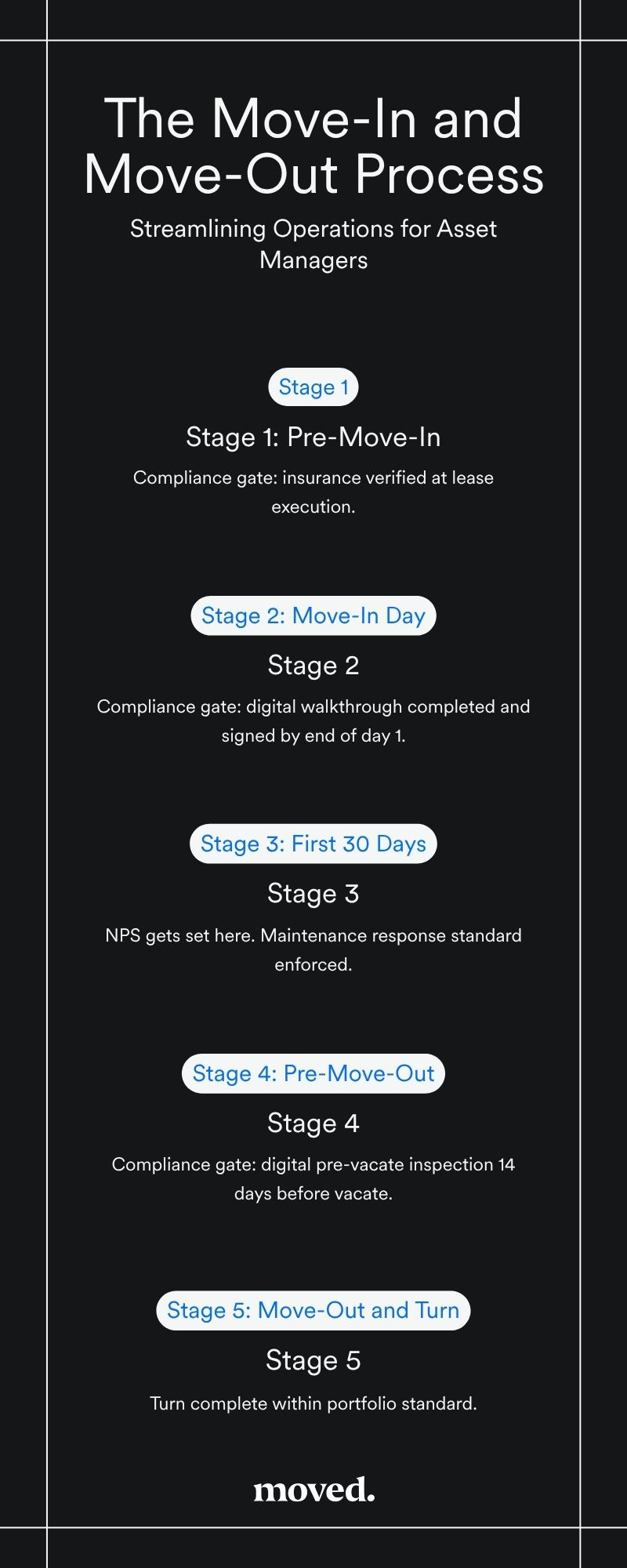
Compliance gate: Keys are not released until insurance is verified (minimum liability limit, additional interested party named correctly, coverage dates valid). This is the single largest risk reduction in the entire workflow.
Stage 2: Move-in day
Duration: The day of move-in plus 24 hours after.
Owner: Community manager with on-site team support.
Resident tasks:
- Complete move-in walkthrough (digital, with photos and timestamped damage notes)
- Acknowledge unit condition report
- Activate utilities (verify they are live before signing off)
- Confirm move-in checklist completion in the resident portal
Property tasks:
- Hand off keys (physical or smart lock activation)
- Walk the resident through the unit and amenities
- Deliver welcome box
- File the move-in inspection report into the resident record
- Trigger the day-1 satisfaction touchpoint (short NPS survey)
Compliance gate: Walkthrough completed and signed digitally before the end of day 1. Any disputes about unit condition are logged here well before move-out.
Stage 3: First 30 days
Duration: Move-in day through day 30.
Owner: Community manager.
This is the highest-impact stretch of the entire lease. NPS gets set here, per BubbleGum BI’s multifamily NPS research, and the residents who score well in the first 30 days renew at 70-80%.
Resident touchpoints:
- Day 1: Welcome message from community manager
- Day 3: Check-in on any outstanding move-in issues
- Day 7: Invite to the new-resident welcome event
- Day 14: Two-question satisfaction survey (anything broken? anything missing?)
- Day 21: Reminder of amenity access and community events calendar
- Day 30: First full NPS survey
Property tasks:
- Resolve any unit-condition disputes by day 7
- Confirm all utility transfers are complete by day 10
- Complete first community event participation by day 30 if possible
Compliance gate: All maintenance tickets opened in the first 30 days resolved within the published response standard (24 hours for non-emergency, 4 hours for emergency).
Stage 4: Pre-move-out (notice to vacate through last day)
Duration: From notice to vacate through the resident’s last day, typically 30 to 60 days.
Owner: Community manager with leasing team support on turnover.
Resident tasks:
- Submit formal notice through the resident portal
- Re-verify renter’s insurance is in force through the last day
- Schedule pre-vacate inspection
- Book movers and packing services if needed
- Acknowledge the move-out cleaning standards and damage charge schedule
- Confirm forwarding address for the security deposit return
Property tasks:
- Confirm the lease end date and any move-out fees
- Schedule the digital pre-vacate inspection 14 days before vacate
- Send the move-out instructions packet (cleaning standards, damage schedule, key return instructions)
- Trigger the move-out satisfaction survey 7 days before vacate
- Begin marketing the unit if no renewal occurred
Compliance gate: Pre-vacate inspection completed digitally with photos and timestamped notes. Any resident-caused damage logged against the deposit ledger before the resident leaves.
Stage 5: Move-out and turn
Duration: Vacate day through rent-ready (target 7 to 10 days for standard turns, longer for extensive make-readies).
Owner: Maintenance with community manager oversight on disputes.
Resident tasks:
- Return keys (physical or digital)
- Complete the move-out checklist in the resident portal
- Acknowledge final inspection findings
Property tasks:
- Complete the final inspection within 24 hours of vacate
- Reconcile damage charges against the pre-vacate inspection
- Coordinate maintenance, cleaning, paint, and any other turn vendors
- Update the unit-ready dashboard at the asset management layer
- Process the security deposit return within the state-mandated timeframe
Compliance gate: Turn complete and unit ready for the next resident within the portfolio standard (typically 7 to 14 days, per Multi-Housing News reporting on turn benchmarks).
The compliance and verification checklist
The five gates above produce a clean compliance trail at the asset management layer.
- Insurance verified against lease requirements at execution (not merely collected)
- Insurance re-verified at move-out
- Move-in walkthrough completed digitally with photos
- Pre-vacate inspection completed digitally with photos
- Turn completed within the portfolio standard
Operators who hit all five gates 90%+ of the time score consistently higher on NPS, renewal, and ancillary revenue capture than operators who hit them 60-70% of the time.
What this SOP compounds into at a 10,000+ unit portfolio
A standardized move-in and move-out SOP run consistently across 10,000+ units compounds into four measurable operator outcomes across the lease cycle:
- Capturable partnership revenue on every move event
- Recovered vacancy from a tighter, more predictable workflow
- Avoided skip-and-eviction loss from front-door insurance verification done correctly
- Avoided turn cost from compressed turn time on the back end
The sizing for any specific portfolio depends on baseline performance, asset class, rent profile, and market mix. The framing of how these operational outcomes flow into NOI and asset value at the portfolio scale is in the Moved CEO’s RevGen newsletter on the third pillar of residential real estate and the RevGen leak map. Both are required reading for any asset manager building the operator argument for SOP investment.
How Moved fits
Moved is the move-in and move-out infrastructure platform that runs this SOP at portfolio scale. We integrate alongside the property management system via API, deliver the resident-facing experience for the five stages above, and surface the compliance gates and ancillary revenue data to the asset management team.
For 10,000+ unit operators, the SOP above runs on a single platform. The on-site teams use it as the workflow. The asset management team uses it as the reporting layer. Residents use it as the only portal they need to interact with for the move.
To see how this SOP runs at portfolio scale, book a walkthrough with our team or visit the Moved multifamily product page.
FAQs
What is the highest-priority compliance gate in the SOP?
Insurance verification at lease execution. Unverified renter’s insurance is the largest single liability exposure in the multifamily operating model.
How long should a standard unit turn take at a 10,000+ unit operator?
Portfolio benchmarks run 7 to 14 days for standard turns, with extensive make-readies taking longer. The published industry average sits near 14 days.
Who owns the move-in and move-out SOP at a 10,000+ unit operator?
The SOP itself sits at the asset management layer. On-site community managers execute it. The reporting layer rolls up to operations leadership.
Do we need a move infrastructure platform to run this SOP?
Some elements can be run through the property management system, manually, or through point solutions. The integration cost across multiple tools usually exceeds the cost of a single platform once the portfolio reaches 5,000 units. Above 10,000 units, the case for a single platform is overwhelming.
How is this SOP different from the property management system’s built-in workflows?
The property management system is the system of record. This SOP is the operating workflow that uses the property management system as the data layer and adds resident-facing experience, vendor management, ancillary revenue capture, and compliance verification on top of it.
The bottom line
A standardized move-in and move-out SOP at 10,000+ unit operators is the highest-impact operational change available without raising rent or adding headcount. The five-stage framework above produces consistent results across the portfolio, captures ancillary revenue in the move window, reduces turn costs, and closes the insurance compliance gap.
For the full operator playbook, see our guide to ancillary revenue in multifamily and our breakdown of how move-in and move-out workflows became a property management revenue engine.