At a 10,000+ unit operator, resident intent is not constant. The same non-rent offer that converts at move-in falls flat during the quiet middle of a lease, and an offer pushed at the wrong moment does more than miss. It teaches residents to tune out the channel. The fourth leak in the RevGen system is the lifecycle leak: the right offer at the wrong moment is worth less than no offer at all. The framing comes from the Moved CEO’s RevGen leak map.
This guide lays out the resident lifecycle map, why timing beats offer volume, and why the move-in and move-out window carries the highest-margin revenue in the entire lifecycle. For the broader model, see our guide to ancillary revenue in multifamily.
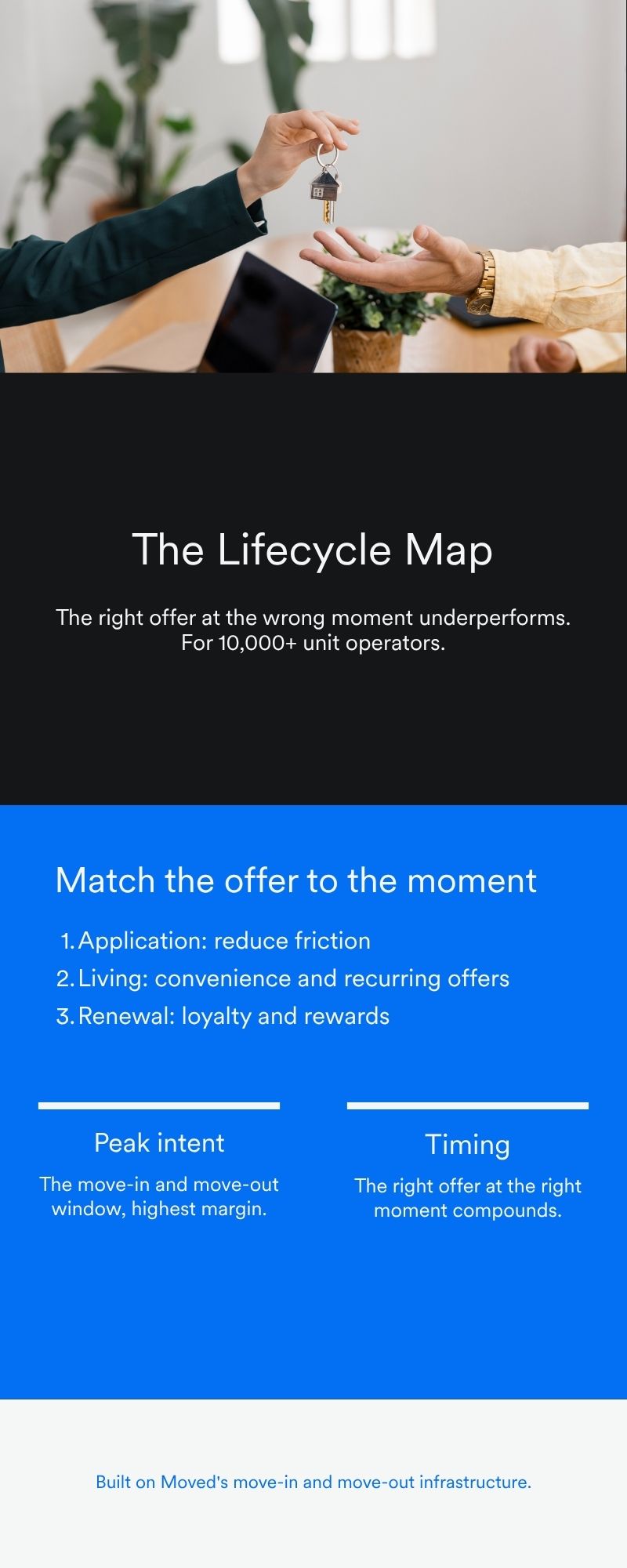
Intent moves through the lifecycle.
A resident’s willingness to act on an offer fluctuates throughout the lease. Treating the entire lease as a single, undifferentiated audience is why so many ancillary pushes underperform. A revenue system presents the right offer at the right moment, rather than broadcasting every offer all the time.
Application: reduce friction
At application, the resident wants the path to their new home made simple. Friction-reducing services and a clear, guided onboarding start building trust and set up everything that follows.
Move-in and move-out: logistics and time-sensitive services
The move-in and move-out window is peak intent. The resident is actively deciding about movers, packing, storage, utilities, internet, and insurance inside a narrow, time-sensitive window. This is where the highest-margin, highest-conversion revenue in the lifecycle sits, because the resident is buying, not browsing.
Living: convenience and recurring offers
During tenancy, intent settles. This is the moment for convenience and recurring offers that fit daily life, not for high-pressure logistics offers that no longer apply.
Renewal: loyalty and rewards
At renewal, the right motion is loyalty and rewards that reinforce the resident experience and support retention, which is exactly where perks and redemption programs belong.
Why timing beats offer volume
Most operators assume that more non-rent revenue requires more offers. In practice, the primary driver is timing and placement within the resident journey. Residents convert when they are already completing the task, under a time constraint, and prefer convenience over comparison. Present the same offer outside that moment and conversion collapses, while the constant noise trains residents to ignore the channel. The Moved CEO’s RevGen leak map sizes the typically uncaptured non-rent opportunity at roughly $15 per unit per month, with most of it concentrated in the move-in and move-out window, where intent peaks. We walk through the mechanism in our breakdown of how move-in and move-out workflows became a property management revenue engine and the onboarding mechanics in our ultimate guide to resident onboarding automation.
The move-in and move-out window is the anchor.
Because the move-in and move-out window is where intent, margin, and timing converge, it is the natural anchor for a lifecycle-aware revenue system. Get that window right, and the rest of the lifecycle becomes a series of well-timed, lighter-touch offers rather than a constant broadcast. Risk mitigation rides along because insurance verification and documentation happen inside the same well-timed flow.
How Moved fits
Moved is the move-in and move-out infrastructure platform that times each offer to the lifecycle stage. Traditional tools focus on task tracking and administrative coordination. Moved embeds revenue-generating services, including movers, packing, storage, utilities, internet, and insurance verification, directly into the resident workflow and presents them at the moment of peak intent rather than all at once. Resident perks, rewards, and partnerships run on Paylode. This Moved company Moved acquired in November 2025 to advance ancillary revenue automation, per the Moved announcement, which is what makes the renewal and loyalty stage work. The resident-facing experience lives inside the Moved resident experience. Moved is built on flexible commercial structures designed to align with property financial goals.
To map your own offers to the resident lifecycle, book a walkthrough with our team or visit the Moved multifamily product page.
FAQs
What is the lifecycle leak in RevGen? It is non-rent revenue lost to bad timing. The right offer presented at the wrong lifecycle moment converts poorly and trains residents to ignore the channel.
What are the stages of the resident lifecycle map? Application, the move-in and move-out window, living, and renewal, each with a different resident intent and a different right offer.
Why is the move-in and move-out window the highest-value stage? Because intent, margin, and timing all peak there, when residents are actively buying movers, storage, utilities, internet, and insurance.
Why does timing beat offer volume? Because residents convert when they are already completing the task under time pressure. Outside that moment, more offers lead to lower conversion and erode attention.
Where do loyalty and rewards fit? At renewal, reinforcing the resident experience supports retention rather than pushing logistics offers that no longer apply.
The bottom line
In residential real estate, non-rent revenue is a timing discipline. Map each offer to the resident’s intent across application, move-in and move-out window, living, and renewal; anchor the system on the move-in and move-out window, where intent peaks, and the same offers convert far better than a constant broadcast ever could.
For the NOI picture, see our guide to increasing multifamily NOI without raising rent.