RevGen is the third pillar of multifamily performance after rent and expenses. The structural argument is established in our companion piece on RevGen as the third pillar. What is less appreciated is where the pillar concentrates inside the resident lifecycle. RevGen is not evenly distributed across twelve months of a lease. It clusters tightly inside the move-in and move-out window.
This article makes the operator case for why the move-in and move-out window is the structural backbone of any serious RevGen program at a 10,000+ unit operator. Three forces converge there at the same time, and no other moment in the lease cycle puts the property in the same position to capture revenue at partnership economics.
Three forces converge in the move-in and move-out window
- Peak resident intent
The move is the single highest-intent moment in the resident lifecycle. Residents are actively shopping for movers, packing services, storage, utility activation, internet, and renters insurance. The decisions get made within a narrow window of days, often within hours. Intent is not constant during a lease. Intent peaks at the move, drops sharply once the resident is settled in, and stays low through the quiet middle of the lease until the renewal window reopens.
Offers that convert at the move moment fall flat in month four of the lease. The window is not a marketing convenience. It is a structural feature of how residents behave.
- Peak workflow
The move is also where every operational workflow converges. The property management system is running the lease activation. The resident is going through onboarding tasks. The on-site team is preparing the unit for arrival. The insurance verification gate is active. The utility activation is happening. If the property has infrastructure at the move moment, every one of those workflows can carry an offer. If the property does not, the workflows run anyway and the offers default to whichever third party the resident finds on their own.
The workflow concentration is what makes the window operationally efficient. Adding a category to capture at the move moment is largely free because the workflow is already in motion. Adding the same category at month six requires building a workflow that does not otherwise exist.
- Peak revenue
The convergence of peak intent and peak workflow produces peak revenue density. Most non-rent revenue categories are monetized once, at one moment. Move-related revenue is monetized at every turn of every unit, by definition. That is what makes the window unique. The same property captures revenue at the move-in window of a new resident and again at the move-out window months later when the resident leaves and someone else moves in.
What sits inside the window
The move-in and move-out window contains the four categories operators most commonly leave uncaptured at scale.
- **Movers and packing partnership revenue.** Almost every resident hires a mover or coordinates packing. If the property is not present at the booking moment, that revenue defaults to a third party.
- **Insurance partnership revenue.** Renters insurance is required by lease, but most operators verify it after the fact rather than partnering with a carrier at the moment of the activation.
- **Utility activation partnership revenue.** Electricity, gas, and bulk internet are activated inside the move-in and move-out window. The property can either be present at that moment or watch the revenue go to whichever utility provider the resident finds first.
- **Storage partnership revenue.** A meaningful share of moving residents need short-term or transitional storage. The decision gets made within the move window.
Each of these is a RevGen category in its own right. Together, the move-in and move-out window concentrates more partnership-economics revenue per resident than any other moment in the lease cycle.
Why this matters for the 10,000+ unit operator specifically
At a single property, missing the move window is a minor leak. At 10,000 units and above, the leak compounds across every turn of every unit, every quarter, every year. The portfolio-level math is what makes the window structurally important. A 10,000+ unit operator that captures the move-related category turns the highest-intent, highest-margin moment in the resident lifecycle into a managed RevGen stream. A 10,000+ unit operator that does not capture it watches the same revenue go to a third party at every turn.
The operator framing for how that capture compounds into NOI and asset value at portfolio scale is the Moved CEO’s third pillar of residential real estate newsletter and the RevGen leak map. Both are required reading for any asset manager building the RevGen argument for portfolio infrastructure.
Why bolt-on programs cannot substitute for the backbone
Many operators try to grow non-rent revenue by adding programs around the edges. A parking optimization here. A pet program revision there. Those programs help, but they cannot substitute for the window. The reason is that parking, pet rent, and storage are already billed monthly through the property management system. The opportunity in those categories is incremental optimization on revenue you are already capturing.
The opportunity in the move-in and move-out window is fundamentally different. The revenue is not currently captured at all. Adding programs around the edges grows the captured part of the line. Building the backbone closes the largest uncaptured gap in the book. The structural reason this asymmetry exists is in the RevGen leak map.
What the backbone actually requires
Building the move-in and move-out window as a RevGen backbone requires four pieces working together.
- **A workflow the resident actually uses.** Resident-facing infrastructure at the moment of the move, integrated with the property management system so it lives inside the onboarding flow rather than alongside it.
- **A partner network with portfolio-scale economics.** Movers, insurance carriers, utility providers, and connectivity partners that can deliver service consistently across every market in the portfolio.
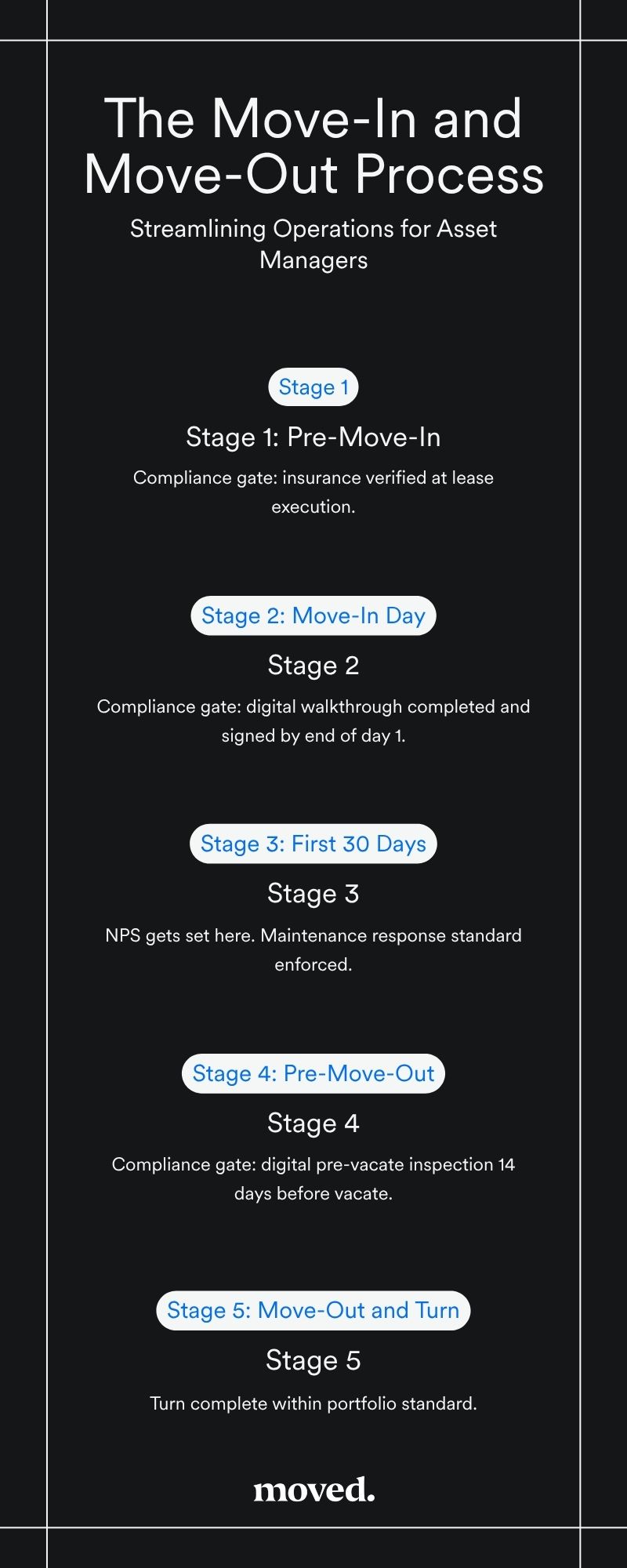
- **Compliance gates in the same flow.** Insurance verification, lease documentation, and digital walkthrough running through the same workflow that carries the partnership offers.
- **Reporting back at the category level.** Attach rate, margin, and revenue per unit returned to the asset management team in the same scorecard structure used for the rest of the non-rent line.
When all four are in place, the move window stops being an operational chore and becomes the highest-margin moment in the asset’s revenue cycle.
How Moved fits
Moved is the move-in and move-out infrastructure platform built for this exact backbone. We integrate alongside the property management system via API, run the resident-facing experience for movers, packing, storage, insurance verification, utilities, and connectivity, and return category-level RevGen data to the asset management team. For 10,000+ unit operators, the platform is the workflow, the partner network, and the reporting layer in one piece of infrastructure.
To see what your move window could capture at portfolio scale, book a walkthrough with our team or visit the Moved multifamily product page.
FAQs
Why is the move-in and move-out window called the RevGen backbone? Because three forces converge there simultaneously. Resident intent peaks, the operational workflow concentrates, and the highest-margin partnership revenue clusters in the same days. No other moment in the resident lifecycle puts the property in the same position.
What categories sit inside the window? Movers and packing, renters insurance, utility activation, and storage partnerships. Each is a RevGen category in its own right, and the window concentrates all four into the same moment.
Why cannot parking and pet programs substitute for the backbone? Because those categories are already captured monthly through the property management system. The opportunity there is incremental optimization on revenue already on the books. The move window opportunity is closing a structural gap where the revenue is not currently captured at all.
What does the backbone require operationally? A resident-facing workflow at the move moment, a partner network with portfolio-scale economics, compliance gates inside the same flow, and category-level reporting back to the asset management team.
Where does the operator framing for the structural argument sit? In the Moved CEO’s third pillar of residential real estate and the RevGen leak map.
The bottom line
RevGen at portfolio scale rises and falls on what happens in the move-in and move-out window. Operators who treat that window as the backbone of the RevGen program capture revenue at partnership economics at every turn of every unit. Operators who treat it as an operational chore watch the same revenue default to third parties for the life of the asset. The structural argument for why this is the case sits in the Moved CEO’s third pillar of residential real estate and the RevGen leak map.
To build the backbone for your portfolio, reach out to our team.